My Song is Love Unknown
Toby Sumpter considers the wonder of God’s love. Audio below, text here.
My song is love unknown
My Savior’s love to me
Love to the loveless shown
That we might lovely be.
Baptized
 Or, as Asher says, “bathtized.”
I was sprinkled as a baby and dunked at the age of 14. I expected that to be a pretty powerful spiritual experience but ended up feeling unchanged. Partly because of that, and partly because I kept coming to a better understanding of the good news, I often wished I had waited longer to be baptized. Several years ago I read something from John Piper that changed my thinking:
Many of us came to faith and were baptized at a point when we did not know very much. This is good. It is expected that baptism happens early in the Christian walk when you do not know very much. So it is also expected that you will learn later more and more of what it means. Don’t think, “Oh, I must go back and get baptized again. I didn’t know it had all this meaning.” No. No. That would mean you would be getting re-baptized with every new course you take in Biblical theology. Rather, rejoice that you expressed your simple faith in obedience to Jesus and now are learning more and more of what it all meant.
This is very comforting: God accepts us in our immaturity, and maturity is not at all what will secure our salvation. But why didn’t baptism seem to change anything? Perhaps it did, in a different way than I was expecting? What is baptism and what does it do?
I married Lisa ten years ago this month. I expected it to change me and I was not disappointed. Sandy Young pronounced us man and wife, and we became man and wife! What did that pronouncement do?
Linguists call something a performative utterance if its accomplishment is wrapped up in the declaration of that accomplishment. If I say “I promise I will pay you,” my speaking is my promise. If Queen Elizabeth declares someone to be a knight, so they are! Declaring is part of a performative utterance, but so is authority: you cannot promise anyone my money; and no one but Queen Elizabeth can dub a British knight.
This is what happens in a pronouncement of marriage: a minister of God’s church, under God’s authority declares a couple man and wife, and this declaration itself accomplishes the marriage. Neither the declaration nor the exchanging of rings or vows actually causes the marriage, but altogether they do accomplish it. This, too, is what happens in baptism: a minister of God’s church, under God’s authority declares a person to belong to God and to be part of God’s family. Baptism doesn’t cause anything; we have a risen Savior and King who does that! But baptism is normally part of how God visibly accomplishes joining us to Christ.
In one sense, baptism is something we do — part of submitting ourselves to Christ. But baptism is much more God’s declaring and doing than our declaring and doing. Consider:
- Baptism takes place in the Triune name; it is done under authority.
- Baptism is done to someone. The one being baptized is not the subject but the object.
- Baptism is spoken of as accomplishing something or bringing us somewhere, in terms that seem very bold to us: it kills us, buries us, washes us, puts on, unites us, saves us. We are baptized into Christ, into his church.
- Finally, if baptism unites us to Christ (Romans 6), and if God declared over Christ that “you are my beloved son; with you I am well pleased” — at his baptism, no less — then our own baptism is certainly God’s declaration of his acceptance of and pleasure in us, in Christ.
Surely a dip in the water cannot cause all this! No, but it accomplishes it, since God has ordained to use baptism to speak and do through his church.
Are you baptized? God wants you to remember and believe and live in this truth: God loves you as his child and is pleased with you. Our Father has finalized our adoption by publicly announcing it. That is a powerful experience!
Ten
 Ten years ago Lisa and I were married.
Then the Lord God said, “It is not good that the man should be alone; I will make him a helper fit for him.”
Lisa is fit for me. Ten years, and through both joys and sorrows it ever grows better. She is fit for me not least because:
- She is the fun to my serious, the extrovert to my introvert, the laugh to my ponder, the poetry to my prose.
- She exceeds me in being observant, especially of others’ cares and needs.
- She surpasses me in compassion and care for others. With our children she calls me to compassion when I am tempted to be disciplinarian.
- Altogether, she is an excellent hostess, mother and friend. She makes our home is a wonderful place to be.
- I like her cooking.
- I like her looks.
- She works hard.
- She reads.
- She is mother to our Ivy, Charlotte and Asher.
So, my love,
Grow old along with me!
The best is yet to be,
The last of life, for which the first was made:
Our times are in His hand
Who saith “A whole I planned,
Youth shows but half; trust God: see all, nor be afraid!”
Lisa, I love you . . . I’m damn lucky that I made you my wife.
Alien
As far as we know, this is the first time Asher’s drawn a face on anything.
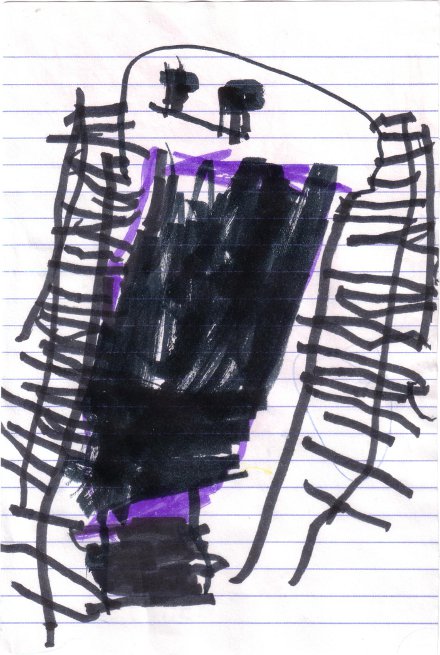
This is an alien; in fact, it is a bad alien. You can tell because he has mean eyes. Fortunately, Spiderman has wrapped up his arms in string. The alien tried to throw a ball, but he couldn’t because his arms are wrapped up. And then everyone heard him growl.
Choose your own assurance
The forest is deep, but it is neither dark nor silent. Even last night’s sounds and the glimmerings of moonlight spoke peace and not terror. You and your mule are more than halfway home, and the promise of feasting quickens your step.
You hear a hoofbeat and voices approaching. Moments later your king and his guard rein their horses before you.
Do you:
- Complain about the violence inherent in the system? Go to page 42.
- Pause to wonder if you got everything in proper order when you swore fealty to him ten years before? Go to page 60.
- Whisk off your cap and look up, glad to see your lord and protector? Go to page 77.
Footdragging
Douglas Wilson, writing in Angels in the Architecture, encourages patience and faith in God’s dealings with kings and nations:
The Psalm says that kings should be worried about the anger of the Lord, not that the Lord’s followers should be worried about the footdragging of kings. (204)
Decimal places
Douglas Wilson, in Angels in the Architecture, writes of the connection between creatureliness and poetry:
Because we men cannot be God, we must learn to be good poets. (181)
And of the limits of precision compared to connotation, imagery and symbolism:
Words do not have decimal places. (191)
Criminal
Douglas Jones, in Angels in the Architecture, writes that
Children should be almost criminal in their love of stories. If they aren’t regularly begging you for stories, even after you seem to have been reading all day, then something may be wrong with them. They live and grow by means of narrative, especially fiction. Families and schedules differ, but our family . . . reads passages from one to three books (fiction, history, theology, or Scripture) at every meal, making sure that we begin the day with plenty of poetry. Meals are especially important for families, since they naturally display sacrifice, intimacy, and beauty. (124)
Blogs I read
Apart from a few work-related subscriptions, these are the blogs in my reader. There are a few more folks I keep up with on Facebook or Twitter (mostly family, church family, and a few friends from college). I feel bad having such a long list, but trimming it down this far has been an accomplishment.
Top three
Family
- My wife, Lisa
- Sister Abby
- Brother-in-law Chad and Judi
Church family
- Brian (also his more techie blog)
- Paul
- Luke and Elizabeth
- Steve and Tracy
- Jordan
- John and Emily
Theology and Christian living
- Our church (plus a few ancillary blogs)
- C. J. Mahaney
- Mark Lauterbach
- Biblical Horizons
- Jeff Meyers
- Gene Veith
- Credenda|Agenda
- Justin Taylor
- John Barach
- Ken Auer
- David Koyzis (also his Genevan Psalter blog)
Comics
Other
- Gene Chase, one of my college professors
- Jon Barlow
- The Big Picture
- Woot! (also Kids.Woot)
Walking
 My pastor recently posed the question, “What do you say when your child says, ‘Mom, I’m a Christian’?” He warned against discouraging or stumbling our children by telling them “we’ll wait and see.”
Perhaps you are uncomfortable calling your children Christians, although Scripture uses the word simply to mean one who is discipled. Regardless, it is not enough to appropriate the name “Christian;” we point beyond it, reminding them and ourselves that faith is a daily walking as much as a starting. So we help them to see all the privileges and responsibilities of belonging to Christ. We are repeatedly saying things like: “Isn’t it so good to . . .”
- . . . be forgiven
- . . . have our sins washed away
- . . . have God as our father
- . . . have God as our provider
- . . . belong to God
- . . . belong to Jesus
- . . . be a part of God’s family
- . . . rely on Jesus
- . . . have Jesus as our savior
- . . . have life in Jesus
- . . . be joined to Jesus
- . . . have Jesus as our king
- . . . have the Holy Spirit to help us love and obey
- . . . have the Holy Spirit to comfort us
- . . . serve God
- . . . obey God
This is simply part of fanning into flame — urging our children to grow and continue and delight in these things that are a part of obedient faith. It is such a delight to know, trust and obey a king who is so great and so good to us! God has designed for our children to trust us instinctively, just so that we can help them to see his goodness and to trust him instinctively now, and with more understanding over the years. Jesus even points to a child’s instinctive, joyful, care-free trusting as an example for us in our own faith.
Some of these things are true even for the hardest of unbelievers — Jesus is king over all the earth, and we are to obey God. Part of our children’s and our own walking in faith is simply seeing, delighting and resting in what is already true, rather than chafing or cursing. “Confess with your mouth that Jesus is Lord and believe in your heart that God raised him from the dead, [and] you will be saved.”

