Archive for June 2026
Hellmouth
Ecclesiocentrism is a decent label for my view of church and state. I want to see the development and growth of Christian nations and Christian families; this term helpfully highlights the fact that families and nations find their fulfillment not merely in their proper orientation to Jesus, but also in their proper orientation to his church.
Ecclesiocentrism also has something to say about the responsibilities and proper orientation of the church. If the sphere of the church is a kind of center-among-equals to the other spheres, then it must operate as a life-giving force. It must be a heavenmouth of life, authority, instruction, and example to the world.
But we know that the church can abandon her mission: she can commit adultery against her husband and become a hellmouth. This does not neutralize her centrality, but instead turns it into a corrupting and contagious kind of death, tyranny, instruction, and example.
James Jordan’s essays on dominion are a helpful introduction to this idea.
Considering the church as a hellmouth, Satanic and demonic activity were fairly rare in the old covenants. In contrast, Jesus encounters demons throughout Israel in his ministry. Jesus even encounters demons in synagogues (Mark 1, Luke 4). By itself this does not prove that the synagogues were the source of demonic activity, but it is interesting and suggestive. Revelation provides further evidence; there are such things as Satanic synagogues (chapter 2). And throughout Revelation there are bitter and bloody and Satanic waters issuing from various places, suggesting the idea that these are originating from false temple-churches and false teachers.
Of course, this polarity does not end in the first century. Rather, the polarity is heightened. The church that now crushes Satan under her feet (Romans 16), might also loose him. If it appears that Satan is deceiving the nations (Revelation 20), you should look first to the church to understand why.
Ecclesiocentrism does not say that political work is worthless. It is not worthless. But it does highlight that political work will not in the long run succeed or persist without also being paired with the reformation and maturation of the church. This is why I feel quite free to write about paedobaptism very pointedly from time to time, even though we have a lot of very important political fish to fry right now together with our baptistic brothers.
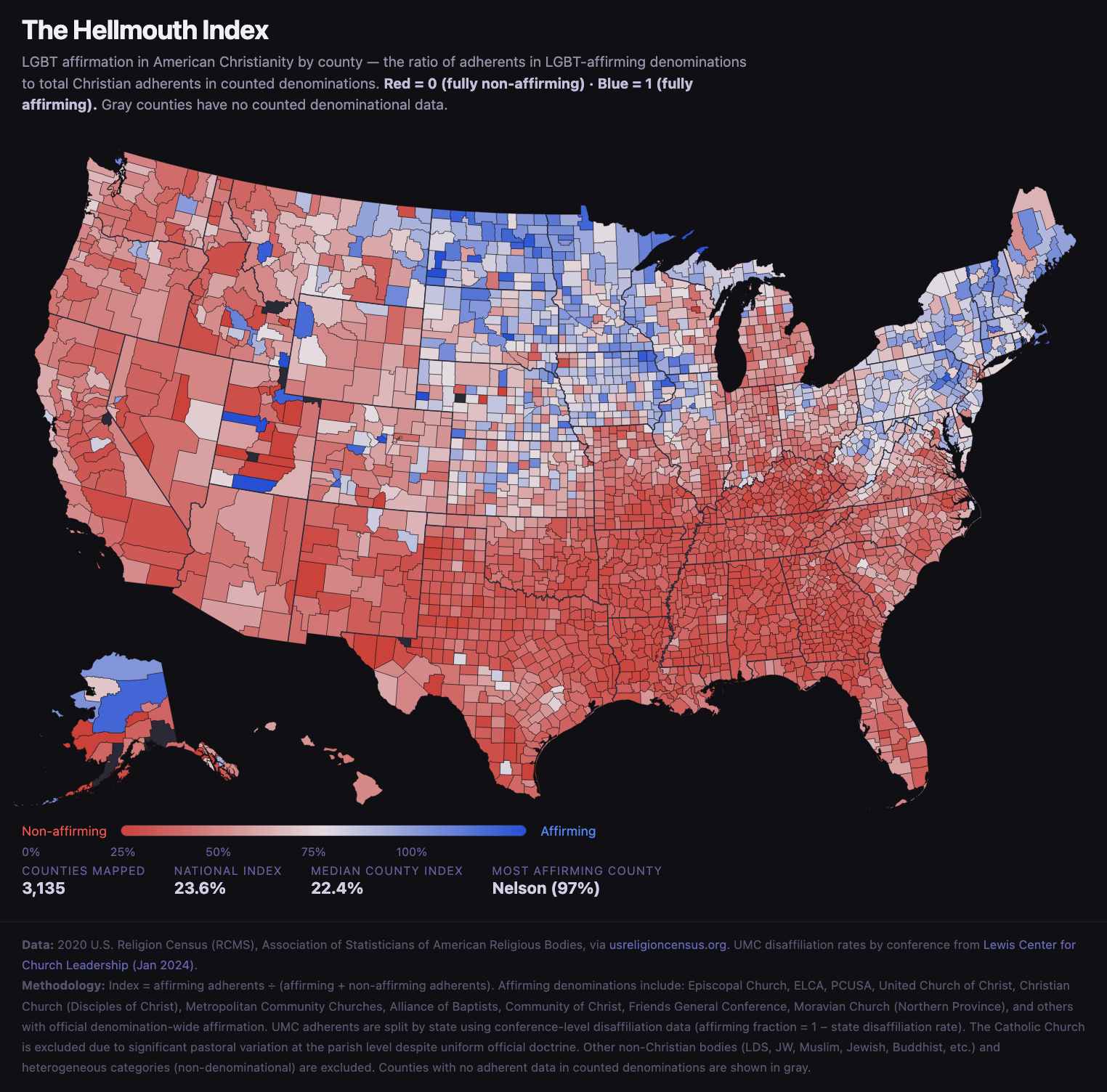
With this in mind, I thought it would be interesting to try to index faithful vs. unfaithful churches in the United States. This is impossible to do perfectly. My imperfect measure was to (1) look at Protestant denominations and their church attendance, and (2) index them on a spectrum of opposition to or affirmation of homosexuality. This is a very baldly obvious indicator of Satanic-demonic activity. One reason I excluded Catholicism is that it is difficult to identify its faithfulness at the level of a diocese or parish. I assumed instead that the Protestant balance was a good indicator of the Catholic tendency. I asked Claude Cowork to perform this analysis, so it is likely that there are a number of faults; but I think it is still interesting and useful as an approximate metric. Claude used a variety of data on denominational faithfulness (for example, PCA = faithful, PCUSA = unfaithful; of course this is a vast oversimplification) and church attendance. Claude also attempted to divide UMC based on whether churches had disafilliated. Interestingly, I had to instruct Claude to ignore Mormonism.
I give you the Hellmouth Index: