Gethsemane
And he came out and went, as was his custom, to the Mount of Olives, and the disciples followed him. And when he came to the place, he said to them, “Pray that you may not enter into temptation.” And he withdrew from them about a stone’s throw, and knelt down and prayed, saying, “Father, if you are willing, remove this cup from me. Nevertheless, not my will, but yours, be done.” And there appeared to him an angel from heaven, strengthening him. And being in an agony he prayed more earnestly; and his sweat became like great drops of blood falling down to the ground. And when he rose from prayer, he came to the disciples and found them sleeping for sorrow, and he said to them, “Why are you sleeping? Rise and pray that you may not enter into temptation.” — Luke 22:39-46
In this passage, Luke shows us Jesus in a garden full of trees, on a mountain, experiencing temptation. All of this should ring a bell for us: the Holy Spirit means for us to read this and think of Adam in Eden, and to reflect on the contrast between Adam and Jesus.
God had promised Adam that eventually “every tree” would be given to him (Gen. 1:29). But Adam had to wait to eat from the tree of knowledge of good and evil. This tree’s name links it with the kingly privilege of exercising judgment. Adam impatiently seized this fruit before his time, before he had endured and matured. In just the same way, the Father intended to give Jesus a kingly seat over all the rulers of the earth. If at this point in Luke we knew only what had happened to Adam, this would leave us on the edge of our seats: Would Jesus call upon the angels for the wrong kind of help? Would he seize his seat at the Father’s right hand, or would he patiently suffer injustice and death in order to gain it? Would he be willing to be made perfect through suffering (Heb. 2:10)?
In the very middle of this passage Jesus does receive help: “an angel from heaven” strengthens him. The way Luke has structured this passage draws attention to this heavenly night-time help, making it the hinge, the turning point, of the passage. This is a kind of midnight Passover deliverance—but it is not the kind of deliverance you might expect. The angelic help does not seem to be a turning point for the better. Jesus was “delivered”—but straight into the Passover holocaust. Everything that happens afterwards is not relief from what came before, but an intensification of what came before, a realization and fulfillment of what was prophesied.
After Jesus received this help, it got much worse before it got better. His battle really begins in earnest as soon as he receives help.
This is frequently how God works. We pray for and receive preliminary help, sometimes even a preliminary victory. But then there is a further test, a greater battle. Adam received a helper, but then encountered a serpent. Jacob was delivered from Laban, then heard fearful news that his brother Esau was coming; Jacob even prefigured Jesus by wrestling in prayer at night over this. Israel was delivered from Egypt, then had to face Pharaoh and his armies. They were delivered miraculously from these at the Red Sea, and given the gift of manna, but then had to face Amalek in battle. Jesus was baptized and filled with the Spirit, only to face Satan in the wilderness. After Jesus’s resurrection, the church in Jerusalem experienced an initial period of growth and fruitfulness, only to have to battle Jews and Judaizers, until the church was sent out to the four corners of the earth by persecution.
We know that it is because Jesus endured his trial that we are able to receive heavenly help in our own trials. It is because he endured that we have received the Holy Spirit, our great helper and strengthener. Adam was not willing to die to defend his bride, but Jesus, in his death, succeeded in rescuing and providing for us. We also know that our own trials will never be so great as his, because he endured the very wrath of God in our place. But there are a few more reflections I want to draw from what we have seen here.
First, it is startling to see that Jesus needed heavenly help to endure his temptation and suffering. Elsewhere, Peter tells us that Jesus had to exercise faith in order to endure (1 Pet. 2:23). This adds greater depth to the assurance in Hebrews that Jesus is a sympathetic high priest, and a king who gladly welcomes us to his throne of grace and mercy. He is sympathetic and understanding even to the point that he needed help to strengthen him to resist temptation.
Second, along with the disciples we are chided by Jesus’s words. Help is available in our need—all we have to do is pray.
Finally, we have a sobering lesson in how help often comes to us in our trials and suffering. God does send us help, through his Spirit, his word, and one another. But very often this help is the prelude to the real battle. The Spirit carries us into the thick of battle. The Spirit strengthens us to fight. He enables us to be full of faith, full of hope, and full of the fruit of the Spirit in spite of the storm that is raging around us.
In the words of Peter: “And after you have suffered a little while, the God of all grace, who has called you to his eternal glory in Christ, will himself restore, confirm, strengthen, and establish you.” (1 Pet. 5:10) Amen.
Heaven is not my home
In his book Heaven Misplaced, Doug Wilson writes about a common misunderstanding among contemporary Christians:
How you take the line of the story matters a great deal. Many Christians believe the cosmos has an upper and lower story, with earth as the lower story and heaven as the upper story. You live the first chapters of your life here. Then you die, and you move upstairs to live with the nice people—because only nice people are allowed on the second story. There might be some kind of sequel after that, but it is all kind of hazy. Maybe we all go live in the attic. But the basic movement in this thinking is from a Philippi “below” to a Rome “above.”
But what Paul teaches us [in Philippians 3:20-21] is quite different. We are establishing the colonies of heaven here, now. When we die, we get the privilege of visiting the heavenly motherland, which is quite different than moving there permanently. After this brief visit, the Lord will bring us all back here for the final and great transformation of the colonists (and the colonies). In short, our time in heaven is the intermediate state. It is not the case that our time here is the intermediate state. There is an old folk song that says, “This world is not my home, I’m just passing through.” This captures the mistake almost perfectly. But as the saints gather in heaven—which is the real intermediate state—the growing question is, “When do we get to go back home?” And so this means that heaven is the place that we are just “passing through.” (23-24)
N. T. Wright writes similarly:
There is no agreement in the church today about what happens to people when they die. Yet the New Testament is crystal clear on the matter: In a classic passage, Paul speaks of “the redemption of our bodies” (Rom. 8:23). There is no room for doubt as to what he means: God’s people are promised a new type of bodily existence, the fulfillment and redemption of our present bodily life. The rest of the early Christian writings, where they address the subject, are completely in tune with this.
The traditional picture of people going to either heaven or hell as a one-stage, postmortem journey represents a serious distortion and diminution of the Christian hope. Bodily resurrection is not just one odd bit of that hope. It is the element that gives shape and meaning to the rest of the story of God’s ultimate purposes.
. . .
The mission of the church is nothing more or less than the outworking, in the power of the Spirit, of Jesus’ bodily resurrection. It is the anticipation of the time when God will fill the earth with his glory, transform the old heavens and earth into the new, and raise his children from the dead to populate and rule over the redeemed world he has made.
See also: The future of Jesus.
Judge me, O Yahweh
In my previous post, I suggested that the Psalms disprove the dictum that we should never pray for justice. There are many such Psalms; one example is David’s Psalm 7:
Yahweh judges the peoples;
judge me, O Yahweh, according to my righteousness
and according to the integrity that is in me.
Oh, let the evil of the wicked come to an end,
and may you establish the righteous—
you who test the minds and hearts,
O righteous God!
My shield is with God,
who saves the upright in heart.
God is a righteous judge,
and a God who feels indignation every day. — Psalm 7:8-11
 Jamie Soles has a great rendition of this Psalm on his album Pure Words, which you can listen to here: Psalm 7. But how can we sing this without the words sticking in our throats? For that matter, how could David sing this?
Before attempting to answer that, we should remember that it is of greater importance that we obediently sing the Psalms (Eph. 5:19, Col. 3:16), and it is only within the context of obedient faith that we seek to grow in understanding them. We approach God with childlike faith and trust in the beauty, goodness and truth of what he has given us. As we become familiar with the Psalms, the Spirit will help us grow in our understanding of them. Even the thousandth time we sing them, God will be revealing new things to us.
Perhaps our first instinct is to read David’s words like this:
Judge me, O Yahweh, according to my perfect obedience
This cannot be what David meant. No one was ever saved — or even promised salvation — on the basis of obedience alone. This was even true of Adam and Eve; if they had persevered, they would have had to do so in faith. This is clear from the way in which Satan tempted them — he tempted them to mistrust and disbelieve God and his goodness toward them. Perhaps surprisingly, this was even true of Jesus; again, we see in his temptations in the wilderness and at Gethsemane that the substance of his struggle was one of faith and not merely obedience. Would he trust his Father’s plan, or would he take things into his own hands? He persevered and saved us through faith (1 Pet. 2:23).
Could this instead be imputed righteousness, the active obedience of Christ?
Judge me, O Yahweh, according to my Savior’s obedience
The difficulty with this suggestion is that we understand imputed righteousness as an “alien” righteousness, a robe that we receive (e.g., Isa. 61:10). David, however, is talking about what is “in me,” in “minds and hearts.”
Calvin suggests that it is a relative or comparative righteousness, when measured against David’s adversaries. He writes of Psalm 7:
The subject here treated of is not how he could answer if God should demand from him an account of his whole life; but, comparing himself with his enemies, he maintains and not without cause, that, in respect of them, he was righteous. But when each saint passes under the review of God’s judgment, and his own character is tried upon its own merits, the matter is very different, for then the only sanctuary to which he can betake himself for safety, is the mercy of God.
This seems somewhat plausible, but unsatisfying. We are still on a treadmill of obedience, only now it is a relativistic one, which makes David’s appeal rather cheap. Why would David not rather appeal to God’s mercy if this was the case?
The answer lies in returning to our observation above that faith is more fundamental than obedience. Skipping a couple chapters back to Psalm 5, Calvin has an insightful comment concerning God’s righteousness:
The righteousness of God, therefore, in this passage, as in many others, is to be understood of his faithfulness and mercy which he shows in defending and preserving his people.
If we understand human righteousness in the same way, that yields the following interpretation:
Judge me, O Yahweh, according to my faithfulness to you and your covenant
Such faithfulness has a number of components. First, it begins with faith: it trusts in God, his goodness and his promises. Second, this faith obeys, because God can be trusted to give us good and wholesome commands, and he can be trusted to be working out what is best for us even if our obedience proves very costly or painful. But third, this faith also grabs hold of God’s provision of a sacrifice for sin when we fail to trust and obey. To be faithful is to regularly confess our sins, repent, and move on in the joy of forgiveness. In this sense, we can be righteous without being sinless, a people who meet with God at mountains and altars. This is the sense in which Zechariah, Elizabeth and Simeon were righteous (Luke 1-2), and in which Noah (Gen. 6), Abraham (Gen. 15) and David were righteous. The righteous shall live by his faith (Hab. 2:4).
Another way of putting this is to say that we have entrusted ourselves wholly to God and not to ourselves or others; that this thorough-going trust is the basis of all righteousness; and thus we are pleading with God that he would not put us to shame for trusting in him:
In you they trusted and were not put to shame. — Ps. 22:5
O my God, in you I trust;
let me not be put to shame;
let not my enemies exult over me.
Indeed, none who wait for you shall be put to shame;
they shall be ashamed who are wantonly treacherous. — Ps. 25:2-3Let me not be put to shame, for I take refuge in you. — Ps. 25:20
And many more. All this is to say that it is a short hop from appealing to our righteousness (God, I have entrusted myself to you!) to God’s righteousness (I know you will be faithful to deliver me!). This is a persistent pattern; for example:
In you, O Lord, do I take refuge;
let me never be put to shame;
in your righteousness deliver me! — Ps. 31:1
Fittingly, this is how Psalm 7 ends up:
The Lord judges the peoples;
judge me, O Lord, according to my righteousness
. . .
I will give to the Lord the thanks due to his righteousness,
and I will sing praise to the name of the Lord, the Most High.
It is because God is righteous and faithful that we can put our complete trust in him. Because of his faithfulness we can be sure that he will vindicate our trust in him.
But we should take care; we cannot always substitute faithfulness for righteousness any more than we could substitute perfect obedience earlier. It is right for us to formulate systematic definitions of words like this, but we also must recognize that the Spirit uses words in Scripture in varied ways.
For example, when Isaiah says that “our righteous deeds are like a polluted garment” (Isa. 64:6), he indicates that Israel’s righteousness has become a mere shell of selective external obedience — they have ceased to walk by faith, to obey the weightier matters of the law, and to truly repent of their sins. They have become faithless. In Luke 18:9ff, Luke draws attention to the irony of righteousness having anything to do with trust in oneself, so here again it has become an empty shell of genuine righteousness.
Paul also uses the word in varied ways. He sometimes uses it to point out that the Jews’ so-called righteousness has become faithless. For example, Romans 5:7 reads the reverse of what one would expect; this seems to me a scathing condemnation, as though it should have been translated with scare quotes. Earlier, when Paul says that “none is righteous” (Rom. 3:10), he is obviously using it in a different sense. He is quoting Psalm 14, where David applies this statement to “the fool,” to “evildoers” and to the “children of man,” but takes comfort because “God is with the generation of the righteous” (i.e., the children of God). It is possible that Paul is applying Psalm 14 in a new direction, to all people everywhere. But there are better passages he could have used if he had wanted to make that point (e.g., Ps. 51:5). It seems more likely to me that he is saying something more subtle. Paul is not saying that no one anywhere is righteous; rather, he is making the provocative application of Psalm 14 to the Jews. They have ceased to be God’s righteous people and have become boastful evildoers, enemies of Jesus and his church. Thus, the deepest sense in which sin caused grace to abound (Rom. 5:20-6:1), in which good was brought about by evil (Rom. 3:8), is that the evil act of crucifying Jesus brought about the salvation of the world.
Finally, as is always the case with the Psalms, we need to circle back and evaluate how they apply to Jesus, and how they apply to the church as the body of Jesus (who is our head). We approach Psalm 7 individually having repented of our sin and renewed our trust in Jesus. But Jesus is able to sing this Psalm with a more perfect sort of righteousness. Thus, when we sing this Psalm together as the gathered church, we sing it in Jesus who is our head, and we share in the confidence of his righteousness. Thus, when we sing the Psalm corporately, there is an additional sense in which the righteousness referred to is Jesus’ righteousness. This is subtly different from the imputed righteousness suggested above: in this sense, we are praying that the church would be vindicated against her enemies. To persecute the church is to persecute Jesus (Acts 9:4).
Psalms
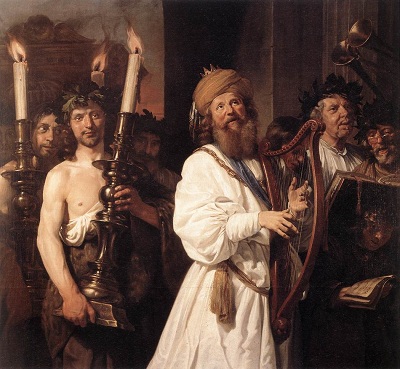 For family worship, we have found a good Psalter — the Anglo-Genevan Psalter produced by the Canadian Reformed Church. We are slowly learning some of the Psalms in there. We also enjoy singing along to the many Psalms that Jamie Soles has set to music.
I do not subscribe to what is called exclusive Psalmody. However, the evangelical church has lost a great treasure in largely neglecting the Psalms in worship. If we were to sing these regularly, this would significantly re-shape our conception of ourselves as individual Christians and as the people of God. The Psalms are the Spirit’s inspired lesson book in prayer and worship, and yet their language and tone often sounds foreign and unbecoming to us. This is a sign that we need to renew our lessons. For example, the Psalms make bold appeals to God far more often than we tend to do in worship, and using a degree of confidence that would embarrass us. David did not know New Calvinism’s dictum that we should only pray for mercy and not justice. He holds God’s law in surprisingly high regard. And he recognizes the Spirit’s work in infants, something we should be teaching our children to sing and confess.
James Jordan has proposed “Jordan’s Laws of Psalmody,” and I think there is wisdom in them. Paraphrasing Jordan, they are as follows:
- The Law of Accurate Psalmody — Use God’s word as it is written. Metrical Psalms are only a paraphrase of the inspired text; if you sing them, you should read a good translation before you sing. Or consider chanting an accurate translation outright.
- The Law of Complete Psalmody — The Psalms are complete units of thought, and you should sing or read an entire Psalm rather than a selection of verses.
- The Law of Comprehensive Psalmody — Our repertoire and diet should include all 150 Psalms. To avoid the uncomfortable portions of the Psalter is to refuse to grow in everything the Spirit would teach us.
- The Law of Musical Psalmody — Sing the Psalms and sing them with musical instruments. (I would add: sing them at a lively tempo.)
- The Law of Preponderant Psalmody — We should sing more Psalms than hymns, especially when we have lost so much ground in acquiring the Spirit’s tastes.
He also goes on to suggest “Jordan’s Law of Hymnody” — to the degree that we do not sing Psalms, we should pursue songs that have the taste and aroma of the Psalms. Scripture gives us many examples of this outside of the Psalter — for example, Mary’s song in Luke 1.
Pig out
 In his 1992 essay Pig Out? 25 Reasons Why Christians May Eat Pork, James Jordan definitively refutes the notions that the Sinaitic food laws have any continuing applicability to the church, or that they ever had any intended health value. While he focuses on the food laws and their symbolism, his comments are also applicable to other can-do-no-wrong fads that search for some basis elsewhere in the ceremonial law, such as essential oils.
Jordan concludes:
The Sinaitic dietary laws were not given for reasons of health or hygiene, but were symbolic. They applied only to Israelites during the period between Moses and Christ. Noah and Abraham were not under these laws, Gentile God-fearers were not under these laws, and New Covenant Christians are not under them either. Deciding how much meat to eat, how often, and what kinds is a matter for Christians to determine for themselves in terms of sanctified common sense and the evidence of dietetic science.
Making these dietary rules a matter of faith in the New Covenant is demonic. Unquestionably this is not the intention of earnest Christians who believe that they have uncovered health secrets in the book of Leviticus. We have to remember, however, that Satan is a great deceiver, and he will mislead the very elect of God. By focusing attention on the Sinaitic dietary laws, Satan diverts attention from the one God-given food law of the New Covenant, which is to fellowship with Him at His table. God invites us to come to His house on His day and bring along some bread and wine. How many Churches serve His meal on His day (not monthly, not quarterly)? How many use bread (not wafers, not crackers, not doughnuts)? How many use wine (not grape juice, not soft drinks)? How many include the children, whom God invited in the Old Covenant, and who are surely invited today (1 Cor. 10: 1-4)? How many Churches see this meal as a covenant renewal, a time of restoring our relationship with our God? How many Churches proclaim that there is health in this covenant renewal, and sickness in abusing it (1 Cor. 11:30)?
Too many pork-haters have a low view of the Church. They replace the sacramental interpretation of the Sinaitic dietary laws with an interpretation that is little more than “medicine man religion. ” They overlook the real health giving meal, the New Covenant sacrament. As a result, they mislead the people of God.
You can order a copy of this paper from Biblical Horizons; refer to their catalog.
Malchus
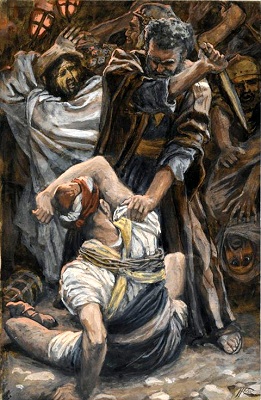 In my previous post I suggested an outline for part of Luke 22.
In this passage, there is an interesting connection between the sword and the ear. The ear is the organ of hearing the master’s instruction. Peter’s sword impaired Malchus’s ability to hear Jesus’s word and command. Jesus restored his ability to hear, so that the greater sword, the word (Eph 6:17, Heb 4:12) could enter his ear and pierce his heart.
From the fact that Malchus’s name is deliberately recorded (John 18:10), it seems quite likely that he became a Christian and was known to the early church.
Malchus received back his ear and gave it to a new master. What would his conversion have cost him, as a servant of the high priest?
Luke 22
Here is a possible chiasm in Luke 22:31-62:
A (vv. 31-34): Peter’s denial foretold
B (vv. 35-36): Swords
C (vv. 37-38): Scripture fulfilled
D (v. 39) Jesus goes out (exerchomai) to the Mount of Olives; the disciples follow
E (v. 40): Pray that you may not enter into temptation
F (v. 41): Jesus withdraws, Jesus kneels
G (v. 42): Wrestling in prayer: remove the cup
H (v. 43): An angel strengthens Jesus
G’ (v. 44): Wrestling in prayer: sweating blood
F’ (v. 45): Jesus rises, disciples sleep
E’ (v. 46): Pray that you may not enter into temptation
D’ (v. 47): Judas leads (proerchomai) a crowd
C’ (v. 48): Prophecy of vv. 21-22 fulfilled
B’ (vv. 49-53): Swords
A’ (vv. 54-62): Peter’s denial
There are a couple things that don’t satisfy me about this. First, it does not connect the cup of vv. 17-20 with the cup of v. 42 (see here for a different outline that attempts to relate these). Of lesser importance, I would like to be able to connect the angel’s strengthening Jesus with his healing Malchus’s ear.
However, I am pleased with a few things that are brought out by this outline. First, I like the contrast this draws between Jesus and Judas and their followers. Second, cup and blood are related by this, thus echoing v. 20 even if it is not brought into the chiasm. Finally, the hinge of this chiasm is the angel’s strengthening Jesus. I think this is significant for a few reasons, about which I will write more later.
A prayer for the church
Who can count the dust of Jesus
or number the fourth part of the church?
Let me die the death of the upright,
and let my end be like his!He has not beheld misfortune in Jesus,
nor has he seen trouble in the church.
Jesus their God is with with them,
and the shout of a king is among them.
Jesus brings them out of the old creation
and is for them like the horns of the wild ox.
For there is no enchantment against Jesus,
no divination against the church;
Now it shall be said of Jesus and the church,
‘What has God wrought!’
Behold, a people! As a lioness it rises up
and as a lion it lifts itself;
It does not lie down until it has devoured the prey
and drunk the blood of the slain.How lovely are your tents, O Jesus,
your encampments, O church!
Like palm groves that stretch afar,
like gardens beside a river,
Like aloes that Jesus has planted,
like cedar trees beside the waters.
Water shall flow from his buckets,
and his seed shall be in many waters;
His king shall be higher than Caesar,
and his kingdom shall be exalted.
Jesus brings them out of the old creation
and is for them like the horns of the wild ox;
He shall eat up the nations, his adversaries,
and shall break their bones in pieces
and pierce them through with his arrows.
He crouched, he lay down like a lion
and like a lioness; who will rouse him up?
Blessed are those who bless you,
and cursed are those who curse you.
Adapted from Numbers 23-24
Spirituality, worship and the world
Mark Horne writes about:
- How to be spiritual according to the Bible
- Ten things a church can do to save the world
- Five things you are not allowed to do on a holy day of worship
The Spirit is opposed to the flesh, but not the body. The Spirit gives life to our bodies and to the church-body.
 I gotta have my orange juice.
True spirituality
with one comment
We have a tendency to regard the truly spiritual as that which is most contemplative and peaceful. Consequently, we bemoan the many mundane and frustrating distractions that tear us away from spiritual things.
It is true that we will enjoy mountaintop experiences where we meet with Jesus and are refreshed by him. In fact, we are privileged to meet with him in this way every Lord’s day. However, consider this description of what it means to be spiritual:
There is no better time to practice this than when we feel distracted, frustrated, unspiritual. It is little work to be patient when we are surrounded by peace and quiet, but it is great work to cultivate patience when we are beset by storms. In a sense, the time that we feel the least spiritual is our greatest opportunity to be spiritual — not by escape, nor by stoicism, but by walking in faith and in the fruit of the Spirit. Not that this is easy: it requires constant death to ourselves, regular repentance and renewal of our faith.
The Spirit is not opposed to the physical and the natural; the Spirit is opposed to the flesh, that which is of sin and death. As we walk in repentance and faith, the Spirit brings resurrection life to the physical and the natural, to the very messy moments of our daily life.
See also:
Written by Scott Moonen
March 16, 2013 at 9:20 am
Posted in Commentary