Tragic
A friend pointed me to a commentary on contemporary worship by Carl Trueman. Trueman suggests that “Christian worship should immerse people in the reality of the tragedy of the human fall and of all subsequent human life.” He commends the Scottish tradition and its “somber tempos of the psalter, the haunting calls of lament, and the mortal frailty of the unaccompanied human voice.”
I’m not a fan of happy-clappy worship, but I believe that Trueman errs on the wrong side. To be fair, Trueman wants tragedy to be woven together with joy and triumph. I agree that we should cover the whole emotional and experiental palette of the Psalms (I would suggest covering all the Psalms themselves). But I raise my eyebrows at “somber” and think that we should err on the side of being outright Pentecostal.
Here’s why: Whatever balance we strike, death cannot become a primary emphasis; it needs to fit properly in a broader story arc that exults, “O death, where is your sting?” History itself is a comedy (in the technical sense) rather than a tragedy, and if we want the worship service to tell the gospel story, then it may have a sense of agon-contest, but will always move towards and culminate in an exuberant, matrimonial, comedic denouement. We worship on Sunday rather than Friday or Saturday: every Lord’s day is a miniature Easter. Also, if our Lord’s-day worship is an assembly and meal in the very presence and house of our king and husband, then something like Nehemiah 8:9-12 should apply (“do not mourn or weep . . . do not be grieved”), at least for the vast majority of worship services. Consider, too, the ratio of feasts to fasts in the old covenants. To mention but one important precedent, the Sabbath was a weekly feast (Lev. 23:1-3).
While a rock band might not be appropriately majestic for the king (compare the bizarre and unbecoming James Bond sequence in the 2012 Olympic opening ceremony), neither is a dirge:
So David and the elders of Israel and the commanders of thousands went to bring up the ark of the covenant of the Lord from the house of Obed-edom with rejoicing. And because God helped the Levites who were carrying the ark of the covenant of the Lord, they sacrificed seven bulls and seven rams. David was clothed with a robe of fine linen, as also were all the Levites who were carrying the ark, and the singers and Chenaniah the leader of the music of the singers. And David wore a linen ephod. So all Israel brought up the ark of the covenant of the Lord with shouting, to the sound of the horn, trumpets, and cymbals, and made loud music on harps and lyres.
And as the ark of the covenant of the Lord came to the city of David, Michal the daughter of Saul looked out of the window and saw King David dancing and celebrating, and she despised him in her heart. — 1 Chronicles 15:25-29
We should take notes from David and not Michal on how we are to behave when we have an audience and meal with the king of kings.
See also: Ascent.
Ascension
Today is Ascension Sunday. Psalm 97 exults:
The Lord reigns, let the earth rejoice;
let the many coastlands be glad!
Clouds and thick darkness are all around him;
righteousness and justice are the foundation of his throne.
Fire goes before him
and burns up his adversaries all around.
His lightnings light up the world;
the earth sees and trembles.
The mountains melt like wax before the Lord,
before the Lord of all the earth.The heavens proclaim his righteousness,
and all the peoples see his glory.
All worshipers of images are put to shame,
who make their boast in worthless idols;
worship him, all you gods!Zion hears and is glad,
and the daughters of Judah rejoice,
because of your judgments, O Lord.
For you, O Lord, are most high over all the earth;
you are exalted far above all gods.O you who love the Lord, hate evil!
He preserves the lives of his saints;
he delivers them from the hand of the wicked.
Light is sown for the righteous,
and joy for the upright in heart.
Rejoice in the Lord, O you righteous,
and give thanks to his holy name!
Never again
God covenanted with Noah and the world:
Then Noah built an altar to the Lord and took some of every clean animal and some of every clean bird and offered burnt offerings on the altar. And when the Lord smelled the pleasing aroma, the Lord said in his heart, “I will never again curse the ground because of man, for the intention of man’s heart is evil from his youth. Neither will I ever again strike down every living creature as I have done. While the earth remains, seedtime and harvest, cold and heat, summer and winter, day and night, shall not cease.” — Gen. 8:20-22
Jeremiah later gave a prophecy that seems to allude to this:
“Behold, the days are coming, declares the Lord, when I will make a new covenant with the house of Israel and the house of Judah, not like the covenant that I made with their fathers on the day when I took them by the hand to bring them out of the land of Egypt, my covenant that they broke, though I was their husband, declares the Lord. For this is the covenant that I will make with the house of Israel after those days, declares the Lord: I will put my law within them, and I will write it on their hearts. And I will be their God, and they shall be my people. And no longer shall each one teach his neighbor and each his brother, saying, ‘Know the Lord,’ for they shall all know me, from the least of them to the greatest, declares the Lord. For I will forgive their iniquity, and I will remember their sin no more.”
Thus says the Lord, who gives the sun for light by day and the fixed order of the moon and the stars for light by night, who stirs up the sea so that its waves roar—the Lord of hosts is his name: “If this fixed order departs from before me, declares the Lord, then shall the offspring of Israel cease from being a nation before me forever.”
Thus says the Lord: “If the heavens above can be measured, and the foundations of the earth below can be explored, then I will cast off all the offspring of Israel for all that they have done, declares the Lord.” — Jer. 31:31-37
I have suggested elsewhere that there are some subtleties here in Jeremiah that we typically overlook. For one, given its context, this passage has a dual fulfillment, fulfilled proximately and partially in the return from exile, and ultimately and fully in Jesus (Heb. 8-10). Furthermore, this passage and the quotations in Hebrews seem more interested with the question of whether God himself will bring an end to the covenant, and less interested in the question of whether particular individuals might break the covenant (a possibility which Hebrews itself countenances; e.g., Heb. 10:29).
Jeremiah’s apparent allusion to Genesis strengthens the notion that he is stressing God’s commitment not to end the covenant. Through Noah, God covenanted with the world that he would not destroy it. Through Jeremiah and now Jesus, God covenants with his people that he will establish them forever, never again leaving them a mere remnant in the earth.
Here is where this prophecy’s ultimate fulfillment in Jesus comes into the foreground. There was to be a remnant of the true Israel at the establishment of the church (Acts 15:16-17, Rom. 11:5). But Jeremiah and Hebrews give us the amazing assurance that, from Jesus’s resurrection onwards, there will never again be a mere remnant of the church. After Israel put her husband to death, the resurrected husband was united to a resurrected bride, “never to die again” (Rom. 6:9).
Anger
Here are some references I collected in preparation for a small group discussion on anger from Ephesians 4:26-27.
Much is written of God’s anger and wrath in Scripture. We should remember that his anger is subordinate to his love. After all, he is “abounding in steadfast love to all who call upon [him]” (Ps. 86:5). In themselves, everyone is subject to God’s wrath, but God offers the gift of life and salvation to all. It is only those who reject and despise him, “neglect[ing] such a great salvation” (Heb. 2:3), who are subject in the end to his jealous anger (e.g., Deut. 6:14-15). So we see that although God has a righteous anger, even this grows up out of a more fundamental mercy. As we see in Exodus 34:6 (also elsewhere, such as Num. 14:18, Neh. 9:17, Ps. 103:8ff, 145:8ff, Joel 2:13, Micah 7:18, Nahum 1:3), the very name of Yahweh identifies him as “The Lord, the Lord, a God merciful and gracious, slow to anger, and abounding in steadfast love and faithfulness.”
Likewise, God wants us to be people whose most basic instinct is to show patience and mercy rather than anger at personal offenses. We are to put off the “enmity, strife, jealousy, fits of anger, rivalries, dissensions, divisions, envy” that are “works of the flesh” (Gal. 5:19-20) and put on “the fruit of the Spirit, [which] is love, joy, peace, patience, kindness, goodness, faithfulness, gentleness, self-control” (Gal. 5:22-23).
Here are some verses that speak of our anger:
Psalm 4:4
Be angry, and do not sin; ponder in your own hearts on your beds, and be silent.
Psalm 37:8
Refrain from anger, and forsake wrath! Fret not yourself; it tends only to evil.
Prov. 14:29
Whoever is slow to anger has great understanding, but he who has a hasty temper exalts folly.
Prov. 15:18
A hot-tempered man stirs up strife, but he who is slow to anger quiets contention.
Prov. 16:32
Whoever is slow to anger is better than the mighty, and he who rules his spirit than he who takes a city.
Prov. 19:11
Good sense makes one slow to anger, and it is his glory to overlook an offense.
Prov. 29:22
A man of wrath stirs up strife, and one given to anger causes much transgression.
Prov. 30:33
For pressing milk produces curds, pressing the nose produces blood, and pressing anger produces strife.
Eccl. 7:9
Be not quick in your spirit to become angry, for anger lodges in the heart of fools.
Matt. 5:22
But I say to you that everyone who is angry with his brother will be liable to judgment; whoever insults his brother will be liable to the council; and whoever says, ‘You fool!’ will be liable to the hell of fire.
Eph. 4:26,31
Be angry and do not sin; do not let the sun go down on your anger. . . . Let all bitterness and wrath and anger and clamor and slander be put away from you, along with all malice.
Col. 3:8
But now you must put them all away: anger, wrath, malice, slander, and obscene talk from your mouth.
1 Tim. 2:8
I desire then that in every place the men should pray, lifting holy hands without anger or quarreling.
James 1:19-20
Know this, my beloved brothers: let every person be quick to hear, slow to speak, slow to anger; for the anger of man does not produce the righteousness of God.
No greater joy
 In February, pastor Joost Nixon taught a parenting conference here in the Triangle: No greater joy: keeping our kids in the Christian faith.
We didn’t have a chance to attend, but are grateful for the recordings.
I’ve also enjoyed and profited from James Jordan’s lectures, Your child in God’s world.
Table
You prepare a table before me
in the presence of my enemies;
you anoint my head with oil;
my cup overflows. — Psalm 23:5
David here is not remembering merely spiritual blessings and refreshment. He is recounting actual feasts at the house of God:
You shall observe the Feast of Weeks, the firstfruits of wheat harvest, and the Feast of Ingathering at the year’s end. Three times in the year shall all your males appear before the Lord God, the God of Israel. For I will cast out nations before you and enlarge your borders; no one shall covet your land, when you go up to appear before the Lord your God three times in the year. — Exodus 34:22-24
The new covenant feast is just that — a table and cup in the house of God, who rebukes those who would trample his bride (Ps. 68:28ff).
See also Mark Horne’s recent post on spiritual metaphor versus sacrament.
Merry
Is any [among you] merry? let him sing psalms. — James 5:13b
This is a challenge to me: I need to learn more Psalms. Jamie Soles has been helpful to me in this area; across his albums our family has been exposed to nearly fifty Psalms or parts of Psalms.
This verse also lends support for Jordan’s law of preponderant psalmody, if you recall that God wants his people to make merry whenever they gather to stand before his throne (Deut. 14:22ff, Neh. 8:9-12).
Refined
There is no man who would not be pleased with eternal blessedness; and yet, without the impulse of the Spirit, no man aspires to it. Since, then, the natural desire of happiness in man no more proves the freedom of the will, than the tendency in metals and stones to attain the perfection of their nature, let us consider, in other respects, whether the will is so utterly vitiated and corrupted in every part as to produce nothing but evil, or whether it retains some portion uninjured, and productive of good desires. — John Calvin, Institutes of the Christian Religion, book 2, chapter 2, section 26
Calvin is here arguing for man’s depravity and inability to seek God in himself. But reflecting on his analogy between men and stones, I believe there is a broader principle we can draw here about what it means to be human.
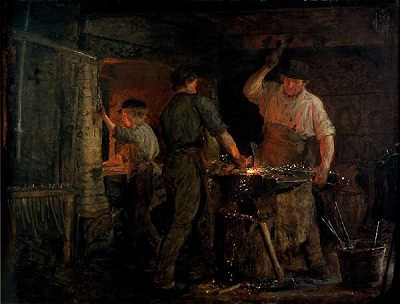 Stones and metals are typological symbols of humanity in the Bible, and precious stones and metals are pictures of mature and glorified humanity. For example, consider the stones on the high priest’s shoulders and breastpiece, which symbolized the tribes of Israel. We ourselves are living stones in the house of God (1 Pet. 2:5). Much of the furniture and structure of the tabernacle and temple were either made of, or coated in, precious metals; such utensils and vessels, as well as the tabernacle and temple themselves, are symbolic of God’s people gathered around his throne and serving him (e.g., Rom. 9:23, 2 Tim. 2:20-21). And when Jesus appears in all his glory and power, he is a metal man (Daniel 10, Rev. 1, 2).
Applying this, it seems that, even apart from sin, God intended to bring mankind from a state of nakedness and immaturity to a state of investiture, glory and maturity; and this through the potentially painful means of God’s forging us. This process of maturation is hinted at in Genesis 2:10-15. In the rivers flowing out of Eden, we see a picture of Adam’s garden-tending and keeping extending out into the whole world. (This imagery of water-life flowing out to the world is repeated in Ezekiel’s visionary temple and in Revelation 22.) In Genesis 2’s calling attention to gold and precious stones there is a hint that Adam was called to refine these and perhaps bring them back to beautify and glorify the garden; the treasure of the nations is meant to be brought into God’s house (e.g., Ps. 68:18,29; Rev. 21:24-26). But just as Adam and his offspring were called to refine and glorify creation, God would be refining and glorifying them. As Calvin observes, it is no more possible for us to attain maturity and glory by ourselves apart from God’s craftsmanship, than it is for metals and gemstones to attain beauty apart from a master craftsman. The fall did not cause gold and gems to become encrusted with earth and stone; it only caused them to resist man more intensely, as God’s curse-prosecuting agents.
We see this process reflected subtly in God’s creating Eve. On each day of creation, God brought his creation from something “good” to a newer and greater good. Yet even apart from sin, there was something “not good” (Gen. 2:18) in God’s creation, something that required Adam to be put into a deathlike sleep, to be cut open, and to have a part of himself cut away. Yet what he receives in exchange is glorious (1 Cor. 11:7), so that everything is “very good” (Gen. 1:31).
This helps us understand what is meant by saying that Jesus was made perfect through suffering (Heb. 2:10, 5:9). He progressed from glory to glory, from good to very good. He was refined, tested and proved. There was something not good in that his bride had forsaken him. He had to die and have his own side pierced in order for her to be re-created and resurrected with him.
Likewise the church, and we as individual believers, experience this process of maturation and refining. Our sin is our greatest barrier to maturity and glory. But even where sin is resisted by the power of the Spirit, God will still be using the heat of his forge and the blows of his hammer to refine and mature us, to increase our capacity for serving him. In this way we will be made more like Jesus, the glorious metal man.
Face
 |
 |
A few weeks ago, we cut a swath out of the ivy on a large oak tree in our front yard and had an arborist come by to trim dead branches. Since then, the ivy has started to wither away and the tree’s leaves are beginning to spring forth. This evening we discovered this fellow emerging from the ivy. His left eye and mouth were missing, but we found them after grabbing a rake and scratching about for a few minutes. Here he is after clearing away more of the ivy.
Click on each picture for a larger view.
Derby
For this year’s Royal Ranger pine-car derby, Asher and I each made a car. We built them on Lego bases:

Asher built a sweep-wing spacecraft, “The Blaster”:

I built a space shuttle:

We were sick the weekend of the official race, so we had to run our own race:
Last year we made Francesco Bernoulli and Asher won the design trophy for his age group!
 I gotta have my orange juice.