Fall
Spring used to be my favorite season.

 Now it’s fall.
I wonder if that is a result of growing older (barely).
I have a theological rationalization handy, of course. You see, the biblical themes of maturation, glorification, reaping and eschatology are just as vital as the biblical theme of regeneration, new life. History moves toward harvest, autumn.
Surely there will be Ferris wheels, funnel cake and pecan pie in the resurrection.
I’m grateful, though, that each year we experience the whole cycle of seasons, that we taste this repetition of death, rebirth, glorification and feasting. My other favorite season is whichever one comes next.
Ephesians and the Ten Commandments
Earlier I pointed out that it would be interesting to map the structure of the middle ethical section of Ephesians relative to the ten commandments. I haven’t yet found an outline that explains the organization of every single commandment in this passage, but I do hope to show that all ten commandments are represented here.
This section of Ephesians runs from 4:17 to 6:9. It seems to have two major divisions, one from 4:17-31 and the other from 5:1-6:9. Each division begins with an introductory statement grounded in the first four commandments, then addresses human relationships out of the last six commandments. The first division focuses on those commandments that address our relations with all men, while the second division focuses on those commandments that have to do with covenantal relations with one another. In the words of Peter, we could summarize this section of Ephesians by saying, “Honor everyone. Love the brotherhood. Fear God.” (1 Pet. 2:17). This gives us an outline as follows:
-
Honor everyone (4:17-31)
- Put on the new self (4:17-24, mainly from the first and second commandments)
- Give no opportunity to the devil (4:25-31, mainly from the sixth commandment)
-
Love the brotherhood (5:1-6:9)
- Walk as children of light (5:1-20, mainly from the first and third commandments)
- Submit to one another (5:21-6:9, mainly from the seventh and fifth commandments)
Let’s see how each of the commandments is represented in this passage. Recall that each of the commandments is meant to be understood broadly, and in particular that the book of Deuteronomy gives us an inspired template for reading the commandments in this way. Note that there is significant overlap in how the commandments appear in Ephesians.
First Commandment
God first commands that we are to have no gods before him. In Deuteronomy 6-11, Moses applies the first commandment to a variety of issues including fearing God, teaching our children, walking in holiness and obedience, idolatry, recalling our disobedience and unworthiness, recalling God’s covenant, circumcising our hearts, and loving, serving and obeying God. This is wide-ranging, but not surprising, since the first commandment can be understood to sum up all ten commandments.
These themes appear throughout this passage in Ephesians, but most particularly in the introductory sections for each division (4:17-24, 5:1-18). The first commandment also relates to the church’s submission to Jesus in 5:23ff, and to fathers instructing children in 6:4.
Second Commandment
While the first commandment is concerned with what James Jordan calls “covenantal idolatry,” the second commandment is concerned with “liturgical idolatry,” that we worship the one God rightly. Thus, in Deuteronomy 12-13, Israel is commanded to be iconoclastic and to worship only at God’s tabernacle and temple. This theme undergirds the introductory section 4:17-24, where our relationship with Jesus is highlighted, but not so much the second introductory section, which is more concerned with our relationship with fellow men. However, the theme does reappear in 5:22ff, as the church must rightly relate to Jesus her head.
Third Commandment
We generally take this commandment to mean that we should not speak God’s name lightly, but the word used is to take or bear God’s name. This has much broader implications: since, as God’s people, we carry his name out into the world, we are to honor his name not only with our lips but also with our actions. We are to rightly represent him before the world in everything we say and do.
In Ephesians, I find this theme in 4:24 (“created after the likeness of God”), 4:30 (grieving the Spirit), and 5:1ff (which are concerned with imitating God and being light to the world).
Fourth Commandment
The fourth commandment concerns work and Sabbath-keeping, but we have seen that it applies to corporate worship in the church. As it relates to work, this appears in Ephesians 4:28. As it relates to worship, it is relevant to singing in 5:19-20, but especially to the church’s rightly relating to her husband in 5:22ff. The church stands before Jesus for his evaluation and approval every Lord’s day.
Fifth Commandment
The fifth commandment, as we have seen before, applies not only to obedience to parents, but also to our relations with anyone who has a place of honor or authority over or under us. This means that all nine verses from 6:1-9 relate to the fifth commandment.
Sixth Commandment
The sixth commandment prohibits murder, but as Jesus reminds us, this commandment applies to much more than murder (Matthew 5:21ff). In Ephesians 4, verses 26-27, 29, 31-32 all apply to the sixth commandment, because they concern destructive speech.
The reason I include verse 27 here is that the devil is said to “steal, kill and destroy” (John 10:10) and to be the “father of lies” (John 8:44). I think that verse 27 countenances not only the sixth but also the eighth and ninth commandments, in that we are to carry out the Spirit’s ministry and not the devil’s ministry.
Seventh Commandment
The seventh commandment prohibits adultery, but in terms of Deuteronomy 22:9-23:14 this includes all forms of sexual immorality. Ephesians 5:3-5 is concerned with sexual immorality in general, and 5:22ff is concerned that marriage specifically be upheld and honored.
Eighth Commandment
The eighth commandment forbids stealing; this is addressed in Ephesians 4:27-28.
Ninth Commandment
The ninth commandment requires us to speak the truth; Ephesians 4 speaks to this in verses 25, 27, 29.
Tenth Commandment
The tenth commandment forbids coveting. Interestingly, Ephesians 5:3-5 links coveting directly to idolatry (the first and second commandments). In their own way, both the first and last commandment serve as summary statements that include all of the other sins contemplated by all ten commandments.
Conclusion
Paul draws from all ten commandments, with a significant amount of overlap. The introductory sections in each of the two divisions draw from the first four commandments. Then, Ephesians 4:25-32 takes as its basic theme destructive speech (the sixth commandment), but it layers on top of it the third, eighth and ninth commandments, in such a way that verse 27 becomes highlighted as the point at which these all stack up. Only towards the end do we have more clearly defined sections that cover the seventh and fifth commandments, but even in these cases there are intrusions (the seventh commandment overlaps significantly with the first, second and fourth; the fifth commandment includes the first when it relates to training our children).
I’m not entirely content with the structure I’ve outlined above. It seems to capture the organization of the passage, but the only significant payoff it has yielded is identifying 4:27 as a kind of keystone for the surrounding verses. But I do hope that I’ve offered something useful in identifying all ten commandments in this passage. Please comment if you find additional connections!
Faithful and Just
The verse 1 John 1:9 is familiar to us:
If we confess our sins, [God] is faithful and just to forgive us our sins and to cleanse us from all unrighteousness.
Calvin vividly describes what it would be to live without this blessing of forgiveness:
It is of great moment to be fully persuaded, that when we have sinned, there is a reconciliation with God ready and prepared for us: we shall otherwise carry always a hell within us. Few, indeed, consider how miserable and wretched is a doubting conscience; but the truth is, that hell reigns where there is no peace with God. The more, then, it becomes us to receive with the whole heart this promise which offers free pardon to all who confess their sins. — Commentaries on the Catholic Epistles
Calvin goes on to comment on the fact that God’s justice or righteousness is spoken of here, where we might expect to see his mercy mentioned instead:
Moreover, this is founded even on the justice of God, because God who promises is true and just. For they who think that he is called just, because he justifies us freely, reason, as I think, with too much refinement, because justice or righteousness here depends on fidelity, and both are annexed to the promise. For God might have been just, were he to deal with us with all the rigor of justice; but as he has bound himself to us by his word, he would not have himself deemed just, except he forgives.
See also:
Sacrilege
The Judeo-Christian ethic of charity derives from the assertion that human beings are made in the image of God, that is, that reverence is owed to human beings simply as such, and also that their misery or neglect or destruction is not, for God, a matter of indifference, or of merely compassionate interest, but is something in the nature of sacrilege. — Marilynne Robinson, The Death of Adam, 47-48
The objectivity of worship
One of the great benefits of understanding worship as a covenant renewal is that it highlights for us that worship is a public, objective and corporate event, not just a private, subjective and personal experience. So:
- Jesus, the greater Ahashuerus, publicly and objectively extends an invitation for us to stand before him
- Jesus hears our confession of sin, and publicly and objectively lifts up our faces and assures us that we stand secure before him
- Jesus publicly and objectively receives and accepts our worship and gifts, then speaks a public and objective word of encouragement and exhortation to us through his word and his servant-ministers (Jesus’s objectively speaking through the latter is implied not least by Ephesians 2:17)
- Jesus publicly and objectively shares a meal with us at his table, freshly marking out our fellowship and union with him
- Jesus publicly and objectively re-commissions us as his representatives and ambassadors to the world
This has implications for how we speak about worship. When we say we are “entering into” worship, we are using Biblical language; for example, Psalm 100 speaks of entering God’s gates and courts. But what we are speaking of is not exclusively an internal frame of mind that tunes out all the noise and focuses on Jesus. Rather, we are publicly gathering together with God’s people to stand before him. Entering into worship includes entering into an “external” frame of mind that takes in everything around us and sees with eyes of faith just what this great assembly is that we are privileged to participate in. We have come to Mount Zion . . . and to God . . . and to Jesus (Heb. 12:22ff)! He is actually among us (Matthew 18:20). We have come into his presence objectively; we don’t have to close our eyes and go there in our minds.
This also is a powerful reassurance to those who are experiencing a dark night of the soul, who are in a dry season in which they feel that God is distant or silent. Worship is not the only occasion where God speaks to us, but he is always, publicly and objectively, near to us in corporate worship and speaking to us in corporate worship.
God is not silent.
Prophet
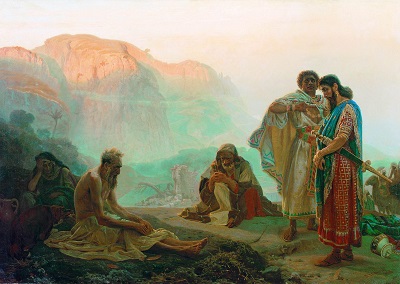 I’ve just finished reading Toby Sumpter’s outstanding commentary on the book of Job, Job Through New Eyes: A Son for Glory. Sumpter works hard to understand Job in terms of God’s declaration that Job has “spoken of me what is right” (42:7), and he makes a compelling case for his reading.
Sumpter’s thesis draws on the observation that, at the outset, the righteous Job is conspicuously absent from God’s courtroom, where the sons of God stand before him. But at the end of the book, Job is now one of these sons of God, standing before God in the position of a prophet. This is the inspired assessment of James (James 5:10-11), but we see it in the book of Job itself. God’s arrival to speak with Job is exactly what he does with his prophets (Amos 3:7). At the end, Job stands in the position of an intercessor for his friends and God has accepted Job himself (literal rendering of Job 42:9). It is the mark of a prophet to stand in the council of God, to hear God’s decrees and speak to his face. Consider Abraham’s conversation with God in Genesis 18:22ff, and his later intercession for Abimelech in Genesis 20:7, where God himself identifies Abraham as a prophet. Moses the prophet similarly intercedes for Israel before God in Exodus 32:11ff.
Seen in this light, the book of Job is the story of God’s wrestling with Job to draw him up into his presence. Job’s suffering is a sort of sacrificial ascension that carries him up to God. Job’s patient suffering and persistent wrestling are the very things that qualify him to stand before God. God’s calls to Job to “dress for action” (38:3, 40:7) are not part of some plan to put Job down into his place; they really are invitations from God as father to his son Job to come up and continue to wrestle. We are reminded of Jacob and Jesus at the Jabbok river (Genesis 32). Job does not model for us a perverse desire for death or to second-guess God; he models a godly desire for resurrection, vindication, and participation in God’s council.
It is interesting to me that the first of the kingly wisdom books thus anticipates the prophets. It is a peek ahead in history, showing that the ultimate purpose of kingship and dominion is not merely to be thrifty assistant managers of creation, but to grow to stand before God as junior co-creators with him. A king brings things to pass by the re-forming work of his hands, but a prophet speaks new things into being with words. As wisdom literature, Job is not a scholarly treatise on God’s sovereignty; it is a kingly training manual, teaching us how to wrestle with the Spirit’s whirlwind. Job teaches us to plead with God, like Moses (Exodus 33:15), for his presence and nearness. Like other wisdom literature (consider some of the Psalms, the Song of Solomon, Ecclesiastes), this manual is a tough nut to crack, a hidden treasure requiring kingly persistence (Proverbs 25:2).
There are two levels at which this applies to the church today. First, it is still the case that one of the surest paths to maturity and to deeper fellowship with Jesus is fellowship with him in suffering. We must, like Job, hold fast in faith to the almost childlike desire to meet with Jesus in our suffering, to see his face.
But at another level, we all enjoy the privilege of standing in God’s council as prophets (Acts 2:17) because we are united with Jesus. It is his suffering and ascension that qualify us to this position (Ephesians 2:4-7), so that we can plead to God with even greater boldness than Job. However, even this calls us to a kind of suffering and deprivation. Whether or not we actually lose everything for Jesus’s sake, we are to count everything as a loss (Philippians 3:7-8, Luke 14:26). If we thus identify with him in his death, we enjoy his resurrection and vindication, and are brought up with him to stand in his presence. The king calls us his friends, his counselors, because he has made everything known to us (John 15:15).
Christians enjoy this status at all times, but we experience it most powerfully every Lord’s day when Jesus holds court with us. We stand before him to dialog with him: receiving his invitation, calling on him in worship to act for his people, bringing tribute to him, hearing a word from him, eating a meal at his table, and being commissioned afresh to our weekly work.
Thus, in one sense, Christians now enjoy the fulfillment of Job’s pleading and prayer, and we are to the world what Job was to his friends: those who bring life in Jesus. Jesus, the latter Job, has even cast Satan out of the heavenly court. But in another sense, we are not satisfied, and we plead with God, like Job and Moses, to see his face more brightly.
Baptisms
We know that all Israel, from infant to adult, was baptized into Moses at the Red Sea (1 Corinthians 10:1ff), being spiritually inducted into what we might call the “body of Moses” (in conjunction with Jude 1:9 and Zechariah 3:2), the Old Testament church; just as we are baptized into the body of Christ. They were not drowned in the waters like Pharaoh and his army, but were sprinkled (Psalm 77:17ff).
There are many other such baptisms. When Jacob and his family re-entered the land after their exile with Laban, he and all his household crossed the river Jabbok (Genesis 32). Another example is Israel’s crossing the Jordan river to enter the land; this was even connected with a circumcision (Joshua 3-5). Baptism is a sign of salvation, resurrection and even ascension (as though passing through the waters above the firmament), while circumcision is a sign of sacrifice and priesthood; these two are joined together in Jesus (the greater Joshua), so that our baptism unites us to his circumcision (Colossians 2:11-12).
We see a double baptism when Absalom attacked David. When David fled Jerusalem, attention is called to the fact that he and all his people crossed the brook Kidron (2 Samuel 15) as they went to the wilderness. Among those who were thus baptized into David’s exile-death are the Philistine convert Ittai (from the city of Gath) and “all his men and all the little ones who were with him” (v. 22). Then, on David’s return into the land, he and all who were with him crossed the Jordan river (2 Samuel 19). This passage indicates that the elders of Judah made a seemingly unnecessary but very symbolic trip across the Jordan in order to bring David back (vv. 15ff), signifying that their own restoration-resurrection depended not only on their repentance but also on their baptism into David and his exile-death and exodus-resurrection.
This is partly what is meant by the author of Hebrews in saying that we should “go to [Jesus] outside the camp and bear the reproach he endured” (13:13). In context, the author is saying that we are freshly joined to Jesus’s death and resurrection when, week by week in worship, we partake of Jesus’s body and blood in the Lord’s supper. But if the Lord’s supper is a weekly renewal of our union with Jesus, then baptism is our initial and definitive union with him, crossing the heavenly waters in a symbolic exile and exodus.
See also Unbelievers.
Patience, again
 I wrote earlier of how the fig tree and mountain of Mark 11 were spoken and written to indicate God’s judgment upon faithless Israel, and to encourage the early church to persevere in prayer for deliverance from persecution. Quoting Mark Horne:
Jesus is discussing the prayers which the early Church will have to pray in the face of opposition from the Temple Mount. . . . Jesus is not speaking of mountains in general. He has made a point of saying which mountain will be cast into the sea by believing prayer. . . . Just as Jesus cursed the fig tree, so will God deliver the Church through the prayers of the saints.
Understanding this gives us insight into the timeframe Jesus was implying when he said that “it will be done for” the one who has such faith. The persecution of Saul began as early as the year of Jesus’s death and ascension, AD 30. There was a “near” deliverance for the church in the conversion of Saul. Fourteen years later, James the brother of John was killed by Herod Agrippa, and there was another “near” deliverance in the death of Agrippa in AD 44. Then the church continued to struggle with persecution. The final removal of this mountain did not come until AD 70 when Rome destroyed Jerusalem.
Counting backwards, the church’s prayers for deliverance continued for 26 years from the death of James, and 40 years from the death of Stephen. When the church prays, we are to have this manner of persistent and patient faith. Not every fig tree withers overnight.
See also: Patience.
Chronological tidbits
One of the things I appreciate about James Jordan is his careful attention to Biblical chronology. This gives us a deeper understanding of Scripture, in ways far beyond dating creation.
For example, we learn that Jacob was 77 years old when he and Rebekah deceived Isaac into repentance, and when Jacob fled to Paddan-Aram to find a wife. His twenty years of service to Laban were from the age of 77 to 97. And Joseph was almost certainly sold into slavery before his brother Benjamin was born, so that the first time he heard of Benjamin was when he overheard his brothers in Egypt.
We learn of contemporaries: Abraham was still alive when Jacob and Esau were born. Isaac died just before Joseph was released from prison, reminding us of the death of the high priest that sets people free (Numbers 35:28, 20:28; Joshua 24:33; 1 Samuel 4:18; Jesus). Samson, Samuel, Jephthah, and Jephthah’s daughter (who almost certainly served at God’s tabernacle rather than being put to death) most likely ministered at the same time, so that Samson’s death in Judges 16 was almost at the same time as the defeat of the Philistines at Mizpah in 1 Samuel 7.
Saul was close to or beyond 40 years of age when he became king, since his son Jonathan was a capable fighter at this time. This adds greater depth to the virtual adoption of Saul by Samuel in 1 Samuel 10:11-12; even as a 40-year-old, Saul was to heed the voice of Samuel his father. This also underscores Samuel’s grief over Saul’s fall (1 Samuel 15:35). If Jonathan was at least 20 years old at the start of Saul’s reign, and Saul reigned for 40 years (Acts 13:21), and David was 30 at the end of Saul’s reign (2 Samuel 5:4), then we see that Jonathan must have been David’s senior by at least 30 years. Jonathan was a truly humble and godly man.
But we gain sad insights as well. For example, we would like to think that the Song of Solomon, possibly written to the daughter of Pharaoh (1 Kings 3:1), was written to his first wife. For theological reasons, the book of Kings stresses that Solomon began running his race well. But we learn later that Solomon was married to Naamah before the daughter of Pharaoh (1 Kings 14:21 taken together with 1 Kings 11:42). So we see that even at his accession, the seeds of Solomon’s sin and fall (Deut. 17:17, etc.) were being planted.
Cube
While growing up there were a few issues of technical magazines that really captured my imagination. In the basement of the music store where I took flute lessons, there were some old Byte magazines. I remember being captivated by an article about OS/2 and Taligent, asking permission to take the issue home with me. Byte also sparked my interest in NeXT. For better or worse, this had the ultimate result that I was inspired to huddle over my PC for months to write a graphical file manager for the QNX platform. I’m not sure that anyone ever used it, but it’s still available for download.

Often we would go to the Hershey public library’s annual library sale. Several times I scooped up batches of Scientific American issues. The March 1981 issue occupied many hours of my time. In this issue, Douglas Hofstadter’s “Metamagical Themas” column addressed the Rubik’s cube, and I was hooked.
Hofstadter’s article was a brisk introduction to cubology. But instead of giving a quick how-to on solving the cube, he described the underlying concepts and patterns for manipulating the cube. No solutions: only a framework for building a solution piece by piece. But this only whetted my appetite to struggle on to understand what he had to say about group theory. Hofstadter did teach me how to disassemble and reassemble the cube, which was a great help as I stumbled along. (This is not only less destructive than peeling stickers, but is actually much easier.)
Hofstadter introduced a notation for operations on the cube. Each face had a letter: F, B, L, R, U and D for front, back, left, right, up and down. Any operation on the cube could be expressed in these terms, with exponents to indicate repeated turns of the same face (positive exponents for clockwise turns, prime symbol indicating a counter-clockwise turn). So, for example, to go from Start to a simple cross pattern on each face, you could execute F²B²L²R²U²D². Another pretty pattern, which Hofstadter calls “Dots,” can be reached from Start with BF’UD’LR’BF’.
My first excited discovery was a move that swapped two pairs of edge pieces: F²U²F²U²F²U², alternately (F²U²)³. From this one operation I was eventually able to derive all of the operations I needed to solve the cube.
These are not the shortest operators by a long shot, but these are the ones I came up with. I use Hofstadter’s notation for the cubes that are affected by each operator. These rather awkwardly tend to focus on solving the bottom face; I may take the time eventually to rewrite them in terms of the upper face. And thus we come to my motive in writing this post: I can never find my “cheat sheet” when I want it.
- Edge operators
- Double edge pair swappers
- (dr,dl)(df,db) — L’RDF²D²F²D²F²DR’L
- (dr,dl)(df,db) — F²D²F²D²F²D’F²D²F²D²F²D
- (fr,fl)(dr,dl) — F²D²F²D²F²D²
- (fr,fl)(br,bl) — F²D²F²D²F²B²D²B²D²B²
- Double edge flippers
- (dl)+(dr)+ —
F’L’R’B’FD’F’LF’D²F²D²F²D²
F’L’FDF’BRLF’D²F²D²F²D²
- (dl)+(dr)+ —
- Three-cycles of edges
- (dl,df,dr) — L’DLF²D²F²D²F²D²L’D’LF²D²F²D²F²D²
- (df,dl,db) — F²B²DR’LF²RL’U²D’F²B²
- Double edge pair swappers
- Corner operators
- Double corner pair swappers
- (dlf,drb)(drf,dlb) — L’RDF²D²F²D²F²DR’LD²
- (dlf,drb)(drf,dlb) — F²D²F²D²F²D’F²D²F²D²F²D’
- (dlf,drb)(drf,dlb) — L²R²D²L²R²U²DL²R²D²L²R²U²D
- Meson makers (quarkscrews)
- (drf)+(dlb)– —
F’UFU²F’U²FL’RDF²D²F²D²F²DR’LD²
F’U²FU²F’U’FL’RDF²D²F²D²F²DR’LD²
- (drf)+(dlb)– —
- Three-cycles of corners
- (dlf,drb,drf)+- (introduces a quark) —
RUR’BLB’L’RDF²D²F²D²F²DR’LD²
BL’B’L’RDF²D²F²D²F²DR’LD²RU’R’ - (dlf,drb,drf) —
R²DF²D²F²D²F²DR’LD²R’D’R²DUL’UL
RDF²D²F²D²F²DR’LD²L²U’LU’D’R²DL’
- (dlf,drb,drf)+- (introduces a quark) —
- Double corner pair swappers
Hofstadter’s article inspired me to put in the effort to read his fascinating book Goedel, Escher and Bach. It is not an exaggeration, as I do here, to describe it as a romp through a variety of fields. Perhaps second only to my high-school programming mentor, I owe Hofstadter my interests in math and computer science.
If you’re interested in Hofstadter’s article on the cube, you can order a digital edition from Scientific American.

