Archive for the ‘Quotations’ Category
Covenant and Adoption
J. I. Packer’s book Knowing God is best known for its chapter on adoption, “Sons of God.” The chapter is outstanding, both as a stirring picture of what a wonderful gift adoption is, but also in how he links our adoption to all of the blessings, privileges and responsibilities we have in Christ. Nothing else is quite as precious or as energizing as our adoption. On p. 201 Packer quotes an article he had written earlier:
You sum up the whole of New Testament teaching in a single phrase, if you speak of it as a revelation of the Fatherhood of the holy Creator. In the same way, you sum up the whole of New Testament religion if you describe it as the knowledge of God as one’s holy Father. If you want to judge how well a person understands Christianity, find out how much he makes of the thought of being God’s child, and having God as his Father. If this is not the thought that prompts and controls his worship and prayers and his whole outlook on life, it means that he does not understand Christianity very well at all. For everything that Christ taught, everything that makes the New Testament new, and better than the Old, everything that is distinctively Christian as opposed to merely Jewish, is summed up in the knowledge of the Fatherhood of God. “Father” is the Christian name for God.
 Peter Lillback, in his book The Binding of God, assembles a picture of John Calvin’s understanding of God’s covenants with man. Throughout the book what I am most struck by is how often Calvin links covenant theology with the doctrine of adoption in order to either make careful and helpful distinctions, or else to illustrate how God’s covenanting with us ought to be a real engine for responsive affections and actions on our part. Probably half of my dog-ears are for adoption-related passages.
So, we see Calvin summarizing the covenant as an adoption (pp. 137-138):
For if God only demanded his due, we should still be required to cling to him and to confine ourselves to his commandments. Moreover, when it pleases him by his infinite goodness to enter into a common treaty, and when he mutually binds himself to us without having to do so, when he enumerates that treaty article by article, when he chooses to be our father and Savior, when he receives us as his flock and his inheritance, let us abide under his protection, filled with its eternal life for us. When all of these things are done, is it proper that our hearts become mollified even if they were at one time stone? When creatures see that the living God humbles himself to that extent, that he wills to enter into covenant that he might say: “Let us consider our situation. It is true that there is an infinite distance between you and me and that I should be able to command of you whatever seems good to me without having anything in common with you, for you are not worthy to approach me and have any dealings with whoever can command of you what he wills, with no further declarations to you except: ‘That is what I will and conceive.’ But behold, I set aside my right. I come here to present myself to you as your guide and savior. I want to govern you. You are like my little family. And if you are satisfied with my Word, I will be your King. Furthermore, do not think that the covenant which I made with your fathers was intended to take anything from you. For I have no need, nor am I indigent in anything. And what could you do for me anyway? But I procure your well-being and your salvation. Therefore on my part, I am prepared to enter into covenant, article by article, and to pledge myself to you.”
And again Calvin summarizes even the old covenant as a gracious act of adoption (p. 140):
The Psalmist addresses himself by name to his own countrymen, whom, as has been stated, God had bound to himself by a special adoption. It was a bond of union still more sacred, that by the mere good pleasure of God they were preferred to all other nations. . . . He expressly states both these truths, first, that before they were born children of Abraham, they were already heirs of the covenant, because they derived their origin from the holy fathers; and, secondly, that the fathers themselves had not acquired this prerogative by their own merit or worth, but had been freely chosen; for this is the reason why Jacob is called God’s chosen.
Lillback moves on to explore several facets of God’s covenants in Calvin’s understanding. We have already seen above that, perhaps unlike Packer, Calvin considers adoption to be a blessing common to both the old and new covenants. First, Lillback explores Calvin’s complex understanding of mutuality and conditionality. Calvin carefully balances an understanding of God’s sovereign working in our salvation with how we as God’s creatures see, understand, receive and respond to his working in time and history. Adoption is a perfect picture of this because it is an undeserved gift that God undertook wholly on his own initiative, but which makes us God’s children and wholly obligates us to him. Lillback quotes Calvin on p. 172:
[Hosea] says that they had acted perfidiously with God, for they had violated his covenant. We must bear in mind what I have said before of the mutual faith which God stipulates with us, when he binds himself to us. God then covenants with us on this condition, that he will be our Father and Husband; but he requires from us such obedience as a son ought to render to his father; he requires from us that chastity which a wife owes to her husband. The Prophet now charges the people with unfaithfulness, because they had despised the true God, and prostituted themselves to idols.
On p. 192 we see how Calvin both distinguishes and weaves together faith and works. The language of sonship and union with Christ serves as a subtle backdrop, underscoring that obedience does not somehow perversely purchase our freedom from slavery and adoption into God’s love (as if it were possible!), but that pleasing our Father is nevertheless a wonderful combination of duty and delight:
When, therefore, we say that the faithful are esteemed just even in their deeds, this is not stated as a cause of their salvation, and we must diligently notice that the cause of salvation is excluded from this doctrine; for, when we discuss the cause, we must look nowhere else but to the mercy of God, and there we must stop. But although works tend in no way to the cause of justification, yet, when the elect sons of God were justified freely by faith, at the same time their works are esteemed righteous by the same gratuitous liberality. Thus it still remains true, that faith without works justifies, although this needs prudence and a sound interpretation; for this proposition, that faith without works justifies is true and yet false, according to the different senses which it bears. The proposition, that faith without works justifies by itself, is false, because faith without works is void. But if the clause “without works” is joined with the word “justifies,” the proposition will be true, since faith cannot justify when it is without works, because it is dead, and a mere fiction. He who is born of God is just, as John says. (I John V. 18) Thus faith can be no more separated from works than the sun from his heat: yet faith justifies without works, because works form no reason for our justification; but faith alone reconciles us to God, and causes him to love us, not in ourselves, but in his only-begotten Son.
Thus good works are not only possible but acceptable to God because, in Lillback’s words, “in the covenant, God ceases to be a strict judge and becomes a father” (p. 196). Quoting Calvin on the same page:
Moreover, we do not deny that for believers uprightness, albeit partial and imperfect, is a step toward immortality. But what is its source except that the Lord does not examine for merits the works of those whom he has received into the covenant of grace but embraces them with fatherly affection?
But this is the peculiar blessing of the new covenant, that the Law is written on men’s hearts, and engraven on their inward parts; whilst that severe requirement is relaxed so that the vices under which believers still labour are no obstacle to their partial and imperfect obedience being pleasant to God.
It is therefore necessary, even when we strive our utmost to serve God, to confess that without his forgiveness whatever we bring deserves rejection rather than his favour. Hence the Prophet says, that when God is reconciled to us, there is no reason to fear that he will reject us, because we are not perfect; for though our works be sprinkled with many spots, they will be acceptable to him, and though we labour under many defects, we shall yet be approved by him. How so? Because he will spare us; for a father is indulgent to his children, and though he may see a blemish in the body of his son, he will not yet cast him out of his house; nay, though he may have a son lame, or squint-eyed, or singular for any other defect, he will yet pity him, and will not cease to love him: so also is the case with respect to God, who, when he adopts us as his children, will forgive our sins. And as a father is pleased with every small attention when he sees his son submissive, and does not require from him what he requires from a servant; so God acts; he repudiates not our obedience, however defective it may be.
This wonderful result is because of our union with Christ the firstborn Son. Quoting Calvin on p. 209:
Yet notwithstanding, the persons of believers being accepted through Christ, their good works are also accepted in him, not as though they were in this life wholly unblamable and unreprovable in God’s sight; but that he, looking upon them in his Son, is pleased to accept and reward that which is sincere, although accompanied with many weaknesses and imperfections.
Nevertheless, there are those who apostatize or break covenant. Calvin depicts this too using familial language: those who break covenant are rebellious children who are disowned, ones who “degenerate from legitimate children to bastards” (Calvin, p. 217). Yet as God’s children we have great assurance of our perseverance, and encouragement to persevere, because our Father who dwells in our midst has pledged himself to us (Calvin, pp. 270-271):
But the inspired writer, calling to remembrance the promises by which God had declared that he would make the Church the object of his special care, and particularly that remarkable article of the covenant, “I will dwell in the midst of you” (Exodus xxv. 8), and, trusting to that sacred and indissoluble bond, has no hesitation in representing all the godly languishing, though they were in a state of suffering and wretchedness, as partakers of this celestial glory in which God dwells. . . . What advantage would we derive from this eternity and immutability of God’s being, unless we had in our hearts the knowledge of him, which, produced by his gracious covenant, begets in us the confidence arising from a mutual relationship between him and us? The meaning then is, “We are like withered grass, we are decaying every moment, we are not far from death, yea rather, we are, as it were, already dwelling in the grave; but since thou, O God! hast made a covenant with us, by which thou hast promised to protect and defend thine own people, and hast brought thyself into a gracious relation to us, giving us the fullest assurance that thou wilt always dwell in the midst of us, instead of desponding, we must be of good courage; and although we may see only ground for despair if we depend upon ourselves, we ought nevertheless to lift up our minds to the heavenly throne, from which thou wilt at length stretch forth thy hand to help us.” . . . . As God continues unchangeably the same — “without variableness or shadow of turning” — nothing can hinder him from aiding us; and this he will do, because we have his word, by which he has laid himself under obligation to us, and because he has deposited with us his own memorial, which contains in it a sacred and indissoluble bond of fellowship.
In seeking to secure our perseverance, God uses both fatherly enticings and fatherly threatenings and discipline. Yet in the end, “the Christian’s life of covenant-keeping, although imperfect before God, is nevertheless a life of encouragement since God is pleased with His adopted children’s faithful efforts” (Lillback, p. 275).
There are some areas of covenant life where Lillback does not quote Calvin in reference to adoption, but where there is a clear link to adoption. One such area is that of “covenant prayer.” The nature of our prayer to God is precisely that of a child appealing to a loving father (Luke 11:1-13).
This is also the case for the sacraments, the covenant signs. Baptism is a pronouncement by God through his church of our adoption and justification. Consider that our baptism is a key beginning of our union with Christ (Romans 6) and Christ’s own baptism was a pronouncement of sonship and acceptance (Matthew 3). (Baptism is of course not the cause of our adoption and justification any more than a minister’s pronouncement of “man and wife” is the cause of a couple’s union.) Similarly, the covenant meal is a family meal. God provides food for us, his children, and we eat before him. This is true of both the Lord’s Supper and also Old Testament meals that priests and often worshippers enjoyed before God after offering sacrifice.
There are, of course, plenty of other ways we can think about God’s covenanting. Adoption showcases the work of God the Father, but we could equally explore the work of Christ or of the Spirit in our salvation. Or we could consider how our children relate to God, explore Calvin’s letter-Spirit distinction over against a Lutheran law-gospel distinction, or consider the many ways in which the old and new covenants are similar yet different.
An advantage of looking at adoption specifically is that it stands up well as a proxy for the kind of questions we want to ask about covenant and sacraments. In particular, it helps us to remember that God’s covenants are not merely legal, but also affective, personal and social. What does it mean to be in covenant with God through Christ and his Spirit? More than anything else, it means to be adopted, named and kept as his own child.
Eucatastrophe
 J.R.R. Tolkien writes to his son Christopher:
For [that fairy-story essay] I coined the word ‘eucatastrophe’: the sudden happy turn in a story which pierces you with a joy that brings tears (which I argued it is the highest function of fairy-stories to produce). And I was there led to the view that it produces its peculiar effect because it is a sudden glimpse of Truth, your whole nature chained in material cause and effect, the chain of death, feels a sudden relief as if a major limb out of joint had suddenly snapped back. It perceives — if the story has literary ‘truth’ on the second plane (for which see the essay) — that this is indeed how things really do work in the Great World for which our nature is made. And I concluded by saying that the Resurrection was the greatest ‘eucatastrophe’ possible in the greatest Fairy Story — and produces that essential emotion: Christian joy which produces tears because it is qualitatively so like sorrow, because it comes from those places where Joy and Sorrow are at one, reconciled, as selfishness and altruism are lost in Love. Of course I do not mean that the Gospels tell what is only a fairy-story; but I do mean very strongly that they do tell a fairy-story: the greatest. Man the story-teller would have to be redeemed in a manner consonant with his nature: by a moving story. But since the author of it is the supreme Artist and the Author of Reality, this one was also made to Be, to be true on the Primary Plane. So that in the Primary Miracle (the Resurrection) and the lesser Christian miracles too though less, you have not only that sudden glimpse of the truth behind the apparent Anankê of our world, but a glimpse that is actually a ray of light through the very chinks of the universe about us. I was riding along on a bicycle one day, not so long ago, past the Radcliffe Infirmary, when I had one of those sudden clarities which sometimes come in dreams (even anaesthetic-produced ones). I remember saying aloud with absolute conviction: ‘But of course! Of course that’s how things really do work’. But I could not reproduce any argument that had led to this, though the sensation was the same as having been convinced by reason (if without reasoning). And I have since thought that one of the reasons why one can’t recapture the wonderful argument or secret when one wakes up is simply because there was not one: but there was (often maybe) a direct appreciation by the mind (sc. reason) but without the chain of argument we know in our time-serial life. However that’s as may be.
— 7–8 November 1944, pp. 100–101 of The Letters of J.R.R. Tolkien
Tolkien, Reading and the Ring
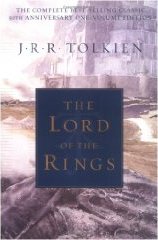 My wife and I have a tradition of watching through The Lord of the Rings at Christmastide. We don’t get to it every year, but we’ve just finished the cycle this time.
It’s been awhile since I read the books, so long that I find myself forgetting things. Most of all I don’t sense the loss of nobility from books to movies as much as I used to. So I’ve decided to re-read Tolkien this year. I’ve started with The Silmarillion, which I haven’t read before. I’ve already read Unfinished Tales and I don’t think I’ll read it through again now, but I will reread both The Hobbit and The Lord of the Rings. Just today, I was pleased to rediscover The Letters of J.R.R. Tolkien on my shelf, one of my wife’s yard sale finds. I think I’ll try to get through that as well. And I’m excited that Mark Horne is working on a Tolkien biography.
Here’s a quote I found while paging through Tolkien’s letters, from a fascinating letter on p. 279 in response to questions about The Lord of the Rings from Miss Rhona Beare:
You cannot press the One Ring too hard, for it is of course a mythical feature, even though the world of the tales is conceived in more or less historical terms. The Ring of Sauron is only one of the various mythical treatments of the placing of one’s life, or power, in some external object, which is thus exposed to capture or destruction with disastrous results to oneself. If I were to ‘philosophize’ this myth, or at least the Ring of Sauron, I should say it was a mythical way of representing the truth that potency (or perhaps rather potentiality) if it is to be exercised, and produce results, has to be externalized and so as it were passes, to a greater or less degree, out of one’s direct control. A man who wishes to exert ‘power’ must have subjects, who are not himself. But he then depends on them.
There’s a lot of food for thought there, with applicability ranging from the inevitable failure of despotism to everything that is bittersweet about parenthood.
Nothing can hinder him from aiding us
The fullest confidence is available to believers in their suffering because of God’s immutable covenant promise by which He has obliged Himself to believers.
But the inspired writer, calling to remembrance the promises by which God had declared that he would make the Church the object of his special care, and particularly that remarkable article of the covenant, “I will dwell in the midst of you” (Exodus xxv. 8), and, trusting to that sacred and indissoluble bond, has no hesitation in representing all the godly languishing, though they were in a state of suffering and wretchedness, as partakers of this celestial glory in which God dwells. . . . What advantage would we derive from this eternity and immutability of God’s being, unless we had in our hearts the knowledge of him, which, produced by his gracious covenant, begets in us the confidence arising from a mutual relationship between him and us? The meaning then is, “We are like withered grass, we are decaying every moment, we are not far from death, yea rather, we are, as it were, already dwelling in the grave; but since thou, O God! hast made a covenant with us, by which thou hast promised to protect and defend thine own people, and hast brought thyself into a gracious relation to us, giving us the fullest assurance that thou wilt always dwell in the midst of us, instead of desponding, we must be of good courage; and although we may see only ground for despair if we depend upon ourselves, we ought nevertheless to lift up our minds to the heavenly throne, from which thou wilt at length stretch forth thy hand to help us.” . . . . As God continues unchangeably the same — “without variableness or shadow of turning” — nothing can hinder him from aiding us; and this he will do, because we have his word, by which he has laid himself under obligation to us, and because he has deposited with us his own memorial, which contains in it a sacred and indissoluble bond of fellowship.
There is always hope, even in the adversities of life, because “the eyes of the Lord are over the righteous, to confirm His covenant towards them by watching for their safety.”
— Peter Lillback, quoting Calvin in The Binding of God, pp. 270-271.
Wiggly Disciples
Douglas Wilson writes of parents shepherding wiggly disciples on Sunday morning:
Many of you are here as parents of little ones and, in some cases, many little ones. For you, the worship of the Lord is a far more arduous task that it is for the rest of us. All of us are engaged in the work of worshipping the Lord, but you are carrying young ones in your arms as you perform the same labor that we do. . . .
Read on for encouragement that is really applicable to all of parenting: our parenting is unto God, and he intends for it to be a real part of our worship.
Encouragement to parents
John Loftness writes:
Humility . . . drives us away from self-sufficiency to believing in the promises of God.
Diligence alone will never make a good parent. Faith will. Faith in God’s promises. When we see what he’s promised about our children, it will shape how we think, what we expect, and therefore how we act. The only way to pray by faith for our children is to begin with a focused belief in God’s will for them. “If you abide in me, and my words abide in you, ask whatever you wish, and it will be done for you” (John 15:7).
These are the words that Nancy and I abide in. They shape our prayers and fix our hope:
“And the LORD your God will circumcise your heart and the heart of your offspring, so that you will love the LORD your God will all your heart and with all your soul, that you may live.” (Deut. 30:6)
“All your children shall be taught by the LORD, and great shall be the peace of your children” (Is. 54:13).
“‘And as for me, this is my covenant with them,’ says the LORD: ‘My Spirit that is upon you, and my words that I have put in your mouth, shall not depart out of your mouth, or out of the mouth of your offspring, or out of the mouth of your children’s offspring,’ says the LORD, ‘from this time forth and forever more'” (Is 59:21).
“For the promise is for you and for your children and for all who are far off, everyone whom the Lord our God calls to himself” (Acts 2:39—read the context, too).
JI Packer quotes Samuel Clark about God’s promises: “A fixed, constant attention to the promises and a firm belief of them, would prevent solicitude and anxiety about the concerns of life” (Knowing God, p. 115). Is there any greater concern than the concerns we carry for our children? Is there any greater comfort and hope than to hear and believe the promises of the one who spoke and worlds came into being? So pray the promises about your children. And see God work, in them and in you.
The Binding of God
. . . the essence of Calvin’s conception of the covenant is the notion of the binding of God. This binding is God’s own act of joining Himself with His creatures. . . . The gracious self-binding of the infinite God whereby He condescends to enter into a mutual covenant with His fallen and unworthy yet sovereignly chosen people is eloquently portrayed by Calvin in his sermon on Deuternonomy 4:44-5:3.
For if God only demanded his due, we should still be required to cling to him and to confine ourselves to his commandments. Moreover, when it pleases him by his infinite goodness to enter into a common treaty, and when he mutually binds himself to us without having to do so, when he enumerates that treaty article by article, when he chooses to be our father and Savior, when he receives us as his flock and his inheritance, let us abide under his protection, filled with its eternal life for us. When all of these things are done, is it proper that our hearts become mollified even if they were at one time stone? When creatures see that the living God humbles himself to that extent, that he wills to enter into covenant that he might say: “Let us consider our situation. It is true that there is an infinite distance between you and me and that I should be able to command of you whatever seems good to me without having anything in common with you, for you are not worthy to approach me and have any dealings with whoever can command of you what he wills, with no further declarations to you except: ‘That is what I will and conceive.’ But behold, I set aside my right. I come here to present myself to you as your guide and savior. I want to govern you. You are like my little family. And if you are satisfied with my Word, I will be your King. Furthermore, do not think that the covenant which I made with your fathers was intended to take anything from you. For I have no need, nor am I indigent in anything. And what could you do for me anyway? But I procure your well-being and your salvation. Therefore on my part, I am prepared to enter into covenant, article by article, and to pledge myself to you.”
The covenant, therefore, highlights God’s grace.
— Peter Lillback, The Binding of God, pp. 137-138.
We are as the prodigal son.
Ends and beginnings and faith
 Peter Leithart writes about faith:
Ruth begins with death – the death of the land in famine, the death of exile, the death of Elimelech, the death of Naomi’s sons, the death of Naomi’s future. Naomi goes out full, and comes back empty. Ruth 1 is a perfect tragic story, a story of endings and emptyings.
But it is chapter 1, and the author wants us to realize that this series of deaths is not an end. The end of chapter 1 is a beginning, as Naomi and Ruth return to Bethlehem “at the beginning of the barley harvest” (v. 22). The author makes his point with a touch so light as to be nearly imperceptible, but the import of that “beginning” is as weighty as anything in Scripture.
“In the beginning” and “once upon a time” make rational sense as the beginning of a story. But recognizing a beginning on the other side of an end is an act of faith.
Mark Dever makes a similar point in his treatment of Ruth. To human eyes, all is despair at the beginning of this book. But the writer of Ruth gives us a glimpse of what a sovereign and good God is planning and working behind the scenes. You can listen to Dever preach on the whole book of Ruth, and also on Ruth chapter 1 specifically.
See also William Cowper’s hymn, God Moves in a Mysterious Way.
Hospitality
Peter Leithart writes of hospitality:
Feasting and care for the poor have been polarized in contemporary culture. If you’re a “conservative,” you’re in favor of free trade, consumption without guilt, festivity without concern for those who can’t join you, who probably deserve their poverty anyway. If you’re a “liberal,” you renounce festivity because other people are hungry and how dare you eat when someone else isn’t.
The Biblical prophets combine a promise of festivity with severe denunciation of greed, luxury, and oppression. But they combine the two seamlessly by emphasizing hospitality. The promise is a feast like the feasts of the Pentateuch, where the widow, stranger, and Levite are not forgotten but included as welcome guests.
Against both “conservative” indifference and liberal asceticism, the Bible presents the ideal of the hospitable society.
Better
“God has better plans for you than an easy life and victories to follow victories.” — Daniel Baker
 I gotta have my orange juice.