Archive for the ‘Quotations’ Category
Regeneration redux
Last year I wrote that we should speak of regeneration as something that God progressively-continually accomplishes in us, and cited Calvin as saying that regeneration is something that occurs progressively.
Ian Hewitson makes a similar observation:
After a brief treatment of union with Christ in chapter 1 [of the Institutes, book 3], Calvin speaks of regeneration. Under the rubric of regeneration, Calvin was taking up the topic of sanctification. (At that point of theological development, “regeneration” had the broad significance of what we now understand by “sanctification”). Calvin, having completed that topic, then takes up the topic of justification. The polemic involved for Calvin was to demonstrate that the Protestant conception of justification did not militate against the moral integrity of the believer as Roman Catholic theology believed would inevitably be the case if a doctrine of justification was grounded in imputed righteousness. Calvin refutes such an understanding by taking up sanctification first, without calling into question the doctrine of justification as a forensic category grounded in the imputation of the righteousness of Jesus Christ. Although the Westminster Confession of Faith (in chapter XIII) sees regeneration as the beginning of sanctification, I am not aware of any modern Reformed theologian who takes up the topic of sanctification before the topic of justification according to the same pattern as the Confession. Reformed theologians do take up the topic of regeneration, and regeneration is a category of transformation. In the course of theological development, the conception of regeneration was narrowed down to initial transformation that is wrought at the inception of the process of sanctification. In this way, regeneration is thought of as a transforming “act” of God that accounts for the emergence of faith in the believer. Attention is then turned to other “acts” of God that precede the “process” of sanctification. The movement is from regeneration to justification. Regeneration gives rise to the faith that justifies and precedes sanctification. Such a pattern is within the bounds of Reformed theology and not contrary to Calvin’s approach, but it remains the case that it is not the pattern found in Book III of the Institutes. (Trust and Obey, 25-26)
Life in faith
Ted Tripp writes of repentance and faith as a way of life rather than an event:
Repentance and faith are not rites of initiation to Christianity. Repentance and faith are the way to relate to God. Repentance and faith are not acts performed one time to become a Christian. They are attitudes of the heart toward ourselves and our sin. Faith is not just the way to get saved; it is the life-line of Christian living.
Your children . . . need to know the cleansing and refreshing forgiveness of God, not just once to get saved, but daily. They must understand the Christian life not simply as living according to a biblical code, but as life in faith, commitment and fellowship with the living God. (Shepherding a Child’s Heart, 55)
Literaturely
Calvin Seerveld writes movingly on how to read the Bible:
The true story of God’s great deeds has been written down (John 20:31) so that we may believe Jesus is the Christ, the son of God, and so believing have life in his name. The Holy Scriptures have been given us historically so that we might come to know the covenanting God and his way of doing things in creation and so that we might be able to obey him more maturely as adopted sons and daughters, who had lost their way in the world. That is crucial, I believe, for rightly understanding the Bible, this God-speaking literature. It must always be pulled back to its primary level of true story for believing children.
That’s a test I have always used when challenged in my confession: I recall the way I responded as a wide-eyed child to Mother reading me Bible stories before I was trundled off to bed. Adam and Eve were real people then . . . and now, quite unlike Sleeping Beauty and Prince Charming. Balaam’s ass saw the angel and talked, and God had a whale swallow Jonah—it said so—because God loved the Israelites so much and all the people and cows around Ninevah; but Hansel and Gretel and the witch in the forest were not people in a true story. Somehow my believing parents gave me a lasting sense of how Genesis 3 and Romans 5, Exodus 20 and Matthew 5–7, Psalm 90, Isaiah 40 and Romans 8—all richly, literarily variegated—integrally told the true story of God’s saving presence on the earth, especially for those who took him at his Word, as my Dad would say (cf. I Timothy 4:10). I learned to use the Bible not so much as a book of special, extra, inside information (the way Thomas Aquinas conceived it, cf. Summe contra gentiles, 4, i) but as a source of knowledge-to-grow-on, the kind of vision (nouthesia) your father would give you as an inexperienced lad who was walking around in the world (Bible as “spectacles,” to use John Calvin’s phrase). And it is that kind of humbled, childlike, expectant hearing and fiducial reception (to use an early English Puritan expression) that I believe must be the first and last way one meets the God-speaking literature called the Bible.
So what am I after? Just this: (1) It is an insight of christian aesthetic theory that bona fide art presents reliable, specific knowledge for others to grasp; and that knowledge is of its own imaginative, suggestion-rich sort. (2) Literature is thoughtful writing that is characterized by such an artistic norming. (3) The Bible is God-speaking literature telling us a true story; that is its nature. Therefore, when faithful, childlike people read the Bible, they should read it literarily. One should not read the Bible literalistically (=”literally”?) and then figuratively when one gets stuck. One should always read it literarily, literaturely, the way it is written, to mine its special wisdom-making, true-storied knowledge for children.
The Bible is not a collection of atomic, bullet like proof-texts to be shot at people. It will take a trained person who subsumes verses within paragraphs, within chapter wholes, within total books, within the perspicuous true story connection I mentioned to interpret Scripture word for word. The Bible is not an anthology of lessons in piety which can be distributed, so to speak, like candy to whoever holds out his hand. The Bible does not give recipes, which when followed to the letter, make wonderful devotional soup. Only when the mighty, true story of civitas Dei vs. civitates mundi dominates the reading of the quiet pilgrim psalm 131 or jumps out at you from Genesis 32 when Jabbok becomes Peniel or overwhelms you seeking comfort in the letter to the Philippians: only then does one learn the God-fearing, quiet intensity (eusebeia) that is becoming to a child of God. The Bible is not like a telephone book where you can find God’s special number for emergency use, and all the heavenly office numbers to call for marriage, births and funerals, lonely hearts, potential suicides, earthquake-like disasters. People use the Bible that way, and God stoops to their weakness, but human weakness does not define the Holy Scriptures.
I am continually bowled over by the fact that this is the book where we hear God talking about what He is actually doing in the world; and its true story is so powerful, with cosmic, historic sweep and a tenderly passionate, apocalyptic temper that one says spontaneously with Paul (Romans 15:4), “All the things written earlier were put in writing for us to understand so that through the firming up and comforting power of the Scriptures we might have hope!” Part of what I am after, as a christian aesthetician, is greater recognition of the Bible as God-speaking literature that is telling a true story, so that the Bible not be so easily trivialized into a private, short-order, spiritual cookbook. That denatures the Holy Scriptures, no matter how infallible you claim the book to be. (Rainbows for the Fallen World, 90-92)
Alwaies Autumne
John Donne preached the following on Christmas evening in 1624:
God made sun and moon to distinguish seasons, and day, and night, and we cannot have the fruits of the earth but in their seasons: But God hath made no decree to distinguish the seasons of his mercies; In Paradise, the fruits were ripe, the first minute, and in heaven it is alwaies Autumne, his mercies are ever in their maturity. We ask panem quotidianum, our daily bread, and God never sayes you should have come yesterday, he never sayes you must come againe tomorrow, but to-day if you will heare his voice, to-day he will heare you. If some King of the earth have so large an extent of Dominion, in North and South, as that he hath Winter and Summer together in his Dominions, so large an extent East and West, as that he hath day and night together in his Dominions, much more hath God mercy and judgment together: He brought light out of darkness, not out of a lesser light; he can bring thy Summer out of Winter, though thou have no Spring; though in the wayes of fortune, or understanding, or conscience, thou have been benighted till now, wintred and frozen, clouded and eclypsed, damped and benummed, smothered and stupified till now, now God comes to thee, not as in the dawning of the day, not as in the bud of the spring, but as the Sun at noon to illustrate all shadowes, as the sheaves in harvest, to fill all penuries, all occasions invite his mercies, and all times are his seasons.
Dogs have compassed me about
 Consider Nathan Wilson’s Empire of Bones, a fun and swashbuckling young adult novel (part of a series, not yet complete) that has a major character singing Psalm 22, singing it joyously—for the joy set before him, as he gives his life in the hope of saving others. With a small quote it’s impossible to capture the intense build-up that has brought the book and series to this point, but here is the bittersweet moment:
Surrounded completely, the Captain’s blade was still fast enough to keep the ring from closing. He laughed as he fought, and his smile was as grim as any reaper’s. And then he began to sing. His accent and his effort slurred his words, but Diana recognized the song. Her own mother sang it in the kitchen, and her happiness in the singing always belied the sorrow of the words.
The Captain sang and he danced and he slashed the ring around him. He sang even when Radu’s chain found his legs and lightning forked from the links and felled him. He sang as the transmortals tore the blade from his hand, grabbed his wrists, and stretched his shaking oak-strong arms out from his sides.
He was singing as they tore off his breastplate, and singing as Rupert pulled Diana back from the rail, away from what was about to happen.
“You are no immortal,” Radu spat. “You are a beggar with a scrap of Odyssean Cloak hidden beneath your skin.”
“Their mouths they opened wide on me,” the Captain sang. “Upon me gape did they, like to a lion ravening and roaring for his prey. For dogs have compassed me about; they pierced my—”
The Captain’s voice broke into a shout of pain, and then he sang on, louder still, filling the vaults with what sounded like triumph, like joy.
John Smith was ready to sail.
Diana shook as Rupert pulled her away. But she heard the beastly snarl as the scrap of Odyssean Cloak was taken from inside the Captain’s chest. She heard a blade sing. The snarling stopped. Mocking laughter began.
He is even strung out in the shape of a cross.
God spede
A strong parting blessing:
It is time for me to go. May the Almighty
Father keep you and in His kindness
watch over your exploits. I’m away to the sea,
back on alert against enemy raiders.(Beowulf: A New Verse Translation 316-319, Trans. Seamus Heaney)
I love you
I read this quote years ago and can’t remember how I came across it. It’s from Tom Wolfe’s I Am Charlotte Simmons: A Novel, which I haven’t read. Wolfe is insightful here:
Charlotte laid her head back on Momma’s shoulder and sobbed softly. She could see Daddy standing right there, and she took her tears to him and threw her arms around his neck, which clearly startled him. Daddy didn’t hold with public displays of affection. Between sobs she whispered into his ear, “I love you, Daddy. You don’t know how much I love you!”
“We love you, too,” said Daddy.
He also didn’t know how much it would have meant to her if he could have only brought himself to say I.
Calvin on prayer
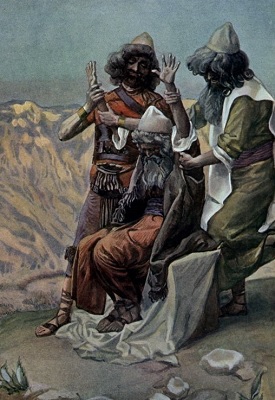 Calvin writes eloquently of prayer as a digging up of treasure:
To prayer, then, are we indebted for penetrating to those riches which are treasured up for us with our heavenly Father. For there is a kind of intercourse between God and men, by which, having entered the upper sanctuary, they appear before Him and appeal to his promises, that when necessity requires they may learn by experiences that what they believed merely on the authority of his word was not in vain. Accordingly, we see that nothing is set before us as an object of expectation from the Lord which we are not enjoined to ask of Him in prayer, so true it is that prayer digs up those treasures which the Gospel of our Lord discovers to the eye of faith. The necessity and utility of this exercise of prayer no words can sufficiently express. Assuredly it is not without cause our heavenly Father declares that our only safety is in calling upon his name, since by it we invoke the presence of his providence to watch over our interests, of his power to sustain us when weak and almost fainting, of his goodness to receive us into favour, though miserably loaded with sin; in fine, call upon him to manifest himself to us in all his perfections. Hence, admirable peace and tranquillity are given to our consciences; for the straits by which we were pressed being laid before the Lord, we rest fully satisfied with the assurance that none of our evils are unknown to him, and that he is both able and willing to make the best provision for us. (Institutes, Book III, 20.2)
Treebeard
We’ve been listening to The Lord of the Rings audiobook as a family. Yesterday we happened upon this great quote:
Merry and Pippin heard, clear in the cold air, the neighing of war-horses, and the sudden singing of many men. The Sun’s limb was lifted, an arc of fire, above the margin of the world. Then with a great cry the Riders charged from the East; the red light gleamed on mail and spear.
Song and warfare go hand in hand. Worship is warfare.
It interests me that Tolkien has the hobbits refer to the sun as feminine:
‘Hullo!’ said Merry. ‘The Sun must have run into a cloud while we’ve been under these trees, and now she has run out again; or else she has climbed high enough to look down through some opening. It isn’t far—let’s go and investigate!’
This rainy Sunday afternoon we drew our impressions of Treebeard. Here’s what we came up with:
Asher

Charlotte
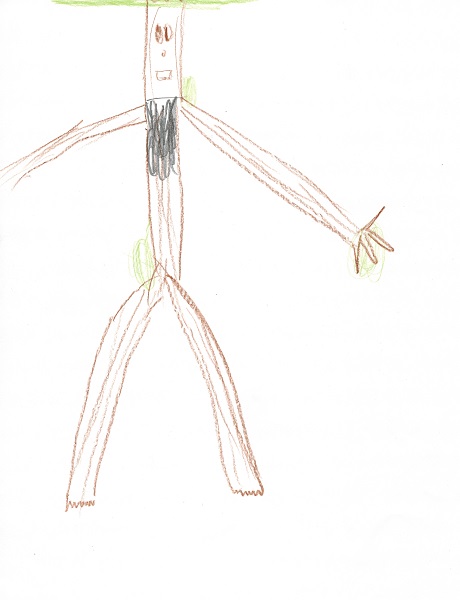
Ivy
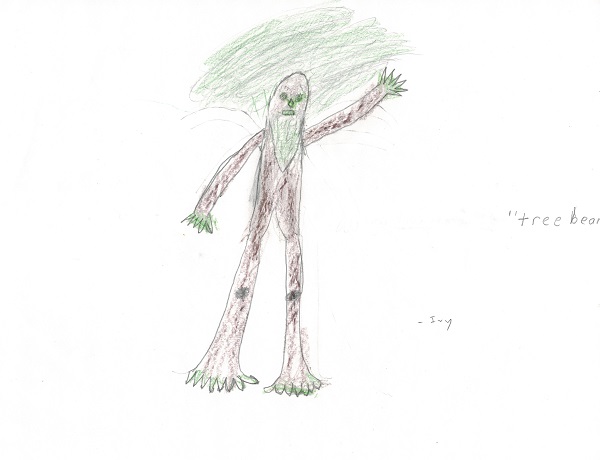
Scott

Reformation
Jon Barlow writes:
History works because of the suckers. I am not ashamed to be counted among the suckers. If the sucker can rule his own heart, he is greater than he who can rule a city (Prov. 16:32). Tell me that the broken politics in America right now is not an externalized vision of your own heart and I’ll praise your self mastery. Otherwise, there is a city for you to rule right now. It requires no compromise. You are a little laboratory of the word and spirit and and you can try out any program of reform you like right now. You can experiment with incentives. You can legislate morality. You can implement austerity. You can give everything away. You can keep everything and use it for good. There will be a day when your little city stands before a much more exalted bar than a senate oversight committee meeting.
Jordan Ballor quotes Bavinck on a similar theme:
All good, enduring reformation begins with ourselves and takes its starting point in one’s own heart and life. If family life is indeed being threatened from all sides today, then there is nothing better for each person to be doing than immediately to begin reforming within one’s own circle and begin to rebuff with the facts themselves the sharp criticisms that are being registered nowadays against marriage and family. Such a reformation immediately has this in its favor, that it would lose no time and would not need to wait for anything. Anyone seeking deliverance from the state must travel the lengthy route of forming a political party, having meetings, referendums, parliamentary debates, and civil legislation, and it is still unknown whether with all that activity he will achieve any success. But reforming from within can be undertaken by each person at every moment, and be advanced without impediment.
 I gotta have my orange juice.