Archive for the ‘Biblical Theology’ Category
Patience
 Patience is a fruit of the Spirit:
But the fruit of the Spirit is love, joy, peace, patience, . . . — Gal. 5:22
Patience and faith and wisdom and maturity are all bound up together. Consider Abraham’s faith and patience:
By faith Abraham obeyed when he was called to go out to a place that he was to receive as an inheritance. And he went out, not knowing where he was going. By faith he went to live in the land of promise, as in a foreign land, living in tents with Isaac and Jacob, heirs with him of the same promise. For he was looking forward to the city that has foundations, whose designer and builder is God. — Heb. 11:8-10
From the time of God’s promise to Abraham, it was over four hundred years before his descendants were freed from Egyptian slavery. It was a thousand years before Solomon dedicated God’s palace in what was once Melchizedek’s Salem on Mount Moriah. It was another thousand years before Jesus the new Melchizedek inaugurated the New Jerusalem of his church.
Sometimes the patience that the Spirit wants to forge in us is a thousand-year patience.
What would it look like if we were to have a thousand-year patience in our dreams and visions for God’s church?
That is not to say that we should be complacent, or work with any less fervor. It is simply to recognize that God’s kingdom grows like yeast or like a tree. We see this in our own lives, too: while there are great seasons of spring-like growth, over the long haul maturation and glorification is largely a matter of plodding self-sacrificial faithfulness. While the kingdoms of men might rise and fall quickly by the compulsion and cowing of the sword, God’s kingdom flourishes by the nurture (Eph. 5:26) and cutting (Eph. 6:17) of the sword of the Spirit — the word of God.
But this also expands our horizons: what would it look like to dream thousand-year dreams and pray thousand-year prayers for God’s church? If God intends to bless his people to a thousand generations (Ps. 105:8), as his own personal name attests (Ex. 34:6-7), then things might only just be starting to warm up after another thousand years.
See also the future of Jesus.
Unbelievers?
Bob Kauflin interviewed Marty Machowski, the author of the Gospel Story for Kids Sunday-school curriculum, here. There’s a lot to appreciate about what Machowski has to say, but he makes a shocking statement:
Our children, meeting in classrooms during our Sunday worship services represent the largest group of gathered unbelievers across the world.
From time to time I hear parents expressing similar sentiments — “they’re all unregenerate [or heathens],” “we can’t expect that of him; he’s not saved,” or “her problem is just that she needs to be saved.” Overwhelmingly we speak of evangelizing our children rather than discipling them. We wring our hands over the possibility of giving them false assurance, but we are almost entirely unconcerned about the danger of creating millstones of false doubt.
God does not speak of or relate to our children in this way, and it is dangerous for us to do so. It is dangerous because it trains us and our children to doubt and test the promises of God rather than believing and acting upon them. This is how God speaks of our children:
- He addresses them with commands and encouragements as part of the body of his elect “saints” (e.g., Ex. 20:2, 12; Eph. 1:1, 6:1; Col. 1:2, 3:20)
- He requires their presence in worship (Ex. 10:8-11, Ps. 96:7) and feasts (Deut. 16:9-15). He receives their worship (Matt. 21:16) as a potent spiritual warfare to silence his enemies (Ps. 8:2).
- They trusted in him before they were born (Ps. 71:6) and as infants (Ps. 22:9)
- He is their God (Gen. 17:8, Ezek. 37:21-28, etc.)
- He has promised the Holy Spirit to them (Isa. 59:21)
- He regards them as holy (1 Cor. 7:14)
We ought to speak of and think about our children in the same way that God does. This will not leave us complacent, but will instead motivate us to go about the work of parenting rightly, with full confidence in God’s being already at work in them. Instead of leading our children to the way, we will train them in the way (Prov. 22:6). What we once called evangelism must become full-orbed discipleship. Our children need the gospel, but in just the same way we do — to be continually reminded of the promises and goodness and nearness of God and to be growing in repentance and faith.
See also
- Other posts on parenting
- Vern Poythress’s helpful article, Indifferentism and Rigorism
Sabbath
Some commentators suggest that the structure of the middle section of Deuteronomy follows the ten commandments. Moses, having meditated on the law over the course of thirty-eight years in the wilderness, preaches an inspired sermon to Israel reflecting on the greater meaning and application of the law. There is some minor disagreement as to the exact boundaries within this part of Deuteronomy, but one possibility is given by James Jordan in his book, Covenant Sequence in Leviticus and Deuteronomy:
- First commandment: Deut. 6-11
- Second commandment: Deut. 12-13
- Third commandment: Deut. 14:1-21a
- Fourth commandment: Deut. 14:21b-16:17
- Fifth commandment: Deut. 16:18-18:22
- Sixth commandment: Deut. 19:1-22:8
- Seventh commandment: Deut. 22:9-23:14
- Eighth commandment: Deut. 23:15-24:7
- Ninth commandment: Deut. 24:8-25:3
- Tenth commandment: Deut. 25:4-26:19
This is in keeping with other places such as Proverbs and Matthew 5-7, where we see further wisdom drawn from reflection upon the law: Moses, Solomon and Jesus are all inspired commentators on the ten commandments. This also supports the church’s practice of striving to read and apply the commandments with maximum breadth. For example, Calvin writes that “in almost all the commandments, there are elliptical expressions, and that, therefore, any man would make himself ridiculous by attempting to restrict the spirit of the Law to the strict letter of the words.” He concludes that, “thus, the end of the Fifth Commandment is to render honour to [all] those on whom God bestows it” (Book II, Chapter 8, Section 8), since the Bible understands the term “father” quite broadly. In just the same way, the Westminster Shorter Catechism states that the fifth commandment requires us to bestow honor and perform duties “belonging to everyone in their several places and relations, as superiors, inferiors, or equals.” Paul himself seems to make this application of the fifth commandment in Ephesians 6, if we consider all of verses 1-9 to be joined together. And Moses does likewise in Deut. 16:18ff as suggested above.
 This observation lends us an interesting bit of help in understanding how the Sabbath commandment can be transfigured in the new covenant from Sabbath to Lord’s day, from last day to first. In the fourth-commandment section (Deut. 14:21b-16:17), Moses mentions three of the seven feasts that God gave to Israel. We see the full list of feasts spelled out in Leviticus 23, beginning with the weekly Sabbath feast and culminating in the feast of booths. The three feasts that Moses lists here in Deuteronomy are the ones that God required to be celebrated at his house. Reading through the entire section, Moses’ application of the fourth commandment establishes the following principles:
- We obey the fourth commandment by bringing a tithe to God’s house
- We obey the fourth commandment by showing generosity and granting rest to others
- We obey the fourth commandment by keeping God’s appointed feasts at his house
These principles help us to understand how Saturday’s Sabbath is transfigured to Sunday’s Lord’s day in the new covenant. God’s house is the gathering of his people before him in worship, and in the new covenant all of the feasts of Leviticus 23 are fulfilled in one feast, the Lord’s supper. Connecting this to Moses’ application of the fourth commandment, we see that the Sabbath itself is fulfilled in the Lord’s supper. Certainly there is much more that needs to be said, but we can say this: when Jesus’s church gathers in his house to celebrate his feast with him and to bring him tribute, there the fourth commandment is being kept.
This also lends support to the practice of weekly communion.
The picture above was painted by my friend, the very talented Jermaine Powell.
Tragic
A friend pointed me to a commentary on contemporary worship by Carl Trueman. Trueman suggests that “Christian worship should immerse people in the reality of the tragedy of the human fall and of all subsequent human life.” He commends the Scottish tradition and its “somber tempos of the psalter, the haunting calls of lament, and the mortal frailty of the unaccompanied human voice.”
I’m not a fan of happy-clappy worship, but I believe that Trueman errs on the wrong side. To be fair, Trueman wants tragedy to be woven together with joy and triumph. I agree that we should cover the whole emotional and experiental palette of the Psalms (I would suggest covering all the Psalms themselves). But I raise my eyebrows at “somber” and think that we should err on the side of being outright Pentecostal.
Here’s why: Whatever balance we strike, death cannot become a primary emphasis; it needs to fit properly in a broader story arc that exults, “O death, where is your sting?” History itself is a comedy (in the technical sense) rather than a tragedy, and if we want the worship service to tell the gospel story, then it may have a sense of agon-contest, but will always move towards and culminate in an exuberant, matrimonial, comedic denouement. We worship on Sunday rather than Friday or Saturday: every Lord’s day is a miniature Easter. Also, if our Lord’s-day worship is an assembly and meal in the very presence and house of our king and husband, then something like Nehemiah 8:9-12 should apply (“do not mourn or weep . . . do not be grieved”), at least for the vast majority of worship services. Consider, too, the ratio of feasts to fasts in the old covenants. To mention but one important precedent, the Sabbath was a weekly feast (Lev. 23:1-3).
While a rock band might not be appropriately majestic for the king (compare the bizarre and unbecoming James Bond sequence in the 2012 Olympic opening ceremony), neither is a dirge:
So David and the elders of Israel and the commanders of thousands went to bring up the ark of the covenant of the Lord from the house of Obed-edom with rejoicing. And because God helped the Levites who were carrying the ark of the covenant of the Lord, they sacrificed seven bulls and seven rams. David was clothed with a robe of fine linen, as also were all the Levites who were carrying the ark, and the singers and Chenaniah the leader of the music of the singers. And David wore a linen ephod. So all Israel brought up the ark of the covenant of the Lord with shouting, to the sound of the horn, trumpets, and cymbals, and made loud music on harps and lyres.
And as the ark of the covenant of the Lord came to the city of David, Michal the daughter of Saul looked out of the window and saw King David dancing and celebrating, and she despised him in her heart. — 1 Chronicles 15:25-29
We should take notes from David and not Michal on how we are to behave when we have an audience and meal with the king of kings.
See also: Ascent.
Never again
God covenanted with Noah and the world:
Then Noah built an altar to the Lord and took some of every clean animal and some of every clean bird and offered burnt offerings on the altar. And when the Lord smelled the pleasing aroma, the Lord said in his heart, “I will never again curse the ground because of man, for the intention of man’s heart is evil from his youth. Neither will I ever again strike down every living creature as I have done. While the earth remains, seedtime and harvest, cold and heat, summer and winter, day and night, shall not cease.” — Gen. 8:20-22
Jeremiah later gave a prophecy that seems to allude to this:
“Behold, the days are coming, declares the Lord, when I will make a new covenant with the house of Israel and the house of Judah, not like the covenant that I made with their fathers on the day when I took them by the hand to bring them out of the land of Egypt, my covenant that they broke, though I was their husband, declares the Lord. For this is the covenant that I will make with the house of Israel after those days, declares the Lord: I will put my law within them, and I will write it on their hearts. And I will be their God, and they shall be my people. And no longer shall each one teach his neighbor and each his brother, saying, ‘Know the Lord,’ for they shall all know me, from the least of them to the greatest, declares the Lord. For I will forgive their iniquity, and I will remember their sin no more.”
Thus says the Lord, who gives the sun for light by day and the fixed order of the moon and the stars for light by night, who stirs up the sea so that its waves roar—the Lord of hosts is his name: “If this fixed order departs from before me, declares the Lord, then shall the offspring of Israel cease from being a nation before me forever.”
Thus says the Lord: “If the heavens above can be measured, and the foundations of the earth below can be explored, then I will cast off all the offspring of Israel for all that they have done, declares the Lord.” — Jer. 31:31-37
I have suggested elsewhere that there are some subtleties here in Jeremiah that we typically overlook. For one, given its context, this passage has a dual fulfillment, fulfilled proximately and partially in the return from exile, and ultimately and fully in Jesus (Heb. 8-10). Furthermore, this passage and the quotations in Hebrews seem more interested with the question of whether God himself will bring an end to the covenant, and less interested in the question of whether particular individuals might break the covenant (a possibility which Hebrews itself countenances; e.g., Heb. 10:29).
Jeremiah’s apparent allusion to Genesis strengthens the notion that he is stressing God’s commitment not to end the covenant. Through Noah, God covenanted with the world that he would not destroy it. Through Jeremiah and now Jesus, God covenants with his people that he will establish them forever, never again leaving them a mere remnant in the earth.
Here is where this prophecy’s ultimate fulfillment in Jesus comes into the foreground. There was to be a remnant of the true Israel at the establishment of the church (Acts 15:16-17, Rom. 11:5). But Jeremiah and Hebrews give us the amazing assurance that, from Jesus’s resurrection onwards, there will never again be a mere remnant of the church. After Israel put her husband to death, the resurrected husband was united to a resurrected bride, “never to die again” (Rom. 6:9).
Table
You prepare a table before me
in the presence of my enemies;
you anoint my head with oil;
my cup overflows. — Psalm 23:5
David here is not remembering merely spiritual blessings and refreshment. He is recounting actual feasts at the house of God:
You shall observe the Feast of Weeks, the firstfruits of wheat harvest, and the Feast of Ingathering at the year’s end. Three times in the year shall all your males appear before the Lord God, the God of Israel. For I will cast out nations before you and enlarge your borders; no one shall covet your land, when you go up to appear before the Lord your God three times in the year. — Exodus 34:22-24
The new covenant feast is just that — a table and cup in the house of God, who rebukes those who would trample his bride (Ps. 68:28ff).
See also Mark Horne’s recent post on spiritual metaphor versus sacrament.
Merry
Is any [among you] merry? let him sing psalms. — James 5:13b
This is a challenge to me: I need to learn more Psalms. Jamie Soles has been helpful to me in this area; across his albums our family has been exposed to nearly fifty Psalms or parts of Psalms.
This verse also lends support for Jordan’s law of preponderant psalmody, if you recall that God wants his people to make merry whenever they gather to stand before his throne (Deut. 14:22ff, Neh. 8:9-12).
Refined
There is no man who would not be pleased with eternal blessedness; and yet, without the impulse of the Spirit, no man aspires to it. Since, then, the natural desire of happiness in man no more proves the freedom of the will, than the tendency in metals and stones to attain the perfection of their nature, let us consider, in other respects, whether the will is so utterly vitiated and corrupted in every part as to produce nothing but evil, or whether it retains some portion uninjured, and productive of good desires. — John Calvin, Institutes of the Christian Religion, book 2, chapter 2, section 26
Calvin is here arguing for man’s depravity and inability to seek God in himself. But reflecting on his analogy between men and stones, I believe there is a broader principle we can draw here about what it means to be human.
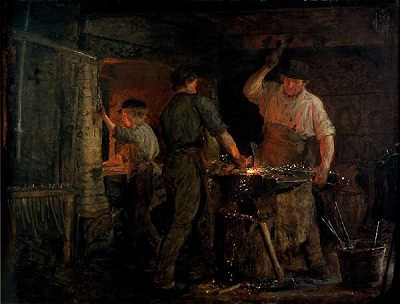 Stones and metals are typological symbols of humanity in the Bible, and precious stones and metals are pictures of mature and glorified humanity. For example, consider the stones on the high priest’s shoulders and breastpiece, which symbolized the tribes of Israel. We ourselves are living stones in the house of God (1 Pet. 2:5). Much of the furniture and structure of the tabernacle and temple were either made of, or coated in, precious metals; such utensils and vessels, as well as the tabernacle and temple themselves, are symbolic of God’s people gathered around his throne and serving him (e.g., Rom. 9:23, 2 Tim. 2:20-21). And when Jesus appears in all his glory and power, he is a metal man (Daniel 10, Rev. 1, 2).
Applying this, it seems that, even apart from sin, God intended to bring mankind from a state of nakedness and immaturity to a state of investiture, glory and maturity; and this through the potentially painful means of God’s forging us. This process of maturation is hinted at in Genesis 2:10-15. In the rivers flowing out of Eden, we see a picture of Adam’s garden-tending and keeping extending out into the whole world. (This imagery of water-life flowing out to the world is repeated in Ezekiel’s visionary temple and in Revelation 22.) In Genesis 2’s calling attention to gold and precious stones there is a hint that Adam was called to refine these and perhaps bring them back to beautify and glorify the garden; the treasure of the nations is meant to be brought into God’s house (e.g., Ps. 68:18,29; Rev. 21:24-26). But just as Adam and his offspring were called to refine and glorify creation, God would be refining and glorifying them. As Calvin observes, it is no more possible for us to attain maturity and glory by ourselves apart from God’s craftsmanship, than it is for metals and gemstones to attain beauty apart from a master craftsman. The fall did not cause gold and gems to become encrusted with earth and stone; it only caused them to resist man more intensely, as God’s curse-prosecuting agents.
We see this process reflected subtly in God’s creating Eve. On each day of creation, God brought his creation from something “good” to a newer and greater good. Yet even apart from sin, there was something “not good” (Gen. 2:18) in God’s creation, something that required Adam to be put into a deathlike sleep, to be cut open, and to have a part of himself cut away. Yet what he receives in exchange is glorious (1 Cor. 11:7), so that everything is “very good” (Gen. 1:31).
This helps us understand what is meant by saying that Jesus was made perfect through suffering (Heb. 2:10, 5:9). He progressed from glory to glory, from good to very good. He was refined, tested and proved. There was something not good in that his bride had forsaken him. He had to die and have his own side pierced in order for her to be re-created and resurrected with him.
Likewise the church, and we as individual believers, experience this process of maturation and refining. Our sin is our greatest barrier to maturity and glory. But even where sin is resisted by the power of the Spirit, God will still be using the heat of his forge and the blows of his hammer to refine and mature us, to increase our capacity for serving him. In this way we will be made more like Jesus, the glorious metal man.
Gethsemane
And he came out and went, as was his custom, to the Mount of Olives, and the disciples followed him. And when he came to the place, he said to them, “Pray that you may not enter into temptation.” And he withdrew from them about a stone’s throw, and knelt down and prayed, saying, “Father, if you are willing, remove this cup from me. Nevertheless, not my will, but yours, be done.” And there appeared to him an angel from heaven, strengthening him. And being in an agony he prayed more earnestly; and his sweat became like great drops of blood falling down to the ground. And when he rose from prayer, he came to the disciples and found them sleeping for sorrow, and he said to them, “Why are you sleeping? Rise and pray that you may not enter into temptation.” — Luke 22:39-46
In this passage, Luke shows us Jesus in a garden full of trees, on a mountain, experiencing temptation. All of this should ring a bell for us: the Holy Spirit means for us to read this and think of Adam in Eden, and to reflect on the contrast between Adam and Jesus.
God had promised Adam that eventually “every tree” would be given to him (Gen. 1:29). But Adam had to wait to eat from the tree of knowledge of good and evil. This tree’s name links it with the kingly privilege of exercising judgment. Adam impatiently seized this fruit before his time, before he had endured and matured. In just the same way, the Father intended to give Jesus a kingly seat over all the rulers of the earth. If at this point in Luke we knew only what had happened to Adam, this would leave us on the edge of our seats: Would Jesus call upon the angels for the wrong kind of help? Would he seize his seat at the Father’s right hand, or would he patiently suffer injustice and death in order to gain it? Would he be willing to be made perfect through suffering (Heb. 2:10)?
In the very middle of this passage Jesus does receive help: “an angel from heaven” strengthens him. The way Luke has structured this passage draws attention to this heavenly night-time help, making it the hinge, the turning point, of the passage. This is a kind of midnight Passover deliverance—but it is not the kind of deliverance you might expect. The angelic help does not seem to be a turning point for the better. Jesus was “delivered”—but straight into the Passover holocaust. Everything that happens afterwards is not relief from what came before, but an intensification of what came before, a realization and fulfillment of what was prophesied.
After Jesus received this help, it got much worse before it got better. His battle really begins in earnest as soon as he receives help.
This is frequently how God works. We pray for and receive preliminary help, sometimes even a preliminary victory. But then there is a further test, a greater battle. Adam received a helper, but then encountered a serpent. Jacob was delivered from Laban, then heard fearful news that his brother Esau was coming; Jacob even prefigured Jesus by wrestling in prayer at night over this. Israel was delivered from Egypt, then had to face Pharaoh and his armies. They were delivered miraculously from these at the Red Sea, and given the gift of manna, but then had to face Amalek in battle. Jesus was baptized and filled with the Spirit, only to face Satan in the wilderness. After Jesus’s resurrection, the church in Jerusalem experienced an initial period of growth and fruitfulness, only to have to battle Jews and Judaizers, until the church was sent out to the four corners of the earth by persecution.
We know that it is because Jesus endured his trial that we are able to receive heavenly help in our own trials. It is because he endured that we have received the Holy Spirit, our great helper and strengthener. Adam was not willing to die to defend his bride, but Jesus, in his death, succeeded in rescuing and providing for us. We also know that our own trials will never be so great as his, because he endured the very wrath of God in our place. But there are a few more reflections I want to draw from what we have seen here.
First, it is startling to see that Jesus needed heavenly help to endure his temptation and suffering. Elsewhere, Peter tells us that Jesus had to exercise faith in order to endure (1 Pet. 2:23). This adds greater depth to the assurance in Hebrews that Jesus is a sympathetic high priest, and a king who gladly welcomes us to his throne of grace and mercy. He is sympathetic and understanding even to the point that he needed help to strengthen him to resist temptation.
Second, along with the disciples we are chided by Jesus’s words. Help is available in our need—all we have to do is pray.
Finally, we have a sobering lesson in how help often comes to us in our trials and suffering. God does send us help, through his Spirit, his word, and one another. But very often this help is the prelude to the real battle. The Spirit carries us into the thick of battle. The Spirit strengthens us to fight. He enables us to be full of faith, full of hope, and full of the fruit of the Spirit in spite of the storm that is raging around us.
In the words of Peter: “And after you have suffered a little while, the God of all grace, who has called you to his eternal glory in Christ, will himself restore, confirm, strengthen, and establish you.” (1 Pet. 5:10) Amen.
Heaven is not my home
In his book Heaven Misplaced, Doug Wilson writes about a common misunderstanding among contemporary Christians:
How you take the line of the story matters a great deal. Many Christians believe the cosmos has an upper and lower story, with earth as the lower story and heaven as the upper story. You live the first chapters of your life here. Then you die, and you move upstairs to live with the nice people—because only nice people are allowed on the second story. There might be some kind of sequel after that, but it is all kind of hazy. Maybe we all go live in the attic. But the basic movement in this thinking is from a Philippi “below” to a Rome “above.”
But what Paul teaches us [in Philippians 3:20-21] is quite different. We are establishing the colonies of heaven here, now. When we die, we get the privilege of visiting the heavenly motherland, which is quite different than moving there permanently. After this brief visit, the Lord will bring us all back here for the final and great transformation of the colonists (and the colonies). In short, our time in heaven is the intermediate state. It is not the case that our time here is the intermediate state. There is an old folk song that says, “This world is not my home, I’m just passing through.” This captures the mistake almost perfectly. But as the saints gather in heaven—which is the real intermediate state—the growing question is, “When do we get to go back home?” And so this means that heaven is the place that we are just “passing through.” (23-24)
N. T. Wright writes similarly:
There is no agreement in the church today about what happens to people when they die. Yet the New Testament is crystal clear on the matter: In a classic passage, Paul speaks of “the redemption of our bodies” (Rom. 8:23). There is no room for doubt as to what he means: God’s people are promised a new type of bodily existence, the fulfillment and redemption of our present bodily life. The rest of the early Christian writings, where they address the subject, are completely in tune with this.
The traditional picture of people going to either heaven or hell as a one-stage, postmortem journey represents a serious distortion and diminution of the Christian hope. Bodily resurrection is not just one odd bit of that hope. It is the element that gives shape and meaning to the rest of the story of God’s ultimate purposes.
. . .
The mission of the church is nothing more or less than the outworking, in the power of the Spirit, of Jesus’ bodily resurrection. It is the anticipation of the time when God will fill the earth with his glory, transform the old heavens and earth into the new, and raise his children from the dead to populate and rule over the redeemed world he has made.
See also: The future of Jesus.
 I gotta have my orange juice.