Archive for the ‘Biblical Theology’ Category
Mercy seat
I wrote recently about one way in which the cross is a type of the day of atonement.
My friend Al writes about another way in which the resurrection is a type of the day of atonement:
. . . In John 20 the stone on which they laid Jesus at this death is empty when Mary visits on the first day of the week. But on either side of the empty bed is an angel. It seems intentional that John wants us to see this place, the resurrection place, as a new mercy seat; the resurrection bed of Jesus is the new place of covering for the law.
He was raised for our justification . . .
Cubit
Ezekiel experiences a vision in which an angel shows him a meticulously measured temple and city. One of the fascinating aspects of this vision is that we are told exactly how we are to meditate on it:
As for you, son of man, describe to the house of Israel the temple, that they may be ashamed of their iniquities; and they shall measure the plan. And if they are ashamed of all that they have done, make known to them the design of the temple, its arrangement, its exits and its entrances, that is, its whole design; and make known to them as well all its statutes and its whole design and all its laws, and write it down in their sight, so that they may observe all its laws and all its statutes and carry them out. (Ezekiel 43:10-11)
We are to see the careful measurements and reflect on the rectitude of our lives and God’s church.
Ezekiel’s visionary temple was never intended to be built, but to reflect the spiritual situation at the return from exile, where God planned for Israel to have a greater influence on the spiritual life of the nations. Consider Nehemiah and Esther, the synagogues that appear throughout the Roman empire in Paul’s day, and the Gentile God-fearers in Acts.
Another interesting thing we learn in Ezekiel’s vision is that the angelic-spiritual cubit is one and a half human cubits:
And behold, there was a wall all around the outside of the temple area, and the length of the measuring reed in the man’s hand was six long cubits, each being a cubit and a handbreadth in length. . . (Ezekiel 40:5)
These are the measurements of the altar by cubits (the cubit being a cubit and a handbreadth): its base shall be one cubit high and one cubit broad, with a rim of one span around its edge. . . (Ezekiel 43:13)
In the book of Revelation, John receives a vision of the new-covenant people of God. The dimensions of the new covenant far exceed those of the restoration covenant. But John also emphasizes that the relationship between human and angelic measurements has changed:
He also measured its wall, 144 cubits by human measurement, which is also an angel’s measurement. (Revelation 21:17)
Why the change? There are a few things we can say about this progression. Psalm 8 and Hebrews 2 indicate that man was made “a little lower than” the angels, but that Jesus and his people are now, instead, “crowned with glory and honor,” exercising dominion over the whole world. Under the old covenants, we were under the tutelage of a law delivered by angels, but in Jesus we have now entered into maturity (Gal. 3-4, Heb. 2). Once it was cherubim that guarded the way to God’s throne, but now the keys to the kingdom have been given to the church (Matthew 16:19), and we are enthroned with Jesus (Eph. 2:6, Rev. 20:4). It is even the case that the church will judge angels (1 Cor. 6:3).
What is happening in the new covenant is that heaven and earth now kiss. Today that takes place spiritually every Lord’s day when we stand before the throne (Heb. 12:22ff); one day that will be a physical reality. Earth will be so fully remade after the heavenly pattern that all earthly measurements conform to heavenly ones; the permanent dwelling place of God will no longer be with the angels:
And I heard a loud voice from the throne saying, “Behold, the dwelling place of God is with man. He will dwell with them, and they will be his people, and God himself will be with them as their God.” (Revelation 21:3)
Glory and beauty
In Exodus 28, God instructs Moses in the creation of “holy garments for Aaron your brother, for glory and for beauty.” The innermost garments are linen undergarments, and upon them are layers of more glorious garments. Ordinarily the high priest wore all these garments for his duties. But on the day of atonement (Leviticus 16), he was to enter into the most holy place dressed only in linen: undergarments, coat, sash and turban. “These are the holy garments” (emphasis added).
The white linen of holiness serves as the precondition — the foundation, the root — of the color and sparkle of glory and beauty. (Equally, we might add, does a blood sacrifice serve as the precondition of glory and beauty.)
How else can we speak of what grows from this root of holiness? The fruit of the holy Spirit is “love, joy, peace, patience, kindness, goodness, faithfulness, gentleness, self-control” (Galatians 5). This is how you measure glory and beauty.
Barabbas
Israel’s yearly day of atonement ritual included the offering of two goats. One was offered on the altar, and the other was sent into the wilderness:
Aaron . . . shall take the two goats and set them before Yahweh at the entrance of the tent of meeting. And Aaron shall cast lots over the two goats, one lot for Yahweh and the other lot for destruction. And Aaron shall present the goat on which the lot fell for Yahweh and use it as a sin offering, but the goat on which the lot fell for destruction shall be presented alive before Yahweh to make atonement over it, that it may be sent away into the wilderness to destruction. . . .
And when he has made an end of atoning for the Holy Place and the tent of meeting and the altar, he shall present the live goat. And Aaron shall lay both his hands on the head of the live goat, and confess over it all the iniquities of the people of Israel, and all their transgressions, all their sins. And he shall put them on the head of the goat and send it away into the wilderness by the hand of a man who is in readiness. The goat shall bear all their iniquities on itself to a remote area, and he shall let the goat go free in the wilderness. (Leviticus 16:6-22)
James Jordan comments that this ritual has two complementary images. First, it reflects the double work that Jesus’s death accomplishes for us: like the first goat, Jesus’s blood covers our sins; and like the second goat, Jesus’s death removes our sins. But this ritual also reflects the reality of limited atonement, the fact that Jesus is a dual redeemer-avenger: those who trust in Jesus have their sins covered by his blood and enter into his throne room, but those who reject Jesus’s sacrifice will go to destruction.
Jesus died at the time of Passover, and much of the imagery surrounding the cross has to do with a Passover-exodus. But there is one key event that calls to mind the ritual of the day of atonement:
Now at the feast the governor was accustomed to release for the crowd any one prisoner whom they wanted. And they had then a notorious prisoner called Barabbas. So when they had gathered, Pilate said to them, “Whom do you want me to release for you: Barabbas, or Jesus who is called Christ?” . . . Now the chief priests and the elders persuaded the crowd to ask for Barabbas and destroy Jesus. The governor again said to them, “Which of the two do you want me to release for you?” And they said, “Barabbas.” Pilate said to them, “Then what shall I do with Jesus who is called Christ?” They all said, “Let him be crucified!” And he said, “Why, what evil has he done?” But they shouted all the more, “Let him be crucified!” (Matthew 27:15-23)
We see two men presented just as with the goats in Leviticus 16. By the will of the priests and elders (Mark also takes pains to say that the chief priests were involved), one man is put to death and one is released. Because of this atonement, the way into the holy of holies is opened:
And behold, the curtain of the temple was torn in two, from top to bottom. And the earth shook, and the rocks were split. (Matthew 27:51)
However, this is an ambiguous day of atonement. It is necessary to accept the sacrifice, but many rejected Jesus:
The Jews then disputed among themselves, saying, “How can this man give us his flesh to eat?” . . . . After this many of his disciples turned back and no longer walked with him. (John 6:52,66)
It is also necessary to confess your sin over the scapegoat and repudiate your sin. But many did not repent from their spiritual pride. John 18 describes Barabbas as a robber or brigand, using the same word that Jesus uses in Matt. 21 and Luke 19 to describe what had become of his house. Far from sending the sin of Barabbas into the wilderness, the priests welcomed his sin into God’s house. And so, since they did not send their own sin to destruction, destruction itself came to Jerusalem in AD 70, Jerusalem that had become Babylon, the ultimate apostate church (Rev. 11:8 taken together with Rev. 18:10ff).
Parousia
[Jesus] ascended into heaven,
and sitteth on the right hand of God the Father Almighty;
from thence he shall come to judge the quick and the dead. (Apostles’ Creed)
When will this coming of Jesus be? We cannot know for sure, but the Bible gives us some helpful clues.
One clue is a prophecy made by David:
Yahweh says to my Lord:
“Sit at my right hand,
until I make your enemies your footstool.” (Psalm 110:1)
Jesus will remain seated until his enemies become his footstool. This is an ambiguous image—they may become his footstool either in repentance or in judgment. Closely related to this, we have the great commission that Jesus gives to his church:
Go therefore and disciple all nations, baptizing them in the name of the Father and of the Son and of the Holy Spirit, teaching them to observe all that I have commanded you. And behold, I am with you always, to the end of the age. (Matthew 28:19-20)
This has echoes of God’s promise to Abraham that “in your offspring shall all the nations of the earth be blessed” (Gen. 22:18). This promise was partially fulfilled at times in the Bible. For example, Joseph became a father to Pharaoh (Gen. 45:8) and ministered to “all the earth” (Gen. 41:56). Much later, through Esther, God’s supremacy was proclaimed “in every province and in every city” of a global empire, so that many peoples were converted (Esther 8:17).
There is no reason to doubt that the gospel of Jesus (the greater Ahasuerus) will be successful in accomplishing the great commission, as the church (the greater Esther) offers her own life for the world. God declares that it is too small a thing for him to save few people or nations:
[Yahweh] says:
“It is too light a thing that you should be my servant
to raise up the tribes of Jacob
and to bring back the preserved of Israel;
I will make you as a light for the nations,
that my salvation may reach to the end of the earth.” (Isaiah 49:6)
But so far we have no indication of timing, only of context. In Joseph’s case, the entire world came to Joseph in fourteen years. In Esther’s case, many nations were converted in nine months. God made David’s and Solomon’s enemies to be at peace with them in a matter of decades.
However, the Bible gives us a time-related clue in another one of God’s promises:
Know therefore that Yahweh your God is God, the faithful God who keeps covenant and steadfast love with those who love him and keep his commandments, to a thousand generations.(Deuteronomy 7:9)
If we take a generation to be 40 years (the time Israel spent in the wilderness, the reign of a king), then God promises to show faithfulness for 40,000 years. There is some elegance to taking this number, because it makes the old covenant, which spanned 4,000 years, to be a tithe of all of history. However, in other places God speaks of plural thousands of generations (Exodus 20:5-6, 34:6-7, Deut. 5:9-10, Jer. 32:18). And in another case when God lays claim to thousands, we take it to be an understatement, not an overstatement:
For every beast of the forest is mine,
the cattle on a thousand hills. (Psalm 50:10)
So it seems that 40,000 years may be a bare minimum.
Perhaps it is not just the earth, but the universe, that God intends for us subdue.
See also: The future of Jesus
Bound
Then I saw an angel coming down from heaven, holding in his hand the key to the bottomless pit and a great chain. And he seized the dragon, that ancient serpent, who is the devil and Satan, and bound him for a thousand years, and threw him into the pit, and shut it and sealed it over him, so that he might not deceive the nations any longer, until the thousand years were ended. After that he must be released for a little while. (Revelation 20:1-3 ESV)
If you are an amillennialist or a postmillennialist, this verse poses a little problem. How can it be that Satan is bound, and yet he also “prowls around like a roaring lion, seeking someone to devour” (1 Pet. 5:8)?
The answer is that, especially for a spiritual being like Satan, binding may refer to something other than total physical restraint. In Satan’s case, it refers to a sort of covenantal or legal restriction placed upon Satan by God. He is not allowed to “deceive the nations” while the church undertakes to disciple the nations, but he may still “prowl around.”
Consider Romans 7:2, which uses the same word but in this legal or covenantal sense:
For a married woman is bound by law to her husband while he lives, but if her husband dies she is released from the law of marriage.
In this sense, it is proper to speak of ourselves as bound to God, and even to speak of God as bound to us. Calvin writes of God’s “mutually bind[ing] himself to us without having to do so.”
Bowls
After this I looked, and the sanctuary of the tent of witness in heaven was opened, and out of the sanctuary came the seven angels with the seven plagues, clothed in pure, bright linen, with golden sashes around their chests. And one of the four living creatures gave to the seven angels seven golden bowls full of the wrath of God who lives forever and ever, and the sanctuary was filled with smoke from the glory of God and from his power, and no one could enter the sanctuary until the seven plagues of the seven angels were finished. Then I heard a loud voice from the temple telling the seven angels, “Go and pour out on the earth [or land] the seven bowls of the wrath of God.” (Revelation 15:5-16:1)
Summarizing James Jordan, the bowls of Revelation constitute a kind of day of at-two-ment. Seven mediators, dressed in linen, come from the cherubim-throne and issue a return-to-sender for centuries of offering bowls, tribute bowls, purifying bowls, and seven-fold sprinklings. This is poured out not only upon the unbelieving land of Israel, but upon the entire old-covenant and old-creation world where Israel served as mediator for the nations.
After Jerusalem falls, Jesus is the only mediator left standing, the fountainhead of the new creation and the greater Solomon to whom kings and nations must gather.
Draw near
My pastor has some helpful reflections on the Christian’s privilege to “draw near to God” at our church blog.
Another important aspect of drawing near relates to Israel’s system of offerings and sacrifices. There are a cluster of Hebrew words that relate to this:
- qarab — to draw near, to offer; used frequently to speak of worshippers bringing an offering
- qorban — an offering, or the “thing brought near”
- qereb — inside, in the midst, inner parts; used of the inner parts of an offering that are burned and made to ascend into God’s presence
So, we can say that God’s people draw near to him through offering a sacrifice. There are two ways in which this is true for the Christian — first, we draw near through the once-for-all sacrifice made by Jesus nearly 2000 years ago. But second, we draw near week to week by offering ourselves, by offering a “sacrifice of praise.”
The purity regulations for worshippers also come into view as we draw near. There are also two ways to take this; on the one hand, we have “once been cleansed” (Heb. 10:2) by Jesus’s blood, so we may stand with confidence before our king. But on the other hand, we are called to actively cleanse our hands and purify our hearts (James 4:8), and we do so by confessing our sins (1 John 1:9). What this means is that the church’s historic practice of corporate confession and public proclamation of our forgiveness in Christ is a very appropriate and helpful part of our drawing near.
Finally, we are helped by remembering the ultimate outcome for sacrificial worship — a fellowship meal with God. The offerings themselves were food for God (Leviticus 1:9), and all but one of Israel’s offerings culminated in the priests or the worshippers sharing food with God. Furthermore, the high points of Israel’s liturgical calendar were the feasts where they met and ate in God’s presence at God’s house. The most familiar example of this is the annual Passover feast at the tabernacle and temple. In the same way, the high point of Christian worship, our drawing near, is our fellowship meal with Jesus in his house: the Lord’s supper. As Calvin writes, “the sacrament [of communion] might be celebrated in the most becoming manner, if it were dispensed to the church very frequently, at least once a-week.” Even if you do not practice the Lord’s supper weekly, you can remember and rejoice in the fact that you have an open invitation to sit at Jesus’s table.
See also: Ascent
Saints
M. F. Sadler discusses the meaning of “saint” in his 1876 book, The Second Adam and the New Birth:
The word “saint,” or “holy person,” is now almost universally used as implying real purity of heart and devotion to God’s service. It is applied to Apostles, such as St. Peter or St. Paul; to eminent men who have been raised up by God in bygone times to contend for the faith, such as St. Athanasius or St. Augustine; or to men and women of very deep holiness and spirituality of mind.
In the New Testament, on the contrary, it is the common appellation of Christians. In no one place is it used to distinguish Christians of very deep holiness and spirituality from those who have not attained to such a measure of conformity to God’s will. In only a small number of texts does it imply internal purity and spirituality, and in these places it has reference not to the present character of Christians, but to that which those will be found to possess at Christ’s second coming who have continued in that service of Christ to which at Baptism they were solemnly separated and set apart. (111)
As James Jordan often says, the meaning of saint is to have sanctuary access:
[God] raised us up with him and seated us with him in the heavenly places in Christ Jesus (Ephesians 2:6 ESV)
Let us then with confidence draw near to the throne of grace, that we may receive mercy and find grace to help in time of need. (Hebrews 4:16 ESV)
Seventy times seven
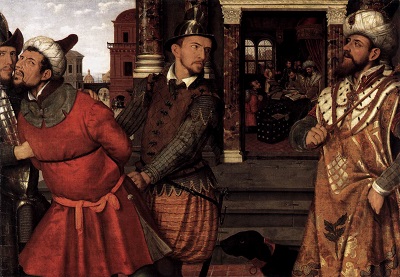 Frequently, in the gospels, when Jesus has words or parables that apply to us as individuals, he is also making a deeper theological point that applies to his people, his church. This is the case for how he speaks to Peter about forgiveness in Matthew 18:21-22:
Then Peter came and said to Him, “Lord, how often shall my brother sin against me and I forgive him? Up to seven times?” Jesus said to him, “I do not say to you, up to seven times, but up to seventy times seven.”
Certainly Jesus’s answer is applicable to us as individuals. But it is not merely the case, as many commentators suggest, that Jesus is employing hyperbole to underscore that our forgiveness is to be without condition, presumably just as God’s forgiveness is without condition. We can see this from the fact that seventy times seven is not just a random and meaningless number that Jesus makes up. There are two previous occurrences of seventy sevens in the Bible that I can make out.
The first is in the time of sin and apostasy leading up to Judah’s exile. Leviticus 26 warns Israel what will happen “if you do not obey Me and do not carry out all these commandments, if, instead, you reject My statutes, and if your soul abhors My ordinances so as not to carry out all My commandments, and so break My covenant” (vv. 14-15). God will give them over to their enemies, make their land desolate, and scatter them among the nations. God concludes that “the land will enjoy its sabbaths all the days of the desolation, while you are in your enemies’ land; then the land will rest and enjoy its sabbaths. All the days of its desolation it will observe the rest which it did not observe on your sabbaths, while you were living on it . . . the land will be abandoned by them, and will make up for its sabbaths while it is made desolate without them” (vv. 34-35, 43). But God also assures them that “if they confess their iniquity and the iniquity of their forefathers, in their unfaithfulness which they committed against Me, and also in their acting with hostility against Me . . . I will remember for them the covenant with their ancestors, whom I brought out of the land of Egypt in the sight of the nations, that I might be their God. I am Yahweh” (vv. 40, 45).
Thus, when Jeremiah prophesies seventy years in exile for Judah (Jeremiah 25, 29), we should recall Leviticus 26 and realize that the land is making up for seventy sabbath years, seventy times seven. God tells us this explicitly in 2 Chronicles 36:21, that the exile “fulfill[ed] the word of Yahweh by the mouth of Jeremiah, until the land had enjoyed its sabbaths. All the days of its desolation it kept sabbath until seventy years were complete.”
The second occurrence of seventy sevens comes as Daniel, the prophetic representative of Israel, realizes the seventy years of exile are ending, and so confesses and repents in obedience to Leviticus 26. Daniel prays:
Alas, O Lord, the great and awesome God, who keeps His covenant and lovingkindness for those who love Him and keep His commandments, we have sinned, committed iniquity, acted wickedly and rebelled, even turning aside from Your commandments and ordinances. Moreover, we have not listened to Your servants the prophets, who spoke in Your name to our kings, our princes, our fathers and all the people of the land. . . . O Lord, hear! O Lord, forgive! O Lord, listen and take action! For Your own sake, O my God, do not delay, because Your city and Your people are called by Your name. (Daniel 9:4-19)
In answer to Daniel’s prayers, the angel Gabriel reveals that there will be a second period of seventy weeks, seventy sevens, for sin to abound and then to be covered forever. This is the great exile which will end with the Messiah’s final great exodus into new creation.
Jesus is self-consciously calling attention to this in his answer to Peter. Jesus is identifying himself as the anointed one who has come at the end of Daniel’s seventy sevens to bring about the new creation, the new covenant, the enduring forgiveness. But, as we see from Leviticus, this new creation is a double-edged sword (Matthew 10:34ff). One of the things that Jesus is doing in the gospels is bringing an indictment against his people, his bride. It turns out that God’s forgiveness is not without condition: after the seventy sevens comes the purging fire of exile; on the other side of exile is death for those who, like the unforgiving servant, treat God’s forgiveness lightly; but resurrection life for those who forsake wickedness and identify with the anointed king and his way of life (which includes seventy sevens’ worth of patient forgiveness). Jesus clearly warns Israel of this throughout the gospels, including the parable of the unforgiving servant that immediately follows his conversation with Peter (Matthew 18:23ff), but elsewhere in even more pointed terms (e.g., Matthew 24).
Thus, while Matthew 18 has general application to individuals today, it had a particular prophetic application in the time of Matthew’s writing. It was both a warning and an encouragement to Israel and the people of Israel that time was running out: they were to identify with their Messiah and walk in his ways, or else suffer final destruction. This prophetic application continues to apply today to God’s church; as Paul reminds us, “Do not be conceited, but fear; for if God did not spare the natural branches, He will not spare you, either” (Romans 11:20-21). And this same prophetic perspective continues into Matthew 19. When Jesus answers the Pharisees’ question about divorce, there is an implied subtext that Jesus would divorce his own bride for her persistence in adultery, and that he would form a resurrected bride out of the remnant (c.f., Ezekiel 16). In every new covenant the old things must pass through death and resurrection; the old kingdom must come over to the new king (2 Samuel 5:1-5).
If, with Matthew 18 and Daniel 9, we speak of seventy sevens of forgiveness and atonement, we are almost certainly speaking about 490 days of atonement (Leviticus 16, 23) — 490 years. But if, with Leviticus 26 and 2 Chronicles 36, we are speaking of seventy sabbaths, it is possible we have a different time interval. If we count jubilee years as years of rest for the land, then seventy years of rest are accomplished in about 430 years. This makes me wonder if seventy sevens also applies to God’s patience toward converted Canaanites. Abraham carried on a ministry of establishing places of worship in Canaan, including among the Amorites (Genesis 13:18, 14:13). God told Abraham that he would delay the conquest of Canaan because “the iniquity of the Amorite is not yet complete” (Genesis 15:16). Unlike the Amalekites, whom God had singled out for destruction for their great wickedness (Deuteronomy 25:17-19), it seems that God had greater patience with the Amorites because at one time they had worshipped him through Abraham. Depending on the starting point, the Amorites were given 400 (Genesis 15:13) or 430 (Exodus 12:40-41) years. Consider, too, that the Amorites were given a further forty-year reprieve because of Israel’s disobedience (Numbers 14). Israel herself is granted a similar reprieve: if Jesus’s resurrection marks the end of Daniel’s seventy sevens, then Israel had forty more years to come into the church before the destruction of Jerusalem in AD 70. Incidentally, this makes the church’s struggle with Jews and then Judaizers a kind of wilderness period before entering into the fullness of the new covenant.

