Archive for the ‘Biblical Theology’ Category
The objectivity of worship
One of the great benefits of understanding worship as a covenant renewal is that it highlights for us that worship is a public, objective and corporate event, not just a private, subjective and personal experience. So:
- Jesus, the greater Ahashuerus, publicly and objectively extends an invitation for us to stand before him
- Jesus hears our confession of sin, and publicly and objectively lifts up our faces and assures us that we stand secure before him
- Jesus publicly and objectively receives and accepts our worship and gifts, then speaks a public and objective word of encouragement and exhortation to us through his word and his servant-ministers (Jesus’s objectively speaking through the latter is implied not least by Ephesians 2:17)
- Jesus publicly and objectively shares a meal with us at his table, freshly marking out our fellowship and union with him
- Jesus publicly and objectively re-commissions us as his representatives and ambassadors to the world
This has implications for how we speak about worship. When we say we are “entering into” worship, we are using Biblical language; for example, Psalm 100 speaks of entering God’s gates and courts. But what we are speaking of is not exclusively an internal frame of mind that tunes out all the noise and focuses on Jesus. Rather, we are publicly gathering together with God’s people to stand before him. Entering into worship includes entering into an “external” frame of mind that takes in everything around us and sees with eyes of faith just what this great assembly is that we are privileged to participate in. We have come to Mount Zion . . . and to God . . . and to Jesus (Heb. 12:22ff)! He is actually among us (Matthew 18:20). We have come into his presence objectively; we don’t have to close our eyes and go there in our minds.
This also is a powerful reassurance to those who are experiencing a dark night of the soul, who are in a dry season in which they feel that God is distant or silent. Worship is not the only occasion where God speaks to us, but he is always, publicly and objectively, near to us in corporate worship and speaking to us in corporate worship.
God is not silent.
Prophet
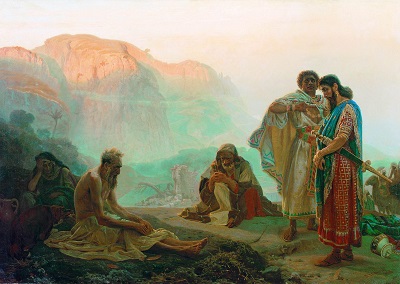 I’ve just finished reading Toby Sumpter’s outstanding commentary on the book of Job, Job Through New Eyes: A Son for Glory. Sumpter works hard to understand Job in terms of God’s declaration that Job has “spoken of me what is right” (42:7), and he makes a compelling case for his reading.
Sumpter’s thesis draws on the observation that, at the outset, the righteous Job is conspicuously absent from God’s courtroom, where the sons of God stand before him. But at the end of the book, Job is now one of these sons of God, standing before God in the position of a prophet. This is the inspired assessment of James (James 5:10-11), but we see it in the book of Job itself. God’s arrival to speak with Job is exactly what he does with his prophets (Amos 3:7). At the end, Job stands in the position of an intercessor for his friends and God has accepted Job himself (literal rendering of Job 42:9). It is the mark of a prophet to stand in the council of God, to hear God’s decrees and speak to his face. Consider Abraham’s conversation with God in Genesis 18:22ff, and his later intercession for Abimelech in Genesis 20:7, where God himself identifies Abraham as a prophet. Moses the prophet similarly intercedes for Israel before God in Exodus 32:11ff.
Seen in this light, the book of Job is the story of God’s wrestling with Job to draw him up into his presence. Job’s suffering is a sort of sacrificial ascension that carries him up to God. Job’s patient suffering and persistent wrestling are the very things that qualify him to stand before God. God’s calls to Job to “dress for action” (38:3, 40:7) are not part of some plan to put Job down into his place; they really are invitations from God as father to his son Job to come up and continue to wrestle. We are reminded of Jacob and Jesus at the Jabbok river (Genesis 32). Job does not model for us a perverse desire for death or to second-guess God; he models a godly desire for resurrection, vindication, and participation in God’s council.
It is interesting to me that the first of the kingly wisdom books thus anticipates the prophets. It is a peek ahead in history, showing that the ultimate purpose of kingship and dominion is not merely to be thrifty assistant managers of creation, but to grow to stand before God as junior co-creators with him. A king brings things to pass by the re-forming work of his hands, but a prophet speaks new things into being with words. As wisdom literature, Job is not a scholarly treatise on God’s sovereignty; it is a kingly training manual, teaching us how to wrestle with the Spirit’s whirlwind. Job teaches us to plead with God, like Moses (Exodus 33:15), for his presence and nearness. Like other wisdom literature (consider some of the Psalms, the Song of Solomon, Ecclesiastes), this manual is a tough nut to crack, a hidden treasure requiring kingly persistence (Proverbs 25:2).
There are two levels at which this applies to the church today. First, it is still the case that one of the surest paths to maturity and to deeper fellowship with Jesus is fellowship with him in suffering. We must, like Job, hold fast in faith to the almost childlike desire to meet with Jesus in our suffering, to see his face.
But at another level, we all enjoy the privilege of standing in God’s council as prophets (Acts 2:17) because we are united with Jesus. It is his suffering and ascension that qualify us to this position (Ephesians 2:4-7), so that we can plead to God with even greater boldness than Job. However, even this calls us to a kind of suffering and deprivation. Whether or not we actually lose everything for Jesus’s sake, we are to count everything as a loss (Philippians 3:7-8, Luke 14:26). If we thus identify with him in his death, we enjoy his resurrection and vindication, and are brought up with him to stand in his presence. The king calls us his friends, his counselors, because he has made everything known to us (John 15:15).
Christians enjoy this status at all times, but we experience it most powerfully every Lord’s day when Jesus holds court with us. We stand before him to dialog with him: receiving his invitation, calling on him in worship to act for his people, bringing tribute to him, hearing a word from him, eating a meal at his table, and being commissioned afresh to our weekly work.
Thus, in one sense, Christians now enjoy the fulfillment of Job’s pleading and prayer, and we are to the world what Job was to his friends: those who bring life in Jesus. Jesus, the latter Job, has even cast Satan out of the heavenly court. But in another sense, we are not satisfied, and we plead with God, like Job and Moses, to see his face more brightly.
Baptisms
We know that all Israel, from infant to adult, was baptized into Moses at the Red Sea (1 Corinthians 10:1ff), being spiritually inducted into what we might call the “body of Moses” (in conjunction with Jude 1:9 and Zechariah 3:2), the Old Testament church; just as we are baptized into the body of Christ. They were not drowned in the waters like Pharaoh and his army, but were sprinkled (Psalm 77:17ff).
There are many other such baptisms. When Jacob and his family re-entered the land after their exile with Laban, he and all his household crossed the river Jabbok (Genesis 32). Another example is Israel’s crossing the Jordan river to enter the land; this was even connected with a circumcision (Joshua 3-5). Baptism is a sign of salvation, resurrection and even ascension (as though passing through the waters above the firmament), while circumcision is a sign of sacrifice and priesthood; these two are joined together in Jesus (the greater Joshua), so that our baptism unites us to his circumcision (Colossians 2:11-12).
We see a double baptism when Absalom attacked David. When David fled Jerusalem, attention is called to the fact that he and all his people crossed the brook Kidron (2 Samuel 15) as they went to the wilderness. Among those who were thus baptized into David’s exile-death are the Philistine convert Ittai (from the city of Gath) and “all his men and all the little ones who were with him” (v. 22). Then, on David’s return into the land, he and all who were with him crossed the Jordan river (2 Samuel 19). This passage indicates that the elders of Judah made a seemingly unnecessary but very symbolic trip across the Jordan in order to bring David back (vv. 15ff), signifying that their own restoration-resurrection depended not only on their repentance but also on their baptism into David and his exile-death and exodus-resurrection.
This is partly what is meant by the author of Hebrews in saying that we should “go to [Jesus] outside the camp and bear the reproach he endured” (13:13). In context, the author is saying that we are freshly joined to Jesus’s death and resurrection when, week by week in worship, we partake of Jesus’s body and blood in the Lord’s supper. But if the Lord’s supper is a weekly renewal of our union with Jesus, then baptism is our initial and definitive union with him, crossing the heavenly waters in a symbolic exile and exodus.
See also Unbelievers.
Patience, again
 I wrote earlier of how the fig tree and mountain of Mark 11 were spoken and written to indicate God’s judgment upon faithless Israel, and to encourage the early church to persevere in prayer for deliverance from persecution. Quoting Mark Horne:
Jesus is discussing the prayers which the early Church will have to pray in the face of opposition from the Temple Mount. . . . Jesus is not speaking of mountains in general. He has made a point of saying which mountain will be cast into the sea by believing prayer. . . . Just as Jesus cursed the fig tree, so will God deliver the Church through the prayers of the saints.
Understanding this gives us insight into the timeframe Jesus was implying when he said that “it will be done for” the one who has such faith. The persecution of Saul began as early as the year of Jesus’s death and ascension, AD 30. There was a “near” deliverance for the church in the conversion of Saul. Fourteen years later, James the brother of John was killed by Herod Agrippa, and there was another “near” deliverance in the death of Agrippa in AD 44. Then the church continued to struggle with persecution. The final removal of this mountain did not come until AD 70 when Rome destroyed Jerusalem.
Counting backwards, the church’s prayers for deliverance continued for 26 years from the death of James, and 40 years from the death of Stephen. When the church prays, we are to have this manner of persistent and patient faith. Not every fig tree withers overnight.
See also: Patience.
Famine
I’ve appreciated what Doug Wilson has had to say about contemporary food idolatries. His latest post is a little oblique, but good. Pulling out some punchy sound bites (and completely glossing over the necessary caveats):
I believe that some wives, in the way they pursue “healthy” menu choices for their home, are inadvertently trying to teach their husbands and children how to cheat. . . .
A school district in New York just recently dropped the First Lady’s school lunch program because the kids were hungry all the time. What happens in a family where the first lady there has implemented a similar regime and does not have buy-in from her husband and kids? One of the obvious things is that the husband often has the resources to fix things at lunch with a greasy burger, after obtaining a vow from his co-workers to “not tell a soul.”
. . . [A] man should not work to put food on the table, his own table, and then come away from that table hungry. . . . [I]t is crucial that the home not become a place of tight-fisted denial, where wives become the governess of no, instead of the mistress of yes.
 I have no idea how common this is. But I want to sidestep that question and take this in a different, but related, direction. There is one marriage, one family, one house and one table that will endure into eternity. These are the archetypes for our marriages, families, houses and tables. So, what kind of table do we believe that Jesus provides for his own bride? And what kind of table is Jesus’s bride setting for him? Is it a famine or a feast?
I’m referring to the Lord’s supper, the new covenant’s one food law and the fulfillment of all old-covenant feasts. We eat this meal together with Jesus at his table in his house. As his bride, we should adorn the table and prepare a kingly feast. And as priests to the king, we have the privilege and responsibility to serve at his request as his royal chefs. There are no more animal sacrifices, of course; we now offer ourselves and the work of our hands, however imperfect, for his evaluation and approval.
Grain and grapes are the Bible’s repeated image of the fruit of the blessed land. Transformed by man’s week-day labor into bread and wine, God uses them again and again to picture the food of the seated and reigning Messiah-king. Because we are seated with him, Jesus gives us a physical taste of his new kingdom; and it is the actual eating and drinking of real bread and wine that is sacramental, rather than merely reflecting on the idea of bread and wine. The Lord’s supper should, as much as possible, convey the greatness, goodness and richness of Jesus’s kingdom. Wherever possible, it is fitting for the church to enjoy the Lord’s supper weekly and to do so lavishly, with rich bread and good wine.
See also: Pig out, Sabbath, The Lord’s table.
Patience
 Patience is a fruit of the Spirit:
But the fruit of the Spirit is love, joy, peace, patience, . . . — Gal. 5:22
Patience and faith and wisdom and maturity are all bound up together. Consider Abraham’s faith and patience:
By faith Abraham obeyed when he was called to go out to a place that he was to receive as an inheritance. And he went out, not knowing where he was going. By faith he went to live in the land of promise, as in a foreign land, living in tents with Isaac and Jacob, heirs with him of the same promise. For he was looking forward to the city that has foundations, whose designer and builder is God. — Heb. 11:8-10
From the time of God’s promise to Abraham, it was over four hundred years before his descendants were freed from Egyptian slavery. It was a thousand years before Solomon dedicated God’s palace in what was once Melchizedek’s Salem on Mount Moriah. It was another thousand years before Jesus the new Melchizedek inaugurated the New Jerusalem of his church.
Sometimes the patience that the Spirit wants to forge in us is a thousand-year patience.
What would it look like if we were to have a thousand-year patience in our dreams and visions for God’s church?
That is not to say that we should be complacent, or work with any less fervor. It is simply to recognize that God’s kingdom grows like yeast or like a tree. We see this in our own lives, too: while there are great seasons of spring-like growth, over the long haul maturation and glorification is largely a matter of plodding self-sacrificial faithfulness. While the kingdoms of men might rise and fall quickly by the compulsion and cowing of the sword, God’s kingdom flourishes by the nurture (Eph. 5:26) and cutting (Eph. 6:17) of the sword of the Spirit — the word of God.
But this also expands our horizons: what would it look like to dream thousand-year dreams and pray thousand-year prayers for God’s church? If God intends to bless his people to a thousand generations (Ps. 105:8), as his own personal name attests (Ex. 34:6-7), then things might only just be starting to warm up after another thousand years.
See also the future of Jesus.
Unbelievers?
Bob Kauflin interviewed Marty Machowski, the author of the Gospel Story for Kids Sunday-school curriculum, here. There’s a lot to appreciate about what Machowski has to say, but he makes a shocking statement:
Our children, meeting in classrooms during our Sunday worship services represent the largest group of gathered unbelievers across the world.
From time to time I hear parents expressing similar sentiments — “they’re all unregenerate [or heathens],” “we can’t expect that of him; he’s not saved,” or “her problem is just that she needs to be saved.” Overwhelmingly we speak of evangelizing our children rather than discipling them. We wring our hands over the possibility of giving them false assurance, but we are almost entirely unconcerned about the danger of creating millstones of false doubt.
God does not speak of or relate to our children in this way, and it is dangerous for us to do so. It is dangerous because it trains us and our children to doubt and test the promises of God rather than believing and acting upon them. This is how God speaks of our children:
- He addresses them with commands and encouragements as part of the body of his elect “saints” (e.g., Ex. 20:2, 12; Eph. 1:1, 6:1; Col. 1:2, 3:20)
- He requires their presence in worship (Ex. 10:8-11, Ps. 96:7) and feasts (Deut. 16:9-15). He receives their worship (Matt. 21:16) as a potent spiritual warfare to silence his enemies (Ps. 8:2).
- They trusted in him before they were born (Ps. 71:6) and as infants (Ps. 22:9)
- He is their God (Gen. 17:8, Ezek. 37:21-28, etc.)
- He has promised the Holy Spirit to them (Isa. 59:21)
- He regards them as holy (1 Cor. 7:14)
We ought to speak of and think about our children in the same way that God does. This will not leave us complacent, but will instead motivate us to go about the work of parenting rightly, with full confidence in God’s being already at work in them. Instead of leading our children to the way, we will train them in the way (Prov. 22:6). What we once called evangelism must become full-orbed discipleship. Our children need the gospel, but in just the same way we do — to be continually reminded of the promises and goodness and nearness of God and to be growing in repentance and faith.
See also
- Other posts on parenting
- Vern Poythress’s helpful article, Indifferentism and Rigorism
Sabbath
Some commentators suggest that the structure of the middle section of Deuteronomy follows the ten commandments. Moses, having meditated on the law over the course of thirty-eight years in the wilderness, preaches an inspired sermon to Israel reflecting on the greater meaning and application of the law. There is some minor disagreement as to the exact boundaries within this part of Deuteronomy, but one possibility is given by James Jordan in his book, Covenant Sequence in Leviticus and Deuteronomy:
- First commandment: Deut. 6-11
- Second commandment: Deut. 12-13
- Third commandment: Deut. 14:1-21a
- Fourth commandment: Deut. 14:21b-16:17
- Fifth commandment: Deut. 16:18-18:22
- Sixth commandment: Deut. 19:1-22:8
- Seventh commandment: Deut. 22:9-23:14
- Eighth commandment: Deut. 23:15-24:7
- Ninth commandment: Deut. 24:8-25:3
- Tenth commandment: Deut. 25:4-26:19
This is in keeping with other places such as Proverbs and Matthew 5-7, where we see further wisdom drawn from reflection upon the law: Moses, Solomon and Jesus are all inspired commentators on the ten commandments. This also supports the church’s practice of striving to read and apply the commandments with maximum breadth. For example, Calvin writes that “in almost all the commandments, there are elliptical expressions, and that, therefore, any man would make himself ridiculous by attempting to restrict the spirit of the Law to the strict letter of the words.” He concludes that, “thus, the end of the Fifth Commandment is to render honour to [all] those on whom God bestows it” (Book II, Chapter 8, Section 8), since the Bible understands the term “father” quite broadly. In just the same way, the Westminster Shorter Catechism states that the fifth commandment requires us to bestow honor and perform duties “belonging to everyone in their several places and relations, as superiors, inferiors, or equals.” Paul himself seems to make this application of the fifth commandment in Ephesians 6, if we consider all of verses 1-9 to be joined together. And Moses does likewise in Deut. 16:18ff as suggested above.
 This observation lends us an interesting bit of help in understanding how the Sabbath commandment can be transfigured in the new covenant from Sabbath to Lord’s day, from last day to first. In the fourth-commandment section (Deut. 14:21b-16:17), Moses mentions three of the seven feasts that God gave to Israel. We see the full list of feasts spelled out in Leviticus 23, beginning with the weekly Sabbath feast and culminating in the feast of booths. The three feasts that Moses lists here in Deuteronomy are the ones that God required to be celebrated at his house. Reading through the entire section, Moses’ application of the fourth commandment establishes the following principles:
- We obey the fourth commandment by bringing a tithe to God’s house
- We obey the fourth commandment by showing generosity and granting rest to others
- We obey the fourth commandment by keeping God’s appointed feasts at his house
These principles help us to understand how Saturday’s Sabbath is transfigured to Sunday’s Lord’s day in the new covenant. God’s house is the gathering of his people before him in worship, and in the new covenant all of the feasts of Leviticus 23 are fulfilled in one feast, the Lord’s supper. Connecting this to Moses’ application of the fourth commandment, we see that the Sabbath itself is fulfilled in the Lord’s supper. Certainly there is much more that needs to be said, but we can say this: when Jesus’s church gathers in his house to celebrate his feast with him and to bring him tribute, there the fourth commandment is being kept.
This also lends support to the practice of weekly communion.
The picture above was painted by my friend, the very talented Jermaine Powell.
Tragic
A friend pointed me to a commentary on contemporary worship by Carl Trueman. Trueman suggests that “Christian worship should immerse people in the reality of the tragedy of the human fall and of all subsequent human life.” He commends the Scottish tradition and its “somber tempos of the psalter, the haunting calls of lament, and the mortal frailty of the unaccompanied human voice.”
I’m not a fan of happy-clappy worship, but I believe that Trueman errs on the wrong side. To be fair, Trueman wants tragedy to be woven together with joy and triumph. I agree that we should cover the whole emotional and experiental palette of the Psalms (I would suggest covering all the Psalms themselves). But I raise my eyebrows at “somber” and think that we should err on the side of being outright Pentecostal.
Here’s why: Whatever balance we strike, death cannot become a primary emphasis; it needs to fit properly in a broader story arc that exults, “O death, where is your sting?” History itself is a comedy (in the technical sense) rather than a tragedy, and if we want the worship service to tell the gospel story, then it may have a sense of agon-contest, but will always move towards and culminate in an exuberant, matrimonial, comedic denouement. We worship on Sunday rather than Friday or Saturday: every Lord’s day is a miniature Easter. Also, if our Lord’s-day worship is an assembly and meal in the very presence and house of our king and husband, then something like Nehemiah 8:9-12 should apply (“do not mourn or weep . . . do not be grieved”), at least for the vast majority of worship services. Consider, too, the ratio of feasts to fasts in the old covenants. To mention but one important precedent, the Sabbath was a weekly feast (Lev. 23:1-3).
While a rock band might not be appropriately majestic for the king (compare the bizarre and unbecoming James Bond sequence in the 2012 Olympic opening ceremony), neither is a dirge:
So David and the elders of Israel and the commanders of thousands went to bring up the ark of the covenant of the Lord from the house of Obed-edom with rejoicing. And because God helped the Levites who were carrying the ark of the covenant of the Lord, they sacrificed seven bulls and seven rams. David was clothed with a robe of fine linen, as also were all the Levites who were carrying the ark, and the singers and Chenaniah the leader of the music of the singers. And David wore a linen ephod. So all Israel brought up the ark of the covenant of the Lord with shouting, to the sound of the horn, trumpets, and cymbals, and made loud music on harps and lyres.
And as the ark of the covenant of the Lord came to the city of David, Michal the daughter of Saul looked out of the window and saw King David dancing and celebrating, and she despised him in her heart. — 1 Chronicles 15:25-29
We should take notes from David and not Michal on how we are to behave when we have an audience and meal with the king of kings.
See also: Ascent.
Never again
God covenanted with Noah and the world:
Then Noah built an altar to the Lord and took some of every clean animal and some of every clean bird and offered burnt offerings on the altar. And when the Lord smelled the pleasing aroma, the Lord said in his heart, “I will never again curse the ground because of man, for the intention of man’s heart is evil from his youth. Neither will I ever again strike down every living creature as I have done. While the earth remains, seedtime and harvest, cold and heat, summer and winter, day and night, shall not cease.” — Gen. 8:20-22
Jeremiah later gave a prophecy that seems to allude to this:
“Behold, the days are coming, declares the Lord, when I will make a new covenant with the house of Israel and the house of Judah, not like the covenant that I made with their fathers on the day when I took them by the hand to bring them out of the land of Egypt, my covenant that they broke, though I was their husband, declares the Lord. For this is the covenant that I will make with the house of Israel after those days, declares the Lord: I will put my law within them, and I will write it on their hearts. And I will be their God, and they shall be my people. And no longer shall each one teach his neighbor and each his brother, saying, ‘Know the Lord,’ for they shall all know me, from the least of them to the greatest, declares the Lord. For I will forgive their iniquity, and I will remember their sin no more.”
Thus says the Lord, who gives the sun for light by day and the fixed order of the moon and the stars for light by night, who stirs up the sea so that its waves roar—the Lord of hosts is his name: “If this fixed order departs from before me, declares the Lord, then shall the offspring of Israel cease from being a nation before me forever.”
Thus says the Lord: “If the heavens above can be measured, and the foundations of the earth below can be explored, then I will cast off all the offspring of Israel for all that they have done, declares the Lord.” — Jer. 31:31-37
I have suggested elsewhere that there are some subtleties here in Jeremiah that we typically overlook. For one, given its context, this passage has a dual fulfillment, fulfilled proximately and partially in the return from exile, and ultimately and fully in Jesus (Heb. 8-10). Furthermore, this passage and the quotations in Hebrews seem more interested with the question of whether God himself will bring an end to the covenant, and less interested in the question of whether particular individuals might break the covenant (a possibility which Hebrews itself countenances; e.g., Heb. 10:29).
Jeremiah’s apparent allusion to Genesis strengthens the notion that he is stressing God’s commitment not to end the covenant. Through Noah, God covenanted with the world that he would not destroy it. Through Jeremiah and now Jesus, God covenants with his people that he will establish them forever, never again leaving them a mere remnant in the earth.
Here is where this prophecy’s ultimate fulfillment in Jesus comes into the foreground. There was to be a remnant of the true Israel at the establishment of the church (Acts 15:16-17, Rom. 11:5). But Jeremiah and Hebrews give us the amazing assurance that, from Jesus’s resurrection onwards, there will never again be a mere remnant of the church. After Israel put her husband to death, the resurrected husband was united to a resurrected bride, “never to die again” (Rom. 6:9).

