Author Archive
Current events
Mark Horne writes about some Christian blind spots.
Mike Shedlock points out that the Keynesian soup is about to flash boil. Bubbles, bubbles!
Patrick Johnston has some surprising things to say about secession.
Church and nations
Genesis 2:5-17 gives us poetic imagery for the relationship between the church and the nations:
When no bush of the field was yet in the land and no small plant of the field had yet sprung up — for the LORD God had not caused it to rain on the land, and there was no man to work the ground, and a mist was going up from the land and was watering the whole face of the ground — then the LORD God formed the man of dust from the ground and breathed into his nostrils the breath of life, and the man became a living creature. And the LORD God planted a garden in Eden, in the east, and there he put the man whom he had formed. And out of the ground the LORD God made to spring up every tree that is pleasant to the sight and good for food. The tree of life was in the midst of the garden, and the tree of the knowledge of good and evil.
A river flowed out of Eden to water the garden, and there it divided and became four rivers. The name of the first is the Pishon. It is the one that flowed around the whole land of Havilah, where there is gold. And the gold of that land is good; bdellium and onyx stone are there. The name of the second river is the Gihon. It is the one that flowed around the whole land of Cush. And the name of the third river is the Tigris, which flows east of Assyria. And the fourth river is the Euphrates.
The LORD God took the man and put him in the garden of Eden to work it and keep it. And the LORD God commanded the man, saying, “You may surely eat of every tree of the garden, but of the tree of the knowledge of good and evil you shall not eat, for in the day that you eat of it you shall surely die.”
Life-giving water flowed from the sanctuary to the world. The food from God’s sanctuary was meant to feed the world. And the wealth of the surrounding lands was meant to be brought back in to God’s sanctuary to beautify it. This was interrupted by sin, but we see it completed in Revelation 21-22, when the nations’ gold and gemstones now adorn God’s city. Out of this city flows a river, and food for the nations:
By its light will the nations walk, and the kings of the earth will bring their glory into it. — Rev. 21:24
Even on the cross Jesus began the process of drawing the nations to himself (John 12:32-33), and he is earnestly engaged in this task now that he has ascended to his throne. Gemstones generally signify people (consider Aaron’s breastplate and the stones on his shoulders, or the precious stones with which Paul built in 1 Cor. 3), and the most significant treasure that Jesus collects from the nations are people, whom he sets into his church (Eph. 4:8ff). Interestingly, Paul here reverses the direction of Jesus’s giving and receiving compared to Psalm 68. He can do so because of the church’s union with Jesus: when Jesus receives tribute from the nations, he distributes these gifts to his church.
Because the anointed kings of Israel were types of Jesus, it is not surprising to find them exhibit this pattern. God’s people provided food for the nations and received gifts to establish his house (2 Sam. 5:11-12, 1 Kings 5, 1 Kings 10). Yet the image is not perfect: even generally faithful kings erred in plundering God’s house to give to the nations (1 Kings 15:9-24).
Israel’s relationship to the Gentile nations is a typological picture of the church’s relationship to the nations today. In that time, there were three broad degrees of nearness to God — Israel’s priestly nearness, Gentile God-fearers who worshipped from a relatively greater distance (but could still offer sacrifices; Num. 15:14), and unbelievers (whether apostate Israelites or unbelieving Gentiles). But in Jesus these distinctions are foreshortened — all of God’s people are now priests to him (Gal. 3:27-29, Eph. 2:11-22, 1 Pet. 2:4-10). Even unbelievers are now drawn more uncomfortably close to Jesus, who is presently seated on his throne as king of kings (Rev. 1:5), leaving the nations with no excuse to reject him (Acts 17:30). Because of this heightened nearness, I suggest that the nearer relationship between the kingdoms of Judah and Israel could serve as a particularly fitting type of the church’s relationship to the nations today.
It does not seem that there was any inherent sin in Israel’s choosing Jeroboam over Rehoboam. What this provided was an opportunity for Israel to demonstrate their faithfulness or faithlessness. But immediately Jeroboam sinned, devising a scheme to lead Israel in worship outside of God’s house (1 Kings 12:25-33), and breaking the second commandment by worshipping Yahweh through images. This became the signal sin for the kings of Israel following him. Ahab heightened this sin, breaking the first commandment by abandoning the worship of Yahweh altogether (1 Kings 16:29-34). Judah had her own sins, and one of them was to reverse the order of things — instead of leading Israel to God’s house in worship, she chased after Israel in her idolatry and sin (Ezek. 23).
Peter Leithart has written on how the book of Kings may serve as an instructive typology for church division and unity. I think from the story of Judah and Israel we can also develop a typology for the church and the nations in the new covenant. Consider that Israel was in this time under God’s law, while all true worship was to take place in Jerusalem. This is roughly the situation today, where all nations are under Jesus’s law and lordship in a more comprehensive way, while all worship, all approach to Jesus’s throne, must still take place in and through the new Jerusalem, Jesus’s church.
If this is the case, we learn a few things about how the nation and church should — and should not — relate. Certainly the nations must not establish idolatrous worship. The only true worship of Jesus exists in and through his church and its officers, not through the king and magistrate. The church belongs to Jesus and not to the nation: the nation should take great care not to mess with Jesus’s bride, but to protect and honor and even adorn her. And for her part, the church has a corresponding responsibility to remain faithful to her husband, and stubbornly refuse to follow the nation in sin, idolatry and foolishness.
God uses the spheres of the church and the state to discipline one another. On the church’s part, some clear examples include the use of excommunication, and praying and singing the less popular corners of the Psalter. There are cases when the church may forsake a grossly faithless king and lend her support to an alternate civil authority (Elisha and Jehu, Jeremiah and Nebuchadnezzar, or in our time Bonhoeffer and the organized resistance). Likewise, the church herself may be disciplined, perhaps by an unwitting tyrant, but also by a wise sponsor-king who knows that the health of his nation is dependent on the faithfulness and unity of the church.
Finally, this underscores that Jesus is the great iconoclast. He is the fulfillment of Josiah, who tore down idolatrous altars in both Judah and Israel (2 Kings 23). Through his church’s worship and self-discipline, Jesus intends to exercise “divine power to destroy strongholds, . . . destroy arguments and every lofty opinion raised against the knowledge of God, and take every thought captive to obey Christ, being ready to punish every disobedience” (2 Cor. 10:4-6). And Jesus intends that civil authorities “carr[y] out God’s wrath on the wrongdoer” (Rom. 13:4).
Sin and trust
David confesses:
I was brought forth in iniquity, and in sin did my mother conceive me. — Psalm 51:5
But he also rejoices:
Yet you are he who took me from the womb;
you made me trust you at my mother’s breasts. — Psalm 22:9Upon you I have leaned from before my birth;
you are he who took me from my mother’s womb.
My praise is continually of you. — Psalm 71:6
Christian parenting embraces both of these truths. We cultivate both the fear of the Lord and the joy of the Lord: repentance and faith as a way of life.
Mark Horne
My list of blogs I read is out of date. I’m probably overdue for a blog purge, so I don’t think I’ll freshen it up right now. But I want to highlight a friend and author who remains among my favorite and most helpful reads: Mark Horne.
You can find Mark writing in a number of places:
- Christendom Unbound, his personal blog
- Hands and Eyes, where he writes to encourage accurate Biblical understanding and application
- He is a writer at Godfather Politics, Political Outcast and The Last Resistance
Here’s two of my favorite posts of his: Paranoia will destroy you and Personal relationship with Jesus. Recently I linked to his series of posts, The future of Jesus.
I appreciate and have been helped by what Mark has to say about the Bible, theology and Christian living, politics and economics. You should check him out.
Nostalgia
nostalgia, n. — the dogged hope that you will somehow survive yesterday’s trials; considering the sufferings of this present time unworthy to be compared with the glory that has passed away from us; a gnawing craving for leeks and onions, accompanied with the realization that you are almost but not quite finished dying to yourself.
See also Mark Horne’s post, The appeal of the past.
Boil
Yesterday there were probably at least a hundred birds — some kind of hawk or buzzard — in the trees near and around our house. They spent most of the day here, but are gone today. I always thought of hawks as solitary birds and never expected to see them gathering in such numbers.
Boil is the collective noun for hawks.
Mountain and sea
 Mark 11:22-25 is a well-known passage on faith:
And Jesus answered them, “Have faith in God. Truly, I say to you, whoever says to this mountain, ‘Be taken up and thrown into the sea,’ and does not doubt in his heart, but believes that what he says will come to pass, it will be done for him. Therefore I tell you, whatever you ask in prayer, believe that you have received it, and it will be yours. And whenever you stand praying, forgive, if you have anything against anyone, so that your Father also who is in heaven may forgive you your trespasses.”
In his commentary on the gospel of Mark, Mark Horne writes about this and the context:
The fig tree story is sandwiched around the story of Jesus’ “cleansing” of the Temple (as it is commonly called). The miracle of the withered fig tree is a parable for Jerusalem and the people of Israel. God wants some fruit from them and he is about to judge them because they are not producing any.
Thus, Jesus’ discussion of prayer in Mark 11:22-26 is not simply a timeless exhortation to have faith and know that all prayers asked in faith will be answered. Jesus is discussing the prayers which the early Church will have to pray in the face of opposition from the Temple Mount. . . . Jesus is not speaking of mountains in general. He has made a point of saying which mountain will be cast into the sea by believing prayer. The “sea” in this case is the same sea Daniel saw in his vision (Dan. 7; cf. Rev. 17:15). Speaking of a foreign invasion as a drowning flood was not uncommon rhetoric for a prophet (Is. 8:7; Jer. 47:2). . . . It is the Gentile nations who will overwhelm Jerusalem as a flood and trample the city underfoot. Just as Jesus cursed the fig tree, so will God deliver the Church through the prayers of the saints.
For this reason, it is important that the persecuted saints not become personally vindictive and hateful. Jesus warns them to forgive all personal offenses. . . (149-150)
Even before Daniel, Isaiah and Jeremiah, we see mountains battling with the sea in Psalm 46:
God is our refuge and strength, a very present help in trouble. Therefore we will not fear though the earth gives way, though the mountains be moved into the heart of the sea, though its waters roar and foam, though the mountains tremble at its swelling. There is a river whose streams make glad the city of God, the holy habitation of the Most High. God is in the midst of her; she shall not be moved; God will help her when morning dawns. The nations rage, the kingdoms totter; he utters his voice, the earth melts. The LORD of hosts is with us; the God of Jacob is our fortress. . . .
Because of Israel’s faithlessness, the city of God was cast into the Babylonian sea in the time of Nebuchadnezzar, but was re-established by God through Cyrus. Antiochus Epiphanes later covered the mountain with the Greek sea. And Jerusalem would be finally cast into the Roman sea in A.D. 70. We see a hint in each case that it is because of the prayers of the persecuted and oppressed that the corrupt and unrepentant mountain is cast into the sea.
Psalm 46 gives hope — not that the sea would be kept at bay, but that there would be protection and restoration for the persecuted, for the faithful and repentant remnant, even though the mountain is destroyed. Just as he had previously desolated the temple (e.g., Ezek. 10), Jesus left the temple desolate of his presence (Mark 13), so that he was no longer “in the midst of her.” He established a new city-mountain in his church (Heb. 12:18ff).
I wonder if there is a subtle ambiguity to this prophetic imagery. For those who do not repent, the raging sea destroys the mountain. But for those who are faithful to Jesus, Jew and Gentile are united in a different and life-giving way, so that in Jesus the two become one tree (Rom. 11), one man and body (Eph.). Both are accomplished through the prayer and witness of the church.
Realizing the pointed nature of Jesus’s imagery here does not lessen the application of this passage to our faith today; on the contrary, it underscores the great power of the praying church.
Christocracy
 David Field gives a fantastic summary of the notion of a confessionally Christian government in his paper, Samuel Rutherford and the Confessionally Christian State (PDF).
Field asserts a postmillennial perspective, then adds a startling historical observation:
It took 1400 years for 1% of the world’s population to become Christians and then another 360 years for that to double to 2%. Another 170 years saw that grow from 2% to 4% and then, between 1960 and 1990 the proportion of the world’s population made up of Bible-believing Christians rose from 4% to 8%. Now, in 2007, one third of the world’s population confesses that Jesus is Lord and 11% of the world’s population are “evangelical” Christians. The evangelical church is growing twice as fast as Islam and three times as fast as the world’s population. South America is turning Protestant faster than Continental Europe did in the sixteenth century. South Koreans reckon that they can evangelize the whole of North Korea within five years once that country opens up. And then there’s the Chinese church consisting of tens of millions of Christians who have learned to pray, who have confidence in Scripture, who know about spiritual warfare, have been schooled in suffering and are qualified to rule. One day in the next century that Church — tens of millions of Christians trained to die — will be released into global mission and our prayers for the fall of Islam will be answered.
Field then lays out Samuel Rutherford’s vision for Christian constitutional government, and defends it against a number of common objections, concluding that:
Given the purpose, origin, nature, and stuff of the human person, it is clear and important that each human being confess the triune God, recognize Jesus as Lord, and live with the Word of God as his or her supreme authority. To Rutherford and the covenanting tradition, it is no less clear and important, given the purpose, origin, nature, and stuff of human government that each human ruler also confess the triune God, recognize Jesus as Lord, and live with the Word of God as his or her supreme authority.
If you find Field’s essay provocative, here’s some additional reading to consider:
- Abraham Kuyper’s Stone lectures on Calvinism were my first introduction to this viewpoint: the insistence that the nations exist for God, and that the magistrate has a duty to God, whether or not he acknowledges it.
- John Frame lays out some helpful principles in his article, Toward a theology of the state
- Peter Leithart discusses many aspects of a Christian attitude towards the state in his books, Against Christianity, Defending Constantine, and Between Babel and Beast.
- Kuyper introduced the notion of sphere sovereignty, which wrestles with the complementary ways that Jesus’s lordship is expressed in different spheres of life such as the church, family and state. David Koyzis describes how this was developed and advanced by students of Kuyper such as Herman Dooyeweerd.
Hat tip: Uri Brito
Laugh
Here’s a Genevan Psalm (Psalm 2) to belt out on your trip to the polling place. Rejoice always!
Lyrics:
Why do the heathen nations vainly rage?
What prideful schemes are they in vain devising?
The kings of earth and rulers all engage
In evil plots, and in their sin contriving,
They take their stand against our God’s Messiah;
They claim they will not keep His binding chains.
The one enthroned in highest heaven, higher,
Mocks them to scorn, on them derision rains.He speaks to them in righteous, holy wrath;
God vexes them and shows His great displeasure.
“Yet have I set My King upon the path
That upward winds to Zion, My own treasure.”
“‘You are My Son, today You are begotten,’
—I will declare what God has said to Me—
‘And not one tribe will ever be forgotten.
You will receive the world, just ask of Me.'”“‘The nations come; You are the only Heir,
The ends of earth will be Your own possession
And broken with a rod of iron there,
Rebellious pottery comes to destruction.'”
Now serve the LORD, with fear and gladness trembling,
And therefore, O ye kings, seek wisdom here.
How blessed are those who trust without dissembling,
Who kiss the Son and bow in reverent fear.
Noah
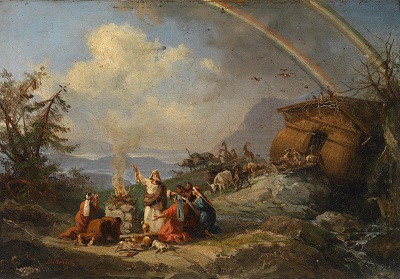 In these articles from 1990 and 1991, James Jordan writes on the meaning of the Noahic covenant and its application today:
A quote:
When the Church is faithful, God will convert the heart of the ruler and he will rule righteously. Conversely, when the ruler is evil and destructive, this means that the Church has not been pleasing to God. The Church is always in charge of culture, and she has been in charge ever since the Flood. We don’t have to take the world and culture over. We already have them. We just have to start using them aright. . . . We don’t change our [rulers] by hypocritically telling them to do things we don’t do. That is the problem with Christian activism and evangelism today. We go door to door telling people they should fear God, when we don’t fear Him enough to do what He says. We tell the government to judge justly, when we refuse to execute justice in Church discipline. We want the government to get out of debt, when the Church owes trillions of dollars in back tithes to God.

