Author Archive
Supplanter
Jacob, Supplanter was his name
Uprooting other kingdoms until he alone remained
Just like Jesus the greater king to come
All His foes will fall until He is the only one— Jamie Soles, Supplanter (listen)
What are some ways in which Jesus fulfills and expands Jacob’s type?
Like Jacob, Jesus was promised a great inheritance (Psalm 2:8). Unlike Esau, the interlopers of this world were too savvy to sell the stolen inheritance for a pittance (Matthew 4:8), and required actual blood for their appeasement rather than “red stuff” (Matthew 2:16-18). To secure his inheritance, Jesus pulls off the greatest righteous deception in all of history. Herod (the Edomite), Caesar, Caiaphas and Satan all believe that they have secured their coup by killing the son (Luke 2:9-18). But Jesus’s death is the very means by which he receives his inheritance and begins to execute judgment on his enemies.
Now therefore, O kings, be wise; be warned, O rulers of the earth.
Serve the LORD with fear, and rejoice with trembling.
Kiss the Son, lest he be angry, and you perish in the way, for his wrath is quickly kindled.
Blessed are all who take refuge in him.— Psalm 2:10-12
Covering
What does water do? It covers, sometimes unto death and sometimes unto life:
- Genesis 7:19-20 — And the waters prevailed so mightily on the earth that all the high mountains under the whole heaven were covered. The waters prevailed above the mountains, covering them fifteen cubits deep.
- Exodus 14:28 — The waters returned and covered the chariots and the horsemen; of all the host of Pharaoh that had followed them into the sea, not one of them remained.
- Exodus 15:5, 10 — The floods covered them; they went down into the depths like a stone. . . . You blew with your wind; the sea covered them; they sank like lead in the mighty waters.
- Job 22:11 — A flood of water covers you.
- Job 36:30 — Behold, he scatters his lightning about him and covers the roots of the sea.
- Job 38:34 — Can you lift up your voice to the clouds, that a flood of waters may cover you?
- Psalm 84:6 — As they go through the Valley of Baca they make it a place of springs; the early rain also covers it with pools.
- Psalm 104:5-9 — He set the earth on its foundations, so that it should never be moved. You covered it with the deep as with a garment; the waters stood above the mountains. . . . You set a boundary that they may not pass, so that they might not again cover the earth.
- Psalm 106:11 — And the waters covered their adversaries; not one of them was left.
- Isaiah 11:9 — The earth shall be full of the knowledge of the Lord as the waters cover the sea.
- Jeremiah 46:8 — Egypt rises like the Nile, like rivers whose waters surge. He said, ‘I will rise, I will cover the earth, I will destroy cities and their inhabitants.’
- Jeremiah 51:42 — The sea has come up on Babylon; she is covered with its tumultuous waves.
- Ezekiel 26:19 — For thus says the Lord God: When I make you a city laid waste, like the cities that are not inhabited, when I bring up the deep over you, and the great waters cover you,
- Habakkuk 2:14 — For the earth will be filled with the knowledge of the glory of the Lord as the waters cover the sea.
This has several implications. First, this supports Leithart’s thesis that baptism is inherently an investiture, a covering. In baptism we are inducted into the priesthood of all believers. Second, this lends strong support to pouring and sprinkling as proper modes of baptism: the water and Spirit move towards us, rather than the reverse, and baptism is much more a pronouncement God makes over us than a statement we make ourselves. Finally, this links baptism with atonement: just as we are covered, our sins are covered (Isaiah 61:10, Psalm 32:1, Romans 4:7).
And now why do you wait? Rise and be baptized and wash away your sins, calling on his name. — Acts 22:16
Worship is warfare
Peter Leithart writes:
Worship is not a retreat to a safe haven where we can offer praise to God in blissful forgetfulness of the challenges before us. Worship is part of the Church’s engagement with the world, one of the chief strategies in our combat. . . . When [the Lord of Hosts] is exalted in our praises, He becomes a terror to our enemies, leaves the field strewn with corpses, and makes the valley of battle into a Valley of Berecah.
Douglas Wilson writes:
So the world is not conquered with a sword. The instruments of conquest, the weapons of our warfare, are Word and Sacrament. The worship of the Church is not a religious meeting in a room, with the assembled seeking to escape from the world outside. . . . We have a battering ram about which the lords and princes of this world know nothing, and every Lord’s Day we take another swing at their gates with it. We do this as we sit down at the Table which He has prepared for us in the presence of our enemies. The Church hearing the Word preached is the Church hearing the terms of conquest. The Church at the Lord’s Table is the church ruling.
See also: Noah, Far as the curse is found, Let us go up.
Mystery
For this reason I, Paul, a prisoner for Christ Jesus on behalf of you Gentiles—assuming that you have heard of the stewardship of God’s grace that was given to me for you, how the mystery was made known to me by revelation, as I have written briefly. When you read this, you can perceive my insight into the mystery of Christ, which was not made known to the sons of men in other generations as it has now been revealed to his holy apostles and prophets by the Spirit. This mystery is that the Gentiles are fellow heirs, members of the same body, and partakers of the promise in Christ Jesus through the gospel. — Ephesians 3:1-6
Paul speaks here of a mystery, and states clearly what it is: the Gentiles are fellow heirs with the Jews in Jesus. He has been sent to proclaim this good news to the Gentiles.
Mystery
In the Greek translation of the Old Testament, the Septuagint, the same word for mystery appears in only one place: Daniel 2, 4. Nebuchadnezzar’s dream is spoken of as a mystery. This mystery is revealed to Daniel, and its interpretation is this: including Nebuchadnezzar, four earthly kingdoms would arise in succession. Following these, a stone uncut by hands “became a great mountain and filled the whole earth,” meaning that it would “break in pieces all these kingdoms and bring them to an end, and it shall stand forever.”
God had previously promised a seed to destroy the serpent and undo the curse (Gen. 3). His heel would be bruised, and he would even die and be resurrected, as Abraham expected of Isaac (Gen. 22) and as every offering testified. God had further promised David that this seed would be a son of his, and that his throne would be established forever (2 Sam. 7). The mystery of the old covenant revealed to Nebuchadnezzar and Daniel is that the promised seed would not just be king of Israel, leading the many nations in righteousness, but that he would be emperor of one kingdom that would fill the earth. So we see that in this phase of Israel’s history, even the world emperors became types of the Messiah (Isa. 44-45).
This gives us added insight into Paul’s mystery. Paul further reveals that the Messiah would not establish this world-wide kingdom either by leading Israel in victory over the nations, or by bringing the nations to be incorporated into Israel. Instead, the Messiah establishes a new kingdom that is forged equally out of Israel and the nations. Israel as much as any other nation must submit to this king and kingdom. Thus, Jesus is not only a new Isaac, David, and Cyrus, but he is even pre-Abrahamic: a new Adam, a new Noah, a new Melchizedek. He is the firstborn of an entirely new creation.
This is not entirely unexpected; with each new covenant, Israel had to die to the past and submit themselves to God’s plan for the future. So, for example, when God created a new Israel in David, it took Israel seven and a half years to repudiate Saul and accept David (2 Sam. 2-5). Israel wandered in the wilderness for forty years because of their refusal to repudiate Egypt and Egypt’s gods. This is repeated in the forty years between Jesus’s ascension and the destruction of Jerusalem.
Pentecost
We can also understand Paul’s mystery in terms of Babel (Gen. 11). Jesus will ultimately overcome all of the effects of sin and the curse, so that Babel will progressively be undone. But the way in which this happens is a mystery, a great surprise. The kingdom of Jesus does not return to a single language, either by dominating or destroying all other languages (sorry, Esperanto). Instead, Jesus subverts Babel by welcoming every language into his kingdom, causing every nation and language to confess his lordship. The confusion and cacophony of tongues becomes a harmony and symphony of tongues.
Pentecost, then, is a gospel event, the beginning of the accomplishment of Paul’s mystery, the good news that all nations are brought in to Jesus. We all stand on equal footing before the king of kings.
Something better for us
And all these, though commended through their faith, did not receive what was promised, since God had provided something better for us, that apart from us they should not be made perfect. — Hebrews 11:39-40
In my previous post I wrote that Paul’s argument in Ephesians 2 is both more subtle and more profound than it seems at first glance. We’ve established that Paul was not saying that either Gentile or Jew had no possibility of salvation before Jesus. So what was Paul saying? I suggest that there are two main categories for understanding what Paul is saying Jesus accomplished in the new covenant: the quality and quantity of salvation.
Quality
But in fact Christ has been raised from the dead, the firstfruits of those who have fallen asleep. For as by a man came death, by a man has come also the resurrection of the dead. For as in Adam all die, so also in Christ shall all be made alive. But each in his own order: Christ the firstfruits, then at his coming those who belong to Christ. Then comes the end, when he delivers the kingdom to God the Father after destroying every rule and every authority and power. For he must reign until he has put all his enemies under his feet. The last enemy to be destroyed is death. — 1 Corinthians 15:23-26
Jesus is presently reigning as king over the whole earth (Rev. 1:5). Everything is presently in subjection to him though we do not yet see it fully realized (Heb. 2:8). Thus, theologians speak of the “already” and the “not yet” of Jesus’s kingdom. In this framework, we may speak of the old covenants as being a time of essential “not-yet-ness,” a time of promise and not fulfillment. Equally, we may speak of the new covenant as a time of essential “already-ness.” We are not now waiting for the promises to be fulfilled, only for them to be experienced in their fullness. We have presently “come to Mount Zion and to the city of the living God, the heavenly Jerusalem” (Heb. 12:22). We are presently seated with Jesus in the heavenly places (Eph. 2:6). There are certainly ways in which this characterization does not capture everything perfectly — Israel truly tasted God’s goodness (Ps. 34:8), and even today we see in a mirror dimly compared to what we anticipate in the resurrection (1 Cor. 13:12). Yet this does capture the essential difference between the old covenants and the new.
This is the culmination of a pattern that God repeated in each new covenant. Adam seized the promised judicial authority before his time, but God freely gave this authority to Noah (Gen. 9:1-7). Abraham is promised that kings will come from him (Gen. 17:6), and this is fulfilled in God’s covenant with David. Ezekiel and Jeremiah promise the exiles that the Spirit will be poured out on them in more powerful ways when they return from exile (Ezek. 37, Jer. 31). In one sense these promises were fulfilled in each new covenant, but in another sense they are not truly fulfilled until Jesus establishes his church. Perhaps the best way to understand this is that the old covenants were powerless in themselves to accomplish anything. What power they had was borrowed against the hope of the new covenant, so that all blessings enjoyed before Jesus were enjoyed in Jesus, foretastes of future life breaking through the chinks of time into the distant past. It is only through Jesus the promised seed that Adam and Eve were preserved.
In terms of Jew and Gentile, Paul is emphasizing two things: first, that both Jew and Gentile now have the same access to God, and second, that Jew and Gentile have a degree of access to God that far exceeds anything available in the old covenant.
Again this is a matter of degrees. We have seen that Gentiles did have access to God before Jesus. God heard the prayers of all old-covenant believers. And yet, by comparison, Gentiles were largely kept farther away from God’s house. In order to approach God’s house to offer a sacrifice, a Gentile had to follow the laws of cleanness and thus in a small symbolic way repudiate his Gentile-ness. Jews themselves were kept apart from God by degrees — most Jews could not enter the tabernacle or temple, only priests could enter the holy of holies, and only the high priest could enter God’s earthly throne room once a year on the day of atonement. We, too, have direct access to God at any time in prayer. But by contrast, in our weekly worship, we do not stand outside God’s house to offer our sacrifices, but rather enter all the way in to stand before his throne.
Peter Leithart points out that “the movement [between covenants] . . . is from rituals and signs of distance and exclusion . . . to signs and rituals of inclusion and incorporation.” You might even say that, while the old covenant was a time in which uncleanness and death were contagious, in the new covenant it is holiness and life that is contagious (consider Matt. 9:20-22). What this means is that we are all made priests, we are all made clean once and for all by our baptisms. Salvation and priesthood are collapsed into one in the new covenant, and there are no longer any degrees of holiness and separation in God’s house.
It should have been no surprise to Israel that Gentiles would be saved. This is pointed to in so many ways — by the inclusion of unclean animals on the ark, by the seventy representative elders who ate with God on the mountain (Ex. 24), by the seventy weeks of Daniel’s vision (Dan. 9). What was less clear, the “mystery” that Paul refers to in Eph. 3, is that the Gentiles would receive salvation by being made priests, but not by being made Jews. Jesus’s circumcision counts for all, so that we only need to be baptized into Jesus but not circumcised into Israel (Col. 2:11-12). While the seventy elders could not go all the way up the mountain, the seventy nations may now stand face to face with Jesus. While Gentiles could not partake of Passover without first becoming Jews, all Gentiles may now freely partake of the church’s weekly Passover feast.
Both Gentiles and Jews are now fully priests, kings and prophets. The new Adam has brought us into everything the first Adam should have attained, and more. He is a priest after the order of Melchizedek.
Quantity
But there is an additional dimension here. Paul is not saying that some small number of Jews and Gentiles will now truly experience God’s nearness. He is saying that the Jews and the Gentiles — the nations — as such, will experience this. So while David spoke of the nations opposing God (Ps. 2), we may now speak of the nations themselves being discipled (Matt. 28:19-20), and of the nations themselves becoming “fellow heirs, members of the same body, and partakers of the promise in Christ Jesus through the gospel” (Eph 3:6). At present, we do not yet see it, but Jesus intends to save Jew and Gentile wholesale, and that by bringing them into one united body, his church. Now we are all priests, ministering to the remaining strongholds of unbelief.
The one who was born king of the Jews (Matt. 2:2) died and ascended to become king of the nations (Rev. 1:4, 15:3-4). He passed the test of Adam, being unwilling to seize his inheritance (Matt. 4:8-10) but waiting for it in patient faith.
God is not content to save a few.
He says:
“It is too light a thing that you should be my servant
to raise up the tribes of Jacob
and to bring back the preserved of Israel;
I will make you as a light for the nations,
that my salvation may reach to the end of the earth.” — Isaiah 49:6
Brought near
There is more going on in Ephesians 2:11-22 than meets the eye:
Therefore remember that at one time you Gentiles in the flesh, called “the uncircumcision” by what is called the circumcision, which is made in the flesh by hands — remember that you were at that time separated from Christ, alienated from the commonwealth of Israel and strangers to the covenants of promise, having no hope and without God in the world. But now in Christ Jesus you who once were far off have been brought near by the blood of Christ. For he himself is our peace, who has made us both one and has broken down in his flesh the dividing wall of hostility by abolishing the law of commandments expressed in ordinances, that he might create in himself one new man in place of the two, so making peace, and might reconcile us both to God in one body through the cross, thereby killing the hostility. And he came and preached peace to you who were far off and peace to those who were near. For through him we both have access in one Spirit to the Father. So then you are no longer strangers and aliens, but you are fellow citizens with the saints and members of the household of God, built on the foundation of the apostles and prophets, Christ Jesus himself being the cornerstone, in whom the whole structure, being joined together, grows into a holy temple in the Lord. In him you also are being built together into a dwelling place for God by the Spirit. — Ephesians 2:11-22 ESV
In my previous post, I suggested that the preceding passage addresses historia salutis rather than ordo salutis. But in the passage above it is much more clear that the beginning speaks of a moment in history when Jesus initiated these things: a once and for all abolishing, which begins an ongoing process of creating, reconciling and preaching.
But Paul is saying something both more subtle and more profound than it seems at first glance. There is, after all, a sense in which Gentiles were not without hope and without God.
Without hope?
God always intended to save Gentiles in every generation. Gentiles were not without a promise of salvation. Before the flood, the seed of the younger son Seth appear to have been in a sort of priestly relationship to the world, in which calling they failed (the “sons of God” in Gen. 6:2). After the flood, Noah appears to establish the younger son Shem in a priestly relationship towards Japheth (Gen. 9:27). There is a possibility that Shem’s priestly ministry was narrowed to the line of Eber, in that the Bible calls attention several times to the fact that Abraham was an Eberite (e.g., Gen. 14:13). In any case, the priestly ministry to the nations is narrowed to the line of the younger son Abraham in God’s covenant with him (Gen. 12:3, 18:18).
Genesis 10 lists seventy nations descended from Noah, and this establishes a biblical symbolism whereby the number seventy often symbolizes the nations of the earth. One of the clearest instances of this symbolism is in Exodus 15:27, where Israel camps by twelve springs feeding seventy palm trees. God intended by this to signify their priestly and life-giving responsibility (as twelve tribes) towards the world of seventy nations.
While the Gentile stranger-sojourner could not participate in the feast of Passover without becoming an Israelite (Exodus 12:48), Gentiles were invited to the feasts of Pentecost and in-gathering (Deut. 16). In particular, the feast of in-gathering (or booths), the climactic feast of the festal calendar, was meant to symbolize that Gentiles would be gathered in to God’s house at the climax of the old covenant. Over the first seven days of this feast, a total of seventy bulls were sacrificed (Numbers 29) on behalf of the nations, with a final bull offered on the eighth day for Israel. The feast of booths followed the day of Atonement; taken together, this indicates that Israel’s priestly ministry to God was not only on behalf of their own sin but also on behalf of the sin of the nations, and for the very purpose of welcoming the nations into God’s feasting and fellowship.
While Israel’s priestly ministry in one sense placed them in a position of honor compared to the nations, it also placed them in a position of servanthood. The Pharisaical situation in the New Testament where Jew and Judaizer despised Gentile was never part of God’s plan. In fact, Gentile stranger-sojourners could present offerings to God at the tabernacle and temple (Num. 15:14-16). The arrangement in Herod’s temple, where Gentiles were separated from Jews (Acts 21:28), was contrary to God’s law. And while clearly the laws of uncleanness had symbolic implications for the nations (Acts 10), individual Gentiles are nowhere as such declared unclean. Since they could enter the assembly to present offerings, it was therefore entirely possible for a Gentile to satisfy the requirement of cleanness (Lev. 7:19-21).
In all this we see that Gentiles did possess a promise, a hope, and a salvation. Gentiles could be saved in one of two ways: either by incorporation into Israel through circumcision; or by remaining a Gentile, submitting to and placing their trust in Israel’s priestly ministry, and supporting and sponsoring this ministry. By these two means, many millions of Gentiles received salvation before the time of Jesus.
A cloud of witnesses
Through faith . . . women received back their dead by resurrection . . . — Heb. 11:35
And the LORD listened to the voice of Elijah. And the life of the child came into him again, and he revived. — 1 Kings 17:22
But in truth, I tell you, there were many widows in Israel in the days of Elijah, when the heavens were shut up three years and six months, and a great famine came over all the land, and Elijah was sent to none of them but only to Zarephath, in the land of Sidon, to a woman who was a widow. — Luke 4:25-26
The best-known example of Gentile salvation through incorporation into Israel is the mixed multitude that came with them out of Egypt (Ex. 12:37-38). Earlier the patriarchs had circumcised all of their numerous servants, resulting in their participation in Israel. Now, in the wilderness, God used a time of intense trial to forge a nation out of Israel’s clans and the mixed multitude. At the time of entry into Canaan, all males were circumcised (Joshua 5). All mention of the mixed multitude has vanished by this point — it appears that they were wholly incorporated into the tribes during their forty years of trial. (A similar thing happened to bring about the mixing of Jew and Gentile in the time of testing of the early church, in the forty years before the destruction of Jerusalem.) Caleb is perhaps the foremost example of this incorporation — he was a Kenizzite rather than an Israelite (Num. 32:12) and yet he is listed as a chief of the tribe of Judah (Num. 34:19).
Another case where many Gentiles converted to Judaism is in the book of Esther (Esther 8:5). While the ESV translates this “declared themselves Jews,” “became Jews” is more accurate. While some of these conversions may have been insincere, there is no reason in context to believe that this is not an overwhelming victory for the gospel. Circumcision is not something entered into lightly. One of the ways that God overcomes his enemies is by their conversion.
There are many examples of Gentiles who remained Gentiles but were saved by covenanting with and sponsoring God’s priestly people, in keeping with God’s promise to Abraham. In fact, the Bible has a name for such Gentiles: God-fearers. This term appears in the Psalms, where several times Israel, the house of Aaron, and God-fearers are listed separately (Ps. 115:9-13, 118:2-4, 135:19-20). Given the overall context of Psalm 66 (“all the earth,” “peoples”) it is likely that Psalm 66:16 also refers to God-fearers. God-fearers appear in Acts 13:16,26, and the Gentile Cornelius is also named a God-fearer (Acts 10:2). Job was not an Israelite (possibly he was the Edomite king Jobab of Genesis 36), and he too is a described as a righteous God-fearer (Job 1:1).
One particularly important group of God-fearers are the Gentile sponsors of some of God’s covenants. Melchizedek sponsors God’s covenant with Abraham (Genesis 14-15), Jethro (elsewhere called Reuel and Hobab) sponsors God’s covenant with Moses (Exodus 18-19), and Hiram the king of Tyre sponsors God’s covenant with David and Solomon (2 Sam. 5-7; 1 Kings 5-6). Cyrus (probably the same man as Darius the Mede) sponsors the restoration covenant with the return of exiles and the building of the temple. Artaxerxes (likely the same man as Darius the Great and Ahasuerus) further sponsors this covenant by sending Nehemiah to rebuild Jerusalem itself. These men feared God, trusted in and sponsored Israel’s priestly ministry, and no doubt led many of their people in the fear and worship of God (the widow of Zarephath mentioned above is part of Hiram’s legacy). Melchizedek is a particular type of Jesus’s priestly ministry (Heb. 5-7), and Cyrus and Ahasuerus as God’s “anointed” (Isa. 44-45, literally “Messiah”) are also types of Jesus.
Although the time of exile does not coincide with a generally recognized covenant, Nebuchadnezzar was also appointed by God, with Daniel’s assistance, to care for Israel during this time. He, too, seems to be genuinely converted. During their exile, Israel conducted missionary work in Babylon beyond converting Nebuchadnezzar; we see fruit of this in the wise men from the east who visit Jesus after his birth (Matthew 2). These men are likely the descendents of faithful God-fearers discipled by Daniel. Familiar with Daniel’s prophecy (Daniel 9:24-27), they were waiting for the end of 490 years just like Anna and Simeon, and knew to seek a prince among the Jews.
The patriarchs carried on a ministry of establishing altars and leading in worship, making God’s name known and spreading blessing through the Abrahamic promise. For example, Abraham established altars at Shechem, east of Bethel, and Hebron (Gen. 12-13). Abimelech covenants with Abraham (Gen. 23). The sons of Heth recognized him as a “prince of God” and unanimously desired to honor him (Gen. 23). Isaac and Jacob both establish altars, and another Abimelech actively seeks out Isaac after his departure in order to covenant with him (Gen. 26). By the end of Genesis, we have a preliminary, if temporary, fulfillment of the Abrahamic promise, in that the whole world is blessed through Joseph (Gen. 41:57). Pharaoh and many of the Egyptians seem to be genuinely converted. Pharaoh recognizes that the spirit of God is in Joseph, after Joseph has testified of God’s power over the land of Egypt (and by implication, its gods; Gen. 41). Pharaoh also submits to Jacob’s blessing (Gen. 47). The greater always blesses the lesser (Heb. 7:7), and Pharaoh submits to a second blessing even after Jacob’s testimony of God-given trials. Moreover, Pharaoh and his servants seem genuinely glad and unresentful to welcome Joseph’s family. Joseph marries the daughter of an Egyptian priest (Gen. 41); she is converted, and possibly her family. Much of Egypt is probably converted at this time, even if later Pharaohs and priests rebel against Yahweh.
While David was on the run from Saul, at several points he stayed with Achish king of the Philistine city of Gath (1 Sam. 21, 27-29). This involved some wise deception on David’s part. But what is interesting is that there is a Gittite in David’s retinue (2 Sam. 15, 18). Another Gittite named Obed-Edom has the great privilege of housing the ark of Yahweh (2 Sam. 6; 1 Chron. 13). Even more astounding, Obed-Edom’s household has an honored place in Israel, among the Levitical musicians (1 Chron. 15-16). Presumably they were circumcised into the tribe of Levi. Finally, when Jeremiah prophesies against the cities of the Philistines (Jer. 25:15ff), one of the five cities is conspicuously absent: Gath. Taken together, all of this seems to suggest that Gath itself may have entered into a God-fearing covenant with Israel.
Earlier we see a similar case with the Gibeonites and their covenanting with Israel (Joshua 9). They do not escape God’s declaration that all of Canaan will be devoted to him. In their case, they are devoted not to destruction but to the honor of service in God’s house (Joshua 9:27). Generations later, we find them still engaged in faithful service (1 Chron. 16:39, 21:29), and God avenges on their behalf (2 Sam. 21).
In the book of Jonah we see the Assyrians repent and serve God (Jonah 3). While the subsequent generation faltered, there is again no reason to doubt that the repentance was genuine or that this was a great victory for the gospel. Just as God appointed a fish to carry Jonah (Jonah 1:17), he was also preparing Assyria to carry Israel for a time.
The Bible is not primarily concerned to tell us about the work God was doing outside of the seed line, so we get only fleeting glimpses of it. Among others, we know of Naaman the Syrian (2 Kings 5), whose subsequent loyalty to God’s people may have extended to serving as a spy (2 Kings 6:12). We know of Uriah the Hittite, Rahab the Canaanite, Ruth the Moabite, and the queen of Sheba (the Ethiopian eunuch in Acts 8:26ff is part of her legacy). Ahab’s righteous steward Obadiah is believed by some to be an Edomite, and others to be a Tyrean.
What, then, of Paul’s statement? In what sense were the Gentiles alienated, without hope, and without God? I’ll address that in my next post.
Historia salutis
In my previous post, I suggested that Ephesians 1:3-4:16 forms a historia salutis section of the book, where Paul reviews the history of salvation climaxing with the new covenant, and the formation and structuring of God’s new-covenant people, the church.
We commonly read Ephesians 2:1-10 as ordo salutis, the work of salvation in the life of an individual believer. But this outline suggests that we should consider reading it first as historia salutis, Jesus’s once and for all historical accomplishment of our salvation. It is clear that the passages immediately preceding and following (Eph. 1:15-23, 2:11ff) refer to Jesus’s work on the cross, so reading the passage in those terms is actually quite natural. This requires that we read “you” as referring to the Gentile world, but this is consistent with the rest of the chapter.
Mark Horne makes this point in his posts, “When were we raised together with Christ?” and “From resurrection to unity.”
Certainly God works resurrection in the lives of individual believers in a small image of the pattern of his great resurrection work in history. It is precisely because of Jesus’s death and resurrection that the Spirit is at work giving life to us here and now, so we have ample warrant to make a secondary application of this passage to our personal histories. If Jesus had not died for us, then what is described here would have been true of us — rebellion, death and wrath! But we should be careful in how we state the application: first of all since we want to grasp the fullest extent of what Paul is exulting in here, and second, because the details will be more or less true of the actual histories of individual believers. Even though this may have been overwhelmingly true of those who were converted in Ephesus, it cannot have been entirely the case even for the original audience: for example, 2:2 would not apply to the covenant children addressed in 6:1-3.
Praise God for the “immeasurable riches of his grace in kindness toward us in Christ Jesus!”
Ephesians’ structure
My pastors have been preaching through Ephesians lately. As we’ve been working through the book, it occurred to me that the structure of Ephesians may roughly follow the covenantal structure of the book of Deuteronomy. Consider this pairing of sections:
- Introduction of God, speaker — Deut 1:1-5, Eph 1:1-2
- Historia salutis, formation of covenant people, preliminary charge — Deut 1:6-4:49, Eph 1:3-4:16
- Ethics — Deut 5-26, Eph 4:17-6:9
- Final charges — Deut 27-30, Eph 6:10-20
- Further plans for conquest-ministry — Deut 31-34, Eph 6:21-23
The sections of Deuteronomy listed here are those suggested by Ray Sutton in his book, That You May Prosper. Sutton names these sections, or aspects of the covenant, transcendence, hierarchy, ethics, sanctions (others call this “oath”) and inheritance (others call this “succession”). I’m not sure we can frame Ephesians in these specific terms (notably sanctions) although Sutton does suggest that all of the epistles follow this model (p. 246).
There are some variances. For example, Deuteronomy’s hierarchy section begins with the appointment of leaders and ends with historia salutis, whereas Ephesians reverses this order. Additionally, Moses structures his ethical sermon according to the ten commandments in sequential order, whereas Paul does not. (It would be interesting to map Paul’s ethical statements to corresponding commandments and analyze the resulting structure.) Finally, Paul’s language is less formally structured than Moses’.
However, there still seems to be a general parallel between the two books. This parallel highlights the unity of Ephesians as a declaration of God’s covenant. We can thus say that the theme of the entire book is our salvation — not only its accomplishment but also its out-working, in just the same sense that 1 Corinthians 15 describes what we might call the past, present and future tenses of our salvation.
More than that, if Ephesians is a covenant document, then it is in fact God’s blueprint for his church’s conquest of the world.
Kindle
I bought a basic Kindle recently and I’m enjoying it. I don’t currently plan to buy many e-books, but rather use the Kindle as a better tool for existing reading compared to my computer and phone. Here’s what I’ve discovered so far:
PDFs
I’ve found a number of free books in PDF form that I plan to work through:
- A number of books and articles by James Jordan are available at Biblical Horizons. Through New Eyes is a great introduction to Jordan’s work if you are unfamiliar with him.
- Gary North has a number of books available for free. At a minimum, right now I plan to work through some of the books by North, David Chilton, Ken Gentry and George Grant.
- There are a number of free books available at the von Mises Institute. Bruno Leoni’s Freedom and the Law in particular comes highly recommended, and I’ve just finished Henry Hazlitt’s outstanding Economics in One Lesson.
There are also lots of books available at Project Gutenberg and the Christian Classics Ethereal Library.
PDF’s aren’t the best format for reading on Kindle. I’ve found two tools for converting PDFs to e-books and uploading them to my Kindle. For simple PDFs (e.g., single column, and not a scanned image), Calibre is great for converting and uploading. However, Calibre does a poor job with PDFs that are scanned copies of books (this applies to many of the books linked above). For these I use a two-step process: first, I run the PDF through the K2PDFOpt tool (at the time of this writing, version 1.63 crashes for me on some books, but 1.51 is stable). This increases the size of the PDF file significantly, but it organizes it in a form that Calibre is much better able to handle. Then I use Calibre to convert these PDFs to e-books, and upload them to my Kindle.
Articles
Until now, I saved longer articles and blog posts for later reading using open tabs in my browser. This quickly grows unwieldy. The Instapaper service allows you to save web pages for later reading, and it integrates with Kindle. Now when I run across a longer article, I click a button to send it to Instapaper, and by the next morning the article is ready to read on my Kindle.
Blogs
The Kindlefeeder service allows you to send blog and news feeds to your Kindle. I’ve selected several of the blogs I read (ones that tend to have longer articles) to be sent to my Kindle, and now I read them there rather than on my computer.
Other
If you have any other tips and tricks I’d appreciate hearing about them.
All of the above should work with e-readers other than Kindle. In the case of Instapaper and Kindlefeeder, you may need to upload a file manually to your reader instead of having it automatically sent there.
Jealousy
And the LORD spoke to Moses, saying “. . . This is the law in cases of jealousy, when a wife, though under her husband’s authority, goes astray and defiles herself, or when the spirit of jealousy comes over a man and he is jealous of his wife. Then he shall set the woman before the LORD, and the priest shall carry out for her all this law. The man shall be free from iniquity, but the woman shall bear her iniquity.” — Numbers 5:11-31
In the 2002 Biblical Horizons conference, James Jordan spent time discussing the inspection of jealousy from Numbers 5. There are no recorded instances of this law’s being practiced as such. However, like all of the law, this law is typological of Jesus, and in a more obvious way than most laws. Jesus routinely inspects his own bride to prove her faithfulness or faithlessness toward him. There are a surprising number of cases where the themes in this passage reappear in God’s inspecting his own people. A couple of the more obvious cases are:
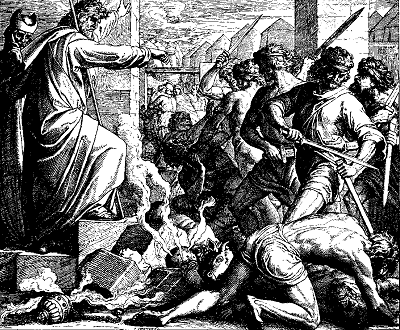 The worship of the golden calf (Exodus 32), which involves Israel’s faithlessness toward her husband, the eating of dust, and a judgment upon those who disobeyed. One wonders if the disobedience became physically evident in the three thousand who fell, as in Numbers 5.
- Eating the Lord’s supper (1 Cor. 10-11). Chapter 10 describes idolatry as being bodily joined to demons instead of to Jesus. The Corinthians’ own sins at the table have resulted in the bread’s becoming death rather than life for them: “That is why many of you are weak and ill, and some have died.” In one sense, the Supper is a weekly visitation from God to judge the faithfulness of his people.
There are many other cases that are possible links to the inspection of jealousy. For example, barley appears infrequently enough in Scripture that it should be considered a possible reference to this pattern. In the case of Ruth, it may be used to call attention to her covenant faithfulness. In the case of Ezekiel’s barley cakes, it may be used to call attention to Israel’s faithlessness and impending judgment.
Jordan suggested that the inspection might have been appropriate not only for a jealous husband, but also for a husband who believed in his wife’s innocence but wanted to vindicate her before public accusations. However, I’m not sure of that. For one, the passage limits itself to cases where the Spirit has moved the husband to jealousy. Two, there are several interesting cases where such an inspection is conspicuously absent. One prominent case is Joseph and Mary:
Now the birth of Jesus Christ took place in this way. When his mother Mary had been betrothed to Joseph, before they came together she was found to be with child from the Holy Spirit. And her husband Joseph, being a just man and unwilling to put her to shame, resolved to divorce her quietly. But as he considered these things, behold, an angel of the Lord appeared to him in a dream, saying, “Joseph, son of David, do not fear to take Mary as your wife, for that which is conceived in her is from the Holy Spirit. She will bear a son, and you shall call his name Jesus, for he will save his people from their sins.” — Matthew 1:18-21
Even though Joseph doubted Mary’s innocence, he is described as righteous for wanting to cover her apparent sin. Also fascinating is the case of Hosea and Gomer:
And the LORD said to me, “Go again, love a woman who is loved by another man and is an adulteress, even as the LORD loves the children of Israel, though they turn to other gods and love cakes of raisins.” So I bought her for fifteen shekels of silver and a homer and a lethech of barley. And I said to her, “You must dwell as mine for many days. You shall not play the whore, or belong to another man; so will I also be to you.” For the children of Israel shall dwell many days without king or prince, without sacrifice or pillar, without ephod or household gods. Afterward the children of Israel shall return and seek the LORD their God, and David their king, and they shall come in fear to the LORD and to his goodness in the latter days. — Hosea 3
Barley is actually mentioned here, but Gomer is not made to eat it — instead, it is the price of her redemption. The guilty and erstwhile unrepentant wife is redeemed from her adultery; she had been consigned to shame and barrenness but is now rescued from it. So we may fill out the pattern of the inspection of jealousy by saying that God is righteous, not only to discipline and purify his bride, but also to restore her to himself.

