Thorn
 Some things James Jordan has said about thorns and about Jacob make me wonder if we can glean additional insight into Paul’s enigmatic statement that “a thorn was given me in the flesh, a messenger of Satan to harass me, to keep me from becoming conceited.”
First, Jacob wrestles with God, a type of prayer, bracketed by two other prayers. He prays for deliverance from his wrestling opponent, Esau; Paul prays three times for deliverance from his thorn. Second, at the time of his wrestling, Jacob has had two Christophanies, one of which is the occasion of his wound. Paul has had two Christophanies (his conversion and 2 Cor 12), the second of which is identified with his thorn. Finally, Jacob’s limp is directly connected with and signifies the blessing he receives from God; Paul’s thorn is directly connected with and signifies a blessing from God, specifically the power and strength of Christ.
So is Paul’s thorn analogous to Jacob’s wrestling, or to his limp?
If the wrestling, Paul’s thorn is a messenger (angelos), just as Jacob’s wrestling partner was the angel of Yahweh. Paul compares it to harassment, insults, persecutions. At the very time Paul mentions his thorn, he is wrestling with “super-apostles” in Corinth, just as Jacob had wrestled with Esau, Isaac and Laban. And Jordan has insightfully observed that Scripture’s constant analogy between men and plants, men and trees, gives the thorny curse of Genesis 3 a double meaning: Adam must wrestle with both thorns of the field and thorns of the flesh. Cain is the first such thorn; I wonder if we are, figuratively, the thorns Jesus bears on his crown. So perhaps Paul’s thorn is his opponents, false teachers, Judaizers.
But if Paul’s thorn is analogous to Jacob’s limp, and this seems to fit better, then it is a “foot” wound like Jacob’s, like the Messianic foot wound that Jesus shares with his people. Paul compares his thorn to weaknesses, hardships, calamities. Paul’s calling his wound a thorn establishes an interesting link between Adam’s curse and the serpent’s curse. We wrestle with thorns of all kinds in order to bear fruit, but it is in our very wrestling that we (Adam, Jacob, Israel, Jesus, Paul, Christians) receive a bruised heel. And Satan is not simply crushed, but it is precisely in Jesus’s and our wrestling with these thorns that Jesus wins victory and his kingdom is established. The curse, the way of decay and death and sacrifice, is the path to its own undoing.
In either case, Paul is a new Jacob. Both men have a name change. Both men experience fourteen years without apparent fruitfulness, but which God uses to prepare them for fruitfulness and dominion. Both men wrestle, although Paul’s wrestling does not seem to come to an end. Both are given a “foot” wound that is a sign of God’s blessing and power. And because their “bodily presence is weak,” they must both lead God’s flock with words and wisdom rather than strength.
Quench
 Some more thoughts on the unpardonable sin in Matthew 12.
First, the Holy Spirit can variously be seen as the personified love of God, the life of God, as life-giving water and breath and fire. The Spirit proceeds between the Father and Son, from the Father and Son to Christians, and from Christian to Christian. All of the gifts and fruits of the Spirit have a one-another focus to them: the Spirit is the unity-giving glue between Christians that ties the church together and strengthens our life.
So, in a sense, to blaspheme the Spirit, to quench the Spirit, is to cut yourself off from the waters of life and from the body of Christ.
Second, there is a corporate reading of this passage that complements the individual reading. Jesus is speaking here to the shepherds of Israel. Later in this chapter Jesus establishes a direct parallel between his miracle of deliverance and the nation of Israel: Jesus would set Israel free, but the demon will return, find the house empty of the Holy Spirit, and fill the house with more evil spirits. “So also will it be with this evil generation.” This is not unusual; many of Jesus’s parables are warnings spoken to Israel and her leaders as a nation, assembly, church.
Reading the passage in this light, blasphemy against the Spirit is the rejection of the Spirit by God’s people. Jesus is warning Israel that the Spirit will depart from them, a direct fulfillment of the Spirit’s leaving the temple in Ezekiel’s vision. The unpardonable sin is thus not only a warning to individuals, but also a warning to churches: if you reject the Spirit, the Spirit will depart from you.
Trespass
 In Leviticus, the sin offering only dealt with lesser sins — sins of inadvertency, or of being led astray. Often it is called the purification offering; in many cases it dealt with issues of uncleanness that were not sins at all. But the purification offering did not deal with any of the more serious sins — sins of trespass against God’s holy things, or high-handed sins.
The only way that a trespass or high-handed sin could be dealt with was by confession and bringing a trespass offering (sometimes translated guilt or reparation). The trespass offering was always followed by a purification offering. James Jordan makes the point that, in one sense, there was no offering that could take away high-handed sins. But by confessing your sin and bringing a trespass offering, God converted your high-handed sins and trespasses into lesser sins, sins of inadvertency that could then be cleansed by the purification offering.
In Psalm 40:6, David lists four of the five offerings, saying that God does not desire sacrifice (peace offering), offering (tribute, or grain, offering), burnt (or ascension) offering, or sin (or purification) offering. The one offering David does not name is the trespass offering. Unlike the sin offering, the trespass offering was a male lamb, the one sacrificial animal most closely linked with Jesus, who came “to do your will” and who sanctified us by the offering of his body (Heb. 10:5ff). All of the offerings prefigured Jesus, but Jesus is preeminently our trespass offering, the ram of God. He is the one offering that is able to take away the worst and greatest of sins, if we confess them. He is the one offering that God does desire.
Seeing how God dealt with high-handed sin might help us to better wrestle with the unpardonable sin (Matt. 12:32). It is common, and right, to say that if you tremble at the thought you have committed this sin, then you haven’t. But perhaps we can go deeper. The unpardonable sin is a high-handed sin. It is a sin for which there is no offering that can cleanse you. But if you confess your sin, even your worst sin, Jesus your trespass offering converts your sin into one that can be pardoned. He is faithful to forgive and cleanse you.
Things I love
I ran across Gideon Strauss’s list of things he loves this week. You can read an earlier post of mine and an editorial of his for some background. I’ve been reflecting on Ecclesiastes, too, and its fundamental perspective that God gives his people a deep and lasting joy in our toil. This is a big part of what Strauss is getting at — training our eyes to see with joy and gratitude.
Joy is a fruit of the spirit, but it is also a habit or discipline we can cultivate, grow in, fight for.
So, in a season where every sunrise comes too soon, and feels so much like the last one, here are some things that I love about right now:
- Morning coffee with Lisa
- A date at home with Lisa, ending with front-porch-sitting in the gloaming
- A smiling baby with rather chubby cheeks
- Three pairs of little hands that are always happy to hug me or to casually hold mine whenever we are walking somewhere
- Lisa’s cooking
- Reading out loud to the three older kids and suddenly realizing that an hour has gone by
- A daily commute filled with James Jordan and Peter Leithart
- The Lord’s supper
Strange loops
Charlotte wrote this little poem today, inspired by one of the many clever poems in A Pizza the Size of the Sun:
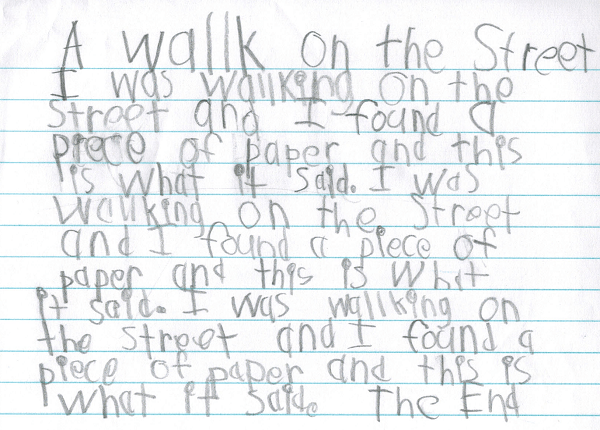
I’m pleased that she is tickled by this. Maybe she will one day share my delight in strange loops, quines, and such?
Ce n’est pas un billet de blog.
Pentecost
 Tomorrow is Pentecost.
Then, God gave us his law. He put it in a chest and wrote it on our hearts. Now, he also fills us with himself, his own spirit.
Then, God taught us to build him a tent-house so that he could live among us. He walked with us for a time in the flesh. Now, he dwells with us through his spirit and one another.
Then, God’s fire engulfed the bush, as a token that the God who keeps his promises would not consume us. Instead, his fire consumed the sacrifice on the altar and rose up as a pleasing memorial to him. Now, God’s fire rests continually upon us, and we consume his body and blood as a pleasing memorial to him.
Some Pentecost reading:
Invictus
The Westminster Confession of Faith reads:
God from all eternity, did, by the most wise and holy counsel of His own will, freely, and unchangeably ordain whatsoever comes to pass; yet so, as thereby neither is God the author of sin, nor is violence offered to the will of the creatures; nor is the liberty or contingency of second causes taken away, but rather established.
We confess that God ordains or decrees everything, but in a way that establishes individual freedom and responsibility. At one level this is simply a mystery to us, but it is possible for us to go a little deeper. Authorship and artistry — or, as Tolkien puts it, sub-creation — have been for me a helpful analogy for God’s sovereignty over creation[1]. It does not even occur to us to accuse Tolkien of tempting or causing Gollum to sin, or of any injustice or violence toward Gollum. Even recognizing Tolkien’s authorship, we do not doubt that Gollum did what he did of his own free will, or that he deserved his end. Philosophers call this compatibilist free will, but it just means that we do what we want to do. An author or artist’s decreeing or ordaining her work is categorically different from ordinary causation or compulsion within the world of the work itself. In fact, the author’s decrees are just what establishes and upholds a structure of causality and responsibility within the world of her work. Otherwise it would be utter chaos.
This also means that God’s very being and existence are categorically different from ours; to use the philosophical term, he is transcendent. This is perhaps the main reason that Anselm’s argument fails: we cannot induct our way outside of the story; we cannot build a ladder that jumps right off the page. We need God to reveal himself to us.
There are some fun ways to explore this creator-creature distinction in story and art. In simplest form, characters might speculate about or comically defy the author. Pushing the analogy to its limits, we end up with self-reference, a multiplicity of levels, and illusions. This gets us into the realm of what Douglas Hofstadter calls the “strange loop,” and as Hofstadter points out, Escher’s work is a great example of all this. But the analogy does break down: our stories are only shadows of reality, and Escher’s lizards and hands and birds only have the illusion of reality. Only God enters his creation in the flesh and allows it to act upon himself.
 While talking with the men from my small group this week, it struck me that this analogy of sub-creation gives literary references to God a double or ironic meaning. When an unbelieving author’s characters rail against or reject God’s authority, they are in one sense railing against him, and so he is undermining his own argument. In his very attempt to boast in human autonomy, he reveals the absurdity of that rebellion. He cannot escape his dependence on and submission to God any more than his characters can escape their obvious dependence on and submission to him.
This gives us an alternate reading of the poem Invictus. Instead of seeing it as the poet’s raising his fist against God, we can equally see it as the character within the poem’s raising his own fist against the poet. In that light, the poem becomes childish and petty.
But who are you, O man, to answer back to God? Will what is molded say to its molder, “Why have you made me like this?”
The idea that we could transcend the boundary between ourselves and our author, or somehow cast off a dependence on him that is fundamental to our very existence, is absurd. Far better to humble our hearts and enjoy where he has set us.
Oh, taste and see that the Lord is good!
Blessed is the man who takes refuge in him!
The analogy of authorship might prove instructive to us in other ways, too. The fact that God’s sovereignty is what establishes causality and responsibility rescues us from futile determinism. And seeing God as an author certainly emphasizes his power over his creation. It is a small thing for him to write of the weaving of his world in seven days, or of a world-wide flood rather than a regional flood: we don’t have to wring our hands over miracles that are hard for our creaturely minds to conceive. And as much as there may be degrees of fellowship with or separation from God, this also suggests that it is misguided to divide creation and our experience into the natural and the supernatural, secular and spiritual, nature and grace. Because of God’s intimate and personal involvement in his story, the overlap between the natural and supernatural is entire and complete. You cannot possibly escape God’s sovereignty, lordship, or grace. That in turn lays the foundation for a robust common grace.
Where shall I go from your Spirit?
Or where shall I flee from your presence?
Finally, this analogy also suggests that, while there is great value in a reductionist approach to understanding God’s world, there is comparatively greater value in seeking to understand God’s word and world holistically, to grasp the sweep of story and persons.
See also: Proof of the non-existence of God.
[1] Yes, this does contradict the WCF quote on the face of it. See John Frame’s distinction between what you might call a proximate and an ultimate sense of authorship, which is what I’m getting at by distinguishing between decree/ordination and causation/compulsion.
Chrysalis
We found a butterfly garden on sale for the kids. It’s been a learning experience for me. I’ve always assumed that a chrysalis was like a cocoon, something a caterpillar built around itself. But now I’ve learned that the chrysalis is actually formed after the caterpillar sheds its outer skin. You can see a clearer picture over at HowStuffWorks, but we were able to catch one of our caterpillars doing it on video. Watch the guy on the right. He slowly shrugs out of his skin and then wiggles frantically to cast it off.
We started with five caterpillars, but one actually got stuck in all their webbing and was unable to climb to the top of the jar. He didn’t make it. Three have now emerged as butterflies, and we’re waiting on the fourth.
Brood XIX
They’re called Brood XIX and their invasion began about a week ago. Fortunately, they only seem to be active during the daytime.
It sounds like emergency vehicles have our neighborhood surrounded. We expect at least a couple more weeks of this constant racket before the cicada mating season is over.
Redeemer
It would be difficult to call a single book my best theological purchase ever, because of the different ways that books can come to us at just the right time and can interact with and build upon each other. Lewis was a particular help to me because I was in a season of doubt. If Van Til hadn’t taught me to be a conscious Calvinist, I would never have needed Carson to steer me out of the hyper-Calvinist ditch, nor would I have been willing to work hard enough at Vos to learn more. And Middle-earth and Narnia are clearly in the running. Plus, I just haven’t read enough to be making such lofty pronouncements.
But realizing this, and even though I’m only partway into it, in my own small way I think the James Jordan audio collection will stand as my best theological purchase ever. Jordan has really incredible insights into the Bible. There are many books worth of material here; five months in and I have only made it through his Genesis lectures and partway into Exodus. But I am hooked, and if nothing else, I feel much better prepared and much more excited for family Bible reading. Jordan has the ability to illuminate many of the “weird” parts of the Bible so that they begin to make sense, and I’m having to give up some patronizing attitudes toward parts of history. It’s exciting to see someone wrestling with why God gave us particular details or obscure passages, even if we don’t have yet have enough information to answer that in every case. Jordan is constantly drawing out vast connections throughout Scripture, including rich symbolism and typology. Here’s a small but surprising example: combining Genesis 39:1, 39:20-23, and 41:10, we see that Joseph never left Potiphar’s house in his imprisonment! It is not clear whether the “keeper of the prison” is Potiphar himself or another of Potiphar’s servants. Regardless, Potiphar seems to have recognized that God blessed him through Joseph, and perhaps even recognized Joseph’s innocence (which would heighten the injustice of Joseph’s imprisonment).
 This week I am listening to Jordan’s comments on Exodus 21. While drawing connections to related passages elsewhere in the Pentateuch, he observes that Hebrew uses a single word, goel or ga’al, to convey both the idea of the kinsman redeemer and the avenger of blood. So the word conveys a person’s status as next-of-kin as much as it does these distinct responsibilities attached to it. Jordan has several valuable observations to make on the blood avenger; in particular, he distinguishes it from a mere family feud by showing it to be a real civil responsibility to guard against bloodguilt (Numbers 35:30-34). Otherwise the land itself will rise up to serve as avenger instead (as in Genesis 4:10-12, Leviticus 20:22, Leviticus 26:18-20). Considering the cities of refuge, Jordan points out that the death of the high priest’s cleansing the land (Numbers 35:28) is another type of Jesus.
Jordan also makes the fascinating offhand remark that this dual use for goel lends further support for the doctrine of particular redemption (or limited atonement). First, it is not possible to identify Jesus as redeemer in the abstract: he is the redeemer of particular individuals who share a kinship with him. Second, we cannot separate the office of redeemer from that of avenger: as a redeemer there are others estranged from him who will suffer his vengeance. Like so many other things, it comes back to adoption.
I’m not trying to prove the doctrine of particular redemption in offering this, and if I were I would take pains to guard against the hyper-Calvinist idea that there is simply no sense in which Jesus shows kindness to those who perish, or in which he died for the sins of the whole world. But as someone who holds to particular redemption, this is a neat confirmation, as well as a great example of the sort of depth that Jordan routinely offers even in passing comments.
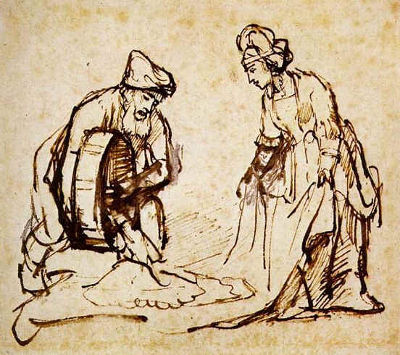
Picture source: Rembrandt.

