Noah
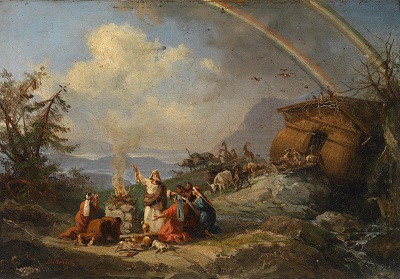 In these articles from 1990 and 1991, James Jordan writes on the meaning of the Noahic covenant and its application today:
A quote:
When the Church is faithful, God will convert the heart of the ruler and he will rule righteously. Conversely, when the ruler is evil and destructive, this means that the Church has not been pleasing to God. The Church is always in charge of culture, and she has been in charge ever since the Flood. We don’t have to take the world and culture over. We already have them. We just have to start using them aright. . . . We don’t change our [rulers] by hypocritically telling them to do things we don’t do. That is the problem with Christian activism and evangelism today. We go door to door telling people they should fear God, when we don’t fear Him enough to do what He says. We tell the government to judge justly, when we refuse to execute justice in Church discipline. We want the government to get out of debt, when the Church owes trillions of dollars in back tithes to God.
Vote
There are a variety of reasons you might vote for someone (or no one!) in a primary or an election (obviously, I write this as an American). Here are a few; perhaps you can think of others.
- I’m voting for someone because I believe he is the best person for the job
- I’m voting for someone because I believe he is relatively righteous and wise. I willingly designate or ratify him to act as as my representative in those decisions entrusted to him.
- I’m voting for someone because, among those candidates likely to win, he is the most acceptable or least unacceptable to me
- I am voting for no one, because in some way I believe the system itself is either unrighteous (e.g., too much power and privilege is arrogated to a particular office), or because in some other way the system has failed (two-party stranglehold, nomination process failure, etc.)
- I am voting for no one, because of the terrible cost-benefit ratio. My vote is unlikely to make a difference, and I can achieve more good by doing something else.
This is all complicated by the fact that voting is a prisoner’s dilemma. Perhaps you would gladly vote according to #1 or #2 as long as everyone else did, but if you expect most people to vote in terms of #3 there is a powerful temptation for you to do so as well. If you were the only person voting, then there would be some ethical obligation to vote in terms of #1 or #2. But since your vote is incredibly diluted, it becomes difficult to attach ethical imperatives to it. Individual votes are so unlikely to determine the outcome of elections that economists frequently describe voting as irrational, at least in terms of the goal of influencing an election outcome. As my friend Mark Horne insightfully observes with a reductio ad absurdum, if we have an ethical obligation to vote, then by implication we have a much greater ethical obligation to put up campaign signs in our yards, something that takes little effort but will have a greater effect on the election outcome.
I am convinced that as Christians we are free to vote according to any of the strategies above. Among these strategies, we do not have warrant to describe any as fundamentally unrighteous or evil, and we cannot bind each other’s consciences to any of them. Instead, we should consider these strategies in terms of wisdom and tactics. This is a matter for persuasion and not invective.
I understand the case for a lesser-of-two-evils strategy, and I have voted that way in the past for presidential elections. This year I am not, for several reasons. Although my vote is statistically unlikely to make any practical difference, I want to use it for its symbolic value. Chiefly, I see my vote as an opportunity to stand for righteousness and against unrighteousness. Obviously, I am speaking in terms of a relative human righteousness and not an absolute righteousness. But both presidential candidates are campaigning to perpetuate gross unrighteousness and foolishness, and voting for a third candidate is a way I can symbolically avoid “sitting with” or casting my lot with the wicked. Even though my vote makes no practical difference, it is still a privilege to participate in the process, and I hesitate to spend this privilege on an unrighteous candidate.
I also want my vote to send a more practical symbolic message. First, I believe that as a general rule, America needs to put the brakes on the growth of political power, and to experience a general shift in power from the national to the local level. By writing in an alternate candidate, I can express my belief that the presidential election should not matter as much as it is currently made out to be. Second, I want to send a message to the Republican party establishment, both that its nomination process is broken, and that I refuse to be taken for a fool. How many times should I be willing to believe false promises to deliver movement on abortion and limited government? I stand for righteousness and not for a party.
Would I prefer one of the two likely winners to the other? Probably. But rooting for a candidate does not require me to vote for him, any more than it requires me to deface my car’s bumper with his sticker. Additionally, I don’t feel confident in tracing out all of the implications of supposedly better and worse paths of unrighteousness and foolishness over the course of time. In the end, I will vote for righteousness but also pray for it, entrusting the outcome to God.
Perhaps you are unpersuaded and will vote for the lesser of two evils; you can do so in good conscience. Certainly, in any case, we have more important opportunities to make a bigger difference:
- We are to participate earnestly in the worship of the church, prayer and evangelism. This is the only means by which any enduring cultural change will come about.
- If you vote, research your local elections at least as diligently as the national ones.
- After the election, write your elected officials at all levels to advocate for righteousness.
Perhaps you have suggestions for my presidential write-in. I’ve not decided yet.
Jesus is king!
The Levir in Romans
 One of the things that happened in the death, resurrection and ascension of Jesus was his vindication in the face of man’s rivalrous judicial execution.
But Jesus’s execution was not just a judicial condemnation of God. At Sinai, Jesus, as Yahweh, espoused his people through the Law, and it is on this basis that the prophets later accused Israel of adultery and called her to repentance and a hope of restoration (e.g., Jer. 31:31ff). In the gospels, Jesus the husband returned to Israel to conduct an inspection of jealousy (Num. 5). Instead of repenting, the guilty bride put her own husband to death as a grotesque way of covering her sin.
Amazingly, God had arranged for just such a death to truly cover (atone for) sin, provided there is repentance.
All of this hearkens back to the death of a previous husband. Adam, the archetypal husband, sinned and died. Eve, the archetypal bride, needed a new husband: Israel needed a new Adam. Eve’s hope, and Israel’s hope, was in the coming seed. So we see here the dual function of the levir (Deut. 25): a new husband, to bring the seed. The bride’s hope, Israel’s hope, was in a new husband, a new Adam. The mother’s hope, Israel’s hope, was in her offspring, the seed. Yet bride Israel destroyed her only hope, by killing her husband; and mother Israel destroyed her only hope, by consuming her own seed (a la Exodus 23:19, etc.).
This may be a helpful framework for approaching Romans 6-8. Paul speaks of Jesus’s death, and our related death to sin and to the law. But in just what way have we died? Here’s my thesis: (1) Israel was espoused to Jesus through the law at Sinai, the former Pentecost; (2) Israel put her husband to death, thereby incurring greater guilt but also dissolving the marriage made through the law; (3) Jesus was raised as his vindication, thereby condemning Israel; (4) a new and resurrected husband was offered to a new Israel, the church: to all individuals who undergo the “death” of repentance; (5) all Israel thus underwent some form of death, whether the death of judgment in AD 70 or the death of repentance; and (6) the church was espoused to her husband through the Spirit rather than the law at the latter Pentecost.
This raises the following suggestions in Romans 6-8:
- We have died to sin in that we have repented, identifying ourselves with the crucified and buried husband rather than the faithless bride
- Baptism (associated with the Spirit), and union with Christ, are both aspects of incorporation into the bride and the bride’s own union with her husband, her head
- The “body of sin” could either refer to our union with Adam, or to Israel herself
- Although the law still reveals God’s will to us (and in fact is said to be written on our hearts), we are not under the law in the sense that the law is no longer the most fundamental form of the church’s communion with her husband. The church is now espoused to Jesus through the Spirit, so that the most fundamental form of communion we have with Jesus is through the Spirit.
- Freedom from the law is only half the picture. We must have a new husband and be faithful to him.
- This all suggests that in Romans 7, Paul is speaking of the historia salutis more than the ordo salutis. He is personifying the bride’s experience — Israel’s experience — more than his personal experience. This is not to say that the passage has no bearing on our experience as individuals; it must, if creation is fundamentally typological. But this is not primarily what Paul has in view; he is speaking of real historical transitions in Jesus’s relationship to his bride.
- This also suggests that there is a corporate reading of Romans 8 that we should layer on top of our individual reading. Jesus not only animates us as individuals through his Spirit, but also his church itself. It is the Spirit who prepares the bride and unites her to Jesus.
Love one another
Here’s a possible chiasm in 1 John 4:7-21:
A (v. 7): Born of God, know God ⇒ love one another
B (v. 8): Not love ⇒ not know God
C (vv. 9-11):
Love is manifest among us
Son sent into the world
God sent Son as propitiation
God loved us ⇒ we love one another
D (v. 12): Love one another ⇒ God abides in us
E (v. 13): The Spirit seals or proves our abiding
F (v. 14): Father sent Son to be Savior of the world
E’ (v. 15): Our confession proves our abiding
D’ (v. 16): Abide in love ⇒ God abides in us
C’ (vv. 17-19):
Love is perfected with us
We are in the world
No fear or punishment; perfected in love
God loved us ⇒ we love
B’ (v. 20): Not love brother ⇒ not love God
A’ (v. 21): Love God ⇒ love brother
There are some pairings of knowledge (A, B) and love (A’, B’), Spirit (E) and confession (E’). I like that verse 14 is at the focal point.
Peter Leithart suggests some possible alternatives, and also suggests a chiasm for the first six verses.
Solmusic
 We’ve found some fantastic Bible music for kids (and adults): the music of Jamie Soles. Jamie has a knack for conveying the essence of Biblical faith, righteousness, and world view in a memorable way. So far I’ve picked up the following albums:
- Up From Here. This is my favorite so far, although I have yet to really become familiar with the other albums. There’s a lot of great biblical worldview and storyline in here, oriented around the theme of the many exoduses in the Bible. Jamie’s portrayal of the creation mandate is wonderfully poetic, and we enjoy singing along to the apostles’ creed. Plus, the Mennonite joke cracks me up every time.
- Giants and Wanderers. This is Jamie’s latest album, delving into the histories of some lesser known Bible characters, both savory and unsavory.
- Fun and Prophets. Jamie tells the stories of many of God’s prophets, the men who speak God’s blessings and curses into being, who are invited into the counsel of God.
- Weight of Glory. Another collection of stories retold, treasures old and new (Matt. 13:52).
- Songs From the 40s/50s/60s. Psalms, that is — cries to God for help and deliverance.
- Memorials. Jamie recounts many of the things that God calls memorials — altars, offerings, even the Lord’s Supper, which is a memorial to God as much as it is a reminder to us.
The future of Jesus
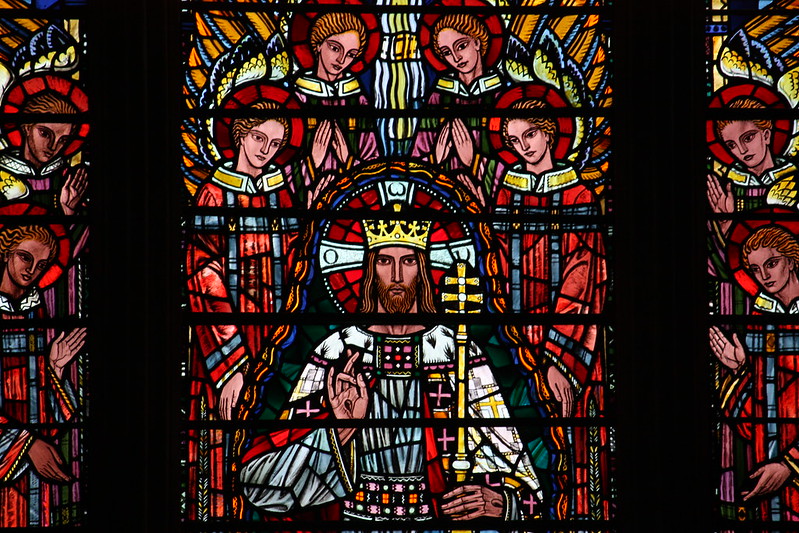
I was a long while in moving from amillennialism to postmillennialism. But like many theological watersheds, more and more I saw it everywhere, and more and more it fit with other convictions.
My friend Mark Horne argues briefly for postmillennialism in a helpful series of posts, “The future of Jesus:”
- The future of Jesus
“God’s objective in Jesus is the release of the human race from slavery — not just slavery from death but slavery from every other tyrant as well.” - Few to be saved?
“It is too small a thing to God for him to show mercy on and bring salvation to a minority of humanity.” - Are there earthly blessings to be expected in the future?
“There is our hope: Not only the return of Jesus, but the victory of His Spirit and His Gospel giving the whole world true knowledge of him and of his Word, bringing about the end of wickedness and an end to the weariness of frustrated labor.” - Will he make a difference in the world?
“If there was ever a time when God allowed human societies to exist apart from loyalty to him, that time is over. God now expects everyone to acknowledge the Lordship of His Son and to obey Him.” - So if Jesus rules, why isn’t life better?
“When the Church does not teach everything Christ has commanded we should expect him to withdraw peace and prosperity from the world. This does not disprove that he reigns and has a plan for future victory; it proves that he does.” - To three thousand-PLUS generations
“So when we read in Esther 8 about a world-wide vindication of God’s people resulting in massive proselytization ‘from India to Ethiopia,’ we should realize that that was rather minimal compared to what is to happen now that Jesus has come and died and risen again.” - The feast of booze
“Jesus loves you and your Christian family but he did not die and rise again to have you in his private party. He died and rose again not only for you but also for the whole world. He wants everyone to come to his table and he will eventually ensure that the whole world is present at his feast.” - When is Jesus king of kings?
“Jesus is not becoming king at some point in the future. To be more pointed, he is not becoming the king of all nations on earth at some point in the future. He already is.” - Who inherits the land/earth?
“How is it Christian to claim that the meek won’t inherit the earth?” - Who will kings acknowledge?
“Kings are called upon to praise the Lord. We are promised that they will all give thanks to God.” - Defending the future of Jesus
“The whole reason there is an ‘antithesis’ between God and Man is because they are claiming the same territory at the same time. The new city begins now. Or rather, began then.”
Totus Christus
Augustine spoke of the totus Christus, or the “whole Christ.” In saying this, he referred to the fact that Jesus and his church are in some ways inseparable, as husband and bride, head and body. Believers are both individually and corporately united to Jesus, and when the church is persecuted, Jesus is persecuted (Acts 9:4). He is in us and we are in him.
It is possible to stretch this imagery too far; it is a union and not an identity. And the church is utterly incomplete without Jesus, while the reverse is not true. Yet there are many applications we can draw from this.
First, this helps us to understand the doctrine of imputation. If the church is united to Jesus as body to head, then we as believers are brought into Jesus’s own obedience and death. We are actually made to be “in him” in his life and death and resurrection. Amazingly, in his death, Jesus chose to be united with us but forsaken by the Father. What love!
Second, it helps us to make some sense of Scripture’s speaking of being in Christ. Part of this is a spiritual reality. But part of it must be realized in the flesh by our participating in Christ’s church, his body. We cannot enjoy, experience and know the whole Christ if we seek to do so apart from his body the church. We must have a complete head-and-body relationship with Jesus. This also gives us a glimpse into one of the purposes of baptism. If we are baptized into Jesus (Romans 6:3), then part of that means that we are brought into his body, the church.
 Third, this gives us a deeper understanding of the imagery of the Lord’s Supper. It is clear that the bread and wine represent Jesus’s body and blood. But we can understand Jesus’s body in two ways — his physical body, and his body the church. It seems that Paul has both of these senses in mind when he writes of the bread and body in 1 Corinthians 10-11. He links the one loaf of bread to the unity of Jesus’s church-body. And when he writes of “discerning the body,” I believe he is primarily concerned that we discern the body as the church, eating the Supper with love and preference for one another. We eat the Supper in a way that reflects the unity we have in the gospel. And in the following chapter, Paul elaborates even further on the image of the church as a body, emphasizing that we must walk in honor and preference and care for one another.
Finally, this reminds us that one of the ways that Jesus is with us to the end of the age (Matt 28:20) is through his church, through our shared life with one another. We enjoy his presence through his word and his Spirit, but also through his body.
Timeless theology
 It seems to me that colloquial American Calvinism can tend toward a timeless theology. In our systematic theology, we tend to think primarily in terms of static eternal-eschatological realities (think TULIP) and to neglect the equally important historical-covenantal perspective. As a result, hyper-Calvinism becomes a temptation for us over against classic covenantal Calvinism (I’ve struggled with this). Similarly, the relative stasis of amillennialism becomes appealing to us over against classic postmillennial Calvinism. And when it comes to parenting, we can focus more on bringing our children to a life-defining moment of repentance and faith, rather than training them in a life of ongoing and growing repentance and faith. We have an appropriately large category for having been definitively saved, yet it seems foreign to speak in any sense of being presently saved (1 Cor 15:2). This can easily lead to a marginalization of the work of the Spirit: everything is settled, so what pressing need is there for the Spirit to wrestle with us, or for us to be drawing strength and life from the church?
In his excellent book, The Difficult Doctrine of the Love of God, D. A. Carson has this to say about the debate between Calvinists and Arminians over the doctrine of atonement, observing a creeping tendency towards hyper-Calvinism:
In recent years I have tried to read both primary and secondary sources on the doctrine of the Atonement from Calvin on. One of my most forceful impressions is that the categories of the debate gradually shift with time so as to force disjunction where a slightly different bit of question-framing would allow synthesis.
I think his observation has broader applicability for our theological formulations. We need to be sure that we are synthesizing both eternal and historical perspectives: both God’s eternal decrees and also also their covenantal working out in time and history. For some good principles on integrating perspectives like this, I recommend Vern Poythress’s book Symphonic Theology.
Cloud
Continuing my previous post’s theme of worship, I want to suggest complementary perspectives on corporate singing.
 James Jordan points out that God’s glory cloud is symbolic of the society of men and angels gathered around God’s throne. What we see as a cloud in Exodus 19, 24 and Ezekiel 1 is myriads of angels in Daniel 7 and Revelation 5. He suggests that the cloud might have even consisted of angels, which you could not distinguish from a distance. In any case, there are suggestive parallels between God’s glory-cloud, his tabernacle and temple, and the true “house” of God, his people.
There are strong connections between singing and going to, becoming, the house of God (e.g., Ps. 22:3, 42:4, 84:4). Likewise, the angels that surround God’s throne create a glorious noise of voices and trumpets and waters and winds (e.g., Exodus 19, Ezek. 1).
Thus, in the church’s corporate singing, through Jesus our sacrifice and by the Holy Spirit, we are brought up and incorporated into the glory cloud, where we gather together with angels and with believers of all ages. We become part of God’s glorious covering as his bride, and through our singing we participate in the mighty sound of God’s presence. We announce and display his greatness and glory to all men and even to the “cosmic powers” (Eph. 6).
More than that, as a host of people and angels gathered around God’s throne, we are also an army gathered around our commander. It is no stretch to say that the church’s singing and shouting is one of the ways that we do real battle against everything that is opposed to Jesus and his church (e.g., Joshua 6; Psalm 8:2 with Matt 21:16; Acts 16:25-26).
 I gotta have my orange juice.
Creation
with 9 comments
But we know better. By Scientific observation and inductive reasoning we can prove the existence of enormous negative page numbers. We know that inductive reasoning functions as incontestable proof, because we are the keepers and guardians of the sacred truth that all worlds are impersonal machines and not stories. Worlds have no plots, and are filled only with particles, not characters. Creationists are stupid. So are all authors, artists, composers and poets — they are all conspiring in a tremendous lie about worlds and Science (all rise!).
Written by Scott Moonen
August 28, 2012 at 8:55 am
Posted in Biblical Theology, Christ is Lord, Commentary
Tagged with art, creation, Music, parable, sarcasm, science, story