Archive for the ‘Miscellany’ Category
Metábasis eis állo génos (2-38)
Lazy days this week:

Lots of time for swimming and games and reading. Sobering and stirring:
The “elder” is at odds with the “expert.” This is a distinction often ignored by the young and impatient.
The expert deals in information, made more and more abundant by science. The elder deals in wisdom, acquired only through long and patient obedience to law and ideal. The elder is the product of time, the expert the product of training. The elder is reflective, the expert is impulsive. The elder is sensitive to human frailty, especially his own; the expert is cocksure. The elder tends to listen, the expert to assertion. The expert may indeed impress the naive by overwhelming the wise with the quantity of his information—but a Church or a culture which cannot distinguish between the quantitative and the qualitative—between knowledge and wisdom—has not long to flourish. (DeKoster and Berghoef, The Elders Handbook, 223-224)
Faithful plodding:
Often the convert through evangelism comes with a freshness of zeal and ardor which delights those who helped lead him to the Lord. Make special effort to put such enthusiasm to work in the Body along channels for which the convert is qualified. But beware that the warmth of the convert’s new-found faith does not become a cloak for judgment upon the presumably “luke-warm” faith of others. The new-born must always be given to understand that coming into the congregation is but the beginning of an arduous and life-long effort to grow in obedience and sanctity. Not everyone wears, or wants to wear, evidence of the depth of his faith upon his sleeve. It may take a while for the new member to find that out. Be sure that this member realizes that the measure of “success” in Christian progress must be one’s growth from year to year and not some self-made comparison with the growth of others. (DeKoster and Berghoef, The Elders Handbook, 245-246)
Lisa is reading a book which must no longer be named:
“All wars are sacred,” [Rhett] said. “To those who have to fight them. If the people who started wars didn’t make them sacred, who would be foolish enough to fight? But, no matter what rallying cries the orators give to the idiots who fight, no matter what noble purposes they assign to wars, there is never but one reason for a war. And that is money. All wars are in reality money squabbles. But so few people ever realize it. Their ears are too full of bugles and drums and fine words from stay-at-home orators. Sometimes the rallying cry is ‘Save the Tomb of Christ from the Heathen!’ Sometimes it’s ‘Down with Popery!’ And sometimes ‘Liberty!’ And sometimes ‘Cotton, Slavery and States’ Rights!’” (161)
And while this is an important insight, and one which I had never thought to apply to the American Civil War, Rosenstock-Heussy cautions us not to go so far as Rhett; that a love for good things may not sanctify a war or revolution, but may yet warrant one’s involvement in it:
We today are sure that economic forces pull all the wires. Washington was the richest man in the colonies, the Federalists speculated in Western land, the Whigs owned ecclesiastical estates, and the French middle class wished to exploit the farmers. This is all true, but no truer than the fact that economics is part of all our lives every day. Bread and butter is an everyday question. For that very reason it is not the permanent question of history, because history selects one or the other everyday question and makes it the centre of attention for a certain time. History is the passing from one question to another, the putting of different questions at different times.
Because of the very fact that economics is so important all the time, it cannot be the question for every period. History would not be history but a recurrent mechanism if it were one and the same question which raised human fury to the pitch of war or revolution in every age. We vary, the seasons vary, mankind varies in its furies, passions, aims and ends, and the emergencies against which we need government vary likewise. (Eugen Rosenstock-Huessy, Out of Revolution, 385)
Thus, Rosenstock-Huessy makes the point that even in the most reprehensible and unjustifiable of revolutions, there may be an element of truth that broke through and which we are now free to affirm even if there is a great deal to be discarded. He summarizes (p. 365):
Russia: Every proletarian a capitalist.
France: Every man of talent an aristocrat.
England: Every gentleman a king.
Germany: Every Christian a priest.
He goes on to stress that “the clue to the success of [these] revolutions was that none of them bribed the respective supporters at the price of diminishing the size of the body politic; they all reached out for a political organization bigger than anything attempted before.” (365) As always, he is over generalizing, but there is still a stimulating idea there. I haven’t finished the book, so I can’t say yet where he goes with that. I do believe that he foresees an end to this age of empires, so perhaps an end to revolution, which he acknowledges has a demonic aspect to it.
Jesus doesn’t want you to panic.
Metábasis eis állo génos (2-37)
If you live in the Triangle area, consider joining the churchmen mailing list. There’s a small but growing group of guys who get together from time to time and have also started To the Word together.
This reading plan has us going through Genesis and John at the same time. This led me to reflect on the following sequential pairs: beast/man, Adam/Eve, John-the-witness/Jesus, Jesus/bride. Two of these cases follow the pattern of 1 Timothy 2, where the one who came first has authority over the one who came later. But the other two cases do not. I’m not entirely sure what to make of this, but it seems possible that we could say: (1) there is a natural order or authority from God-to-man and then from image-of-God to all-creation; but (2) where things are of the same kind, there is a natural order or authority from first-to-last, from alpha-to-omega. In the case of Adam and Eve, the fact that man and woman are of the same kind is well understood. But in the case of the eternal bride, the church, it is a great surprise and wonder that God would raise her up to be co-regent with his son.
Peter Leithart reflects on the life of the early church:
Let’s live in such a way that — even when they don’t show it — the people cannot help but esteem us highly.
Peter goes on to offer some helpful diagnostic questions for the past year and a half.
Duane Garner exhorts us to take worship seriously:
We worship as if the world depended upon it, because it does! It is the most important event of the week, and the future of the world depends upon it. In worship, each week we strike a heavy blow against the dominion of darkness . . . We beat it back in worship. And then we go out all week collecting the fruit of that victory that God works on our behalf when we humble ourselves and submit to him. So when you come, understand that this is what we’re doing: we’re interceding for the world, and we’re beating back the kingdom of Satan.
My friend Nathaniel posted this recently:
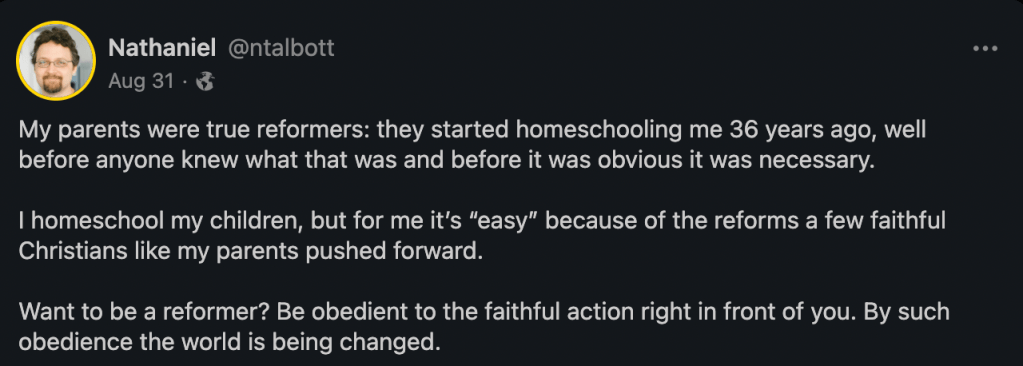
I was homeschooled from second grade through senior year of high school. Like Nathaniel, I’m so glad for my parents’ example in pursuing what they believed to be right in spite of its being an uphill effort. It looks increasingly like the future is going to bring some more pioneering work for Christians, and I’m very grateful to have my parents’ example and foundation to build upon!
Bitcoin is interesting to watch. I’m increasingly sympathetic with Nassim Taleb’s conclusion that its long term value is zero. But so are many of the works of man, and consider how much gold now lies at the bottom of the ocean. Yet in the meantime, there are lots of interesting speculative and political considerations. I found myself wondering this week how quickly El Salvador’s digital stockpile would be stolen. Then this article caught my attention, as did the SEC lawsuit against Coinbase. It will certainly remain interesting to watch!
I was trying to think of a good picture of a happy warrior, and the image on this page came to mind. You should laugh like this. And you should listen to this excellent audio magazine issue as well!
It’s all in Girard:
Metábasis eis állo génos (2-36)
Join me!

Daniel’s vision in Daniel 8 contains a ram and a goat; it’s strange to see sacrificial animals as symbols for Gentile kings and powers. The ram symbolizes Persia; I wonder if it is a positive image since Cyrus is a messianic figure (Isaiah 45:1) and this ram does not devour God’s people. However, the goat symbolizes Greece, and it attacks God’s people “because of transgression.” We speak sometimes of the bowls in Revelation as being priestly bowls “returned to sender;” I wonder if the goat is a similar image, the annual scapegoat being returned to sender after years of faithless offerings. So, it turns out that Azazel is in Greece!
The name Elisha means “God is salvation” and the name Joshua means “Yahweh is salvation.” The name “Jesus” is a form of “Joshua,” and Joshua is a clear type of Jesus. But so is Elisha, whose name is just a further small step away from Jesus.
And, it turns out, to be buried with him is also to be raised.
Then Elisha died, and they buried him. And the raiding bands from Moab invaded the land in the spring of the year. So it was, as they were burying a man, that suddenly they spied a band of raiders; and they put the man in the tomb of Elisha; and when the man was let down and touched the bones of Elisha, he revived and stood on his feet. (2 Kings 13:20-21, NKJV)
Or do you not know that as many of us as were baptized into Christ Jesus were baptized into His death? Therefore we were buried with Him through baptism into death, that just as Christ was raised from the dead by the glory of the Father, even so we also should walk in newness of life. For if we have been united together in the likeness of His death, certainly we also shall be in the likeness of His resurrection, knowing this, that our old man was crucified with Him, that the body of sin might be done away with, that we should no longer be slaves of sin. For he who has died has been freed from sin. Now if we died with Christ, we believe that we shall also live with Him, knowing that Christ, having been raised from the dead, dies no more. Death no longer has dominion over Him. For the death that He died, He died to sin once for all; but the life that He lives, He lives to God. Likewise you also, reckon yourselves to be dead indeed to sin, but alive to God in Christ Jesus our Lord. (Romans 6:3-11, NKJV)
Mark Horne writes:
You arrive be realizing you haven’t arrived. Figuring out how to put others interests before your own not only takes sanctification but also wisdom. To do that without bitterness. Without ambition. Without being presumptuous or patronizing. It takes ongoing attention and prayer. Even Paul doesn’t want to claim he has arrived except that he realizes how to go forward.
Darwin and Marx reverse Anselm; in their reckoning of the world, gray goo (q.v.) is that than which none greater can be conceived. All the eloquence of the Sagans and Tysons is just opium for the masses, a smokescreen to cover for the fact that gray goo and heat death are the great telos of stardust.
But the Spirit and the bride say, “Come!” There is one than whom none greater can be conceived whose favor you need not vie for and which lasts a lifetime, and who is a boundless source, leading to both a present and a telos that no mind has ever conceived.
A lot of conservatism is about taking a Washington process—legislation—and moving it two degrees, another two degrees, oh no it comes back. Whereas a workable model, no matter how small, is far more influence in the long run than just moving that Maginot line back a couple of meters in one direction in Washington. Because that can go viral. (Jerry Bowyer)
I wonder, did our military leave behind any cryptography devices in Afghanistan?
I had to reinstall Windows 10 on our PC this week, and together with that reinstalled our copy of Office 2003. To my surprise, it installed just fine. There were a few minor glitches updating it, but it got there in the end. Not too bad for an eighteen-year-old program.
Metábasis eis állo génos (2-35)
Lessons learned from René Girard: (1) We all construct our desires and beliefs through imitation and rationalize them later. This is equally true if we think we have outgrown imitation. Since imitation is inescapable, choose carefully whom you imitate. (2) Righteousness and virtue are social. We all acquire righteousness by being joined to the right group and by casting shame on the right scapegoat-victim. Since the pursuit of righteousness is inescapable, make sure you join yourself to King Jesus and cast your guilt and shame on him, rather than envying and despising and biting and devouring one another. (3) Very often the temptation to envy and despise and bite and devour comes with those closest to and most like us, because we must find some small difference that allows us to vaunt over each other. (4) Job is, first and foremost, a type of Jesus.
Lessons learned reflecting on Edwin Friedman: (1) Do not be anxious. (2) Do not get caught up in others’ anxiety. (3) The anxious brother is not a weaker brother toward whom you must adjust your behavior because he is tempted to follow your example into a kind of sin. Rather, he is an immature brother who should be following your example. (4) Anxiety is cancerous. The only way to get rid of it is to cast it up to Jesus, and receive peace coming down from him. (5) Jesus is not anxious! (6) Leaders, parents, etc. can walk in Jesus’s footsteps and be anxiety absorbers and calming peace givers provided that they pass the anxiety on up to him rather than holding on to it. (7) One key way in which a leader or parent absorbs anxiety is simply by their own “gracious stability” (Toby Sumpter) or “calm presence” and “non-anxiety” (Friedman) which has a calming effect. This is how Jesus comforts us. (8) Another way in which we absorb others’ anxiety and help them mature is by mixing our patience and consideration toward them with tough love that allows them to face and overcome their anxieties rather than coddling them. (9) This is how God matures us.
Insights from Eugen Rosenstock–Huessy: (1) People and bodies of people are always stretched out along at least two axes, what ERH calls the “cross of reality”—past and future, in–group and out–group. In terms of a church you could think of these axes as teachers and prophets on the one hand, and discipleship and evangelism on the other hand. It’s fruitful to reflect on what these axes mean for your business (e.g., quality control and research, engineering and marketing) or household. (2) Enduring organizations must strike a balance between all four points of the compass. Mature individuals also need to make provision for a balance, but it is natural to have inclinations and specialties and to make up the differences together with your spouse, family, church, community, etc. In fact there are natural average tendencies for men and women here. (3) In a sense, because there is a tugging in all of these directions, the balance will always be struck by a kind of “tearing,” but the tearing needs to be a gracious giving–honor to one another and not an envious or Satanic competition. Another way of saying this is that for a body of people not to be torn apart by garden–variety differences, we must absorb the tearing into ourselves by following 1 Corinthians 13; our personal preferences and inclinations cannot at every moment be pre–eminent even, and perhaps especially, if we are in a position of leadership. Good leadership begets fruitful work at all points of the compass. (4) Love is the fuel on which the world operates and by which it overcomes entropy. Choose yourself a spouse, church, vocation, etc. and give yourself to that one in a joyful and risky Chestertonian “duel to the death.” (It is truly amazing to listen to a college professor preaching to his students.) (5) History cycles between phases of tribe, nation, and empire; and the next tribal phase is imminent. ERH likes to speak of 500–year patterns, in which case we seem overdue. According to his view, then, we should not expect to see a successor empire like China or Islam or an international banking cabal, but a truly tribal state of the world.
My wife has a rule that she strives to live by and teaches to our daughters: what would a Jane Austen herione do or say? This is a good rule.
In this week’s Theopolitan newsletter, Peter Leithart quotes David Dusenbery reflecting on Justinian’s Institutes. Dusenbery observes that “Justinian inscribes, at the head of his foyer-text to his monumental code of Roman law . . . as a sanctifying and legitimating figure, [our Lord Jesus Christ,] the name of a man who was crucified by a Roman judge as a Roman convict.” Leithart comments that “the invocation of Jesus is at least a standing rebuke to any pretense that Roman law, or any law, automatically secures justice.”
I reflect briefly on the [ab]use of NoSQL. Stick with sonnet form, kids; free verse only brings slavery.
Metábasis eis állo génos (2-34)
Mark Horne writes about God’s perfect justice and how God acts generationally (part 1, part 2, part 3), concluding as follows (but you should read all three):
We need to distinguish between descendants being affected by the sins of their ancestors and their being guilty of those sins. . . . So yes, sometimes God’s public justice destroys people who didn’t personally commit the injustice. The young and marginal in Sodom and Gomorrah got burned up with the rest. Achan’s family (along with the warriors who first attacked Ai) got destroyed for his sin that some may not have had a part in. Those deaths are punishments of the sinner (Achan and whoever was an accessory) but their personal deaths are justified in Genesis 3, not in what Achan did. Their deaths are, on a personal level, no different than the deaths of Job’s children who were killed because he was righteous.
Three key points to keep in mind are that (1) death comes to all of us in Adam; (2) it is not necessarily judicial (for which see the moving 1 Kings 14:13); and (3) the Bible often hides for us either a distinction that God is making, or at least his reasons for making it. One example of this is the sons of Saul in 2 Samuel 21; it is clear that not all of Saul’s sons are put to death, but we are not let in on the (obviously) righteous distinction that was made. Another example is the family of Korah in Numbers 16; it seems from this passage that God put the entire family to death, but Numbers 26:11 tells us that at least some of Korah’s children were preserved, and it is likely their offspring are the Korahites faithfully serving in God’s house in 1 Chronicles 26 and several of the Psalms.
This is a good time to remember that Jephthah did not offer up his daughter. However, God was righteous in commanding Abraham to offer up Isaac.
I revisited Deuteronomy 20 wanting to decide whether “civilian” was a proper distinction for jus in bello. I’m not sure that it is. At the city level, all of the men of a contumacious city are subject to the sword. I’m not sure to what degree this extends beyond the level of a city; I’m not convinced that Judges 19-21 is a righteous example. It’s also worth reflecting on the typology of trees and thorns; what are fruit trees? Are they women?
I’m so thankful for the elders of the CREC!
The Lord’s table must reflect the diversity of his body (Galatians 2, James 2, 1 Corinthians 11). Now, James teaches the church not to engage in partial social engineering—as if we would fly in someone from Saskatchewan, or work especially hard to bring in a Florida man, or begin conducting our services with Hungarian translation. And since the old covenant was completely torn down in AD 70, the church does not even go “to the Jew first” but to all men. But James does command us to welcome all those whom God sends our way. Therefore it is of utmost urgency that the church baptize her little ones and welcome them to the table. In the new covenant, where holiness and cleanness are now contagious rather than death (Matthew 9, 1 Corinthians 7), our little ones are now more welcome in Jesus than ever before (Mark 10; you can be sure that Jesus’s blessings are not mere platitudes); “your children shall come back” (Jeremiah 31), “they all shall know Me, from the least of them to the greatest . . . for I will forgive their iniquity” (Jeremiah 31, Hebrews 8). If we do not welcome our little ones to their Lord’s table, then we fail to “discern the body [of Christ]” and become “guilty” of his body and blood (“for this reason many are weak and sick”); we are “out of step with the truth of the gospel;” and we “stand condemned” as Peter and the disciples—ultimately teaching the world a lie about the place of little ones in a polis.
This is why they look at me with suspicion, seeing me as a sort of sheep in wolf’s clothing. (Conversations with René Girard, 181)
As the scapegoat mechanism has been revealed, we do not return directly to it, that is, we do not directly accuse the victim of having done something. We don’t blame them directly. But the scapegoat mechanism continues to work, though in a different way: the politically correct movement accuses their opponents of creating scapegoats. They accuse them of victimizing others. It’s like Christianity turned upside down: they take whatever is left of Christian influence, whatever is left of Christian language, but to opposite ends, in order to perpetuate the scapegoat mechanism. (Conversations with René Girard, 182)
Christianity never had this goal. It never sought to organize society. (Conversations with René Girard, 182)
Today people in academia are not even trying to be honest. (Conversations with René Girard, 183)
It seems like the ancient, primitive fatalities, temporarily discarded by the light of the prophets and the Gospel, are coming back. In the Bible, the protection of children appears alongside the protection of the handicapped, lepers, cripples. These are the preferential victims of ancient societies, and we understand we must protect them. We still protect crippled people, handicapped people, but in the center of it all we find a sort of cancer growing, which is the return to infanticide. This is a decisive argument, which few people will take into consideration: those who defend abortion are trying to make our society go back to pre-Christian barbarism. (Conversations with René Girard, 184)
This was a fascinating Twitter thread. I recently bought a Berkey filter thinking that the main benefits would be chlorine and fluoride filtering. But it seems like there are more benefits—and also that you might want to consider a filter even if you drink well water.
Metábasis eis állo génos (2-33)
Now is the time for states, counties, and municipalities to be enacting a great many sanctuary laws. You may have heard of this in relation to the second amendment, but we need to expand the idea to cover abortion, mask mandates, lockdowns, and vaccine mandates.
I’m in favor of the following tests for political office: (1) familiarity with the Bible, (2) familiarity with René Girard, and (3) familiarity with Edwin Friedman. I think this would solve a lot of problems.
There is one place where social distancing is against the law: the Lord’s weekly supper (Gal. 2). There is neither masked nor unmasked, vaccinated nor unvaccinated, but Christ is all and in all. Greet one another with a holy kiss. And go do likewise at your own tables and workplaces.
We saw a velvet ant on a walk yesterday; I had never seen or heard of them before. They are actually wasps, and are sometimes called “cow killers,” not because their sting is dangerous but because it is painful:

James Jordan writes about long-haul postmillenialism:
As an orthodox, Bible-believing Christian who has been a postmillennialist for nearly twenty years, I think about this when I look at the postmillennial resurgence in America today. Is it going to be a true, Biblical postmillennialism? Will it have room for Ecclesiastes? Will it have room for cross-bearing? Will it see that for us God really is incomprehensible, though not inapprehensible? Will it be clay in the Master’s hand?
I do think that some day we will be wrestling with the chains of Pleiades and the cords of Orion.
I am not necessarily hostile to all the things which I do not mention in my writing. (Conversations with René Girard, 60)
Nothing would be easier [than to put humanity back on the right path] if we wanted to do it: but we don’t want to. To understand human beings, their constant paradox, their innocence, their guilt, is to understand that we are all responsible for this state of things because, unlike Christ, we’re not ready to die. (Conversations with René Girard, 73)
Revelation is dangerous. It’s the spiritual equivalent of nuclear power.
What’s most pathetic is the insipidly modernized brand of Christianity that bows down before everything that’s most ephemeral in contemporary thought. Christians don’t see that they have at their disposal an instrument that is incomparably superior to the whole mishmash of psychoanalysis and sociology that they conscientiously feed themselves. It’s the old story of Esau sacrificing his inheritance for a plate of lentils.
All the modes of thought that once served to demolish Christianity are being discredited in turn by more “radical” versions of the same critique. There’s no need to refute modern thought because, as each new trend one-ups its predecessors, it’s liquidating itself at high speed. . . . For a long time, Christians were protected from this insane downward spiral and, when they finally dive in, you can recognize them by their naïve modernist faith. They’re always one lap behind. They always choose the ships that the rats are in the midst of abandoning.
They’re hoping to tap into the hordes of people who have deserted their churches. They don’t understand that the last thing that can attract the masses is a Christian version of the demagogic laxity in which they’re already immersed. (Conversations with René Girard, 77)
Once the Soviet state is created, the Marxists see first of all that the wealth is drying up and then that economic equality doesn’t stop the various kinds of discrimination, which are much more deeply ingrained. Then, because they’re utopians, they say: “There are traitors who are keeping the system from functioning properly”; and they look for scapegoats. In other words, the principle of discrimination is stronger than economics. It’s not enough to put people on the same social level because they’ll always find new ways of excluding one another. In the final analysis, the economic, biological, or racial criterion that is responsible for discrimination will never be found, because it’s actually spiritual. Denying the spiritual dimension of Evil is as wrong as denying the spiritual dimension of Good. (Conversations with René Girard, 82)
I think the reason we talk so much about sex is that we don’t dare talk about envy. The real repression is the repression of envy. (Conversations with René Girard, 100)
What people call the partisan spirit is nothing but choosing the same scapegoat as everybody else. (Conversations with René Girard, 133)
We have experienced various forms of totalitarianism that openly denied Christian principles. There has been the totalitarianism of the Left, which tried to outflank Christianity; and there has been totalitarianism of the Right, like Nazism, which found Christianity too soft on victims. This kind of totalitarianism is not only alive but it also has a great future. There will probably be some thinkers in the future who will reformulate this principle in a politically correct fashion, in more virulent forms, which will be more anti-Christian, albeit in an ultra-Christian caricature. When I say more Christian and more anti-Christian, I imply the future of the Amit-Christ. The Anti-Christ is nothing but that: it is the ideology that attempts to out christianize Christianity, that imitates Christianity in a spirit of rivalry. (Conversations with René Girard, 141)
Metábasis eis állo génos (2-32)
Do you have a theology of disobedience?
I wrote this last year with masks in mind, but much applies to forced jabs and lockdowns. Resisting tyranny is an important way to love your neighbor, and is already necessary for faithful churches in some places.
Some of my comments on this topic on Facebook have mysteriously vanished. At one time I wondered if the coming tribal epoch would be spurred on by a great technological collapse. But an alternative possibility is that we are simply being discipled to take all the big things more lightly. Have a laugh at the joke God is making rather than becoming a part of it.
I really should have bought an impact wrench years ago, but I’m proud to say that I’ve now rectified that mistake.
I was talking recently with a friend about differences between East and West. He’d read a book that painted these differences very starkly. One point he drew out was a kind of Eastern heightened suspicion combined with a surround-and-conquer strategy. This made me think very much of Liu Cixin’s dark forest concept.
On reflection, I think there is in most cases like this a kind of double-edged sword. Veneration of ancestors might be a perverse thing, but once you are grafted into a new family tree, it could be discipled into a very honorable thing. Likewise, a surround-and-conquer approach to the work of the leaven of the kingdom may well be a great complement to the divide-and-multiply approach that has characterized the West for some time. Both East and West belong to Jesus.
I was glad to grab an original copy of this book when Aaron Renn recommended it. Now it is much easier to come by:
On Goodreads you can find my collected favorite quotes from this book.
Aaron reflects briefly on the tradeoffs of homeschooling. I’m a happy homeschooling father, but what strikes me most about this is the common thread between homeschool failures, courtship failures, and baby-training failures: a rigid, formulaic approach to anything seems to automatically result in the death of that thing.
Hear Roosh’s confession:
God is not here to satisfy your warped desires and disordered passions; He will not grant you prosperity disconnected from salvation.
I went back and listened to Rob Maddox’s 2009 lectures on “Reconsidering Medical Science in the Light of Scripture” this week [1] [2]. This is a timely reminder of the idolatrous cult of shamanistic scientism.
Maddox reminds us to count wrongful deaths against modern medicine, which already puts it nearly two billion in the red. But however you count the impact of the Chinese panic, and the benefits or costs of the so-called vaccines, this is by any measure a stroke against modern medicine too.
Maddox also comments that hope is the single biggest demonstrable factor in medical health. But I think that hope has other intimate connections. It seems to me that a strong sense of purpose and mission are also powerful medicine.
For I am hard-pressed between the two, having a desire to depart and be with Christ, which is far better. Nevertheless to remain in the flesh is more needful for you. And being confident of this, I know that I shall remain and continue with you all for your progress and joy of faith, that your rejoicing for me may be more abundant in Jesus Christ by my coming to you again. (Philippians 1:23–26, NKJV)
Metábasis eis állo génos (2-31)
We just got back from vacation visiting family in Minnesota. We saw lots of corn and soybeans, admired the strange beauty of wind turbines, did lots of hiking and a little running and biking, swam and fished in the Mississippi, ate at a county fair, and played very much Dominion.

A society which doesn’t burn witches is the exception. In order to invent science, in my view, you have to stop burning witches first. You don’t stop burning witches because you have invented science. No. It’s for religious reasons you stop burning witches. (Conversations with René Girard, 22)
We live in a world today, especially in the humanities, where the very notion of truth has become the enemy. The idea is you must have plurality. So, today, the interest of plurality takes precedence over the search for truth. You have to say ahead of time that you don’t believe in truth. In most of the circles in which I move, decency is equated with a skepticism verging on nihilism. Engineers know there are solutions that work and solutions that don’t work. Well, in the humanities, we are also looking feverishly for solutions but we are not supposed to find any. In intellectual life today, there is a sort of paralysis, because people are so afraid of not being nice enough to each other—you know, offending the opinion of the next fellow, that they’ve given up the search for truth very often. Or they regard it as evil in itself, which I think is wrong. Do you see what I mean? It’s going too far the other way. They are so afraid of dogmatism that they prefer to reject all possible beliefs. The number one imperative is the avoidance of conflict. We can only succeed through sterility. (Conversations with René Girard, 22–23)
A religion of the innocent victim, a religion that goes against the immemorial tradition of sacrifice in human culture, will produce a lot of hypocrisy, a lot of false compassion, a lot of resentment, as Nietzsche says, as soon as it is imperfectly embraced. Given the imperfection of real human beings, it is more or less certain that Christianity will be imperfectly embraced.
The terrible error of Nietzsche was to see these faults in our world not merely as the illegitimate child but as the father and creator of the biblical religions. You cannot have a parody of the victim’s truth before the genuine article has first appeared into he world. This truth appears nowhere in mythology, it appears only in the gospels and “prophetic” text of the Bible.
Nietzsche correctly saw that the Christian world had weakened and interiorized revenge rather than given it up entirely, as recommended by the gospels. The medicine he proposed was worse than the disease. It was to go back to real revenge, which is a little bit like bluing yourself up because you have a mosquito biting you, or something like that. I think that resentment, hypocrisy, negative feelings in our society can be very dangerous, but they are nothing compared with the potential of destruction with real revenge. And now we can see it. (Conversations with René Girard, 26)
[Interviewer] the Bible is ignored, and as you said before, it has become another form of sacrifice.
Yes, that’s right, the expulsion of the text. It’s especially true in universities. Or, the text is sometimes regarded in a very fetishistic way. . . .
Totalitarian societies are regressive in their very effort to get rid of the sacred through violent means. They tend to damage seriously the independent judicial institutions. They need scapegoats much more than we do. The trials in which the victim is forced to confess publicly are extremely significant. Their purpose is to restore the unity of the community through a unanimous condemnation of the victim, which is the very essence of “scapegoating.” (Conversations with René Girard, 29)
Deconstruction is the ultimate democratization of romantic singularity. Let us all cling to difference and be “ourselves.” It might even provide us with the fifteen minutes of fame that Andy Warhol has promised to each one of us. A world in which difference as difference is the ultimate intellectual fetish must be a world in which imitation and the pressure for conformity are irresistible. (Conversations with René Girard, 52)
Mimetic rivalry hides behind ideas, of course, and many people confuse it with a war of ideas, but it is really something else. But even if people still believe in the ideas currently fashionable, they are not existentially attached to them in the manner that they were in the past. Our ideas are less and less lovable and, as a result, they are no longer loved. . . .
I do not agree that ideas and beliefs are the real cause of violence. Religious beliefs, especially. It is fashionable, nowadays, to say that religion is extremely violent and the real cause of most wars. Both Hitler and Stalin were hostile to religion and they killed more people than all past religious wars combined. When Yugoslavia started to fall apart, there were dark hints once again that the true culprit was religion. Since then, I have not seen one single piece of evidence that religion has anything to do with the various abominations that are going on there. If we had more genuine religion, we would have less violence. This is what most ordinary people still believe, and, as a rule, when the ordinary people and the intellectuals do not agree, it is safer to go with ordinary people. (Conversations with René Girard, 56)
Metábasis eis állo génos (2-30)
Baptism is an announcement of adoption; it is no surprise, then, that it is a conferral of glory and honor:
For He received from God the Father honor and glory when such a voice came to Him from the Excellent Glory: “This is My beloved Son, in whom I am well pleased.” (2 Peter 1:17, NKJV)
The Byzantine reading of this passage (“Greeks” rather than “they”) clears up a confusion for me:
Then all the Greeks took Sosthenes, the ruler of the synagogue, and beat him before the judgment seat. But Gallio took no notice of these things. (Acts 18:17, NKJV)
I was confused because it seemed as if the Jews were beating one of their own. It’s certainly possible that God sent them into a judicial confusion, but the Greeks doing so makes a little more sense. However, Calvin points out that this is likely the same Sosthenes as 1 Corinthians 1. Perhaps this provocation is related to his conversion. Also, the fact that the church met next to the synagogue (Acts 18:7) is significant to 1 Corinthians 14 and the identity of the unbeliever.
Garrett Soucy comments on the turning of the age:
Churches are not only closing, but they are also thriving, and this for the simple reason that if ministers of God can tell the people what is happening around them and interpret the story for them in light of the Word of God, the hungry will rightly believe that they have found a people with wine and bread to spare. We are entering an era of preaching . . . not an era of celebrity preaching, or internet preaching . . . but of local preaching. It must not simply be an expository analysis of a text, but a deep understanding of the Word and a proclamation of the cross of Christ in the event of eating. We must be men, not only of math, but of myth. Is there a chief in the house? There is a story that needs interpreting, but first it needs a telling.
Many men have been influential in my turn to what you might call an objective covenant theology. I count Doug Wilson, Mark Horne, James Jordan, and Peter Leithart among the most significant influences. But before spending much time with them I read Geerhardus Vos’s Biblical Theology, and I think that he, together with a little bit of Van Til, set all the conditions in place for my theological avalanche.
Here is the summary of Vos I wrote sixteen years ago. These are the points that stick in my mind the most today:
- Vos makes a point of stressing that the effect of the tree of life and the tree of knowledge of good and evil is not magical. I think I am borrowing from other writers than Vos to call the results “judicial,” but the thought that sacramental obedience and disobedience is not magical but is an ordinary working out of our standing before God is significant. For example, as I remark above, to be baptized is to receive an objective declaration from God through his church.
- The unity of God’s work in history through his covenants, and especially the gracious nature of every covenant, is profoundly important.
- The fact that the old covenants are not only shot through with grace, but also founded on faith in the work of Jesus, and involve the life-giving work of the Spirit, is also profoundly important. This casts the old covenants in a very different light.
‘The counsel of Gandalf was not founded on foreknowledge of safety, for himself or for others,’ said Aragorn. ‘There are some things that it is better to begin than to refuse, even though the end may be dark. (Tolkien, The Two Towers)
Metábasis eis állo génos (2-29)
Another pair of things that we must hold together is the distinction between sin and foolishness, or between salvation and maturity.
It is possible to fail to hold these things together rightly by calling foolishness a sin. But it is also possible to fail by exonerating foolishness; it isn’t sin, so shouldn’t we lighten up? No; God considers that to be fully righteous is to be wise:
The mouth of the righteous speaks wisdom,
And his tongue talks of justice.
The law of his God is in his heart;
None of his steps shall slide. (Psalm 37:30–31, NKJV)
Satan is glad to confuse the church in many different ways, but one significant way he is attacking the evangelical church today is to accommodate and even glorify foolishness and immaturity. This has a veneer of plausibility since we want the hypothetical immature Christian to really enjoy the forgiveness they have in Jesus. But we also want them to mature, and calling them to wisdom and maturity does not call their salvation into question—rather, it calls them to make the most of their salvation and Savior.
Foolishness may not be a sin, but its careful cultivation definitely is. No one is ever static; if we become practiced in foolishness, sin will be the resultant fruit. Likewise if we accommodate foolishness, accommodation of sin is not far behind. The tyranny of the weak may earn us the quick approval of the world, but at the cost of our saltiness and the approval of our Savior.
This plays out in many different ways. Even if we granted for the sake of argument all of the antecedents in this list, none of the consequents follow:
- Someone might at some time be permitted to wear this outfit; therefore it is good for me to wear it here and now
- Someone might at some time be permitted to send their children to public school; therefore it is good for me to do so
- At times a wife and mother might be permitted to work outside the home; therefore it is good for me to do so
- Churches at some times might be permitted to close their doors on Sunday; therefore it is good for us to do so now
- Jesus might permit us to wear masks in worship; therefore it is good for me to do so
- Jesus might permit us to delay the baptism of our children; therefore it is good for me to do so
- Jesus understands that at times his church may not be able to celebrate his supper every week; therefore it is good for us to do so
- Jesus understands that at times his church may not be able to use wine in celebrating his supper; therefore it is good for us to do so
- Someone might at some time be permitted to stay home from church; therefore it is good for me to do so today
What is permissible, what is good, and what is best are not the same. This is applicable within the church, but also for parents; we are responsible to disciple our children to maturity. As Sproul points out, Paul’s principle is not merely one of accommodating the weak brother. Paul’s goal for us and for the weak brother is to avoid that which is unprofitable, to edify:
All things are lawful for me, but not all things are helpful; all things are lawful for me, but not all things edify. (1 Corinthians 10:23, NKJV)
There is an infantile kind of mere Christianity that is content to remain mere; let us instead be the kind that runs—and invites!—further up and further in.
I mentioned that suffering and deformity were the special mark of God’s secret agents. Luther describes how God presents himself to us through a variety of masks; in the same way, we are often the mask of God toward others.
Overheard on Slack:
GM Steve.
Oops wrong channel… anyway if you are Steve, good morning.
 I gotta have my orange juice.