Author Archive
Baptism
. . . of a different kind. Some friends and I have been discussing baptism in or with the Spirit: Pentecostalism vs. charismatic vs. third wave. My view is essentially third wave, as follows.
It’s an interesting academic and biblical theological question to ask what is meant by baptism in the Spirit. But the more crucial question is how we think of our relationship to the Spirit, and how we pray. Should I pray for (1) something that I don’t have; or (2) much, much more of what I do have? Depending on which prayer is “right”, the “wrong” prayer involves some kind of important confusion about either the Spirit’s absence or presence in our lives.
The doctrine of regeneration is an important part of this. It’s interesting to me how the meaning of the term has shifted from the time of the reformation to the present day. For some background and reflections, refer to the following posts:
We can say, then, that regeneration is the continual life-giving procession of the Spirit from Father and Son to us; this is part of our union with Jesus and of his promise to be with us always. From an individual perspective, baptism in the Spirit is therefore the one beginning of or entry into that stream (what we now call regeneration), and filling with the Spirit is an opening of the flood gates. The Spirit is not divided; there is no second stream of the Spirit other than this continual regeneration, no power and joy vs. sanctification (as Martyn Lloyd–Jones would have it). There may be varying sources of the stream, however: direct, through the word, through one another. So our prayer is: more, more!
The reason our experience is different from that of first–century believers is that we don’t set foot in the old covenants first. Contrary to Martyn Lloyd–Jones, there is much in Acts that is unique to the first century, including people’s receiving water baptism who had been saved for many years; going to the Jew first and then to the Gentile; and Nazirite vows.
There is also a corporate meaning of the baptism with the Spirit; the first–century formation of the church out of the ashes of Israel (a la Ezekiel’s bones; a corporate resurrection). This corporate sense points to why we no longer experience or expect tongues of flame today—that was the Spirit’s first setting fire to the altar when the new temple–body is first filled with God’s presence, as happens with every new covenant. As with all altar fires, the Spirit’s fire is now continually present in the temple of God’s church and people.
Tradition
At the end of 1 Timothy, Timothy is exhorted to “guard what has been entrusted to you,” or perhaps, “guard what has been deposited with you.” This exhortation calls to mind the image of one person depositing a large sum of money or some other valuable item with another for safekeeping. The scriptural writers and the Christian writers who followed them saw the Christian truths and way of life as a great treasure, one that had been entrusted to their care and that was to be handed over intact to the next generation. . . . The modern mind tends to view “tradition” very differently—as something left–over, unexamined, something which probably needs to be updated or discarded. It is “just tradition.” By contrast the first Christians viewed tradition as the careful handing on of their great treasure—the life in Christ and the teachings which made that life possible. They could not be truly faithful to Christ unless they could hand on what had been handed on to them. They could not really be faithful to Christ unless they could maintain and uphold that with which they had been charged (see 1 Tm 1:18; 6:14; 2 Tm 2:2, 4:1–5). (Stephen B. Clark, Man and Woman in Christ, 281)
Culture
Trying to determine whether or not a teaching [of the Bible] is historically or culturally conditioned is not helpful in evaluating its worth, since everything human is historically and culturally conditioned. The real issue is this: Among the historically and culturally conditioned teachings we find before us, which have God’s authority behind them? Which are expressions of his ways, his character, and his purpose for the human race? When it comes to a conflict, which has more authority: a human culture, or the culture that God taught through Jesus and his apostles? The recent attempt to separate culturally determined elements from timeless truths in the area of Christian personal relationships and the roles of men and women has been just as much a failure as was the liberal attempt in the nineteenth century to identify the progressive, timeless elements of Christianity. Both attempts failed for basically the same reason. The reason is not, as is sometimes stated, that the enduring truths simply cannot be distinguished from cultural elements that are not essential to the Christian teaching. Rather, the reason is that when the scripture is allowed to speak for itself, it becomes clear that it is precisely those elements in it that many modern people would like to expunge as time–bound and culturally determined that the scriptural writers considered most central and fundamental. In consequence, modern writers who set out to disengage Christian teaching from culturally determined elements end up by canonizing the approach of their modern culture and using that as a standard by which to judge the teaching of scripture. They do this because they cannot find any standard within scripture that would allow them to accept the elements they want to accept and reject those they want to reject.
The cultural question for Christians should be very different from what it is for contemporary people who are not Christians. Contemporary Christians should be seeking to preserve the culture revealed by God while they live among people whose way of life is no longer compatible on many points, including many of the most fundamental ones, with what God has taught. This involves sorting out inherited cultural traditions so that the Christians can see more clearly what came from God’s revelation and what was accumulated from a particular culture and history. This also involves understanding what the distinctive Christian approach should be and how to wisely translate it into contemporary society so that Christians can be all things to all men—that they might by all means save some (1 Cor. 9:22). (Stephen B. Clark, Man and Woman in Christ, 279)
Fulfillment
Genesis 2:18 describes the man’s problem as being his aloneness, but it describes the solution as being “a helper fit for him.” This phrase is important for understanding the relationship of woman to man, especially in marriage. . . As Von Rad points out, the phrase is not a romantic evaluation of woman. Rather, it presents woman as “useful” to man. The use of the word “useful” here does not suggest that Genesis teaches that man should approach woman as “a thing” or “use her,” nor that he should not love her and care for her. But in an age when many writers tend to idealize deep interpersonal sharing relationships and read them back into Genesis, it is important to point out that the writers of scripture approach personal relationships with a certain practicality and common sense. A man’s wife is supposed to “do something” for him, just as he is supposed to “do something” for her. If she does not do what she is supposed to do for him, (and if he does not do what he is supposed to do for her) deep interpersonal sharing will not make the marriage a good marriage. Genesis describes her part in the marriage as being a helper to the man in the work of establishing a household and family. (Stephen B. Clark, Man and Woman in Christ, 22)
Who is proud when the heavens are humble
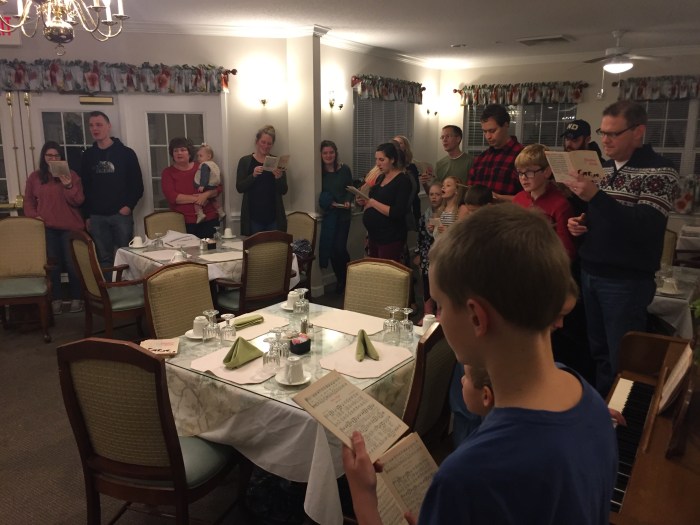
Our family caroled with friends at a local nursing home this past weekend.
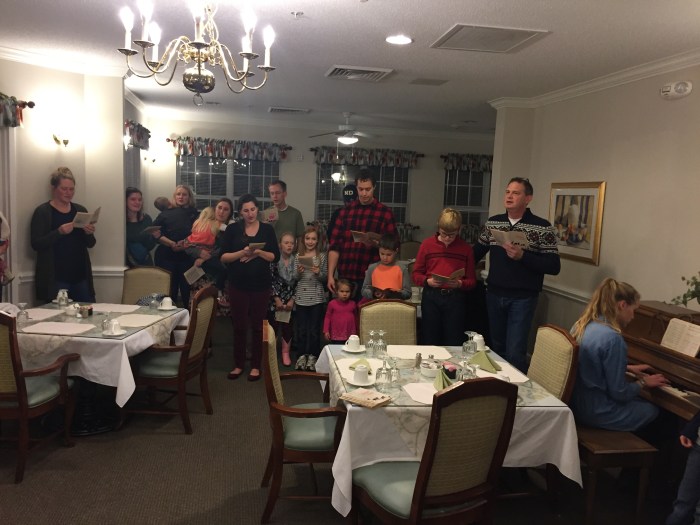
Merry Christmas!
Otherwise
A young man who only asks for painlessness, gentlemen, cannot grow up. To grow up means to have pain. And very heavy pain. There is no other way for life. Have you ever seen a child born? Have you? You should, because then you would know how costly it is to be born, that your mother has a travail. That’s a terrible pain. And that has to be so, because otherwise your life won’t be good.
Life struggles against death, and the heavier, more passionately it struggles, the more life it is. . . . A painless life, gentlemen, is no life. It’s worse than death. Can neither live nor die. (Eugen Rosenstock-Huessy, Comparative Religion, 1954)
A great story
You can learn nearly every secret of life if you really faithfully live out your great love, and become the husband of a wife, of one wife. That’s a great story. (Eugen Rosenstock-Huessy, Comparative Religion, 1954)
Singing and slaying
The Rohirrim sing oft in battle:
Merry and Pippin heard, clear in the cold air, the neighing of war–horses, and the sudden singing of many men. The Sun’s limb was lifted, an arc of fire, above the margin of the world. Then with a great cry the Riders charged from the East; the red light gleamed on mail and spear.
And much later:
And then all the host of Rohan burst into song, and they sang as they slew, for the joy of the battle was on them, and the sound of their singing that was fair and terrible came even to the City.
See also: Worship is warfare, Treebeard, Worship is warfare (2)
Resurrection
Gentlemen, you and I cannot live naturally. . . You must die to your adolescence and just become men. And you have died already to your boyhood and now you are a student. And you have been a baby and you became a boy. And you will have to die to your manhood and become a father. And you will have to die to your fatherhood and become an ancestor. . . And you can’t help it. You have just the choice, to die or to live. That is, time overtakes you all the time, and makes you old. But you can . . . grow old with honor and you can grow old without honor. And you have all the idea that old age has just to be shunned and postponed and you want even to live 150 years, gentlemen. If you can live 70 years spiritually, thank your maker. That’s enough, because in 70 years you have to die perhaps five or six times. And anybody who can conquer death that often, you see, will then die like King David, satisfied with life, as you know. The Bible says that when King David died, he was satiated with life, and had no interest to live another 70 years. And you see how irreligious, how naturalistic modern man is that he actually thinks doctors should be allowed to prolong life to 150 years, old as Methuselah. . . .
Life cannot be arbitrarily shortened. It cannot be arbitrarily prolonged. But it can be mastered, and the mastery of life consists in conquering the deaths that occur in the meantime, in between. (Eugen Rosenstock-Huessy, Comparative Religion, 1954)
The secret of religion
Protestants are inclined to leave [education] more to the public school. It should be the other way around, because the living religious attitude is that part of our growth, or spiritual growth, is that we are becoming more and more the authority for our children, the more we are real fathers and mothers. . . .
The secret of religion [is] that it is a relation between two generations. . . .
Religion begins, gentlemen, with the point of contact between two lives separated by a death. . . And all religion is a victory over death. (Eugen Rosenstock-Huessy, Comparative Religion, 1954)
Did he not make them one, with a portion of the Spirit in their union? And what was the one God seeking? Godly offspring. So guard yourselves in your spirit, and let none of you be faithless to the wife of your youth. (Malachi 2:15 ESV)
 I gotta have my orange juice.