Current events
Fit to Burst is free for Kindle this weekend. It’s not just for moms!
We’re extremely excited that Jamie Soles’s new album is almost ready!
At the moment there are still about 80 tickets remaining for the Andrew Peterson Christmas concert in Durham. You should join us there.
Rene Girard
I’m surprised that it’s taken almost two weeks for me to learn about the death of Rene Girard. May he find himself vindicated, not for seeing everything or even some things aright, but in Jesus Christ!
Watch this interview he gave in 2009 for an introduction to him and his work:
Sabbath feast
I’ve written previously that the long middle section of Deuteronomy serves as an inspired commentary on the ten commandments. If we examine the fourth-commandment section, Deuteronomy 14:21b-16:17, three themes emerge concerning the application of Sabbath-keeping: tithing, rest-giving, and feast-keeping.
We have already concluded that tithing has significant implications for feasting: tithing is linked to Abraham and Melchizedek’s covenant meal of bread and wine; the purpose of tithing is to bring food to God’s house; and in this very section of Deuteronomy feasting is commanded as part of bringing in the tithe.
In the case of the rest-giving of every seventh Sabbath year, there is again an aspect of feasting. The indentured servant set free was to be provided not just with necessary provisions, but with the means of feasting, in light of how God provides for us: “You shall furnish him liberally out of your flock, out of your threshing floor, and out of your winepress. As Yahweh your God has blessed you, you shall give to him.” (Deut. 15:14)
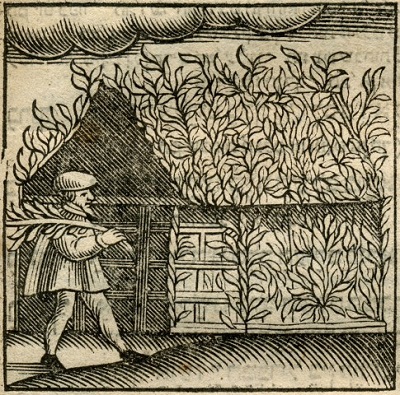 Finally, Moses’s application of the Sabbath commandment culminates in the celebration of the three great annual feasts: Passover, Pentecost, and Booths. These were the three feasts at which Israel was commanded to visit the tabernacle and temple (Deut. 16:16), and here again we have an expression of tithe or tribute given to God (vv. 16b-17).
In the new covenant in Jesus, there is no longer a physical, earthly temple at which we worship. Instead of three great annual worship events, God’s people come to visit him in the heavenly Jerusalem (Heb. 12) week to week as we worship. It is clear throughout the New Testament that the weekly appointed worship of the church is far more the heir of the old covenant’s temple worship than it is of the old covenant’s synagogue meetings. Thus, it is quite proper for us to speak of a weekly feast, because we worship at the very house of God—indeed, we are the house of God—week to week rather than three times a year.
Thus, weekly communion (and weekly tribute-bringing): following the inspired application of Moses, feasting on every appointed day of the Lord is how we are privileged to obey the fourth commandment in the new covenant.
This day is holy
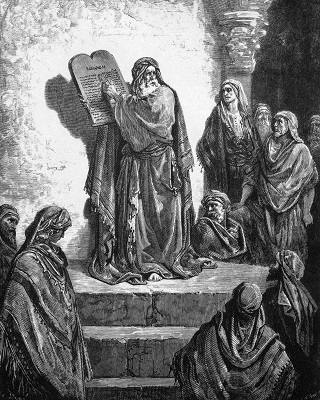 We have seen that bread and wine in worship is commended such that there is “nothing better.” But more than that, the book of Nehemiah teaches us that feasting in worship is in fact commanded:
And Nehemiah, who was the governor, and Ezra the priest and scribe, and the Levites who taught the people said to all the people, “This day is holy to Yahweh your God; do not mourn or weep.” For all the people wept as they heard the words of the Law. Then he said to them, “Go your way. Eat the fat and drink sweet wine and send portions to anyone who has nothing ready, for this day is holy to our Lord. And do not be grieved, for the joy of Yahweh is your strength.” So the Levites calmed all the people, saying, “Be quiet, for this day is holy; do not be grieved.” And all the people went their way to eat and drink and to send portions and to make great rejoicing, because they had understood the words that were declared to them. (8:9-12)
Thus, weekly communion: joyful feasting is commanded on every day set aside for the Lord, every Lord’s day.
Nothing better
The book of Ecclesiastes expresses a faith-filled perspective on life. In light of eternity, we can find joy in the midst of the seeming futility of this life, trusting in God’s wisdom and goodness even though we “cannot find out [that is, fathom] the work [of God] that is done under the sun [that is, in this life]” (8:17). Solomon’s famous counsel is not a counsel of despair, but one of contentment and joy with the gifts God has given us:
And I commend joy, for man has nothing better under the sun but to eat and drink and be joyful, for this will go with him in his toil through the days of his life that God has given him under the sun. (8:15)
Go, eat your bread with joy, and drink your wine with a merry heart, for God has already approved what you do. (9:7)
Solomon’s counsel is true at our own tables, but it is doubly true at God’s table, where our experience of God-given joy is at its highest. Solomon would agree that we are especially to “eat and drink and be joyful” together with Jesus. Jesus has in fact commanded it:
And before Yahweh your God, in the place that he will choose, to make his name dwell there, you shall eat the tithe of your grain, of your wine, and of your oil, and the firstborn of your herd and flock, that you may learn to fear Yahweh your God always. And if the way is too long for you, so that you are not able to carry the tithe, when Yahweh your God blesses you, because the place is too far from you, which Yahweh your God chooses, to set his name there, then you shall turn it into money and bind up the money in your hand and go to the place that Yahweh your God chooses and spend the money for whatever you desire—oxen or sheep or wine or strong drink, whatever your appetite craves. And you shall eat there before Yahweh your God and rejoice, you and your household. (Deut. 14:23-26)
It is precisely in worship that we gain the insight that Solomon is sharing with us; our visit to God’s throne room reminds us that his plans for eternity give meaning to our seemingly meaningless existence in this life. Recall Asaph’s Psalm 73:
But when I thought how to understand [the wicked’s prosperity and righteous’s suffering],
it seemed to me a wearisome task,
until I went into the sanctuary of God;
then I discerned their end. (16-17)
Solomon and Asaph are in perfect agreement, and their perspective allows us to have the kind of quiet contentment David expresses in Psalm 131, and the kind of contented joy that Solomon commends to us both at God’s table and our own.
Thus, weekly communion: as vital as sermons and other Lord’s-day activities are, especially in worship there is truly “nothing better” than to eat and drink and be merry before our king.
Facebread
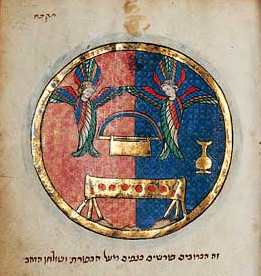 God established that there would be bread set on a table before him in his house “continually” (Ex. 25:30). On this table God also commanded flagons to be set out (Ex. 25:29) filled with beer (Num. 28:7). This continued into God’s new covenant with Solomon (1 Kings 7:48), when God’s presence moved into a palace rather than a tent. Possibly the drink offerings at God’s table also contained wine, especially once Israel entered into the land of promise, as drink offerings of wine begin “when you come into the land” (Num. 15:1-10). Certainly God sets the table in his house today with bread and wine, and the tables in his tent and palace were both modeled after the pattern of his heavenly house (Ex. 25:40, 1 Chron. 28:11-19, Heb. 8:5), where there is surely wine (Matt. 26:29). The bread and beer and wine in God’s house were not reserved exclusively for him; he shared them with the priests who served in his house (Lev. 24:9). God commanded that the table would be refreshed weekly (Lev. 24:8).
The bread in God’s house is called “bread of the presence,” or more succinctly “face bread” or “show bread,” indicating that it rests in front of or in the presence of God. There are twelve loaves of bread on the table (Lev. 24:5), which strongly suggests that it symbolizes the nation of Israel. The table of bread sits before the lampstand, which is fashioned in the style of an almond tree (Ex. 25, 37) and which gives light in front of it (Num. 8:2). The almond design is significant because the Hebrew word for almond also means watcher. This strengthens the suggestion that the bread symbolizes Israel; the bread and lampstand symbolize God’s watching over Israel. Considering the lampstand to be the eyes of a watcher relates to Jesus’s statement that the eye is the lamp of the body (Matt. 6:22, Luke 11:34); our eyes take in and evaluate the world in the same way that the light of a lamp discovers and reveals what is present in a room. Further confirming this reading, elsewhere the seven lamps are explicitly said to be the seven eyes of God (Zech. 4), and Jesus himself is said to have seven eyes (Rev. 5:6).
You might think that in the new covenant, where all God’s people travel all the way in to the most holy place to stand before him in worship (Heb. 4:16), there would be no more need for bread and wine to stand before God to represent us. But the new covenant does have a table filled with bread and wine, and the bread is still said to symbolize Jesus’s body, the church (1 Cor. 10-11). The new covenant in Jesus does not bring an end to ritual; instead, it transforms the ritual in God’s house from one that highlights concentric circles of separation (only priests may enter the holy place, and only priests may eat from this table outside the house) to one that highlights our union with Jesus and with one another (all of God’s people are invited all the way in to his throne room to feast weekly with him).
Thus, weekly communion: in every covenant bread and wine are to be set out continually on the table in God’s house to welcome his people.
Jealousy
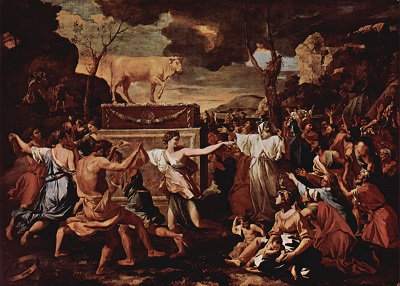 We have said that worship is a kind of tryst between Jesus and his bride. We must also add that it is a tryst at which Jesus expects to find his bride faithful to him. Every Lord’s day is implicitly a day of the Lord. Days of the Lord are a time of inspection and judgment upon the whole world, but particularly a time of inspection for Jesus’s church, because judgment always begins at the house of God.
We see a clear example of this in the book of Revelation, which takes place on the Lord’s day (Rev. 1:10) and which commentators have observed follows the structure of a worship liturgy. Very early in this book Jesus inspects and evaluates seven churches in Asia, and the book itself constitutes an inspection and prophesied judgment upon an eighth church, the apostate house of Israel in Jerusalem.
Such inspections follow the pattern of the jealousy inspection in Numbers 5. The bride brings a tribute offering, which consisted of bread (Leviticus 2) and which we know was also typically offered together with wine (Exodus 29). In addition, the bride drinks, and her drinking reveals her faithfulness or faithlessness. While this ritual seems strange, and there are no human examples of its practice, there are many times when Jesus inspects his bride according to this pattern. One clear example is the case of the golden calf (Exodus 32), where Israel is made to drink water with gold dust and those who were unfaithful to Jesus were put to death. Apostate Israel drank the blood of prophets and saints (Matt. 23, Rev. 16-18), which had the result that “their table became a snare and a trap” (Rom. 11 quoting Ps. 69).
In the same way, the Lord’s supper serves as a jealousy inspection of Jesus’s bride. It is a bringing of bread and wine before Jesus that discriminates between those who fellowship with him and those who fellowship with demons (1 Cor. 10). It distinguishes between those who eat in unity and those who eat in disunity (1 Cor. 10–11; Gal. 2), even to the point of bringing about sickness and death.
A faithful church need not fear Jesus’s inspection, his walking among the lampstands; she can confidently enjoy free fellowship with him at his table. And even a faithless church ought to welcome Jesus, for he brings discipline and restoration for those who repent.
Thus, weekly communion: every Lord’s day is inescapably a day of the Lord; as his bride, we must present ourselves for his inspection together with bread and wine. But we do so in eager anticipation of his blessing (even if it arrives through his discipline) and table fellowship. The inspection ends with the tryst.
DeYoung on interpretive maximalism
Every word in the Bible is in there because God wanted it there. (Kevin DeYoung, Taking God at His Word, 118)
War room
And Jacob said to Pharaoh, “The days of the years of my wrestling and limping and weeping in prayer in my war room are 130 years. Few and evil have been the days of the years of my life, and they have not attained to the days of the years of the life of my fathers in the days of their sojourning.” And Jacob blessed Pharaoh and went out from the presence of Pharaoh. (Genesis 47:9-10 Scott Nonstandard Version)
“It is beyond dispute that the inferior is blessed by the superior.” (Hebrews 7:7 ESV)
Often faith allows you to pass through evil and trials, because it is a far greater, more glorious, and more life-giving victory to pass through them than it is to have them removed (Hebrews 11). Jacob’s trials literally brought salvation to the whole world through Joseph (Genesis 41:57).
Disentangling
Six years ago, I combined several blogs into this one. But the juxtaposition of technical and personal-theological interests is awkward at times.
Today I’ve separated some of my technical posts into a new blog, which I am somewhat whimsically calling “full valence”—