Archive for the ‘Miscellany’ Category
Knowledge of good and evil
As part of a men’s group at church, I had to devise an outline for a class for young men. My first inclination was to structure it around the fruit of the Spirit. I eventually ended up with: (1) love for the Bible, (2) basic doctrine, (3) dominion and vocation, (4) fruit of the Spirit, (5) Kuyperian Chestertonianism (about which see more below), (6) wisdom and leadership. But I’ve just finished rereading J. C. Ryle’s Thoughts for Young Men; I wonder if I was reaching too high and should have stuck with the fruit of the Spirit.
I’ve been searching for a pithy quote from Lewis on the kinds of readers and books that read or are read repeatedly. I’m not sure there is a single quote that catches it all; looks like I am going to have to read An Experiment in Criticism, which is not such a bad thing.
Reflecting more on the topic of wisdom and leadership, as well as some books I could read repeatedly, here is a partial list of things I’ve learned and which I want to pass on to my children:
1. Devote yourself to Scripture. Invest time in it; cultivate your understanding of it and your love for its stories, poetry, and truth. Some men who have helped me here are Dad (by example), Geerhardus Vos (Biblical Theology started me on the road of covenant theology with a striking vision of just how much the Old Testament is shot through with grace), and James Jordan (whose complete audio collection was the best $100 I ever spent, introducing me to the deep typological poetry of scripture and reality). For basic doctrine, J. I. Packer’s Knowing God is an excellent start, and Calvin’s Institutes is hard to beat as a far ranging and pastoral introduction. Peter Lillback’s The Binding of God does a great job spelling out a biblical covenant theology from Calvin’s writings.
It is difficult to summarize just how much Jordan has helped me. He ranges from grand typological patterns down to delightful detailed insights. For example, one fruitful model he develops is a series of exodus patterns from one end of scripture to the other. He identifies a progression of priest, king, and prophet in several contexts. Another great organizing pattern is his idea that Scripture and history have three themes rather than just one. You can observe these themes by considering the two great falls in Genesis 3: (1) if there had been no fall, God’s purpose was for the maturation and glorification of humanity and creation; (2) once Satan fell, God additionally purposed to wage holy war against sin; and (3) once Adam fell, God finally intended to redeem humanity and creation.
2. Wisdom. One of the Bible’s terms for wisdom is knowledge of good and evil (Compare 2 Chron 1:10 with 1 Kings 3:9), which should ring some bells. Relative to Adam and Eve, this points to a connection between wisdom and maturity. Relative to Solomon, this reminds us that wisdom has partly to do with exercising judgment (a la 1 Kings 2:9). James Jordan has impressed on me, partly from his work on the lives of the patriarchs (see his helpful book Primeval Saints) that wisdom, faith, patience, maturity, and what he calls a “long time sense” are all closely linked with one another. I think this is true and bears much fruit upon reflection. See also Hebrews 11.
3. Trust and obey. I have found it tremendously helpful and freeing to look at a situation through the lens of trust and obey. What parts of this situation do I have to entrust to God, and what parts of this am I responsible for? Part of maturity is accepting that a great part of your life and circumstances are beyond your control or authority to change, and may never change.
It goes deeper as well, for there is a way in which trusting must cover all things and also a way in which obeying must cover everything. Our trust must be obedient and our obedience must be full of faith.
4. The fruit of the Spirit. The fruit of the Spirit is the picture of the mature Christian. It is especially important to pursue all of the fruits of the Spirit, lest we become joyful busybodies or self-controlled stoics. It is also important to work hard at cultivating the fruit while we pray for the Spirit’s help. The times you feel least like you are walking effortlessly in the fruit are precisely the times that you have the opportunity to grow in it.
We speak of sharing our “real” or “authentic” selves as if this were a virtue. Certainly there is a place for confessing our fears and temptations one another for the purpose of fighting them. But much of what passes for our “real” selves is the indulgence of our fears and temptations. In fact we are always making a choice how to reveal our selves to the world; we are always wearing one kind of mask or another. We must wear the right mask; we must choose the fruit of the Spirit. It is strange to think that we should be less gracious to those who are close to us.
C. R. Wiley helpfully summarizes much of what a leader must put on as gravitas. See his helpful books Man of the House and The Household and the War for the Cosmos. As part of your work on the fruits of faithfulness and self control, you should be working on knowledge, competence, and even strength and endurance. At the same time, cultivate the fruit of humility, remembering that all these, and leadership itself, are in the service of Another.
5. Mimesis and scapegoating. The imitative scapegoating process is how humans seek justification apart from Jesus (for that matter, it is how we are justified in Jesus). Understanding scapegoating and its tremendous prevalence in our world will help to inoculate us from participating in it, rob it of its ability to surprise and threaten us, equip us to expose and defuse it, and strengthen us to resist it. You should go to Rene Girard; start with his book, I See Satan Fall Like Lightning.
6. Do not be anxious. Anxious leadership is the rock on which many families and institutions have foundered. Edwin Friedman treats on this in A Failure of Nerve (see Alastair Roberts’s helpful summary). If you can fight these subtle forms of anxiety, while also avoiding the errors of apathetic and aloof leadership, all while calmly and confidently resisting anxious and even scapegoating sabotage, then you are well on your way to effective leadership.
7. Torn. Eugen Rosenstock-Huessy’s cross of reality has been a fruitful picture for me. He pictures life laid out on one axis from past to future, and another axis from inside to outside. Families, churches, nations, and businesses are all laid out upon this cross in different ways. For example, in the church, you have the concerns of orthodoxy (past), reformational growth in development and understanding and holiness (future), discipleship (inside), and evangelism (outside). These two dimensions fit together, so that there are inside and outside aspects to past and future, and vice versa. Most people gravitate in particular directions, but it is crucial to any family or institution that all of the directions be adequately represented (sales and engineering depend on each other; every institution is a “body” with eyes and and ears and hands and feet). This means that we must welcome and appreciate a diversity of interests and skills in our families, churches, nations, and workplaces. It also means that in some ways we must be willing to experience internal tensions within ourselves so that these various bodies remain whole. We are torn in little ways along the lines of this “cross” of reality so that the body itself is not torn apart. Love does not insist on its own way. Not every part of family, church, or business life will cater to our interests or stir up our hearts. In fact, it’s best for us that we are surrounded by friends who tug us in different directions.
8. Kuyperian Chestertonianism: two portly men whose work I greatly appreciate. Kuyper I appreciate because of his vision for Jesus’s exhaustive lordship over all of life; his Lectures on Calvinism is a good introduction. There is no sacred and secular; everything belongs to Jesus who is reigning at this very moment on his throne. Chesterton I appreciate for his similar delight in the goodness and glory and surprising freshness of every aspect God’s world. Taken together it really is a thrilling vision.
Jesus is lord of everything, including history, and so I am postmillennial. (He’s lord of our families too, and so I am a paedobaptist as well.) However, Jesus’s world is not just a world in which Proverbs is true, but also Job, and Psalms, and Ecclesiastes. It’s a world in which victory comes through suffering and sacrifice, and resurrection life comes through death. Grappling with the reality of toil and mist is important, but at the same time we are sustained by an inexpressible joy that can only be a gift from God. Doug Wilson’s Joy at the End of the Tether was my first introduction to this hopeful reading of Ecclesiastes. So we die to ourselves gladly, on account of the joy set before us. N. D. Wilson’s books Notes From the Tilt-a-Whirl and Death by Living capture this vision together with an exuberant Kuyperian Chestertonianism.
Various
By now you have probably seen Anderson Cooper and Steven Colbert talk about suffering and grief. If not, have a look. Tolkien uses the words doom and gift to refer to the same things: both the immortality of elves and the mortality of men.
Drew Holcomb and the Neighbors just released a new album.
Come to Andrew Peterson’s 20th anniversary Behold the Lamb of God concert with us.
I wonder where multi-site churches like The Summit Church will be in ten years’ time. I suspect there is a bubble there that will naturally burst, though I pray it happens gently. I wonder if the same is true on a longer timescale (twenty years?) for large denominations over against local semi-formal church networks. Rosenstock-Huessy observes a natural tribe-kingdom-empire cycle in history. If he is right, there is going to be some kind of unexpected metastasis where great institutions everywhere scintillate into smaller forms. We should be cultivating strong local connections anyway, but it will serve us and the church particularly well if such a transition occurs.
A friend recommended B.R.A.K.E.S. driving school very highly. We were able to get Ivy into an upcoming session.
It’s not too early to register to run the 2020 Tobacco Road Half Marathon with Charlotte, Asher, and me.
Contentment
You should probably be using the tool that you hate the most. You hate it because you know the most about it.
Dan McKinley
Crossposted to full◦valence.
Various
Lisa gave me a subscription to the Mars Hill Audio Journal for Christmas; a most thoughtful gift. I’m finally making my way through volume 142, although 143 is due any day now. Myers interviews Alan Jacobs, which led me to check out his blog. I liked this post, and so now I have to add another blog and another book to my list.
Maybe I am listening to too many podcasts. I added C. R. Wiley’s Theology Pugcast, and Peter Robinson has picked up his pace. I haven’t had an open window to fall back on Dan Carlin or my Rosenstock–Huessy listening project in months. Unrelated, I’ve switched to Overcast as my podcast player at Jordan’s suggestion. Mars Hill is the only thing I savor at 1x speed. Is that bad?
Perhaps you will enjoy this poem by Wendell Berry. We’ve loved reading his Selected Poems. I’m trying out Brooks Haxton next (I keep malapropping him as Braxton Hicks).
Easter and Pentecost approach! There seem to still be a few tickets left to join us at Andrew Peterson’s Resurrection Letters concert in Raleigh. Reflecting on Easter from the perspective of the Lord’s Supper, I recalled that there are two cups of wine, and that everyone will drink a cup. Your cup will either be filled with wrath-wine of staggering, or with the king’s festive wine of joy and fellowship. Thanks to Jesus for taking the first cup for us!
Beverly Cleary is still alive! Happy 103rd birthday to her.
I finally finished Man and Woman in Christ. I’m still surprised and delighted to find a very thoughtful and sympathetic charismatic RC. I’ve blogged most of my favorite quotes here, with a couple still awaiting time to transcribe. The book recommendation came from Aaron Renn’s Masculinist newsletter, which I have been enjoying.
The big kids and I are switching from body–weight exercise to strength training using Mark Rippetoe’s Starting Strength program. I’m kind of excited about it especially since they are all interested in joining me in it. It’s been great to run and workout together with them over the last couple years.
Who is proud when the heavens are humble
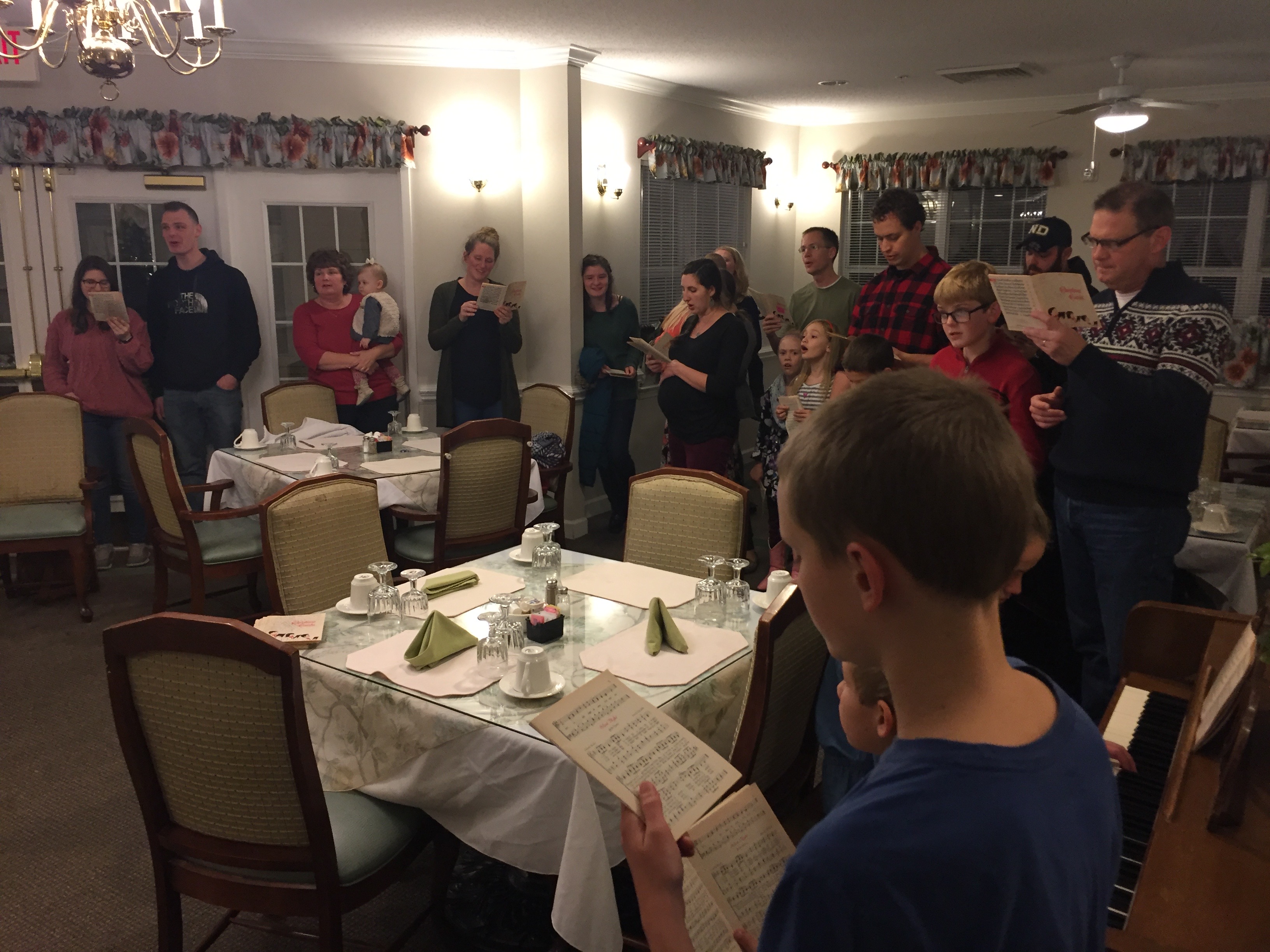
Our family caroled with friends at a local nursing home this past weekend.

Merry Christmas!
Rest
We considered how stress and self-discipline result in growth and strength, whether that is physical, mental, emotional, or spiritual. However, an important corollary of this is that intervals of rest are needed so that we are able to recover stronger instead of ending up progressively worn down.
From nature and our own experience we can see that this rest needs to happen on several cycles. There is a daily rest (1/3 of our time is spent sleeping), a wise principle of weekly rest (one day out of seven), and a yearly rest (winter, vacations). We could even consider the wisdom of longer cycles of rest (e.g., taking sabbatical every 7 to 11 years as many universities practice for their faculty, and as Intel has done).
These principles apply not only to organic life but also to organizations. While agile principles and techniques do increase team efficiency and productivity, it is a mistake to think that agile’s goal is continuous apparent productivity. There are a number of shatterings of continuous apparent productivity that are necessary to healthy agile product development. It is important to brainstorm, learn, conduct retrospectives, take time to refactor, experiment and evaluate alternatives . . . and also to rest. Paradoxically, all of these ways of taking time to slow down often help to improve your team’s long-term productivity.
Obviously our individual daily, weekly, and annual cycles of rest help with the health of our agile team. But the team itself should also be engaging in rest. There are many possibilities here, including team outings and shared meals, team training, and planning for gap sprints or gap weeks to focus on lighthearted or experimental work (what if I rewrote this in Clojure, Haskell, or Racket). In keeping with the spirit of agile, the team should evaluate its own need for rest and plan appropriate kinds of rest.
Crossposted to full◦valence.
Difficulty
Mark Horne writes of strength training:
The rule seems to be that your body adapts so that the most difficult thing you do eventually feels hard to do. As you age this process accelerates. When you give up an activity because it feels hard another one starts to feel hard to do. As your body loses strength you start to avoid tasks and chores that were once easier. You accumulate weakness. In the words of Seneca, “Soft living imposes on us the penalty of debility; we cease to be able to do the things we have long been grudging about doing.”
But this is true not only of your body but also your mind and will and spirit: the hardest thing you do feels hard. This leads us to several helpful insights:
First, it helps us sympathize with others who are experiencing difficulty. It is tempting to despise others who have greater difficulty with smaller challenges compared to yourself. However, this principle allows you to sympathize, since you know that difficulty is relative rather than absolute.
Second, this teaches us that contentment, peace, and joy are not primarily related to our circumstances but to our philosophy and outlook on life. Excluding obvious exceptions such as injustice and extreme hardship, this principle reveals that if you are complaining or anxious in one difficulty, you will still be complaining or anxious in other and even lighter difficulties. Therefore, your work to cultivate contentment, peace, and joy cannot wait; you must find deep roots unrelated to your circumstances. And even in cases of injustice and extreme hardship, this reveals that there is a possible path to contentment, peace, and joy even while you wait on, plead for, and pray for relief.
Third, this also indicates a way to grow in our capacity for work and difficulty. It is helpful simply to recognize that difficulty is relative, since you can cultivate gratitude that you are not experiencing greater difficulty. But this also gives you a tool to expand your capacity: you can periodically subject yourself to greater or artificial difficulty, combined with periods of rest and recovery, in order for your current difficulties to become lighter. In the physical sphere, you increase your capacity with sprint exercises, intervals, and progressive loading. Furthermore, growth in self-discipline and capacity in one sphere of life tends to have a side effect benefit across all of life. It is strangely easier to wake up early and to eat well if you are working hard at strength training; there is a kind of snowball effect to growing in health and strength and capacity.
Finally, all this applies not only to yourself but also to how you can lead others to grow in joy and capacity. As Edwin Friedman writes, “increasing one’s pain threshold for others helps them mature.”
Crossposted to full◦valence.
The joy-filled life
I was delighted by C. R. Wiley’s thoughts on Tom Bombadil in these two blog posts: Bombadil at Home and The Bombadil Option.
I try to keep [Bombadil] in mind when the Gandalfs of the world try to send me gallivanting off on an adventure. I’m not immune, mind you. At times I feel the stirring, and sometimes I even ride off to try and save the day. But eventually I come home again. And after that?—wistfully stare out the window and long for significance?
Or should I gather water lilies for my Goldberry and enjoy her charms; eating the food she has prepared for me and sitting by the fire and laughing as I recall the queer antics of badgers? I think so—because that’s the world I’m made for, the world I go to save when the lust for derring-do sweeps me along. That’s the world I’ve been given to serve as master.
A god too great for the sky
This weekend our small group enjoyed our second annual caroling in downtown Fuquay.

Merry Christmas!
Success
Eugen Rosenstock-Huessy points out that the transitive and intransitive forms of succeed are closely related. It is not possible to “turn out well” without reference to that which you have inherited or followed. All success is dependent on, builds upon, translates, and perhaps transcends, something that has come before.
See also: Less
 I gotta have my orange juice.