Author Archive
Magi, did you know?
Now after Jesus was born in Bethlehem of Judea in the days of Herod the king, behold, wise men from the east came to Jerusalem, saying, “Where is he who has been born king of the Jews? For we saw his star when it rose and have come to worship him.” When Herod the king heard this, he was troubled, and all Jerusalem with him; and assembling all the chief priests and scribes of the people, he inquired of them where the Christ was to be born. They told him, “In Bethlehem of Judea, for so it is written by the prophet:
‘And you, O Bethlehem, in the land of Judah,
are by no means least among the rulers of Judah;
for from you shall come a ruler
who will shepherd my people Israel.’Then Herod summoned the wise men secretly and ascertained from them what time the star had appeared. And he sent them to Bethlehem, saying, “Go and search diligently for the child, and when you have found him, bring me word, that I too may come and worship him.” After listening to the king, they went on their way. And behold, the star that they had seen when it rose went before them until it came to rest over the place where the child was. When they saw the star, they rejoiced exceedingly with great joy. And going into the house, they saw the child with Mary his mother, and they fell down and worshiped him. Then, opening their treasures, they offered him gifts, gold and frankincense and myrrh. And being warned in a dream not to return to Herod, they departed to their own country by another way. (Matthew 2:1–12 ESV)
This is the word of the Lord.
Brothers and sisters, this story is true.
I wish we had time to reflect on everything interesting here. I don’t know what it means for a star to stoop to earth, although I think C. S. Lewis came close to the truth. However, tonight let’s focus our attention on the greater miracle of God’s stooping to earth.
To help us, let’s consider what brought these men here. Our translation calls them wise men; you may also know them as magi, or as three kings “of Orient” (even though the number three is a complete guess). The scope of their wisdom could well extend to dreams, magic, astrology, and sorcery. They come from the east, from Persian lands. All of this may remind you of the Old Testament prophet Daniel and his run–ins five hundred years earlier with Babylonian magicians, enchanters, and astrologers over the matter of dreams and worship—these were the Babylonian magi. Daniel went on to serve the kings of Media and Persia who conquered Babylon. Wise men are record–keepers; they do not forget. It seems likely that Matthew’s wise men had a connection with Daniel the wise man. Were they taught by him to look for and hope in a king of the Jews? Let’s see what they might have learned from Daniel.
The wise men were seeking the king of the Jews. Jew literally means someone from Judah. Since the tribes of Israel returned from their exile in Babylon, they all carried the name of this one tribe from which the great king David came. Daniel knew that God promised Judah would be first among his brothers and would have an unending kingship. From Genesis 49:
“Judah, your brothers shall praise you;
your hand shall be on the neck of your enemies;
your father’s sons shall bow down before you.
Judah is a lion’s cub;
from the prey, my son, you have gone up.
He stooped down; he crouched as a lion
and as a lioness; who dares rouse him?
The scepter shall not depart from Judah,
nor the ruler’s staff from between his feet,
until tribute comes to him;
and to him shall be the obedience of the peoples.” (Genesis 49:8–10 ESV)
Daniel might also have taught the wise men of Babylon the prophecy of Balaam, who declared in Numbers 24 that a victorious star would come out of Judah’s father Jacob:
“I see him, but not now;
I behold him, but not near:
a star shall come out of Jacob,
and a scepter shall rise out of Israel;
it shall crush the forehead of Moab
and break down all the sons of Sheth.” (Numbers 24:17 ESV)
God’s sending a star is a fitting announcement of the coming of the king of the Jews.
Interestingly, even though the prophet Micah came before Daniel, the wise men do not seem to have had his prophecy or did not connect it with their mission. Matthew makes Micah’s prophecy the centerpiece of this little story; it is a second witness that confirms the words of the wise men. A ruler and shepherd will be born for Israel in Bethlehem of Judah. This is just what the wise men are seeking: the king of the Jews.
The prophet Isaiah lived about the same time as Micah, and Daniel was much more likely aware of his writings. Isaiah says that the nations will stream to Israel and her king. He has such a rich set of passages to choose from, but here is one where he shows the nations bringing gold and frankincense, so that Matthew’s wise men are perhaps very deliberately walking right into this prophecy!
Lift up your eyes all around, and see;
they all gather together, they come to you;
your sons shall come from afar,
and your daughters shall be carried on the hip.
Then you shall see and be radiant;
your heart shall thrill and exult,
because the abundance of the sea shall be turned to you,
the wealth of the nations shall come to you.
A multitude of camels shall cover you,
the young camels of Midian and Ephah;
all those from Sheba shall come.
They shall bring gold and frankincense,
and shall bring good news, the praises of the LORD.
All the flocks of Kedar shall be gathered to you;
the rams of Nebaioth shall minister to you;
they shall come up with acceptance on my altar,
and I will beautify my beautiful house. (Isaiah 60:4–7 ESV)
This sounds wonderful for the people of Israel, but why should Persians gladly go out of their way to honor and serve the king of the Jews? These are not even the first Persians to show such interest; emperors Cyrus and Ahasuerus and Artaxerxes showed great interest in Israel and Jerusalem and in God’s temple. What would they have learned from the wise man Daniel, the man who also taught Nebuchadnezzar the ways of God? Could it be that these promises are for us too?
Yes! Daniel knew that God’s promises are for the world and not just for Israel. God’s first promise of salvation from sin and evil was to Adam and Eve, long before the founding of Israel. At the very beginning of Genesis, God cursed the evil serpent, declaring that someone was coming who would wound him. Later, God promised to Abraham that through him “all the families of the earth shall be blessed.” What’s good for Israel is good for the world. We see an early example of this in Genesis when God gave Joseph the Hebrew insight and wisdom to feed “all the earth” during a famine.
Daniel first served the great emperor Nebuchadnezzar, and so Daniel became another blessing to the families of the earth at that time. Nebuchadnezzar had a vision of a great king and kingdom to come that would shatter the kingdoms that came before, that would cover the earth and “never be destroyed.” Later Daniel himself had a vision that this great change would begin in about 500 years. So, the wise men were prepared to wait for just this moment. It seems that little Israel is going to become pretty important.
But something interesting happened to Daniel. An angel told him that part of his vision was to be shut up and sealed: a mystery. Daniel’s mystery is the same mystery that we see ripped wide open much later in the New Testament. The mystery is this: Jesus is not just taking the old ways and the old Israel and setting up Israel in charge of everyone else. Instead, Jesus is making a new kingdom out of and over all nations: his church. The apostle Paul says that Jesus is making a “new man” of the church by uniting Jew and Gentile. He calls the church the “Israel of God,” and the author of Hebrews calls the church the “heavenly Jerusalem.” Paul says that God counts someone a son of Abraham not by genealogy but by faith. The king of the Jews turns out to be the king of kings. What’s good for the church is now good for the world.
Matthew’s wise men may not have understood this mystery of Jesus making a new kind of kingdom, but they did understand from Daniel that Jesus would be king of the world, that the world owes its allegiance to him, and that the world can only find happiness in him. The great irony here is that Herod and all Jerusalem, especially God’s priests, should have known this; in fact, Matthew shows us that they did know it without acknowledging it. In a strange mix of fear and pride, they rejected the king and his blessings and his warnings, clutching their current way of life.
But this baby Jesus, this king Jesus, must have our complete allegiance. Everything is his, so anything that we treasure more than him or apart from him is not ours to have and keep. Herod lost what he tried to keep.
Jesus himself says that everyone who is not against him is for him, and everyone who is not for him is against him. It is not possible to be neutral or indifferent; we are always walking in allegiance or defiance of him. Psalm 2 underscores this test that is set before all of us:
Now therefore, O kings, be wise;
be warned, O rulers of the earth.
Serve the LORD with fear,
and rejoice with trembling.
Kiss the Son,
lest he be angry, and you perish in the way,
for his wrath is quickly kindled.
Blessed are all who take refuge in him. (Psalm 2:10–12 ESV)
There is a high cost but also a rich blessing set before us. We give our very lives to Jesus, day after day after day; he gives us the real blessings of Psalm 2 and Isaiah 60 and so many other passages. The first and greatest blessing is that he forgives all our rebellion. This is why the Christmas angels announce to the shepherds the good news that Jesus is a Savior. And this salvation is the foundation of all his other blessings. All the best Advent and Christmas carols are true! We begin to taste them now through Jesus and his church, and we will eventually receive them in totality. God does not promise bread to his children and give us stones.
It is an open secret that this king is right now sitting on his throne and has infiltrated his enemies’ dominions from the highest to the lowest places. His people enjoy constant communication with him in prayer and by the presence of his Holy Spirit; and we have a special audience with him every week. He has us on a special mission which includes suffering and sacrifice, and this is why we do not yet see all the promises coming true. It is because, through us, he wants to flash his light into every possible darkness, to win more people to himself, and to share his blessings more widely.
It is good to belong to Jesus!
If you do not yet belong to him, I promise you will not regret giving your allegiance to him.
If you do belong to him, then let the great faith of the wise men remind and encourage you that it is good to give your allegiance to Jesus. Your allegiance will be tested, but you will not regret serving him wholeheartedly and unashamedly. Daniel and the wise men show us that we can still serve earthly kingdoms, but Herod is a lesson to us not to make our homes there. Your home is in the house of God.
It is good to belong to Jesus!
Let’s pray.
Father, you gave your only–begotten Son to take our nature upon him. You caused us to be born again and made us your children by adoption and grace. Renew and refresh us by your Holy Spirit, through Jesus Christ our Lord. To you and Jesus and the Holy Spirit be all honor and glory, now and forever. Amen.
Various
Of the Father’s Love Begotten is a new carol to me; I’m liking it very much. The Wexford Carol is not new to me but it is also wonderful.
Another annual treat: Chesterton’s “Gloria in Profundis.”
Duane Garner recently finished a sermon series on the Song of Songs, and now has launched into Revelation.
Some quotes from Eugen Rosenstock–Huessy’s 1954 Comparative Religion class, lecture 16:
Once you have disturbed a holy experience, you have destroyed it. . . . If you and another person go to a grave, and you make a silly remark on the way to the grave, as most people do who go to a funeral, and you are ashamed of your tears, you destroy also the faith and the love of this other person. She has to listen to this silly remark which you make there. . . .
There’s more destruction, gentlemen, done by the people with good intentions and rational philosophy than by anybody else in the world. You do the mischief with your wrong philosophy. Not the “weak” people who cry and laugh and so on. They may be silly, certainly, . . . stupidity is in itself not a merit, gentlemen. But the people who think by their cleverness to be superior, they are much more dangerous. Much more. And the country—the world—America is dying from their silliness.
Did I tell you my story about Scipio? . . . As you know, the Roman Empire has still has quite a ring, even in your ears, as the empire that lasted longer than anything else. The empire only ceased to exist in 1805, and it began in this year 146 before Christ, when Scipio conquered Carthage and Corinth, the last Greek province and the African coast. At that time, the Roman Empire was established as the governess and mistress of the Mediterranean world. Well, to make a very long story short, the gist of the matter was that Scipio wept on the day of the surrender of Carthage. And when he was asked by his best friend and tutor and professor of philosophy why he did weep, . . . he said, “Because when the queen of Carthage perpetrated her unconditional surrender to me, I foresaw the day on which Rome would fall, too.” . . . If you weep, gentlemen, in such a situation, you will prolong the existence of your empire for untold centuries. The Roman Empire has lasted so long, because Scipio wept. And the United States of America will not last, will not last 600 years. It’s impossible, because of the behavior of the Americans in the year of the Lord 1945. They did not weep. They just had a rational philosophy. . . We have carried out our policy. That’s not good enough, gentlemen. . . . Gentlemen, these were people out of which the United States drew all their human reserves for 300 years. Therefore, Europe cannot be treated according to plan. That’s a different story. That’s your family. Maybe the wicked part of the family, but still your own family. . . .
Gentlemen, . . . the condition of the life everlasting is your and my not thinking that we make it. As soon as you think that we make our lives, that we make our policies, that we win our wars, this life will not last long, because you exaggerate the place of plan. . . .
and lecture 17:
And I always feel that many men in this country are so ridiculously intimidated by the girl, and they are so grateful that this girl condescends to marry them, that they sacrifice too much. You sacrifice the better man in you [together with the child–playboy]. This you must never do, because the man in you is the only power that can make this girl happy. She can never rest, when she gets you without your real inner growth, without the stage in which you have reached a decision. Do I make myself clear? And wherever I look, I see this, gentlemen, and it’s so many tragedies in this country—all live between 20 and 30 and after this, no life whatsoever left. This country, which has abolished tragedy, is full of tragedy. It is terrible, and tragedy that can never be healed. Because once a woman has stepped in this sense on your sanctuary and says, “That’s all over now. We get married and that’s all just the past,” she has declined to allow you to grow. And once this is capped, once this is cut, this growing point is seared and cauterized for the rest of your life, you may be the breadwinner of your family, and you may be a little rooster, but that’s all. . . .
Playboy religion is always pluralistic, because they are all short-lived pleasures. They are all shorter than the real life. You can have 10 amours. You can have 20 dates. But you can have only one wife. And you can have 20 drunken parties, you see. But you can have only one wedding, or one great occasion in which your candidacy for office is celebrated or not. But that’s all much more limited. One. But all the pleasures you can multiply. That’s why playboy religion is always multifarious. You can go on from one party to the next, swimming and canoeing and tennis-playing and football, and on it goes. And these pleasures are innumerable. . . .
Gentlemen, that’s why it is necessary to have the Bible. The one book—the Bible is the book of books, as you know. There had to be one book which is only once, in order to make clear to you that you are all apt to get stuck with the best-sellers. That’s the playboy religion, that you go on from one book to the next, and to the next, in endless succession. As long as you play with these books, it’s all right. But it’s the great saving of your orientation that you must know there is one book that is not read for pleasure, and therefore it’s only one. . . . Anybody who wants to abolish religion says that the Bible is literature. Literature is playboy religion, Muses, liberal arts, plural, many, you see. Literature means that one book can take the place of another book. And the Bible means that no book can take the place of this book. There is only one Bible, or there is no Bible. But if there’s no Bible, don’t read it. That is, you can never treat the Bible as literature. You can decide not to read the Bible, because it’s just old stuff and superstition. Nobody can force you to take to the Bible. But never mistake it to be what it is not. The Bible is not one book out of many.
A Failure of Nerve
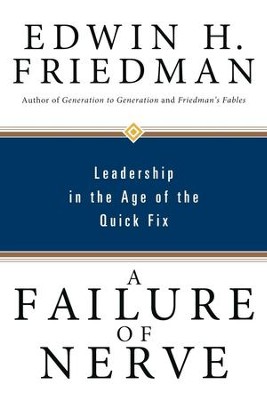 For several years now I’ve appreciated and benefited from Edwin Friedman’s book on leadership, A Failure of Nerve. I enjoy thinking about big ideas that help to make sense of God’s world. For example, it is helpful to think of all sin as being a form of idolatry, or a form of pride, or arising from a kind of covetousness. We look for a structure of conflict and climax in most of our stories. René Girard teaches us to look for imitation and scapegoating in all of the crises of story and history, and points us to the one scapegoat who alone can cover mankind’s sin.
Edwin Friedman’s organizing big idea revolves around anxiety. He was a student of organizational behavior, ranging from families and churches to businesses and nations. He suggests that all of the ways that an organization can break down involve a kind of anxiety on the part of the group or the leader or both. And from this he draws a program of non-anxious leadership.
Friedman sees anxiety behind how a group or organization becomes stagnant, resistant or even hostile to change and growth; and also behind leaders’ addictions to either quick fixes or to data rather then decisive action. He suggests that a non-anxious approach to leadership is crucial, that the “calm presence” of a leader matters more to calming an organization’s anxiety than almost anything else the leader says or does. He develops this into an idea of what he calls “differentiation,” which is the leader’s own focus on his integrity and stability. Out of this non-anxious differentiation, he charges leaders to allow their organizations to experience a healthy dose of their own learning experience and even pain so that they can mature; what you might call a sort of non-anxious “tough love” that is appropriately sympathetic but does not devolve into the kind of empathy that is powerless to help others grow. In Friedman’s model, the leader functions both as a kind of anxiety absorber and also an immune system.
Although Friedman was not a Christian, many of his ideas have Christian parallels. Jesus charges us not to be anxious, and the fact that Jesus himself is not anxious is perhaps the greatest boost to our own faith. It is faith, after all, that is the true antidote to fear and anxiety, and Jesus invites us to bring our cares to him. Perhaps a way of expressing Friedman’s differentiated self is to say that it is a faith-filled, wise, mature, patient, and Spirit-governed self. This integrity of a leader includes the careful watching of his life and doctrine, and the taking of logs out of our own eyes before we address the specks in others’ eyes.
There is a superficial way of reading Friedman that suggests that leaders should be aloof and uncaring. I don’t think this is what he is saying, but in any case we want to be careful not to swing the pendulum that far. And while anxious leadership may be the problem of our time, we should also be on guard for a sinful complacency.
Additional reading:
- Friedman’s outline
- Challenging presence
- Alastair Roberts’ lengthy review and interaction
Friedman’s outline
Edwin Friedman summarizes his leadership principles as follows:
A summary of principles
1. Society
- The characteristics of a chronically anxious family, organization, or society—reactivity, herding, blaming, a quick-fix mentality, lack of well-differentiated leadership—will always be descriptive of a regressed institution.
- When any institution, relationship, or society is imaginatively gridlocked, the underlying causes will always be emotional rather than cerebral.
- All pathogenic (that is, destructive) organisms, forces, and institutions, whether we are considering viruses, malignant, cells, chronically troubling individuals, or totalitarian nations, lack self-regulation and are therefore invasive by nature and cannot be expected to learn from their experience.
- For terrorists to have power, whether in a family or in the family of nations, three conditions must be fulfilled: (1) the absence of well-defined leadership; (2) a hostage situation to which leaders are particularly vulnerable; and (3) an unreasonable faith in reasonableness.
- A major criterion for judging the anxiety level of any society is the loss of its capacity to be playful.
- A society’s culture does not determine its emotional processes; rather, a society’s culture provides the medium through which a society’s emotional processes work their art.
- The basic tension that must constantly be re-balanced in any family, institution, or society is the conflict between the natural forces of togetherness and self-differentiation.
2. Relationships
- It is easier to be the least mature member of a highly mature system than the most mature member of a very immature system.
- Increasing one’s pain threshold for others helps them mature.
- Stress and burnout are relational rather than quantitative, and are due primarily to getting caught in a responsible position for others and their problems.
- In any partnership, the more anxious you are to see that something is done, the less motivated your partner will be to take the lead.
- In any stuck relationship between an overadequate member and an underadequate other (person or organization), the overfunctioner must change before the underfunctioner can change.
- In any relationship anywhere, the partner doing the least amount of thinking about the other is the more attractive one to the other.
- When people differ, the nature of their differences does not determine the extent or the intensity of the differing.
3. Self
- Trauma lies in the self-organizing quality of the system and the response of the organism rather than in the event. In other words, the trauma is in the experience and the response to it, not in the event itself.
- The toxicity of an environment in most cases is proportional to the response of the organism or the institution, rather than to the hostility of the environment.
- What is essential are stamina, resolve, remaining connected, the capacity for self-regulation of reactivity, and having horizons beyond what one can actually see.
- There is no way out of a chronically painful condition except by being willing to go through a temporarily more acutely painful phase.
- People who are cut off from relationship systems, especially their family of origin, do not heal, no matter what their symptom.
- Most of the decisions we make in life turn out to be right or wrong not because we were prescient, but because of the way we function after we make the decision.
- A self is more attractive than a no-self.
4. Leadership
- Mature leadership begins with the leader’s capacity to take responsibility for his or her own emotional being and destiny.
- Clearly defined, non-anxious leadership promotes healthy differentiation throughout a system, while reactive, peace-at-all-costs, anxious leadership does the opposite.
- Differentiation in a leader will inevitably trigger sabotage from the least well-differentiated others in the system.
- Followers cannot rise above the maturity level of their mentors no matter what their mentor’s skill and knowledge-base.
- The unmotivated are notoriously invulnerable to insight.
- Madness cannot be judged from people’s ideas or their values, but rather from (1) the extent to which they interfere in other people’s relationships; (2) the degree to which they will constantly try to will others to change; and (3) their inability to continue a relationship with people who disagree with them.
- People cannot hear you unless they are moving toward you, which means that as long as you are in a pursuing or rescuing position, your message will never catch up, no matter how eloquently or repeatedly you articulate your ideas.
- The children who work through the natural difficulties of growing up with the least amount of difficulty are those whose parents made them least important to their own salvation.
(Edwin Friedman, A Failure of Nerve, 201-203)
Challenging presence
Edwin Friedman has his own way of charging parents to keep a close watch on ourselves, to pay attention to the logs in our own eyes:
Everything I have said above [about data addiction and anxiety] holds true for parenting as well. Over the years I found parents so engulfed in data and techniques that I stopped trying to educate them and started trying to free them from this “syndrome.” I developed a presentation entitled “How to Get Your Kid to Drop Out and Save $100,000 in Tuition” (it was $30,000 when I began). I always mention at the very beginning that all the specific “techniques” I am going to offer such as how to escalate conflict, screw up communication, and increase the generation gap will work better if parents will commit themselves to reading all they can about raising children. This, I point out, will help make them more anxious, more inconsistent, less self-confident, and far less the kind of non-anxious, challenging presence that could ultimately cost them a bundle of tuition. The advantages of trying to keep up, I point out, are that they can consistently worry if they are reading the right book, if the real truth has just come out and they do not even know about it, and if there are experts out there who “know” how to do it.
Parenting is no different from any other kind of “managing.” The critical issues in raising children have far less to do with proper technique than with the nature of the parents’ presence and the type of emotional processes they engender. I have, for example, almost never seen a mother who had mature relationship with her own mother have trouble with her daughter. Similarly, I never saw a highly reactive or hypercritical father who was not distant from his own family of origin (and who, thereby, made the members of his new nuclear family too important to him).
Where parents are willing to take responsibility for their own unworked-out relationships either with their own parents or with one another, children rarely develop serious symptoms. Symptoms in a child are most likely to develop in the areas of the parents’ own traumatization where they, therefore, have the least emotional flexibility. (Parents never seem to get the problems they can handle.) And to the extent child-focus enables parents not to have to deal with their own relationships or their own unresolved issues, that projection process will retard if not nullify all techniques and well-meaning efforts to improve the child, including the aid they seek from tutors and counselors.
To expect parents to focus on the emotional process in their own relationships rather than focus on their children requires having counselors (therapists, educators, clergy, and so on) who are willing to do likewise. And it is much easier for everyone to conspire to focus on data and technique instead. The social science construction of reality that would diagnose children instead of family emotional process, and that would allow parents to blame their ethnic background rather than take responsibility for their own responses, furthers the anxiety.
Edwin Friedman, A Failure of Nerve, 112-113
Hear Ye
My friend Michael and I exchanged our recent listening. Here’s what I’m listening to these days:
- I cycle slowly through the Bible; finishing up Deuteronomy right now
- I just listened to, and loved, Michael Hordern’s recording of The Wind in the Willows
- I’m not a hip hop guy, but I am enjoying Jesus is King and rejoicing in Ye’s conversion
- Get yourself a copy of Jamie Soles’ new Christmas album, In Those Days. This will tide you over until Kanye’s Christmas album is released.
- I use Overcast for my podcast listening. I subscribe to the following podcasts:
- Dan Carlin’s unconventional podcast Hardcore History always grabs my attention
- Doug Wilson thinks about all the things
- C. R. Wiley (you may recall his Bombadil option) and friends are also thinking about all the things
- Peter Leithart, Alastair Roberts, and James Jordan look deep into the Bible’s truth, beauty, and goodness
- Michael Foster and Bnonn Tennant are thinking about biblical manhood
- Can you believe that there is a literary podcast dedicated to Gene Wolfe? Surely this is the best of all possible worlds.
- Although Peter Robinson and his guests are a bit too neocon for my preference, I generally find his Uncommon Knowledge interviews fascinating. Be sure to check out Rene Girard from the archives.
- My friend Duane Garner pastors and preaches at a church in the area
- I listen occasionally to the following podcasts:
- I catch up on my pastors’ sermons when I miss them
- At Mark Horne’s recommendation I listened to Barbell Medicine episodes on programming. Very helpful!
- I checked out the Apologia Radio interview of a pastor working closely with Kanye.
- My friend John recommends The Art of Manliness episodes from time to time. Always good.
- My friend Dan recommends Dad Tired episodes occasionally. Also good. They are coming to the Triangle in February.
- Uri Brito anchors Kuyperian Commentary as well as the Kuyperian Commentary Podcast. If you are a Kuyperian Chestertonian like me, you will enjoy this.
- In between all these, I’m slowly working through, and enjoying, Eugen Rosenstock–Huessy’s recorded class lectures from the 50’s and 60’s
Be sure
As each has received a gift, use it to serve one another, as good stewards of God’s varied grace: whoever speaks, as one who speaks oracles of God; whoever serves, as one who serves by the strength that God supplies-in order that in everything God may be glorified through Jesus Christ. To him belong glory and dominion forever and ever. Amen. (1 Peter 4:10-11 ESV)
I have always read the latter verse as “if you are going to speak, be sure it is an oracle of God; if you are going to serve, be sure it is not in your own strength.” I don’t think this is an unwarranted reading, but my friend Eli pointed me to an important complementary reading that balances the entire passage: “when the oracle comes to you, be sure to speak it; when you are filled with God’s strength, be sure to serve.”
Knowledge of good and evil
As part of a men’s group at church, I had to devise an outline for a class for young men. My first inclination was to structure it around the fruit of the Spirit. I eventually ended up with: (1) love for the Bible, (2) basic doctrine, (3) dominion and vocation, (4) fruit of the Spirit, (5) Kuyperian Chestertonianism (about which see more below), (6) wisdom and leadership. But I’ve just finished rereading J. C. Ryle’s Thoughts for Young Men; I wonder if I was reaching too high and should have stuck with the fruit of the Spirit.
I’ve been searching for a pithy quote from Lewis on the kinds of readers and books that read or are read repeatedly. I’m not sure there is a single quote that catches it all; looks like I am going to have to read An Experiment in Criticism, which is not such a bad thing.
Reflecting more on the topic of wisdom and leadership, as well as some books I could read repeatedly, here is a partial list of things I’ve learned and which I want to pass on to my children:
1. Devote yourself to Scripture. Invest time in it; cultivate your understanding of it and your love for its stories, poetry, and truth. Some men who have helped me here are Dad (by example), Geerhardus Vos (Biblical Theology started me on the road of covenant theology with a striking vision of just how much the Old Testament is shot through with grace), and James Jordan (whose complete audio collection was the best $100 I ever spent, introducing me to the deep typological poetry of scripture and reality). For basic doctrine, J. I. Packer’s Knowing God is an excellent start, and Calvin’s Institutes is hard to beat as a far ranging and pastoral introduction. Peter Lillback’s The Binding of God does a great job spelling out a biblical covenant theology from Calvin’s writings.
It is difficult to summarize just how much Jordan has helped me. He ranges from grand typological patterns down to delightful detailed insights. For example, one fruitful model he develops is a series of exodus patterns from one end of scripture to the other. He identifies a progression of priest, king, and prophet in several contexts. Another great organizing pattern is his idea that Scripture and history have three themes rather than just one. You can observe these themes by considering the two great falls in Genesis 3: (1) if there had been no fall, God’s purpose was for the maturation and glorification of humanity and creation; (2) once Satan fell, God additionally purposed to wage holy war against sin; and (3) once Adam fell, God finally intended to redeem humanity and creation.
2. Wisdom. One of the Bible’s terms for wisdom is knowledge of good and evil (Compare 2 Chron 1:10 with 1 Kings 3:9), which should ring some bells. Relative to Adam and Eve, this points to a connection between wisdom and maturity. Relative to Solomon, this reminds us that wisdom has partly to do with exercising judgment (a la 1 Kings 2:9). James Jordan has impressed on me, partly from his work on the lives of the patriarchs (see his helpful book Primeval Saints) that wisdom, faith, patience, maturity, and what he calls a “long time sense” are all closely linked with one another. I think this is true and bears much fruit upon reflection. See also Hebrews 11.
3. Trust and obey. I have found it tremendously helpful and freeing to look at a situation through the lens of trust and obey. What parts of this situation do I have to entrust to God, and what parts of this am I responsible for? Part of maturity is accepting that a great part of your life and circumstances are beyond your control or authority to change, and may never change.
It goes deeper as well, for there is a way in which trusting must cover all things and also a way in which obeying must cover everything. Our trust must be obedient and our obedience must be full of faith.
4. The fruit of the Spirit. The fruit of the Spirit is the picture of the mature Christian. It is especially important to pursue all of the fruits of the Spirit, lest we become joyful busybodies or self-controlled stoics. It is also important to work hard at cultivating the fruit while we pray for the Spirit’s help. The times you feel least like you are walking effortlessly in the fruit are precisely the times that you have the opportunity to grow in it.
We speak of sharing our “real” or “authentic” selves as if this were a virtue. Certainly there is a place for confessing our fears and temptations one another for the purpose of fighting them. But much of what passes for our “real” selves is the indulgence of our fears and temptations. In fact we are always making a choice how to reveal our selves to the world; we are always wearing one kind of mask or another. We must wear the right mask; we must choose the fruit of the Spirit. It is strange to think that we should be less gracious to those who are close to us.
C. R. Wiley helpfully summarizes much of what a leader must put on as gravitas. See his helpful books Man of the House and The Household and the War for the Cosmos. As part of your work on the fruits of faithfulness and self control, you should be working on knowledge, competence, and even strength and endurance. At the same time, cultivate the fruit of humility, remembering that all these, and leadership itself, are in the service of Another.
5. Mimesis and scapegoating. The imitative scapegoating process is how humans seek justification apart from Jesus (for that matter, it is how we are justified in Jesus). Understanding scapegoating and its tremendous prevalence in our world will help to inoculate us from participating in it, rob it of its ability to surprise and threaten us, equip us to expose and defuse it, and strengthen us to resist it. You should go to Rene Girard; start with his book, I See Satan Fall Like Lightning.
6. Do not be anxious. Anxious leadership is the rock on which many families and institutions have foundered. Edwin Friedman treats on this in A Failure of Nerve (see Alastair Roberts’s helpful summary). If you can fight these subtle forms of anxiety, while also avoiding the errors of apathetic and aloof leadership, all while calmly and confidently resisting anxious and even scapegoating sabotage, then you are well on your way to effective leadership.
7. Torn. Eugen Rosenstock-Huessy’s cross of reality has been a fruitful picture for me. He pictures life laid out on one axis from past to future, and another axis from inside to outside. Families, churches, nations, and businesses are all laid out upon this cross in different ways. For example, in the church, you have the concerns of orthodoxy (past), reformational growth in development and understanding and holiness (future), discipleship (inside), and evangelism (outside). These two dimensions fit together, so that there are inside and outside aspects to past and future, and vice versa. Most people gravitate in particular directions, but it is crucial to any family or institution that all of the directions be adequately represented (sales and engineering depend on each other; every institution is a “body” with eyes and and ears and hands and feet). This means that we must welcome and appreciate a diversity of interests and skills in our families, churches, nations, and workplaces. It also means that in some ways we must be willing to experience internal tensions within ourselves so that these various bodies remain whole. We are torn in little ways along the lines of this “cross” of reality so that the body itself is not torn apart. Love does not insist on its own way. Not every part of family, church, or business life will cater to our interests or stir up our hearts. In fact, it’s best for us that we are surrounded by friends who tug us in different directions.
8. Kuyperian Chestertonianism: two portly men whose work I greatly appreciate. Kuyper I appreciate because of his vision for Jesus’s exhaustive lordship over all of life; his Lectures on Calvinism is a good introduction. There is no sacred and secular; everything belongs to Jesus who is reigning at this very moment on his throne. Chesterton I appreciate for his similar delight in the goodness and glory and surprising freshness of every aspect God’s world. Taken together it really is a thrilling vision.
Jesus is lord of everything, including history, and so I am postmillennial. (He’s lord of our families too, and so I am a paedobaptist as well.) However, Jesus’s world is not just a world in which Proverbs is true, but also Job, and Psalms, and Ecclesiastes. It’s a world in which victory comes through suffering and sacrifice, and resurrection life comes through death. Grappling with the reality of toil and mist is important, but at the same time we are sustained by an inexpressible joy that can only be a gift from God. Doug Wilson’s Joy at the End of the Tether was my first introduction to this hopeful reading of Ecclesiastes. So we die to ourselves gladly, on account of the joy set before us. N. D. Wilson’s books Notes From the Tilt-a-Whirl and Death by Living capture this vision together with an exuberant Kuyperian Chestertonianism.
Duty
Duty impresses a structured hierarchy onto our lives. Duty never says, “You be you,” or “Go ahead and do what makes you happy.” Duty says, “This is who you are; do what is required.”
C. R. Wiley, The Household and the War for the Cosmos
I felt this was the key difference between the movie and book versions of A Wrinkle in Time, and perhaps many other such pairs as well.
See also: Self-control
Inventory
As soon as you don’t read the New Testament, all these irreligions come up again, because the Bible isn’t written as a luxury of sentiment. It is written as the inventory of the stupidities of the human race.
Eugen Rosenstock-Huessy, Comparative Religion, 1954
 I gotta have my orange juice.