430
Awhile back, I wrote about seventy sevens and suggested that the figure of an evaluation period of 490 years might also have a connection with 430 years (as in the case of the sin of the Amorites), if you count as Sabbath not only Sabbath years but also jubilee years.
There is another evaluation period of 430 years in Ezekiel, broken into a 390 + 40:
“Then lie on your left side, and place the punishment of the house of Israel upon it. For the number of the days that you lie on it, you shall bear their punishment. For I assign to you a number of days, 390 days, equal to the number of the years of their punishment. So long shall you bear the punishment of the house of Israel. And when you have completed these, you shall lie down a second time, but on your right side, and bear the punishment of the house of Judah. Forty days I assign you, a day for each year. And you shall set your face toward the siege of Jerusalem, with your arm bared, and you shall prophesy against the city. And behold, I will place cords upon you, so that you cannot turn from one side to the other, till you have completed the days of your siege. (Ezekiel 4:4-8)
430 years of evaluation plus 70 years of judgment makes for a nice round 500 years.
I think we still must take Daniel’s seventy sevens symbolically. There are more, not less, than 490 years to be made up between Cyrus and Jesus.
Books
Goodreads sent a note congratulating me for reading three books in 2014, which didn’t seem quite right even though it has been a very busy year! It turns out that I’d not marked a “date read” for many of the books, bringing the tally to 15, including some read-alouds with the kids.
My top three books for 2014 are:
- Poetry: Beowulf
- Fiction: Peace Like a River, by Leif Enger
- Non-fiction: The Supper of the Lamb, by Robert Capon
The Lord of the Rings earns an honorable mention; while it was not a new book for 2014, we really enjoyed listening to the Rob Inglis narration together as a family. Right now we are partway through reading The Yearling aloud, and plan to read N. D. Wilson’s Boys of Blur next.
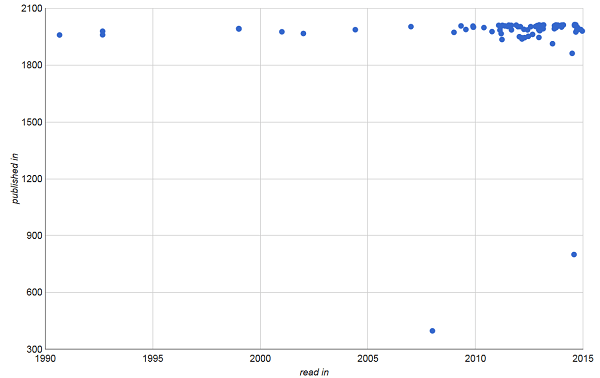
For fun, I looked up some of my Goodreads stats. The date read vs. date published chart is fascinating. Augustine and Beowulf are my outliers. Some huge gaps to fill in there!
Future
Peter Leithart writes about one of the symbolic undertones of the ritual of circumcision:
This also highlights the fact that circumcision is the beginning of a pedagogy of weakness, of renunciation of fleshly achievement, of renunciation of the future. If circumcision is a symbolic sacrifice of a newborn son, it is a symbolic offering of the future of your name and family to Yahweh. If Yahweh chooses to raise your son from the dead, then you have a future. But the act entrusts the future into Yahweh hands, which is of course where the future always lies anyway.
The ritual of baptism is the reverse of this in some ways; it is actually our induction into a future that has already begun:
[God] saved us, not because of works done by us in righteousness, but according to his own mercy, by the washing of regeneration and renewal of the Holy Spirit (Titus 3:5)
In baptism we are joined to Jesus, who has completed the exodus into the new creation (Luke 9:31) and reigns seated at the right hand of God the Father Almighty. Even now we reign with him (Ephesians 2:6). We must still suffer and sacrifice as we look towards the full arrival of this future, and we must still entrust it to God (Ephesians 2:7), but in baptism there is a much greater emphasis on the future’s present arrival in Jesus, and on the church’s participation with him in not just announcing, but actually living out, the kingdom of the new creation.
See also: In the regeneration
Literaturely
Calvin Seerveld writes movingly on how to read the Bible:
The true story of God’s great deeds has been written down (John 20:31) so that we may believe Jesus is the Christ, the son of God, and so believing have life in his name. The Holy Scriptures have been given us historically so that we might come to know the covenanting God and his way of doing things in creation and so that we might be able to obey him more maturely as adopted sons and daughters, who had lost their way in the world. That is crucial, I believe, for rightly understanding the Bible, this God-speaking literature. It must always be pulled back to its primary level of true story for believing children.
That’s a test I have always used when challenged in my confession: I recall the way I responded as a wide-eyed child to Mother reading me Bible stories before I was trundled off to bed. Adam and Eve were real people then . . . and now, quite unlike Sleeping Beauty and Prince Charming. Balaam’s ass saw the angel and talked, and God had a whale swallow Jonah—it said so—because God loved the Israelites so much and all the people and cows around Ninevah; but Hansel and Gretel and the witch in the forest were not people in a true story. Somehow my believing parents gave me a lasting sense of how Genesis 3 and Romans 5, Exodus 20 and Matthew 5–7, Psalm 90, Isaiah 40 and Romans 8—all richly, literarily variegated—integrally told the true story of God’s saving presence on the earth, especially for those who took him at his Word, as my Dad would say (cf. I Timothy 4:10). I learned to use the Bible not so much as a book of special, extra, inside information (the way Thomas Aquinas conceived it, cf. Summe contra gentiles, 4, i) but as a source of knowledge-to-grow-on, the kind of vision (nouthesia) your father would give you as an inexperienced lad who was walking around in the world (Bible as “spectacles,” to use John Calvin’s phrase). And it is that kind of humbled, childlike, expectant hearing and fiducial reception (to use an early English Puritan expression) that I believe must be the first and last way one meets the God-speaking literature called the Bible.
So what am I after? Just this: (1) It is an insight of christian aesthetic theory that bona fide art presents reliable, specific knowledge for others to grasp; and that knowledge is of its own imaginative, suggestion-rich sort. (2) Literature is thoughtful writing that is characterized by such an artistic norming. (3) The Bible is God-speaking literature telling us a true story; that is its nature. Therefore, when faithful, childlike people read the Bible, they should read it literarily. One should not read the Bible literalistically (=”literally”?) and then figuratively when one gets stuck. One should always read it literarily, literaturely, the way it is written, to mine its special wisdom-making, true-storied knowledge for children.
The Bible is not a collection of atomic, bullet like proof-texts to be shot at people. It will take a trained person who subsumes verses within paragraphs, within chapter wholes, within total books, within the perspicuous true story connection I mentioned to interpret Scripture word for word. The Bible is not an anthology of lessons in piety which can be distributed, so to speak, like candy to whoever holds out his hand. The Bible does not give recipes, which when followed to the letter, make wonderful devotional soup. Only when the mighty, true story of civitas Dei vs. civitates mundi dominates the reading of the quiet pilgrim psalm 131 or jumps out at you from Genesis 32 when Jabbok becomes Peniel or overwhelms you seeking comfort in the letter to the Philippians: only then does one learn the God-fearing, quiet intensity (eusebeia) that is becoming to a child of God. The Bible is not like a telephone book where you can find God’s special number for emergency use, and all the heavenly office numbers to call for marriage, births and funerals, lonely hearts, potential suicides, earthquake-like disasters. People use the Bible that way, and God stoops to their weakness, but human weakness does not define the Holy Scriptures.
I am continually bowled over by the fact that this is the book where we hear God talking about what He is actually doing in the world; and its true story is so powerful, with cosmic, historic sweep and a tenderly passionate, apocalyptic temper that one says spontaneously with Paul (Romans 15:4), “All the things written earlier were put in writing for us to understand so that through the firming up and comforting power of the Scriptures we might have hope!” Part of what I am after, as a christian aesthetician, is greater recognition of the Bible as God-speaking literature that is telling a true story, so that the Bible not be so easily trivialized into a private, short-order, spiritual cookbook. That denatures the Holy Scriptures, no matter how infallible you claim the book to be. (Rainbows for the Fallen World, 90-92)
Anointing
And [Jesus’s disciples] cast out many demons and anointed with oil many who were sick and healed them. (Mark 6:13)
Is anyone among you suffering? Let him pray. Is anyone cheerful? Let him sing Psalms. Is anyone among you sick? Let him call for the elders of the church, and let them pray over him, anointing him with oil in the name of the Lord. And the prayer of faith will save the one who is sick, and the Lord will raise him up. And if he has committed sins, he will be forgiven. (James 5:13-15)
In the old covenants, priests and kings were ordained through anointing with oil. In the new covenant, all God’s people are priests (1 Pet. 2:5) and are seated with Jesus as kings (Eph. 2:6). You might expect that anointing would be used for all believers as a sign of our union with Jesus the anointed one through his Holy Spirit. So it is a little startling that God appoints anointing, not for our baptism, but for those who are sick or in pain.
Of course there is no magic in either the oil or in the act of anointing. Instead, what this is showing us is that Christians who suffer sickness or pain have a unique privilege of closer fellowship with Jesus as they suffer under the curse. You could say that this anointing establishes a sort of office of suffering, in which Christians who endure sickness and pain are recognized and honored as having a special position in the service of our anointed king.
When the elders of the church anoint and pray for those who are sick, the church is, through her elders, honoring those whom Jesus has called to suffer, and praying that Jesus will by his Holy Spirit sanctify their suffering for his glory and praise. The church is also identifying sick believers with Jesus, the anointed one who heals us (Matt. 11:1-16), and with the Holy Spirit, the one who brings life to our mortal bodies (Romans 8:11). Finally, through this we pray earnestly that Jesus will bring their suffering to an end, just as Jesus’s own suffering was finally crowned with his glorification and reign.
Five years
Five years ago we celebrated Asher’s third birthday at the Outer Banks. Here’s a picture from our visit to Jockey’s Ridge:

Last week we went back to the Outer Banks with some friends from church and recreated the picture:

Mercy seat
I wrote recently about one way in which the cross is a type of the day of atonement.
My friend Al writes about another way in which the resurrection is a type of the day of atonement:
. . . In John 20 the stone on which they laid Jesus at this death is empty when Mary visits on the first day of the week. But on either side of the empty bed is an angel. It seems intentional that John wants us to see this place, the resurrection place, as a new mercy seat; the resurrection bed of Jesus is the new place of covering for the law.
He was raised for our justification . . .
Cubit
Ezekiel experiences a vision in which an angel shows him a meticulously measured temple and city. One of the fascinating aspects of this vision is that we are told exactly how we are to meditate on it:
As for you, son of man, describe to the house of Israel the temple, that they may be ashamed of their iniquities; and they shall measure the plan. And if they are ashamed of all that they have done, make known to them the design of the temple, its arrangement, its exits and its entrances, that is, its whole design; and make known to them as well all its statutes and its whole design and all its laws, and write it down in their sight, so that they may observe all its laws and all its statutes and carry them out. (Ezekiel 43:10-11)
We are to see the careful measurements and reflect on the rectitude of our lives and God’s church.
Ezekiel’s visionary temple was never intended to be built, but to reflect the spiritual situation at the return from exile, where God planned for Israel to have a greater influence on the spiritual life of the nations. Consider Nehemiah and Esther, the synagogues that appear throughout the Roman empire in Paul’s day, and the Gentile God-fearers in Acts.
Another interesting thing we learn in Ezekiel’s vision is that the angelic-spiritual cubit is one and a half human cubits:
And behold, there was a wall all around the outside of the temple area, and the length of the measuring reed in the man’s hand was six long cubits, each being a cubit and a handbreadth in length. . . (Ezekiel 40:5)
These are the measurements of the altar by cubits (the cubit being a cubit and a handbreadth): its base shall be one cubit high and one cubit broad, with a rim of one span around its edge. . . (Ezekiel 43:13)
In the book of Revelation, John receives a vision of the new-covenant people of God. The dimensions of the new covenant far exceed those of the restoration covenant. But John also emphasizes that the relationship between human and angelic measurements has changed:
He also measured its wall, 144 cubits by human measurement, which is also an angel’s measurement. (Revelation 21:17)
Why the change? There are a few things we can say about this progression. Psalm 8 and Hebrews 2 indicate that man was made “a little lower than” the angels, but that Jesus and his people are now, instead, “crowned with glory and honor,” exercising dominion over the whole world. Under the old covenants, we were under the tutelage of a law delivered by angels, but in Jesus we have now entered into maturity (Gal. 3-4, Heb. 2). Once it was cherubim that guarded the way to God’s throne, but now the keys to the kingdom have been given to the church (Matthew 16:19), and we are enthroned with Jesus (Eph. 2:6, Rev. 20:4). It is even the case that the church will judge angels (1 Cor. 6:3).
What is happening in the new covenant is that heaven and earth now kiss. Today that takes place spiritually every Lord’s day when we stand before the throne (Heb. 12:22ff); one day that will be a physical reality. Earth will be so fully remade after the heavenly pattern that all earthly measurements conform to heavenly ones; the permanent dwelling place of God will no longer be with the angels:
And I heard a loud voice from the throne saying, “Behold, the dwelling place of God is with man. He will dwell with them, and they will be his people, and God himself will be with them as their God.” (Revelation 21:3)
Glory and beauty
In Exodus 28, God instructs Moses in the creation of “holy garments for Aaron your brother, for glory and for beauty.” The innermost garments are linen undergarments, and upon them are layers of more glorious garments. Ordinarily the high priest wore all these garments for his duties. But on the day of atonement (Leviticus 16), he was to enter into the most holy place dressed only in linen: undergarments, coat, sash and turban. “These are the holy garments” (emphasis added).
The white linen of holiness serves as the precondition — the foundation, the root — of the color and sparkle of glory and beauty. (Equally, we might add, does a blood sacrifice serve as the precondition of glory and beauty.)
How else can we speak of what grows from this root of holiness? The fruit of the holy Spirit is “love, joy, peace, patience, kindness, goodness, faithfulness, gentleness, self-control” (Galatians 5). This is how you measure glory and beauty.
Alwaies Autumne
John Donne preached the following on Christmas evening in 1624:
God made sun and moon to distinguish seasons, and day, and night, and we cannot have the fruits of the earth but in their seasons: But God hath made no decree to distinguish the seasons of his mercies; In Paradise, the fruits were ripe, the first minute, and in heaven it is alwaies Autumne, his mercies are ever in their maturity. We ask panem quotidianum, our daily bread, and God never sayes you should have come yesterday, he never sayes you must come againe tomorrow, but to-day if you will heare his voice, to-day he will heare you. If some King of the earth have so large an extent of Dominion, in North and South, as that he hath Winter and Summer together in his Dominions, so large an extent East and West, as that he hath day and night together in his Dominions, much more hath God mercy and judgment together: He brought light out of darkness, not out of a lesser light; he can bring thy Summer out of Winter, though thou have no Spring; though in the wayes of fortune, or understanding, or conscience, thou have been benighted till now, wintred and frozen, clouded and eclypsed, damped and benummed, smothered and stupified till now, now God comes to thee, not as in the dawning of the day, not as in the bud of the spring, but as the Sun at noon to illustrate all shadowes, as the sheaves in harvest, to fill all penuries, all occasions invite his mercies, and all times are his seasons.

