Archive for the ‘Worship’ Category
Prophet
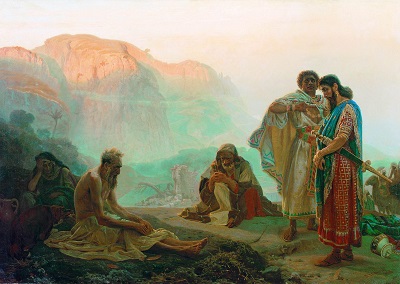 I’ve just finished reading Toby Sumpter’s outstanding commentary on the book of Job, Job Through New Eyes: A Son for Glory. Sumpter works hard to understand Job in terms of God’s declaration that Job has “spoken of me what is right” (42:7), and he makes a compelling case for his reading.
Sumpter’s thesis draws on the observation that, at the outset, the righteous Job is conspicuously absent from God’s courtroom, where the sons of God stand before him. But at the end of the book, Job is now one of these sons of God, standing before God in the position of a prophet. This is the inspired assessment of James (James 5:10-11), but we see it in the book of Job itself. God’s arrival to speak with Job is exactly what he does with his prophets (Amos 3:7). At the end, Job stands in the position of an intercessor for his friends and God has accepted Job himself (literal rendering of Job 42:9). It is the mark of a prophet to stand in the council of God, to hear God’s decrees and speak to his face. Consider Abraham’s conversation with God in Genesis 18:22ff, and his later intercession for Abimelech in Genesis 20:7, where God himself identifies Abraham as a prophet. Moses the prophet similarly intercedes for Israel before God in Exodus 32:11ff.
Seen in this light, the book of Job is the story of God’s wrestling with Job to draw him up into his presence. Job’s suffering is a sort of sacrificial ascension that carries him up to God. Job’s patient suffering and persistent wrestling are the very things that qualify him to stand before God. God’s calls to Job to “dress for action” (38:3, 40:7) are not part of some plan to put Job down into his place; they really are invitations from God as father to his son Job to come up and continue to wrestle. We are reminded of Jacob and Jesus at the Jabbok river (Genesis 32). Job does not model for us a perverse desire for death or to second-guess God; he models a godly desire for resurrection, vindication, and participation in God’s council.
It is interesting to me that the first of the kingly wisdom books thus anticipates the prophets. It is a peek ahead in history, showing that the ultimate purpose of kingship and dominion is not merely to be thrifty assistant managers of creation, but to grow to stand before God as junior co-creators with him. A king brings things to pass by the re-forming work of his hands, but a prophet speaks new things into being with words. As wisdom literature, Job is not a scholarly treatise on God’s sovereignty; it is a kingly training manual, teaching us how to wrestle with the Spirit’s whirlwind. Job teaches us to plead with God, like Moses (Exodus 33:15), for his presence and nearness. Like other wisdom literature (consider some of the Psalms, the Song of Solomon, Ecclesiastes), this manual is a tough nut to crack, a hidden treasure requiring kingly persistence (Proverbs 25:2).
There are two levels at which this applies to the church today. First, it is still the case that one of the surest paths to maturity and to deeper fellowship with Jesus is fellowship with him in suffering. We must, like Job, hold fast in faith to the almost childlike desire to meet with Jesus in our suffering, to see his face.
But at another level, we all enjoy the privilege of standing in God’s council as prophets (Acts 2:17) because we are united with Jesus. It is his suffering and ascension that qualify us to this position (Ephesians 2:4-7), so that we can plead to God with even greater boldness than Job. However, even this calls us to a kind of suffering and deprivation. Whether or not we actually lose everything for Jesus’s sake, we are to count everything as a loss (Philippians 3:7-8, Luke 14:26). If we thus identify with him in his death, we enjoy his resurrection and vindication, and are brought up with him to stand in his presence. The king calls us his friends, his counselors, because he has made everything known to us (John 15:15).
Christians enjoy this status at all times, but we experience it most powerfully every Lord’s day when Jesus holds court with us. We stand before him to dialog with him: receiving his invitation, calling on him in worship to act for his people, bringing tribute to him, hearing a word from him, eating a meal at his table, and being commissioned afresh to our weekly work.
Thus, in one sense, Christians now enjoy the fulfillment of Job’s pleading and prayer, and we are to the world what Job was to his friends: those who bring life in Jesus. Jesus, the latter Job, has even cast Satan out of the heavenly court. But in another sense, we are not satisfied, and we plead with God, like Job and Moses, to see his face more brightly.
Famine
I’ve appreciated what Doug Wilson has had to say about contemporary food idolatries. His latest post is a little oblique, but good. Pulling out some punchy sound bites (and completely glossing over the necessary caveats):
I believe that some wives, in the way they pursue “healthy” menu choices for their home, are inadvertently trying to teach their husbands and children how to cheat. . . .
A school district in New York just recently dropped the First Lady’s school lunch program because the kids were hungry all the time. What happens in a family where the first lady there has implemented a similar regime and does not have buy-in from her husband and kids? One of the obvious things is that the husband often has the resources to fix things at lunch with a greasy burger, after obtaining a vow from his co-workers to “not tell a soul.”
. . . [A] man should not work to put food on the table, his own table, and then come away from that table hungry. . . . [I]t is crucial that the home not become a place of tight-fisted denial, where wives become the governess of no, instead of the mistress of yes.
 I have no idea how common this is. But I want to sidestep that question and take this in a different, but related, direction. There is one marriage, one family, one house and one table that will endure into eternity. These are the archetypes for our marriages, families, houses and tables. So, what kind of table do we believe that Jesus provides for his own bride? And what kind of table is Jesus’s bride setting for him? Is it a famine or a feast?
I’m referring to the Lord’s supper, the new covenant’s one food law and the fulfillment of all old-covenant feasts. We eat this meal together with Jesus at his table in his house. As his bride, we should adorn the table and prepare a kingly feast. And as priests to the king, we have the privilege and responsibility to serve at his request as his royal chefs. There are no more animal sacrifices, of course; we now offer ourselves and the work of our hands, however imperfect, for his evaluation and approval.
Grain and grapes are the Bible’s repeated image of the fruit of the blessed land. Transformed by man’s week-day labor into bread and wine, God uses them again and again to picture the food of the seated and reigning Messiah-king. Because we are seated with him, Jesus gives us a physical taste of his new kingdom; and it is the actual eating and drinking of real bread and wine that is sacramental, rather than merely reflecting on the idea of bread and wine. The Lord’s supper should, as much as possible, convey the greatness, goodness and richness of Jesus’s kingdom. Wherever possible, it is fitting for the church to enjoy the Lord’s supper weekly and to do so lavishly, with rich bread and good wine.
See also: Pig out, Sabbath, The Lord’s table.
Sabbath
Some commentators suggest that the structure of the middle section of Deuteronomy follows the ten commandments. Moses, having meditated on the law over the course of thirty-eight years in the wilderness, preaches an inspired sermon to Israel reflecting on the greater meaning and application of the law. There is some minor disagreement as to the exact boundaries within this part of Deuteronomy, but one possibility is given by James Jordan in his book, Covenant Sequence in Leviticus and Deuteronomy:
- First commandment: Deut. 6-11
- Second commandment: Deut. 12-13
- Third commandment: Deut. 14:1-21a
- Fourth commandment: Deut. 14:21b-16:17
- Fifth commandment: Deut. 16:18-18:22
- Sixth commandment: Deut. 19:1-22:8
- Seventh commandment: Deut. 22:9-23:14
- Eighth commandment: Deut. 23:15-24:7
- Ninth commandment: Deut. 24:8-25:3
- Tenth commandment: Deut. 25:4-26:19
This is in keeping with other places such as Proverbs and Matthew 5-7, where we see further wisdom drawn from reflection upon the law: Moses, Solomon and Jesus are all inspired commentators on the ten commandments. This also supports the church’s practice of striving to read and apply the commandments with maximum breadth. For example, Calvin writes that “in almost all the commandments, there are elliptical expressions, and that, therefore, any man would make himself ridiculous by attempting to restrict the spirit of the Law to the strict letter of the words.” He concludes that, “thus, the end of the Fifth Commandment is to render honour to [all] those on whom God bestows it” (Book II, Chapter 8, Section 8), since the Bible understands the term “father” quite broadly. In just the same way, the Westminster Shorter Catechism states that the fifth commandment requires us to bestow honor and perform duties “belonging to everyone in their several places and relations, as superiors, inferiors, or equals.” Paul himself seems to make this application of the fifth commandment in Ephesians 6, if we consider all of verses 1-9 to be joined together. And Moses does likewise in Deut. 16:18ff as suggested above.
 This observation lends us an interesting bit of help in understanding how the Sabbath commandment can be transfigured in the new covenant from Sabbath to Lord’s day, from last day to first. In the fourth-commandment section (Deut. 14:21b-16:17), Moses mentions three of the seven feasts that God gave to Israel. We see the full list of feasts spelled out in Leviticus 23, beginning with the weekly Sabbath feast and culminating in the feast of booths. The three feasts that Moses lists here in Deuteronomy are the ones that God required to be celebrated at his house. Reading through the entire section, Moses’ application of the fourth commandment establishes the following principles:
- We obey the fourth commandment by bringing a tithe to God’s house
- We obey the fourth commandment by showing generosity and granting rest to others
- We obey the fourth commandment by keeping God’s appointed feasts at his house
These principles help us to understand how Saturday’s Sabbath is transfigured to Sunday’s Lord’s day in the new covenant. God’s house is the gathering of his people before him in worship, and in the new covenant all of the feasts of Leviticus 23 are fulfilled in one feast, the Lord’s supper. Connecting this to Moses’ application of the fourth commandment, we see that the Sabbath itself is fulfilled in the Lord’s supper. Certainly there is much more that needs to be said, but we can say this: when Jesus’s church gathers in his house to celebrate his feast with him and to bring him tribute, there the fourth commandment is being kept.
This also lends support to the practice of weekly communion.
The picture above was painted by my friend, the very talented Jermaine Powell.
Worship is the foundation of righteousness
The first foundation of righteousness undoubtedly is the worship of God. When it is subverted, all the other parts of righteousness, like a building rent asunder, and in ruins, are racked and scattered. What kind of righteousness do you call it, not to commit theft and rapine, if you, in the meantime, with impious sacrilege, rob God of his glory? or not to defile your body with fornication, if you profane his holy name with blasphemy? or not to take away the life of man, if you strive to cut off and destroy the remembrance of God? It is vain, therefore, to talk of righteousness apart from religion. Such righteousness has no more beauty than the trunk of a body deprived of its head. Nor is religion the principal part merely: it is the very soul by which the whole lives and breathes. Without the fear of God, men do not even observe justice and charity among themselves. We say, then, that the worship of God is the beginning and foundation of righteousness; and that wherever it is wanting, any degree of equity, or continence, or temperance, existing among men themselves, is empty and frivolous in the sight of God. We call it the source and soul of righteousness, in as much as men learn to live together temperately, and without injury, when they revere God as the judge of right and wrong. — Calvin, Institutes of the Christian Religion, book 2, chapter 8, section 11
Ascension
Today is Ascension Day, the day Jesus ascended to his seat at the right hand of the Father. Psalm 24 describes Jesus’s ascension in victory and our ascension in worship:
The LORD is King of earth’s domain,
The world and all that dwell therein.
Rejoice, O Zion’s sons and daughters,
For it stands firm by His decrees;
He founded it upon the seas,
Established it upon the waters.Who shall ascend the hill of God,
Stand in His holy place, and laud
The LORD, who lives and reigns forever?
He who withstands the wicked’s lure,
Who has clean hands, whose heart is pure,
Who keeps his oaths and does not waver.Rich blessings shall be his reward,
And vindication from the LORD,
Who is the Rock of his salvation.
Such are the men who seek the face
Of Jacob’s God, so rich in grace.
From Him is all their expectation.Lift up your heads, you arch and gate;
O ancient doors, rise up and wait;
Let Him come in, the King of glory.
Who is that King of glorious fame?
The LORD Almighty is His Name,
He who in battle goes before me.Lift up your heads, you arch and gate;
O ancient doors, rise up and wait;
Let Him come in, the King of glory.
Who is that King, in glory great?
The LORD of hosts, Him we await.
The LORD, He is the King of glory!
This is from an Anglo-Genevan Psalter. You can hear Michael Owens sing the tune, although I prefer a more lively tempo. There is a great rendition in French at David Koyzis’s Genevan Psalter blog. The versification above is by Wolter van der Kamp.
 I gotta have my orange juice.