Archive for the ‘Worship’ Category
Table
One of the things that is happening in the Lord’s-day worship service is that the church is conducting spiritual warfare. We see this throughout the book of Revelation, where it is the church’s songs and prayers that call forth God’s powerful action. We see it, too, in that God uses even the singing of babies to silence his enemies (Ps. 8:2 taken together with Matt. 21:16). Jesus prepares a table for his church in the very presence of her enemies (Ps. 23).
Thus, weekly communion: for when is the church not surrounded by enemies?—and she must always find a table and an overflowing cup there.
Banquet
One of the aspects of the church’s Lord’s-day worship is that we gather as the spiritual army of God to assemble before Jesus our commander. It is a sort of dress review or dress parade before our commander and king, in which we also receive instructions and orders for the coming week.
In the Old Testament, this military review occurred three times a year (Ex. 23:17), on three of Israel’s feast days (Ex. 23:14). This made it equally a kind of military banquet with the commander.
Thus, weekly communion: our dress parade before the king is always accompanied with a banquet.
Tryst
The church gathered is Jesus’s bride. One of the aspects of Lord’s-day worship is that Jesus holds tryst with his bride.
Seemingly every other page of the Bible has something to do with food. Food is the chief avenue for the consummation of fellowship; if we are what we eat, then when we eat together, we become more united. We have already seen Jesus’s desire to eat with his church. Ahashuerus prepares a feast for his people (Esther 1). Esther prepares feasts for Ahashuerus (Esther 5, 7). Joseph prepares a table for his brothers (Gen. 43). Jesus prepares breakfast for his disciples, then instructs them to feed his flock (John 21). Melchizedek prepares a meal (of bread and wine!) for Abraham (Gen. 14), and Abraham later prepares a meal for Jesus and two angels (Gen. 18). In spite of their differences, Jacob and Laban share a meal to seal their covenant (Gen. 31:54). Jesus prepares a table for us in the very presence of our enemies (Ps. 23). Solomon and his bride banquet with and feast upon one another. In a sense, Jesus eats us into his body (Rev. 3:16, also considering we are the loaves of Lev. 24 and 1 Cor. 10), and we eat Jesus (John 6).
Thus, weekly communion: every tryst has its morsels and wine (e.g., Esther 5, 7), and every reunion its repast. Jesus provides not only enough wine when the groom meets with the bride, but also the best wine (John 2).
See also: Famine.
Tribute
As I have previously suggested, the Lord’s supper has much in connection to the tribute, or grain, offering. The priests in Israel offered bread and wine to God every morning and evening (Num. 28:1-9), and additional bread and wine every Sabbath (Num. 28:10). The priests ate portions of the bread (Lev. 2) but had no portion of the wine, which was poured out entirely (Lev. 10:9). And interestingly, the tribute offering, together with the frankincense that accompanied it, is the only offering described as a memorial. Likewise, Jesus calls the Lord’s supper a memorial (1 Cor. 11, often confusingly translated “remembrance”).
Clearly Jesus means us to draw connections between his supper and the daily offering of bread and wine. This is one of the many ways in which the worship of the church has become a sort of transfiguration of temple worship; for example, the church is the temple (1 Cor. 3), we offer a sacrifice of praise (Heb. 13), and we draw near in worship (Heb. 10), which is sacrificial language. Likewise, as a kingdom of priests, we eat bread—and now drink wine!—together with God in his house.
Thus, weekly communion: if every priest offered memorial bread and wine every day that he stood in service in God’s house, how much more should we eat memorial bread and wine every day that we stand together as the house of God?
Knock
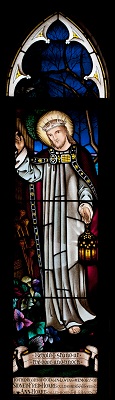 Revelation 3:20 is a well-known verse:
Behold, I stand at the door and knock. If anyone hears my voice and opens the door, I will come in to him and eat with him, and he with me. (Revelation 3:20 ESV)
In spite of the many artistic and evangelistic portrayals of this verse, the context establishes that Jesus is actually knocking at the door of his church, not at the door of individuals. Doug Wilson comments on this, saying that “This is, in the first instance, the door of the church at Laodicea, and then by extension, any church that has people who have drifted into a lukewarm approach to Jesus.”
From elsewhere in Revelation we can establish that a worship service contains prophetic preaching (trumpets) and singing. But those are not present in this verse. Instead, Jesus’s highest intention in meeting with his people is to share a meal with them.
Thus, weekly communion: why open the door but refuse the meal?
Give thanks
While 1 Thessalonians 5 is applicable to all of the Christian life, it has repeated overtones of the weekly public worship service:
- Weekly public worship is one of the several kinds of “day of the Lord” that we can speak of
- As seen in 1 Corinthians, drunkenness and sobriety is particularly applicable to the Lord’s supper
- Our response to church leaders is especially important in the liturgical setting
- Admonishment, encouragement, rejoicing, prayer, thanksgiving, prophecy, and testing-discernment all take place in public worship
- The command to “always rejoice” has particular application to public worship; in Jesus’s presence we have a sort of weekly heavenly furlough from our battle in the world, and are “not [to] be grieved, for the joy of Yahweh is your strength” (Neh. 8:10)
- The focus of the Spirit’s work, and the occasions where we have the most danger of quenching the Spirit, are in the “one another” settings of the whole body of Christ such as public worship
Verse 18 carries similar overtones: in all, give thanks. Translating this as “in all circumstances” or “in all things” is certainly correct; we would not limit its application to public worship. However, it has an intensive application to public worship, where we corporately give thanks to God. And, as the church has recognized throughout history, our giving thanks for the bread and for the wine means that thanksgiving is an appropriate synecdoche for the Lord’s supper.
Thus, weekly communion: in all worship, eucharist!
Enrolled in heaven
The book of Hebrews is critical to understanding the worship of the church under the new covenant. Hebrews 12 contrasts the worship of the church with Israel’s worship at Sinai:
For you have not come to what may be touched, a blazing fire and darkness and gloom and a tempest and the sound of a trumpet and a voice whose words made the hearers beg that no further messages be spoken to them. For they could not endure the order that was given, “If even a beast touches the mountain, it shall be stoned.” Indeed, so terrifying was the sight that Moses said, “I tremble with fear.” But you have come to Mount Zion and to the city of the living God, the heavenly Jerusalem, and to innumerable angels in festal gathering, and to the assembly of the firstborn who are enrolled in heaven, and to God, the judge of all, and to the spirits of the righteous made perfect, and to Jesus, the mediator of a new covenant, and to the sprinkled blood that speaks a better word than the blood of Abel. (Hebrews 12:18-24 ESV)
From this we understand that the church stands in the presence of Jesus as we gather every Lord’s day. But more than that, we stand in the company of angels, and of the saints that have gone before us. So one of the ways that we can remind ourselves that we grieve with hope (1 Thess 4:13) for saints who have gone before us is that we stand shoulder to shoulder with them every week in the worship of our king. We are sent back into the field of battle without them, but we rejoin them at our weekly furlough-feast.
This is another reason that our worship can be without mourning or weeping (Neh. 8:9), since we are spiritually experiencing a foretaste of all things being made right.
Draw near
My pastor has some helpful reflections on the Christian’s privilege to “draw near to God” at our church blog.
Another important aspect of drawing near relates to Israel’s system of offerings and sacrifices. There are a cluster of Hebrew words that relate to this:
- qarab — to draw near, to offer; used frequently to speak of worshippers bringing an offering
- qorban — an offering, or the “thing brought near”
- qereb — inside, in the midst, inner parts; used of the inner parts of an offering that are burned and made to ascend into God’s presence
So, we can say that God’s people draw near to him through offering a sacrifice. There are two ways in which this is true for the Christian — first, we draw near through the once-for-all sacrifice made by Jesus nearly 2000 years ago. But second, we draw near week to week by offering ourselves, by offering a “sacrifice of praise.”
The purity regulations for worshippers also come into view as we draw near. There are also two ways to take this; on the one hand, we have “once been cleansed” (Heb. 10:2) by Jesus’s blood, so we may stand with confidence before our king. But on the other hand, we are called to actively cleanse our hands and purify our hearts (James 4:8), and we do so by confessing our sins (1 John 1:9). What this means is that the church’s historic practice of corporate confession and public proclamation of our forgiveness in Christ is a very appropriate and helpful part of our drawing near.
Finally, we are helped by remembering the ultimate outcome for sacrificial worship — a fellowship meal with God. The offerings themselves were food for God (Leviticus 1:9), and all but one of Israel’s offerings culminated in the priests or the worshippers sharing food with God. Furthermore, the high points of Israel’s liturgical calendar were the feasts where they met and ate in God’s presence at God’s house. The most familiar example of this is the annual Passover feast at the tabernacle and temple. In the same way, the high point of Christian worship, our drawing near, is our fellowship meal with Jesus in his house: the Lord’s supper. As Calvin writes, “the sacrament [of communion] might be celebrated in the most becoming manner, if it were dispensed to the church very frequently, at least once a-week.” Even if you do not practice the Lord’s supper weekly, you can remember and rejoice in the fact that you have an open invitation to sit at Jesus’s table.
See also: Ascent
Do this
It is rare to practice the Lord’s supper without reading from 1 Corinthians 11. There is certainly nothing wrong with this, but it is odd. We have plenty of other material to draw from for communion reflections; it would take a year alone to work through passages that reference bread (or grain) and wine, not to mention food and feasting in general.
I worry that we have come to believe reading God’s instructions discharges our duty to obey them. Jesus commands us to “do this.” Considering 1 Corinthians 10-11 together with Matthew’s and Mark’s accounts, what is it that we are to do?
- Use bread
- Give thanks to God for the bread
- Break the bread
- Use wine
- Give thanks to God for the wine
- Examine ourselves to ensure we discern one another’s membership in the body
Many evangelical churches are failing on all counts listed above, possibly with a sense that it is permissible to ignore these, but without the necessary conviction that it is better to ignore them.
The last point may be the least obvious. I have argued elsewhere that Paul’s use of discern and examine is generally misunderstood. I suggest that we are failing to do this not least in failing to recognize our young children’s participation in Jesus and their full welcome to his presence and his table. We therefore, with Peter, stand condemned and out of step with the truth of the gospel (Gal. 2:11ff). If we were to work through those many food and feasting passages, we would become more sensitive to this.
The result is that we have arrived at something unnaturally stilted, unfamilial, un-supper-like. It is not straining in every way to enact a foretaste of Jesus’s marriage feast, or to welcome all those here who would be welcome there if they were to die today.
See also: Unbelievers?
The objectivity of worship
One of the great benefits of understanding worship as a covenant renewal is that it highlights for us that worship is a public, objective and corporate event, not just a private, subjective and personal experience. So:
- Jesus, the greater Ahashuerus, publicly and objectively extends an invitation for us to stand before him
- Jesus hears our confession of sin, and publicly and objectively lifts up our faces and assures us that we stand secure before him
- Jesus publicly and objectively receives and accepts our worship and gifts, then speaks a public and objective word of encouragement and exhortation to us through his word and his servant-ministers (Jesus’s objectively speaking through the latter is implied not least by Ephesians 2:17)
- Jesus publicly and objectively shares a meal with us at his table, freshly marking out our fellowship and union with him
- Jesus publicly and objectively re-commissions us as his representatives and ambassadors to the world
This has implications for how we speak about worship. When we say we are “entering into” worship, we are using Biblical language; for example, Psalm 100 speaks of entering God’s gates and courts. But what we are speaking of is not exclusively an internal frame of mind that tunes out all the noise and focuses on Jesus. Rather, we are publicly gathering together with God’s people to stand before him. Entering into worship includes entering into an “external” frame of mind that takes in everything around us and sees with eyes of faith just what this great assembly is that we are privileged to participate in. We have come to Mount Zion . . . and to God . . . and to Jesus (Heb. 12:22ff)! He is actually among us (Matthew 18:20). We have come into his presence objectively; we don’t have to close our eyes and go there in our minds.
This also is a powerful reassurance to those who are experiencing a dark night of the soul, who are in a dry season in which they feel that God is distant or silent. Worship is not the only occasion where God speaks to us, but he is always, publicly and objectively, near to us in corporate worship and speaking to us in corporate worship.
God is not silent.
 I gotta have my orange juice.