Archive for the ‘Worship’ Category
Fruit of the vine
In this post I move from consideration of weekly communion to the use of wine in the Lord’s supper. While both wine and grape juice may be permissible in communion, I believe that wine is preferable for a number of reasons. Herein I take it for granted that in the Bible wine is wine, strong drink is beer, both of these are gifts from God to be received with gratitude (which, like all gifts, can be abused), and that the use of grape juice in communion is a very modern and largely American development whose widespread practice is made possible only by the introduction of pasteurization by Welch almost 150 years ago. While it’s not my intention to establish these assumptions here, you can refer to Jeff Meyers’ essays on wine and beer (part 1, part 2) for some helpful considerations.
First we will consider some biblical-theological and typological reasons why the use of wine is most fitting in the supper. Then we will consider some practical considerations and precautions related to changing the church’s practice.
Do this. The New Testament uses the words “blood” and “fruit of the vine” rather than “wine” to refer to what we drink in the “cup” of the Lord’s supper. From this statement alone it is certain that Jesus is drinking wine. Genesis 49:11 and Deut. 32:14 strengthen this conclusion by establishing a Biblical imagery that specifically identifies wine as the blood of grapes. We will find further support as we look at the covenant meals that underlie the Lord’s supper, but for now we can say that using bread and wine are ways that we can more fully obey Jesus’s command to “do this.”
Passover. The Lord’s supper is strongly connected to Passover. It is interesting that only lamb and bread are directly prescribed for this feast. However, the Passover is a kind of peace offering; we see this in a couple of ways: first, that the ritual of the Passover matches that for the thanksgiving form of the peace offering. The peace offerings were the only offerings that worshippers could eat together with God. Like the Passover, the thanksgiving peace offering was an offering of an animal together with unleavened bread, and could not be eaten the following day. Second, Passover is described as a sacrifice (Deut. 16, Ex. 12, 34); of all the offerings, the peace offering is the only specific offering described as a sacrifice. Realizing this, we can now establish the connection between Passover and wine; as the people of Israel came to the promised land, God added a drink offering of wine to the ritual of the peace offering (Num. 15). We see additionally that other drink offerings were prescribed for Passover, although they seem to be connected to the ascension offering rather than the peace offering (Num. 28). Thus, wine is prescribed for Passover and therefore is also most appropriate for the Lord’s supper as its antitype.
Tribute offering. While the Lord’s supper is most closely connected to Passover, it is also connected to the tribute, or “grain” offering. We see this in that Jesus describes the supper as a remembrance (or memorial). Of all of the offerings, the tribute offering is the only specific offering described as a memorial. The tribute offering itself consisted of bread (Leviticus 2), oil, and frankincense (symbolizing the prayers of the saints), together with wine (Ex. 29). This offering was made twice daily by the priests. Since wine is prescribed for the daily tribute offering, it is also most fitting for the Lord’s supper as its antitype.
Tithes and offerings. Wine is also connected with the bringing of tithes and offerings. We see that when Abraham brought his tithe to Melchizedek, they shared a meal of bread and wine provided by the priest-king (Gen. 14). When Israel brought their tithe periodically to Jerusalem, God commanded them to feast on “whatever you desire—oxen or sheep or wine or strong drink, whatever your appetite craves” (Deut. 14). The giving of our tithes is partly to ensure that there is “food in my house” (Mal. 3); God wants to show forth his prodigal generosity to his people, and his serving an overflowing cup of wine to us at his table (Ps. 23) is part of this. Furthermore, the firstfruits offerings were distributed to the priests and Levites, and in particular “the best of the wine and of the grain” belonged to them (Num. 18, also Deut. 18). As a kingdom of priests, it is right for us to enjoy good bread and wine from God’s hand at his table.
Worship. We see further examples of this in Nehemiah 8, where the people are commanded to drink wine rather than mourn on God’s holy days, and in Ecclesiastes 9, where joyful consumption of bread and wine is commended to us. Certainly Ecclesiastes applies to all spheres of life, but it applies in a heightened way to worship and the eating of covenant meals at God’s house; with Asaph in Ps. 73 we recognize that the only way to unravel the mysteries set forth in Ecclesiastes is by faith, and especially as we worship God and eat together with him at his house.
Tryst. We have many images for what happens in corporate worship; one such is that it is a tryst between Jesus and his bride. Jesus is present with us in a special way above and beyond his presence day to day. We see an example of this with Ahasuerus and Esther (Esther 5, 7), and we see Jesus ensuring that a wedding has not only enough wine, but also the best wine (John 2). It is not lady Folly but lady Wisdom who sets her table with wine (Prov. 9). It is true that wine is a symbol of lovers offering themselves, and is contrast with love and blessings that exceed wine (Song of Solomon; Psalm 4; Isaiah 55). But this is precisely why it is a most fitting symbol for the Supper.
Blessing. We can go on to count more blessings that wine conveys. We see wine bringing kingly rest at the end of labors (Gen. 5 and the play on “nacham” and “Noach,” taken together with Gen. 9). Wine is said to cheer both God and man (Judges 9, Eccl. 2), to gladden man’s heart (Ps. 104) and life (Eccl. 10). Wine is used for health and healing (Luke 10, 1 Tim 5). All these points make wine a fitting picture of God’s goodness to us which serves to enrich its meaning in the supper. By settling for less than wine we cheapen the picture of God’s prodigality that Jesus intends for us to experience in the “cup of blessing.”
Priests and kings. While priests enjoyed the wine that was brought to God’s house, they were not allowed to enjoy it in God’s house at his own table (Lev. 10, Ezek. 44), nor did they even sit in God’s house (Heb. 10). Jesus, the king of kings, did enjoy a perpetual service of wine and beer in his own house, like earthly kings throughout history; consider Melchizedek the priest-king, Joseph the greater cupbearer to Pharaoh, wine a symbol for kingly Judah (Gen. 49), Nehemiah the cupbearer to Artaxerxes, Ahasuerus repeatedly drinking and serving wine, the cup in God’s hand throughout the Psalms and prophets, and the cups that Jesus pours out in Revelation. In the new covenant, we not only have the privilege of all being priests in God’s house, but have the greater privilege of being seated with Jesus as fellow sons and kings (Luke 22:30; Eph. 2). Thus, one of the great changes from the old covenant to the new is that Jesus seats and serves us at his table in his house, like so many Mephibosheths. We see the Corinthians taking this great new privilege to excess in their excitement, but to refuse the privilege of drinking wine with God in his house is in some sense to deny the newness and betterness of the new covenant, to be content with more distant fellowship with Jesus when he is willing to give us more.
Nazirite. This progression from covenant to covenant is related to the restrictions placed on the Nazirite, which included prohibition not only of wine but of all products of the grape (Num. 6; Judges 13; Luke 1, 7). What we can say about this is that it seems that the Nazirite underwent a temporary deprivation of the blessings of the promised land, reverting to a sort of wilderness estate in order to conduct a holy war campaign. This helps us to understand why Jesus refused wine on the cross (Matt. 26:29, 27:34; Mark 14:25, 15:23; Luke 22:18), as he was both acting as our high priest according to the law, and also acting as a Nazirite holy warrior. This culminated with the drinking of wine when he had finished his work (John 19:30), so that we can say that Jesus, having finished his work and sat down, is himself no longer under a prohibition of wine. Indeed, he shares it with us week to week as he serves us his supper at his table.
We admit that the appearance of Naziritehood twice in Acts (18, 21) is a strange occurrence. A plausible explanation is that it is a unique historical situation prior to the total destruction of the entire old-covenant system in AD 70; much like the “to the Jew first” practice of church planting, which we also no longer practice today. In any case, we hold that the law of the Nazirite has no relevance today and no bearing on the lawfulness of using wine in the supper.
Covenant sanctions. God provides wine to his people as part of his blessing for their faithfulness (Deut. 7, 11; Prov. 3) and as a benefit of their redemption and regeneration (Jer. 31). At the same time, God also promises to remove his blessing of wine as a consequence of discipline and judgment (Deut. 28; also many of the prophets). To serve wine to God’s church is therefore to show forth God’s blessing and favor; to withhold it is to show forth his displeasure and judgment.
Inspection. Wine is a symbolic double-edged sword in scripture. It is not just the case that believers are warned against excess and drunkenness (Prov. 20, 21, 23, 31; Eph. 5; 1 Tim. 3; Tit. 2). More than that, wine is actually a symbol of God’s judgment upon the wicked, so that we can speak of a sort of “wrathwine” (Ps. 75, throughout the prophets and Revelation). It is even as a symbol of the suffering of God’s people (Ps. 60) and of Jesus’s propitiatory suffering for us (Ps. 69). Drunkenness is therefore not only a sin but also a judgment for sin. Thus, just as baptism is a double-edged sword of judgment and salvation (you are either drowned like the Egyptians or saved like Israel), so wine has a discriminating effect (you are either made merry or made to reel and stagger). This is not inconsistent with the imagery of the Lord’s supper, in that Paul makes it out to be a discriminator between those who eat with Jesus and demons (1 Cor. 10), and between those who eat in unity and disunity (1 Cor. 10-11; Gal. 2). This makes the bread and wine of the supper a sort of “jealousy inspection” (as in Num. 5, which included a tribute-grain offering so that it had both bread and wine) whereby God inspects the faithfulness and unity of his bride. Thus, the use of wine is most fitting as we allow God to do his potent work of inspection and winnowing. It is not a question of whether you will drink wine; it is only a question of whether it will prove a blessing or a curse.
History. The church has consistently used wine throughout history in the supper, and it is likely still the majority practice worldwide today. While we do not regard historical practice as absolutely normative, we do take it into serious consideration as an indication of how the Holy Spirit has led the church to understand how we are to apply scripture.
Practicals and precautions
For a church that offers grape juice today, I suggest that wine be offered as an additional option for those who are interested in taking it, so that both wine and grape juice are available and no one’s conscience is bound either way. For churches that pass out communion cups in trays, it would be possible to distinguish between the two either by the tint of the cups, by markings on the tray slots themselves (the inner rows are of one kind, the outer rows of another), or by passing several trays.
Certainly it must be a guiding principle for the church that “it is good not to eat meat or drink wine or do anything that causes your brother to stumble” (Rom. 14:21). There are several kinds of stumbling to consider:
- A brother who is prone to drunkenness may be tempted by the use of wine in the supper. This is a legitimate concern. For this brother it would be quite possible to continue to offer grape juice. However, it is also worth noting that this option has not been available throughout much of church history. It seems good to hope that many brothers in this position could be helped by being trained over time to drink wine rightly, connected with joy and fellowship rather than isolation and escape.
- A believer who is unaccustomed to the thought that Christians may lawfully drink wine, or that it is possible to drink wine without becoming drunk, may be severely distracted by the serving of wine. For churches in this situation, it would be pastorally necessary to provide education and time to reflect upon these ideas as a part of changing the church’s practice.
- However, a believer who remains prone to judge other believers who drink wine is not in view in Paul’s warning here. Such a believer is neither tempted to idolatry nor tempted to sin himself, but is rather passing judgment “on the servant of another” (Rom. 14) and is not walking “in step with the truth of the gospel” (Gal. 2). It is a kind of legalism or Judaizing to be confidently settled in our own practice and have scruples about how other believers behave, especially if it causes us to disdain, judge or withdraw from one another at the table (Rom. 14; 1 Cor. 10-11; Gal. 2). The introduction of wine in communion could actually provide a beneficial opportunity to a church to discuss how believers are to walk through disagreements over matters of practice, by highlighting the necessity not to pass judgment or to bind others’ consciences. This is always timely, because such issues are constantly cropping up in the church in diverse areas (education, nutrition, parenting, vaccination, entertainment, courtship, technology, etc.).
Conclusion
In determining how important the use of wine ought to be, we should consider just what kind of thing the supper is. Is it at root a visible-edible word-idea that primarily engages us at a rational-intellectual level? Or is it at root a covenant renewal meal that we sit down to eat together with Jesus in his very presence? This has a lot of implications, but as it relates to wine: do we really believe that we are seated together to dine with an extravagant king who calls us his friends? What kind of table do we believe that Jesus would set for his bride, or his bride for him? Does our practice tend towards reflecting all these beliefs and convictions?
Provided it is pursued carefully and wisely, I believe that a church can reintroduce the use of wine in communion in such a way that the whole church grows and benefits. Wine most appropriately shows forth and allows us to experience what Jesus intends to convey in seating and serving us at his table: including the richness and goodness of his creation and covenant, and his joy, merriment and prodigality toward us.
Essence and order
Related to my weekly communion jaunt, a friend asked whether I see communion as central to the liturgy, and what elements of the service ought to be present weekly.
As to which facet of corporate worship is central, I’m not sure we can identify that any more than we can identify which leg of a stool is central. I do see communion as the celebratory climax of the service, but no less important is Jesus himself speaking a word to his people through the mouths of his representative heralds (consider how it is that Jesus preaches peace to the Ephesians in 2:17).
The notion of worship as covenant renewal helps to answer the question of what is essential and even in what order these facets ought to appear. It is interesting that the New Testament portrays the church more as the new temple (2 Cor. 6:16, Eph. 2:21) and the new Zion-Jerusalem-assembly (Heb. 12) than the new synagogue. New covenant worship is the explicit heir of the old covenant’s sacrificial worship (Rom. 12:1, Heb. 13:10–16). We ought to look closely at how models like Sinai (consecration, word, meal with God) and the sacrificial system (the order of which is always purification offering, ascension & tribute, peace offering meal) translate into the new covenant. Other obvious covenant renewals like Deuteronomy and Ezra-Nehemiah are useful here; so too are David’s liturgical reforms that overlay sacrifice with song; and Revelation, however obscure, nevertheless gives us a heavenly pattern for organized corporate worship. Kline and others have done work analyzing the structure of Biblical covenants that is helpful here. But even considering only Sinai and the sacrificial system it seems evident that we ought to have a minimal pattern of confession-absolution; followed by ascension in song to bring tribute and hear a word from our commander-king-husband; and closing with a meal. (It seems possible to link these three legs of the stool with the offices of Jesus, and also with the members of the Trinity.) In addition to these three, a good case can be made as well for a kind of call and commissioning as opposite book-ends of the service.
How do we integrate this order of worship with 1 Cor. 14, where everyone is to bring a hymn, lesson, revelation, tongue, or interpretation? These fit with the central “ascension” portion of the service: the song and tithe and word. Obviously that leaves unanswered questions of what these things look like in detail, and what their specific place and proportion is.
Returning to the question of what is central in worship: it is Jesus who stands behind both word and food; worship is an actual going–up to meet with him. If he has spiritual eyes, who does the worship leader see when he turns around on the Lord’s day? It is Jesus (Rev. 1:10ff). Who is the true worship leader? It is Jesus (Heb. 2:12).
Weekly communion
Following is a series of blog posts arguing for the practice of weekly communion in the church. Weekly communion is not something for which we have an explicit command in scripture, so at best it is possible to establish it as a “good and necessary consequence” of scriptural examples and commands. This makes it a question of fittingness, betterness, and wisdom rather than a matter of right and wrong that ought to bind everyone’s conscience equally. Still, we ought to pursue not only what is permissible but also what is best, and I hope that you will consider with me the merits and blessings of celebrating weekly communion in the church. What follows is a set of arguments primarily from biblical theology and biblical typology: what you might call a sort of typological logic. I hope you will find these arguments to be cumulatively persuasive.
- In everything, eucharist!
- Jesus knocks: will we open the door and have a meal with him?
- Worship is sacrificial, so as priests we too have a daily partaking of bread and wine
- Worship is a tryst, thus morsels and wine
- Worship is the gathering of the host, a dress review banquet
- Worship is spiritual warfare, and we must always find a table set in the presence of enemies
- Tithing is linked with bread and wine via Abraham and Melchizedek, and is to result in “food in my house”
- Worship is not only a tryst, but a jealousy inspection, a day of the Lord
- Bread is to be set out continually in God’s house
- There is nothing better than to eat, drink, and be joyful
- Joyful feasting is commanded on the day of the Lord
- Following Moses’s inspired application, Sabbath feasting is how we obey the fourth commandment
- The church’s week to week experience ought to be a taste of God’s blessing rather than his judgment and withdrawal
- Whether or not we eat communion, we are showing forth something about the kind of table Jesus sets for his people
- Worship is covenant renewal, and to renew covenant is to feast
- Worship is in fact the renewal of a marriage covenant, and is it even necessary to ask how often a husband and wife should get together?
- Now that we have a perpetual sacrifice and are made permanently holy, we are continually in a festal season
- Worship ought to be accessible to all, from the least to the greatest
- The worship service that the early church inherited from the apostles was a Eucharistic service
- To enter God’s gates with thanksgiving is to enter them with a thanksgiving feast
- Not to eat together with the church worldwide is to fail to walk in step with the truth of the gospel
- The memorials of the Sabbath and the Supper are linked
- We must not grow weary of the table of Yahweh
- God is the kind of father who, if his son asks for bread, gives him bread
While Jesus may graciously overlook the fact that much of his church today does not practice weekly communion, we still ought to consider whether it is better for us not to practice weekly communion, and for this I think we have hardly any excuse. God could have chosen the ongoing renewal of his covenant to take many forms, and he chose to cast it as a meal, a covenant meal, a family meal, for very good reasons. It is a widely acknowledged truism even among unbelievers that families ought to to eat together as much as possible.
I hope you will find that this has not only brought to mind the merits of weekly communion, but also other applications. There are many additional worthwhile directions we could take our investigation, and perhaps your mind is already reaching towards some of them. For example, we could ask whether it is better to use wine or grape juice in communion; whether it is better to use bread or crackers; what is the most fitting portion size for communion celebration; whether communion should tend to a penitential or a celebratory tone (Deut. 14:26, Neh. 8:9-12); just what kind of self-examination the apostle Paul means for us to make; whether little children ought to have a place at Jesus’s table (Ex. 10:9-11); where communion ought to fall in the order of worship and whether it ought to carry the burden of confession and absolution; the appropriateness or impropriety of individuals’ withdrawing from the table; and what sort of passages might be appropriate for use in communion exhortation beyond the tried and true words of institution. Perhaps we will consider some of these in the future if time permits.
History
Thus far in our consideration of weekly communion we have contemplated the testimony of the Holy Spirit through the biblical theology presented in scripture. But the Holy Spirit also works through the church—teachers are a gift of the Spirit—and it is useful to consider how the Holy Spirit has worked through the church in history.
It is generally acknowledged that weekly, twice-weekly, or even daily communion were the common practice of the early church. There are some hints of this in the Bible itself which are suggestive of a high frequency of communion if not weekly communion (e.g., Acts 2:42, 20:7; 1 Cor. 11:18, 20, 25). What is particularly interesting is to consider the absence of any indication that the supper could possibly be severed from ordinary corporate worship. This is so far unusual that Wes Baker writes that:
I have been unable to find evidence that any professing Christian until the Zurich Reformation (16th century), ever thought that Christians could have their regular Sunday worship without the sacrament of the Lord’s Supper. I am not saying that they rigidly insisted that it never be omitted. My point is simply that they would consider such worship irregular. . . .
It was Zwingli’s liturgy that first introduced the idea that regular worship is primarily a preaching service. Up until that point, no one that I have found, ever seems to have thought that way. (The Lord’s Supper and the Weekly Assembly, unpublished manuscript)
Even by the time of Augustine, weekly communion still seems to be the general practice. In fact, Augustine urges tolerance toward churches that celebrate the supper weekly rather than daily:
There are other things, however, which are different in different places and countries: e.g., some fast on Saturday, others do not; some partake daily of the body and blood of Christ, others receive it on stated days: in some places no day passes without the sacrifice being offered; in others it is only on Saturday and the Lord’s day, or it may be only on the Lord’s day. In regard to these and all other variable observances which may be met anywhere, one is at liberty to comply with them or not as he chooses; and there is no better rule for the wise and serious Christian in this matter, than to conform to the practice which he finds prevailing in the Church to which it may be his lot to come. For such a custom, if it is clearly not contrary to the faith nor to sound morality, is to be held as a thing indifferent, and ought to be observed for the sake of fellowship with those among whom we live. (Letter 54, Section 2)
We certainly would not wish to swallow everything from the early church fathers hook, line and sinker. But it is instructive to consider that the early church lived in an environment where the Lord’s Supper was frequently celebrated.
Thus, weekly communion: because we have every reason to believe that the worship service the early church inherited from the apostles was quite plainly a Eucharistic service.
Covenant renewal
While we have considered several models of Lord’s-day worship such as a tryst or the gathering of a military host, the primary model for corporate worship presented to us in scripture is that of covenant renewal. This is presented to us more by way of model and repetition than by way of explicit instruction, but it is one of those things that you begin to see everywhere once you realize it is there.
God’s people live and worship in covenant with him. Consistently, when God’s people assemble before him, there is a structure to that assembly that we call covenant renewal. This structure is repeated time and time again: in some of the great covenant renewals such as those of Deuteronomy and Ezra-Nehemiah, in the order of sacrifices prescribed for tabernacle and temple worship, and even in the heavenly pattern of worship laid out in Revelation. We see this in much of the language used to describe worship: worship is sacrificial (Rom. 12:1, Heb. 13:15), a drawing near to God (Heb. 4:16, 10:22), a visit to the new Jerusalem (Heb. 12:22), an eating at an altar-table (Mal. 1:7, Heb. 13:10), a going to Jesus (Heb. 13:13), an ascending to be with God (Ps. 24:3) that often symbolically takes place in an upper room (Acts 1:13, 20:8).
The consistent structure of covenant renewal is this:
- God calls his people into his presence
- God’s people respond by consecrating themselves: confessing sin
- God’s people ascend in song to meet with him, he speaks his word to them, and his people give tribute-gifts to him
- God fellowships and feasts with his people by serving them a covenant meal
- God commissions his people to go back into the world as his ambassadors and army
All of these elements are properly aspects of every covenant renewal, and the renewal is really incomplete if they are missing. For example, we ought to bring tithe-tribute to God every time we meet with him (Deut. 16:16). Likewise, to call worship a sacrifice is in fact to identify it essentially as a covenant meal: the one old-covenant offering that is called a sacrifice is the peace offering, which was the one offering that all worshippers were to eat with God in his presence. Similarly, Israel’s worship at Sinai was equated with a feast (Exodus 5:1,3; 10:7,9), and the worship-service of Revelation culminates in a feast (Rev. 19:9).
Thus, weekly communion; because we have weekly worship, and to worship is to renew covenant is to feast.
Tables
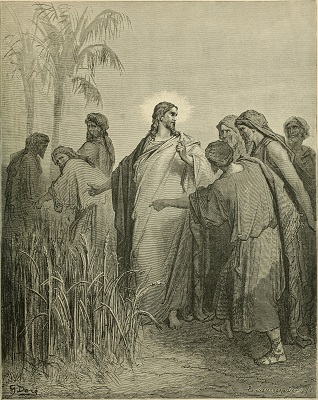 Jesus and the Pharisees argued over his disciples’ plucking of grain on the Sabbath (Matt. 12:1-8). Instead of minimizing the seriousness of what his disciples were doing, Jesus actually magnified it, comparing it to the example of David’s eating holy bread in 1 Samuel 21, but insisting that “something greater than the temple is here” (Matt. 12:6). Thus, weekly communion: to sit at a full table is to enjoy the blessings of the new covenant, but to sit at an empty table is to taste the relative impoverishment of the old covenant, and to side in a small way with the Pharisees, who wished to keep such blessings behind walls of partition.
Paul teaches us that Peter’s failure to eat together with Gentiles was “not in step with the truth of the gospel” (Gal. 2:14). Thus, weekly communion: if failing to eat together is such, failure to eat together at all is likewise a removal of our experience of the “one body” (1 Cor. 10-11) that is brought about by the gospel and is so inextricably connected to table fellowship.
It was to the Corinthians’ shame that their divisive practice of the Lord’s supper was so far removed from this truth of the one body brought about by the gospel that “when you come together, it is not [even] the Lord’s supper that you eat” (1 Cor. 11:20). Thus, weekly communion: if it is a shame to try to share the supper and fall short, it is equally a shame not even to try.
David sought out Jonathan’s crippled son Mephibosheth and honored him, so that Mephibosheth “ate always at the king’s table” (2 Sam. 9:13). Thus, weekly communion: if it is to David’s great credit and glory that Mephibosheth ate always at his table, it is to Jesus’s shame if we should eat only sometimes at his.
Whether we share communion or not on any given week, something is nonetheless being shown forth about the kind of table Jesus sets for his people, and the kind of welcome he gives to that table.
Exile
In the books of the prophets, God’s judgment upon his people, and their exile from the land and the fruits of the land, are often connected with a cessation of bread and wine.
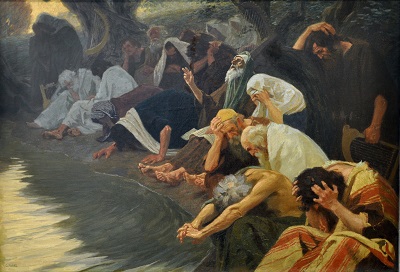 In Lamentations, the people cry “where is bread and wine?” (Lam. 2:12). In Hosea, God warns faithless Israel that “I will take back my grain in its time, and my wine in its season” (Hosea 2:9). In Joel, the coming judgment will ensure that “the grain is destroyed, the wine dries up” (Joel 1:10). In Haggai, God calls for “a drought on the land and the hills, on the grain, the new wine, the oil, on what the ground brings forth, on man and beast, and on all their labors” (Haggai 1:11).
Likewise, the restoration from exile involves a restoration of bread and wine. God promises through Isaiah that “I will not again give your grain to be food for your enemies, and foreigners shall not drink your wine for which you have labored” (Isa 62:8). Jeremiah prophesies that in the new covenant we “shall be radiant over the goodness of the Lord, over the grain, the wine, and the oil” (Jer. 31:12). God promises through Hosea that Israel herself “shall flourish like the grain; they shall blossom like the vine” (Hosea 14:7). God pledges through Joel that “I am sending to you grain, wine, and oil, and you will be satisfied . . . the threshing floors shall be full of grain; the vats shall overflow with wine and oil” (Joel 2:19, 24). Zechariah prophesies that with God’s salvation, “grain shall make the young men flourish, and new wine the young women” (Zech. 9:17).
Thus, weekly communion: because Jesus has brought creation out of the relative exile of the old creation into the new covenant and new creation. Except for seasons during which a church is under the discipline of God, her experience in God’s house week to week ought to be one of tasting his blessing and acceptance rather than tasting—by the absence of bread and wine—the visible sign of his judgment and discipline and withdrawal.
Sabbath feast
I’ve written previously that the long middle section of Deuteronomy serves as an inspired commentary on the ten commandments. If we examine the fourth-commandment section, Deuteronomy 14:21b-16:17, three themes emerge concerning the application of Sabbath-keeping: tithing, rest-giving, and feast-keeping.
We have already concluded that tithing has significant implications for feasting: tithing is linked to Abraham and Melchizedek’s covenant meal of bread and wine; the purpose of tithing is to bring food to God’s house; and in this very section of Deuteronomy feasting is commanded as part of bringing in the tithe.
In the case of the rest-giving of every seventh Sabbath year, there is again an aspect of feasting. The indentured servant set free was to be provided not just with necessary provisions, but with the means of feasting, in light of how God provides for us: “You shall furnish him liberally out of your flock, out of your threshing floor, and out of your winepress. As Yahweh your God has blessed you, you shall give to him.” (Deut. 15:14)
 Finally, Moses’s application of the Sabbath commandment culminates in the celebration of the three great annual feasts: Passover, Pentecost, and Booths. These were the three feasts at which Israel was commanded to visit the tabernacle and temple (Deut. 16:16), and here again we have an expression of tithe or tribute given to God (vv. 16b-17).
In the new covenant in Jesus, there is no longer a physical, earthly temple at which we worship. Instead of three great annual worship events, God’s people come to visit him in the heavenly Jerusalem (Heb. 12) week to week as we worship. It is clear throughout the New Testament that the weekly appointed worship of the church is far more the heir of the old covenant’s temple worship than it is of the old covenant’s synagogue meetings. Thus, it is quite proper for us to speak of a weekly feast, because we worship at the very house of God—indeed, we are the house of God—week to week rather than three times a year.
Thus, weekly communion (and weekly tribute-bringing): following the inspired application of Moses, feasting on every appointed day of the Lord is how we are privileged to obey the fourth commandment in the new covenant.
This day is holy
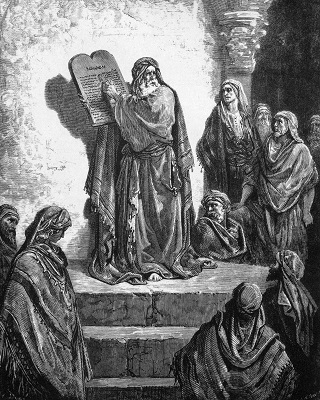 We have seen that bread and wine in worship is commended such that there is “nothing better.” But more than that, the book of Nehemiah teaches us that feasting in worship is in fact commanded:
And Nehemiah, who was the governor, and Ezra the priest and scribe, and the Levites who taught the people said to all the people, “This day is holy to Yahweh your God; do not mourn or weep.” For all the people wept as they heard the words of the Law. Then he said to them, “Go your way. Eat the fat and drink sweet wine and send portions to anyone who has nothing ready, for this day is holy to our Lord. And do not be grieved, for the joy of Yahweh is your strength.” So the Levites calmed all the people, saying, “Be quiet, for this day is holy; do not be grieved.” And all the people went their way to eat and drink and to send portions and to make great rejoicing, because they had understood the words that were declared to them. (8:9-12)
Thus, weekly communion: joyful feasting is commanded on every day set aside for the Lord, every Lord’s day.
Nothing better
The book of Ecclesiastes expresses a faith-filled perspective on life. In light of eternity, we can find joy in the midst of the seeming futility of this life, trusting in God’s wisdom and goodness even though we “cannot find out [that is, fathom] the work [of God] that is done under the sun [that is, in this life]” (8:17). Solomon’s famous counsel is not a counsel of despair, but one of contentment and joy with the gifts God has given us:
And I commend joy, for man has nothing better under the sun but to eat and drink and be joyful, for this will go with him in his toil through the days of his life that God has given him under the sun. (8:15)
Go, eat your bread with joy, and drink your wine with a merry heart, for God has already approved what you do. (9:7)
Solomon’s counsel is true at our own tables, but it is doubly true at God’s table, where our experience of God-given joy is at its highest. Solomon would agree that we are especially to “eat and drink and be joyful” together with Jesus. Jesus has in fact commanded it:
And before Yahweh your God, in the place that he will choose, to make his name dwell there, you shall eat the tithe of your grain, of your wine, and of your oil, and the firstborn of your herd and flock, that you may learn to fear Yahweh your God always. And if the way is too long for you, so that you are not able to carry the tithe, when Yahweh your God blesses you, because the place is too far from you, which Yahweh your God chooses, to set his name there, then you shall turn it into money and bind up the money in your hand and go to the place that Yahweh your God chooses and spend the money for whatever you desire—oxen or sheep or wine or strong drink, whatever your appetite craves. And you shall eat there before Yahweh your God and rejoice, you and your household. (Deut. 14:23-26)
It is precisely in worship that we gain the insight that Solomon is sharing with us; our visit to God’s throne room reminds us that his plans for eternity give meaning to our seemingly meaningless existence in this life. Recall Asaph’s Psalm 73:
But when I thought how to understand [the wicked’s prosperity and righteous’s suffering],
it seemed to me a wearisome task,
until I went into the sanctuary of God;
then I discerned their end. (16-17)
Solomon and Asaph are in perfect agreement, and their perspective allows us to have the kind of quiet contentment David expresses in Psalm 131, and the kind of contented joy that Solomon commends to us both at God’s table and our own.
Thus, weekly communion: as vital as sermons and other Lord’s-day activities are, especially in worship there is truly “nothing better” than to eat and drink and be merry before our king.

