And Yahweh said to Moses, “When you go back to Egypt, see that you do all those wonders before Pharaoh which I have put in your hand. But I will harden his heart, so that he will not let the people go. Then you shall say to Pharaoh, ‘Thus says Yahweh: “Israel is my son, my firstborn. So I say to you, let my son go that he may serve me. But if you refuse to let him go, indeed I will kill your son, your firstborn.”’”
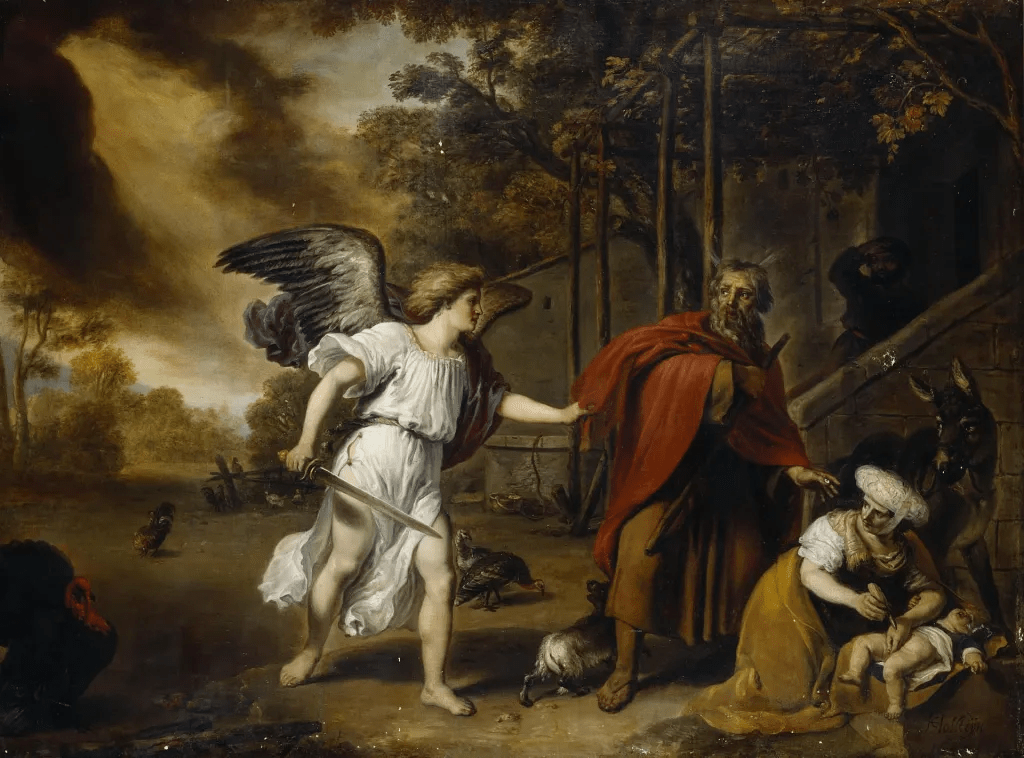
And it came to pass on the way, at the encampment, that Yahweh met him and sought to kill him. Then Zipporah took a sharp stone and cut off the foreskin of her son and cast it at Moses’ feet, and said, “Surely you are a husband of blood to me!” So he let him go. Then she said, “You are a husband of blood!”—because of the circumcision. (Exodus 4:21-26)
God requires the dedication of children to him. The children of the unrighteous are destroyed, while the children of the righteous are covenanted to him—on pain of death (in the case of Moses) or of excommunication:
And the uncircumcised male child, who is not circumcised in the flesh of his foreskin, that person shall be cut off from his people; he has broken My covenant. (Genesis 17:14)
This is why the Westminster Confession of Faith reminds us that “it [is] a great sin to contemn or neglect” baptism, including the baptism of our little ones. It is noteworthy that Moses faces this opposition from God on his way to be rejoined to God’s people; in fact, on his way to make preparations for a feast: it is especially important for our children to wear the sign of God’s covenant with them when they enter into his presence in worship.
Likewise, it is a great sin to contemn or neglect our little ones’ participation in the Lord’s Supper. I have written of how strongly this is implied by the New Testament food laws (do not destroy or stumble your brother; you will either be eating at God’s table or the table of demons; examine yourself; discern the body; wait for one another; walk straightforwardly about the truth of the gospel). But this requirement also goes back to the time that the church was given the name of Israel:
But the man who is clean and is not on a journey, and ceases to keep the Passover, that same person shall be cut off from among his people, because he did not bring the offering of Yahweh at its appointed time; that man shall bear his sin. (Numbers 9:13)
Are you clean (1 Corinthians 7:14)? You must be baptized and you must participate in the feast. In neglect of this command, the evangelical church has largely excommunicated her children. Until she repents of despising God’s children in this way, God will oppose her just as he opposed Moses.
I heartily hold that the common understanding of Paul’s use of examine and discern and body in 1 Cor 11 is both misguided and even harmful to our little ones. I’ve argued for this at severaltimes.
But let’s assume for a moment that Calvin is right. Consider the words of Jesus:
At that time Jesus answered and said, “I thank You, Father, Lord of heaven and earth, that You have hidden these things from the wise and prudent and have revealed them to babes. Even so, Father, for so it seemed good in Your sight. All things have been delivered to Me by My Father, and no one knows the Son except the Father. Nor does anyone know the Father except the Son, and the one to whom the Son wills to reveal Him.” (Matthew 11)
In that hour Jesus rejoiced in the Spirit and said, “I thank You, Father, Lord of heaven and earth, that You have hidden these things from the wise and prudent and revealed them to babes. Even so, Father, for so it seemed good in Your sight. All things have been delivered to Me by My Father, and no one knows who the Son is except the Father, and who the Father is except the Son, and the one to whom the Son wills to reveal Him.” (Luke 10)
What we have said is sufficient, as one can see, to show how unreasonably and thoughtlessly these people trouble the Lord’s church. They arouse questions and debates in order to censure the holy observance which has always, since the time of the apostles, been carefully kept by the faithful. It is sufficient because we have clearly proved that the baptism of children has certain and assured foundation in the holy scripture, and on the contrary we have abundantly refuted all the objections which they are accustomed to make against it. So we do not doubt that all good servants of God, after having read this treatise, may be clearly satisfied and perceive with their eyes that all the attacks which are made to overturn and abolish this holy ordinance are deceitful machinations of the devil, in order to diminish the comfort that the Lord wanted to give us by His promise, and by so much to obscure the glory of His name—which is the more exalted the more the generosity of His mercy is fully poured out on people. For when the Lord visibly testifies to us by the sign of baptism that for love of us He wants to pay attention to our posterity and to be the God of our children, do we not have good grounds to rejoice as David did, when we consider that the Lord takes the role of a good father of a family for us, extending His providence not only over us but over those who are ours after our death? In that rejoicing God is particularly glorified.
This is why Satan strives to deprive our children of the communication of baptism—so that when this testimony that the Lord ordained in order to confirm for us the graces which He wants to give our children has been erased from before our eye, we might likewise little by little forget the promise which He has given us for them. From that would follow not only ingratitude and lack of recognition of the Lord’s mercy toward us but a negligence in instructing our children in the fear and discipline of His law and in the knowledge of His gospel. For it is a significant goad to incite us to nourish them in true piety and obedience to God when we hear that from their birth the Lord has received them among His people, as members of His church. That is why, not rejecting our Lord’s great kindness, let us boldly present to Him our children, to whom He has given entrance by His promise into the company of those whom He avows for household members of His house, which is the Christian church. (John Calvin, Institutes of the Christian Religion, 1541 French edition, trans. by Elsie Anne McKee, chapter 11, “Of Baptism”)
Daniel’s vision in Daniel 8 contains a ram and a goat; it’s strange to see sacrificial animals as symbols for Gentile kings and powers. The ram symbolizes Persia; I wonder if it is a positive image since Cyrus is a messianic figure (Isaiah 45:1) and this ram does not devour God’s people. However, the goat symbolizes Greece, and it attacks God’s people “because of transgression.” We speak sometimes of the bowls in Revelation as being priestly bowls “returned to sender;” I wonder if the goat is a similar image, the annual scapegoat being returned to sender after years of faithless offerings. So, it turns out that Azazel is in Greece!
The name Elisha means “God is salvation” and the name Joshua means “Yahweh is salvation.” The name “Jesus” is a form of “Joshua,” and Joshua is a clear type of Jesus. But so is Elisha, whose name is just a further small step away from Jesus.
And, it turns out, to be buried with him is also to be raised.
Then Elisha died, and they buried him. And the raiding bands from Moab invaded the land in the spring of the year. So it was, as they were burying a man, that suddenly they spied a band of raiders; and they put the man in the tomb of Elisha; and when the man was let down and touched the bones of Elisha, he revived and stood on his feet. (2 Kings 13:20-21, NKJV)
Or do you not know that as many of us as were baptized into Christ Jesus were baptized into His death? Therefore we were buried with Him through baptism into death, that just as Christ was raised from the dead by the glory of the Father, even so we also should walk in newness of life. For if we have been united together in the likeness of His death, certainly we also shall be in the likeness of His resurrection, knowing this, that our old man was crucified with Him, that the body of sin might be done away with, that we should no longer be slaves of sin. For he who has died has been freed from sin. Now if we died with Christ, we believe that we shall also live with Him, knowing that Christ, having been raised from the dead, dies no more. Death no longer has dominion over Him. For the death that He died, He died to sin once for all; but the life that He lives, He lives to God. Likewise you also, reckon yourselves to be dead indeed to sin, but alive to God in Christ Jesus our Lord. (Romans 6:3-11, NKJV)
You arrive be realizing you haven’t arrived. Figuring out how to put others interests before your own not only takes sanctification but also wisdom. To do that without bitterness. Without ambition. Without being presumptuous or patronizing. It takes ongoing attention and prayer. Even Paul doesn’t want to claim he has arrived except that he realizes how to go forward.
Darwin and Marx reverse Anselm; in their reckoning of the world, gray goo (q.v.) is that than which none greater can be conceived. All the eloquence of the Sagans and Tysons is just opium for the masses, a smokescreen to cover for the fact that gray goo and heat death are the great telos of stardust.
But the Spirit and the bride say, “Come!” There is one than whom none greater can be conceived whose favor you need not vie for and which lasts a lifetime, and who is a boundless source, leading to both a present and a telos that no mind has ever conceived.
A lot of conservatism is about taking a Washington process—legislation—and moving it two degrees, another two degrees, oh no it comes back. Whereas a workable model, no matter how small, is far more influence in the long run than just moving that Maginot line back a couple of meters in one direction in Washington. Because that can go viral. (Jerry Bowyer)
I wonder, did our military leave behind any cryptography devices in Afghanistan?
I had to reinstall Windows 10 on our PC this week, and together with that reinstalled our copy of Office 2003. To my surprise, it installed just fine. There were a few minor glitches updating it, but it got there in the end. Not too bad for an eighteen-year-old program.
Actually, NT authors always read the OT correctly. Sorry if this offends.
“It is the Lord’s Passover.” (Ex. 12:11) I submit that this verse shows us how to think about the meaning of the word “is” in Jesus’ words “This is my body.”
A friend passed along this article by Steven Wellum from last April on the federal vision.
In theology there are a great many pairs and triads of truths that we hold in harmony: for example, there is one God who exists in three persons; Jesus is fully God and fully man; we are justified by faith alone, but the faith by which we are justified is not alone; we have been saved (Romans 8:24, Ephesians 2:5-8), we are being saved (1 Corinthians 1:18, 15:2), and we will be saved (Romans 5:9, 1 Corinthians 3:15). Here are two beautiful examples of this theological harmony from the Westminster confession:
God from all eternity, did, by the most wise and holy counsel of His own will, freely, and unchangeably ordain whatsoever comes to pass; yet so, as thereby neither is God the author of sin, nor is violence offered to the will of the creatures; nor is the liberty or contingency of second causes taken away, but rather established. (WCF 3.1)
God did, from all eternity, decree to justify all the elect, and Christ did, in the fullness of time, die for their sins, and rise again for their justification: nevertheless, they are not justified, until the Holy Spirit does, in due time, actually apply Christ unto them. (WCF 11.4)
I love the phrases that John Frame and Vern Poythress use to describe this multifaceted way of thinking: perspectival theology and symphonic theology. There are always many things going on at once in God’s revelation and his works.
Of course, from time to time theology goes lopsided and we must take up a defense of one or another of the voices in each harmony. Trinitarian heresies are a particular great example of this. At other times we must defend the harmonies themselves from the idea that clarity is unimportant, lest they become a muddy theological mush where nothing really matters.
Sadly, it is also a temptation to become overscrupulous and suspicious of one another. Someone who loves the beauty of salvation by faith alone and grace alone may be veering antinomian, or they may be rejoicing in real truth. Someone who considers God’s commandments to be sweeter than honey may be a budding legalist, or they may be rejoicing in real truth that lights the way of life. There are real battles to be fought against antinomianism and legalism; and it is even true that someone may be falling into error unwittingly and in spite of good intentions, and need rescue from it; but there is also real delight to be had in drinking deeply of both the freedom of grace and the perfection of God’s law. Knowing which situation we are dealing with calls for wisdom.
I think that a failure to read one another charitably—the instinct to jump to “either-or” rather than “both-and”—is involved in much of the controversy surrounding Norman Shepherd, the New Perspective, and the Federal Vision. Even if one does not fully accept any of these as a whole package, I believe they have made a valuable contribution to theology.
This is a great over-simplification, but I suggest we could touch on some of the differences Wellum mentions as follows:
Credobaptists especially appreciate God’s internal and extraordinary work in a believer, while paedobaptists especially appreciate God’s external and ordinary work in a believer. Credobaptists want to stress the importance of calling our children to faith, while paedobaptists—especially paedocommunionists—want our children to have confidence in Jesus’s glad and ready welcoming of their childlike faith.
Contemporary paedobaptists want to be able to say to a brother, “examine yourself as to whether you are in the faith.” Federal vision proponents want to be able to say to a brother, “do not fear, your sins are forgiven, and you are among the elect of God.”
“Amber lager” federal vision proponents treasure the initial work of the Spirit in our salvation; “dark stout” federal vision proponents treasure the ongoing work of the Spirit in our salvation especially through the church.
The traditional perspective on Paul wants to preserve the truth that salvation by our own obedience or merit is impossible. The new perspective on Paul wants to recognize that other forms of spiritual pride are deadly as well, and maybe we should develop a taxonomy of spiritual pride rather than forcing it all to fit in one box.
Those who emphasize the imputation of Jesus’s active obedience rightly want to protect against smuggling our own merit into our salvation. Those who de-emphasize imputation rightly want to remind us that salvation is not a distant impersonal transaction, and remind us that we receive so much more than merit in receiving Jesus himself; as Piper says, “Jesus is the gospel.” See also Packer and Murray effusing on our glorious union with Jesus.
Those who emphasize a covenant of works want to preserve the uniqueness of how Jesus redeems us from sin. Those who emphasize a continuity between the covenants want to preserve the truth that every covenant is a gracious, undeserved, unilateral gift from God, whatever its terms or administration, and whether it involves redemption or only testing and maturation. “In everything give thanks.”
Of course, if we are thinking rightly, we appreciate, agree with, and seek to harmonize both poles of each point above. We can appreciate the harmonious voices provided by one another without having to agree with the interpretation of every single scripture, or agree with every single implication and choice of terminology.
Addressing some of Wellum’s specific concerns, I would say:
I have read several of the rejections of the federal vision (e.g., PCA, OPC, Guy Waters) and I find they have generally failed to appreciate how federal vision proponents are attempting the kind of gospel-faithful harmonizations that I suggest above. More than that, I think the federal vision proponents have advanced a great deal of evidence that they are continuing in a line of faithful covenant theology, at times even contrary to their opponents (e.g., I think it is a mistake to associate R. Scott Clark with traditional covenant theology).
It is inescapable for us to have to develop a theology that harmonizes objectivity and subjectivity, assurance and apostasy, promise and warning. You may not come out of this with a systematic theology that describes two kinds of election (although Calvin does!) but you must have some kind of language for it nonetheless. I believe the federal vision proponents do justice to both sides of these coins while in some cases their opponents do not. In fact, one of the motivations of the federal vision is the desire to speak both promises and warnings with their full force as pastoral wisdom requires.
We must admit that modern systematic theology uses “regeneration” in a different way from the Bible and from the reformers. It is perfectly normal for systematic theology to develop precise definitions for words that the Bible uses in a different or broader way (e.g., “salvation”) or for words that do not appear in the Bible at all (e.g., “Trinity”). But in the case of “regeneration,” the waters run deep, because they cover whole the landscape of church, kingdom, covenant, and eschatology. Thus, many will have very different opinions, and this area is ripe for misunderstanding—but I personally find no one advancing the kind of baptismal regeneration that we all rightly reject. On the other hand, it is truly a great and glorious thing for our little ones to be admitted to the covenant and church, to the household of the Spirit—to what some call the regeneration.
I am convinced that Jesus wants his little ones to participate in the Supper (Is it not the consistent testimony of the church throughout history that they will be seated at Jesus’s table if they die? Why do we deny them this admission here and now?) but it is strange to me that as a credobaptist Wellum is especially concerned about this. Usually the lack of paedocommunion is a “gotcha” employed by credobaptists against inconsistent paedobaptists.
It is a common accusation that paedobaptists import Israel into the church, the old covenants into the new. Far from this, I have found that what they are doing is recognizing just how much new-covenant grace is shot through the old covenants. No one was ever saved apart from faith, grace, Jesus, and the regenerating work of his Spirit. All of these things are fruit of Jesus’s work in the new covenant but were still the only way of salvation in the old covenants. The truly spiritual nature of the old covenants and of circumcision (e.g., Deuteronomy 10:16) should rightly force us to rethink some of the ways we have claimed the new covenant is unique.
I’ve benefited greatly from the work of many of the FV men and have great affection for them. I consider myself a federal vision “dark stout,” but I love my brothers of other persuasions, because they are my brothers and because we believe and hold to a common gospel.
Staying loyal while suffering is subduing the earth and taking dominion over it. Job had faithfully maintained his own integrity [so] God could entrust him with more.
Mark’s reflections on suffering have led me to frame the idea that suffering is a kind of “special mission” for sons who are otherwise free (Matthew 17:26, Ezra 7:24). Certain kinds of suffering are even honored with a special office in the kingdom (James 5:14).
René Girard likes to talk about how Jesus changed the scapegoating process forever. But Mark’s reflections on Job make me think that there are lesser ways that all other scapegoating—and suffering—transforms human suffering forever, because it opens our eyes to God’s ways and fuels our faith. (Contra the way Girard sometimes speaks, Jesus was not the first scapegoat to deny his guilt, though he is still the perfect scapegoat.)
Jesus suffered in a particular way so that we would never have to suffer in that way, if we receive the gift of his suffering. But so did Jacob. And so did Job. And so did David, and Paul, and a glorious company of such witnesses who are all our brothers in arms. Likewise any suffering we experience is a gift to our brothers and sisters and neighbors and children, so that they will not suffer in that particular way either, if they receive the gift of our suffering.
Eugen Rosenstock-Huessy likewise speaks of the hoary head and how God intends for it to be identified by a surplus of attachment. With wisdom and experience and suffering come the ability to give, to love, to protect, to attach to others with no expectation of giving or love or attachment in return. We have of course all seen examples of the hoary head that has grown bitter by life’s suffering and is unable to give and love freely and generously. But God intends for us to transform our life and suffering into the ability to give and love so freely as he himself has done for us. I think of Shasta’s experience and how this is meant not just to carry us to old age, but to characterize our old age:
Shasta’s heart fainted at these words for he felt he had no strength left. And he writhed inside at what seemed the cruelty and unfairness of the demand. He had not yet learned that if you do one good deed your reward usually is to be set to do another and harder and better one. (C. S. Lewis, The Horse and His Boy)
We are to train our children not just to avoid evil, but to conquer evil. We are to train children who know, not just how to interpret the world, but how to transform it. – Rich Lusk
Re-baptizers are the real ones who treat baptism as sacerdotal magic. Think of it: what other human rituals require a sprinkling of the magical fairy dust of deepest earnest self-reflection and sincerity to activate them? Re-baptizers clearly think that baptism “works,” and are dead set on getting the magic right.
Of course, it is important to be obedient in the matter of covenant signs.
And the uncircumcised male child, who is not circumcised in the flesh of his foreskin, that person shall be cut off from his people; he has broken My covenant.” (Genesis 17:14, NKJV)
I read and enjoyed Gaffin’s By Faith, Not by Sight recently. I think that he could have gone a little farther towards finding multi-perspectival resolutions, but I am generally very appreciative of the book. Some choice quotes:
Since the goal of redemption is union with the risen Lord, there seems little doubt that, if Paul has a center to his order of salvation, it is this doctrine. When other applied blessings, such as justification or sanctification, are made central, there are inevitably deleterious consequences for the Christian life, whereby incipient forms of antinomianism and legalism creep in. For example, a certain Lutheran view that justification precedes sanctification, so that it causes union with Christ and sanctification, ends up attributing to justification a renovative/transformative element. The notion that one applied benefit can cause another applied benefit has always perplexed me. But when union with Christ structures the whole of applied redemption, the aforementioned errors are dealt with better. This has to do with the fact that Christ’s person, not simply his work or his applied benefits, must have the preeminence. Indeed, the gift of Christ’s person is a greater gift to us than his benefits. As many of our finest divines have vigorously argued, there exists a priority of Christ’s person over his work. Union with Christ helps us to keep this salient fact in mind. We are not simply recipients of his benefits; we also belong to him. (Mark Jones, Foreword, p. x)
One important methodological consideration is that, with all due attention being given to his immediate historical context, including relevant extracanonical texts and materials, in interpreting [Paul’s] letters the context that is not only primary but privileged is the canonical context. (10)
All along I have been speaking of Paul’s “theology” and referring to him as a “theologian.” For many, that will not be a problem, but this way of speaking warrants some clarification, since for some it is questionable at best. The perceived danger here is that we will, as it could be put, “drag Paul down to our level.” . . . What offsets this leveling danger is appreciating Paul’s identity as an apostle, at least if we understand apostleship properly. . . . Regarding [his] authority, the apostle is as Christ himself.
Paul the theologian, then, is Paul the apostle. That points to the God-breathed origin and authority of his teaching, its character as the word of God. It highlights the radical, categorical difference there is between his theology and post-apostolic theology. His teaching, along with the teaching of the other biblical writers, is Spirit-borne, canonical, and foundational. (14-15)
Increasingly over the course of the last century, to fill out this brief historical sketch, a new consensus concerning Paul emerged across a broad front in biblical studies. This happened in tandem with a reassessment of the kingdom proclamation of Jesus. It is now widely maintained that the controlling focus of Paul’s theology, as for Jesus before him, is eschatology—or what is equivalent for some, redemptive history (historia salutis). Specifically, the center of his theology has been recognized to be the death and resurrection of Christ in their eschatological significance.
In my view, this basic conclusion is sound and, by now, well established. (29)
The center of Paul’s soteriology, then, at the center of his theology as a whole, is neither justification by faith nor sanctification, neither the imputation of Christ’s righteousness nor the renewing work of the Spirit. To draw that conclusion, however, is not to decenter justification (or sanctification), as if justification is somehow less important for Paul than it is for the Reformers. Justification is supremely important; it is absolutely crucial in Paul’s “gospel of salvation” (cf. Eph. 1:13). If his teaching on justification is denied or distorted, it ceased to be gospel; there is no longer saving “good news” for guilty sinners. But no matter how close justification is to the heart of Paul’s gospel, in our salvation there is an antecedent consideration, a reality that is deeper, more fundamental, more decisive, more crucial: Christ and our union with him, the crucified and resurrected, the exalted, Christ. Union with Christ by faith—that is the essence of Paul’s ordo salutis.
At the opening of Book 3 of his Institutes of the Christian Religion and controlling all that he has to say about “the way” of salvation—that is, its personal, individual appropriation, including what he will eventually say about justification—Calvin writes, “First, we must understand that as long as Christ remains outside of us, and we are separated from him, all that he has suffered and done for the salvation of the human race remains useless and of no value for us.” (49-50)
[Some have observed] that Paul’s exhortations to the church as a whole, his ethics of the Christian life in their entirety, can be summed up in the epigram, “Become what you are.” This is helpful, but by itself it carries a liability that can render it decidedly unhelpful (suggesting some form of personal autonomy), unless it is read with an all-encompassing Christological gloss, “Become what you are in Christ.” (80)
The point here is that “the path of good works runs not from man to God, says Paul, but from God to man.” [quoting Berkouwer] Ultimately, in the deepest sense, for Paul “our good works” are not ours, but God’s. They are his work, begun and continuing in us, his being “at work in us, both to will and to do what pleases him” (Phil. 2:13). That is why, without any tension, a faith that rests in God the Savior is a faith that is restless to do his will. (88)
On the coherence between [faith and works], it is hard to improve on what J. Gresham Machen writes aphoristically, “As the faith which James condemns is different than the faith that Paul commends, so also the works which James commends are different than the works which Paul condemns.” (118)
In the New Testament, Peter and Paul speak of two great old–covenant baptisms: the baptism of the flood, and the baptism of the Red Sea crossing.
In both of these, God rained water on his people, and drowned his enemies. Psalm 77 tells of God’s rain at the Red Sea crossing, and Psalm 68—the great battle Psalm of the Huguenots—tells of rain in the wilderness:
O God, when You went forth before Your people, When You marched through the wilderness: The world shook; Indeed, the heavens dripped at the presence of God, the One of Sinai, At the presence of God, the God of Israel. A rain of gifts You showered, O God; Your inheritance, though it languished, You Yourself established. Your beasts dwelled in it; You prepared it in Your goodness for the lowly, O God. (Psalm 68:7–10, James Jordan)
So you see that the waters of baptism are a rescue from judgment and death, and they are a source of life and refreshment. But they are also a commissioning, into a priesthood and into an army! As soon as Israel had crossed the Red Sea in battle array, they fought the Amalekites. Likewise, Psalm 68 continues:
My Master gives the word; The messengers are a great army. Kings of armies flee; they flee; And those remaining at home divide the spoil, Those remaining with the sheepfolds: A dove’s wings covered with silver, And her pinions with green–gold. When the Almighty scattered kings there, You made it snow on Black Mountain. O mountain of gods, mountain of Bashan, O mountain of ridges, mountain of Bashan, Why your hostility, you mountains of ridges, Toward the mountain God delighted for His dwelling? Yes, Yahweh will dwell there endlessly. The chariots of God are twice myriads, Thousands upon thousands, My Master among them, At Sinai, in the holy place! You ascended on high; You captured a captivity; You took men as gifts— And even rebels— In order that Yah, God might dwell. (Psalm 68:11–18, James Jordan)
The same thing happened when Israel crossed the Jordan into the promised land. God brought them safely through waters, circumcised them, and formed them into his own army to conduct a holy war.
Amos, God still has an army that wages holy warfare with the sword of the Spirit: the word of God. God has commissioned you into his service today. You are and will always be a soldier of Jesus. You belong completely to him, and it is good to belong to him. I charge you to serve him faithfully and fearlessly!
But there is a limit, and beyond it one is no longer willing, one finds it too repulsive, to be a reasonable little rabbit. And that is the limit beyond which rabbits are enlightened by the common understanding that all rabbits are foredoomed to become only meat and pelts, and that at best, therefore, one can gain only a postponement of death and not life in any case. That is when one wants to shout: “Curse you, hurry up and shoot!”
It was this particular feeling of rage which took hold of Vlasov even more intensely during his forty-one days of waiting for execution. In the Ivanovo Prison they had twice suggested that he write a petition for pardon, but he had refused.
But on the forty-second day they summoned him to a box where they informed him that the Presidium of the Supreme Soviet had commuted the supreme measure of punishment to twenty years of imprisonment in corrective-labor camps with disenfranchisement for five additional years.
The pale Vlasov smiled wryly, and even at that point words did not fail him:
“It is strange. I was condemned for lack of faith in the victory of socialism in our country. But can even Kalinin himself believe in it if he thinks camps will still be needed in our country twenty years from now?” (The Gulag Archipelago, Vol. 1, 455)
After all, we have gotten used to regarding as valor only valor in war (or the kind that’s needed for flying in outer space), the kind which jingle-jangles with medals. We have forgotten another concept of valor—civil valor. And that’s all our society needs, just that, just that, just that! That’s all we need and that’s exactly what we haven’t got. (The Gulag Archipelago, Vol. 1, 462)
I haven’t found a video with all three verses, but isn’t this deeply wonderful:
Thanks to Uri Brito for the find. I must say, this is far better than Toto’s version, which unfortunately is making the rounds of my household.
Isn’t it interesting that we love the beginning of Psalm 139 but not so much the end?
Oh that you would slay the wicked, O God! O men of blood, depart from me! They speak against you with malicious intent; your enemies take your name in vain. Do I not hate those who hate you, O Yahweh? And do I not loathe those who rise up against you? I hate them with complete hatred; I count them my enemies. (Psalm 139:19–22)
Something is out of balance if we struggle to find appropriate objects for this prayer, or, worse, struggle to see it as appropriate at all. Somewhat related, I was reflecting on Ruth this week:
But Ruth said, “Do not urge me to leave you or to return from following you. For where you go I will go, and where you lodge I will lodge. Your people shall be my people, and your God my God. (Ruth 1:16 ESV)
Isn’t it remarkable that conversion and loyalty to God is inseparable from conversion and loyalty to God’s people? Ruth and Naomi remind me as well of of Jacob’s blessing Pharaoh in spite of the few and evil days of his life. Isn’t it equally remarkable that these testimonies of God’s faithfulness and purpose in suffering would result in robust conversion?
Sadly, in days when suffering and sacrifice are rare, a husband is not always a protection against this:
But refuse to enroll younger widows . . . They learn to be idlers, going about from house to house, and not only idlers, but also gossips and busybodies, saying what they should not. (1 Timothy 5:11–13 ESV)
If a church sees new visitors during this season of rona, is it really wise to encourage them to return to their original home when it is all over? Why would you encourage someone to return to shepherds who practically abandoned them? Related, I wonder if the church is experiencing a rise in separations and divorces in this year of spiritual distancing. Body must body!
Also related, it seems to me that we have developed today a functional theology of the “real absence” of Jesus at his covenant meal. The Lord’s supper is no longer seen as an entry into the heavenly marriage supper, nor even a joyful and eucharistic foretaste of it. This explains why the supper is often so bland and solemn and infrequent. But it also explains how we have arrived at the conclusion that our own absence at that meal is a matter of little consequence.
Considering also how we arrive at the supper, I’m intrigued by the fact that the Lord’s prayer does not open with an early confession of sin. In fact, its appeal for forgiveness does not even really constitute a confession. Although repentance is a way of life for the Christian, and is liturgically appropriate, repentance is not the fundamental flavor of that festive life.
Speaking of the marriage supper, last week I mentioned Galileo. Considering the book of Revelation, and both our present worship and eternity, it is clear that in the most important sense of the word, the earth is the center of the universe.
I mentioned previously Toby Sumpter’s phrase “cheerfully difficult.” This is another way of saying “happy warrior.” Crucially, the happy warrior is characterized by joy and laughter; he is not anxious.
Speaking of Toby, I reread Lewis’s space trilogy earlier this year. It occurs suddenly to me that the vision of dominion–maturity set for Tor and Tinidril and their generations is the exact picture of what Sumpter sees laid out for us in God’s wrestling with Job. I commend this reading of Job to you, as well as the Girardian reading.
Duane Garner reflects on the key differences between God’s law and the laws of tyrants. God’s law is limited and actually establishes freedom and agency. God is in the business of multiplying agency and authority and dominion. Godly leaders follow this pattern (this is the mission of parenting in a nutshell), while tyrants are in the business of limiting and collecting authority.
I’m sure you don’t need my encouragement to read Doug Wilson’s or Mark Horne’s latest.
May all our sons follow in the footsteps of this manly lad. I dare you to read it without getting a little misty eyed.
We took a trip to Pennsylvania and New York recently. It was fascinating to compare them with Wake County. From afar, we have only been aware of how draconian Pennsylvania and New York have been with their ‘rona restrictions, including the requirement for us to quarantine for two weeks upon arrival. But our observations on the ground were that compliance with these restrictions was far less than we see here in North Carolina’s capital county. To me this seems to correlate (hear me carefully) with red–county–blue–state and blue–county–red–state. Or, levels of affluence and their corresponding priorities and affordances. Not coincidentally, on our visit I learned of the widespread sanctuary county movement.
Also, the Pennsylvania firefly experience beats the North Carolina experience, hands down. We all know that our childhood houses are bigger in memory than in reality, but in this case childhood memories proved completely factual.
I’ve only caught snippets of Tucker the last couple months, and have been intrigued, so I watched an extended speech from last year. Very impressed; you should watch it too.
Ivy asked me why I think the end is not near (courtesy Duane Garner for that phrase). In a nutshell: First, I say this because God promised to be faithful to thousands of generations, and if he owns the cattle on many thousands of hills and not just a thousand hills (Google tells me there are over a million mountains in the world), it seems we should think he intends to be faithful to at least a few thousand generations. Second, God intends for the leaven of the gospel to disciple the nations themselves. This is not just the conversion of the nations (Nineveh shows that he can accomplish this quickly), but their discipleship, their maturation. We expect the process of faith’s maturation to be slow because part of it is the acquisition of patience, of a long time sense (Hebrews 11). (Now put that in your eschatolegislative agency–multiplying pipe and smoke it.) Finally, and similarly, from 1 Corinthians 15, we know that Jesus will not return in order to reign, but rather that he is reigning now and will return only after his enemies have been subdued by the gospel, and then he will give the kingdom to his Father. It is not beyond him to accomplish this quickly, but if you compare this with Hebrews 2 and elsewhere, I think we should expect this spiritual warfare to be a long and sacrificial leavening process. See also: Parousia.
I previously suggested that Christians should normally think of ourselves as righteous. But, you say, “none is righteous, no, not one!” Well, Paul is actually making a pointed accusation against his contemporaries when he asserts this in Romans 3. He is quoting from Psalm 14, where David goes on to say that “God is with the generation of the righteous.” Paul is not making a universal statement as we so often assume, but rather arguing that the old covenant church was faithless to God and are therefore not counted righteous. Christians should think of ourselves as righteous, because God preserves us in the very covenant that makes sacrificial provision for our righteousness.
I recently revisited part of Calvin’s Institutes, book 1. I’m impressed with how boldly and unapologetically he speaks to the unbeliever, as if God dealt with rebellion in laughter and derision. Calvin is operating out of very psalmic categories; from the very first moment with him, you know that God demands the bending of your knee:
At this day, however, the earth sustains on her bosom many monster minds—minds which are not afraid to employ the seed of Deity deposited in human nature as a means of suppressing the name of God. Can any thing be more detestable than this madness in man, who, finding God a hundred times both in his body and his soul, makes his excellence in this respect a pretext for denying that there is a God? He will not say that chance has made him differ from the brutes that perish; but substituting nature as the architect of the universe, he suppresses the name of God.
Contra Calvin, I did find some evidence of Keller’s city–gospel at work! Perhaps if I read just a couple Bible verses I will know how to live as salt and light, and discover the exact pressure point to winsomely command the city’s repentance and obedience.
Andy Stanley is not reopening until 2021. The Summit still hasn’t announced their plans but remains closed through tomorrow at least. Now, work with me for a minute. Paul says that the law of muzzling an ox was written for our benefit rather than the ox (1 Cor 9:8ff), and links this not only to apostles but also to elders (1 Tim. 5:17–18). Looking back to Deuteronomy 25, we see that this command is juxtaposed to the law of the levir. Taking Paul into account, it seems plain to me that this law was not written for the benefit of the ox, but for the levir. Consider: treading is a readily understood metaphor for sexual relations, and therefore it is apparent that God wishes for the levir to enjoy the temporary use of the inheritance (i.e., eat the produce) until the child possesses it.
What this means is that Paul is building on this metaphor to identify the apostle and elder as a kind of levir. The elder is, quite unsurprisingly, a surrogate husband for the church while her Husband is in abstentia: appointed to care for the bride and raise up her offspring into their maturity and inheritance.
What will the Husband have to say to these men who have failed to gather His bride for her appointed feasts with Him? Are there not very few greater goods than His feasts, for which many Christians around the world still literally risk their lives each week to attend? And consider this: at least in the Corinthians’ case, the feasts were themselves a cause of death and the answer was to keep the feast aright (1 Cor 11), that is, with the utmost brotherly love. Thus: you should flee for the time being to the pure countryside air and its churches if necessary, but the feast will go on here for all who remain, and even if they wish to bring veiled faces.
Keep the feast! This is a crucial part of our being warriors full of joy and laughter.

 I gotta have my orange juice.
Metábasis eis állo génos (8)
leave a comment »
A week at the beach with cousins:
This afforded some time for Solzhenitsyn:
I haven’t found a video with all three verses, but isn’t this deeply wonderful:
Thanks to Uri Brito for the find. I must say, this is far better than Toto’s version, which unfortunately is making the rounds of my household.
Isn’t it interesting that we love the beginning of Psalm 139 but not so much the end?
Something is out of balance if we struggle to find appropriate objects for this prayer, or, worse, struggle to see it as appropriate at all. Somewhat related, I was reflecting on Ruth this week:
Isn’t it remarkable that conversion and loyalty to God is inseparable from conversion and loyalty to God’s people? Ruth and Naomi remind me as well of of Jacob’s blessing Pharaoh in spite of the few and evil days of his life. Isn’t it equally remarkable that these testimonies of God’s faithfulness and purpose in suffering would result in robust conversion?
Sadly, in days when suffering and sacrifice are rare, a husband is not always a protection against this:
Fascinating: the lost colony was never lost, just not found.
Way too many good tweets this week to do a practical roundup. You should follow: Hans Fiene, Michael Foster, Andrew Isker, Alex Berenson.
If a church sees new visitors during this season of rona, is it really wise to encourage them to return to their original home when it is all over? Why would you encourage someone to return to shepherds who practically abandoned them? Related, I wonder if the church is experiencing a rise in separations and divorces in this year of spiritual distancing. Body must body!
Also related, it seems to me that we have developed today a functional theology of the “real absence” of Jesus at his covenant meal. The Lord’s supper is no longer seen as an entry into the heavenly marriage supper, nor even a joyful and eucharistic foretaste of it. This explains why the supper is often so bland and solemn and infrequent. But it also explains how we have arrived at the conclusion that our own absence at that meal is a matter of little consequence.
Considering also how we arrive at the supper, I’m intrigued by the fact that the Lord’s prayer does not open with an early confession of sin. In fact, its appeal for forgiveness does not even really constitute a confession. Although repentance is a way of life for the Christian, and is liturgically appropriate, repentance is not the fundamental flavor of that festive life.
Speaking of the marriage supper, last week I mentioned Galileo. Considering the book of Revelation, and both our present worship and eternity, it is clear that in the most important sense of the word, the earth is the center of the universe.
Written by Scott Moonen
August 21, 2020 at 9:09 pm
Posted in Commentary, Miscellany, Quotations, Suffering, Union with Christ, Worship