Archive for the ‘Covenant’ Category
Ephesians’ structure
My pastors have been preaching through Ephesians lately. As we’ve been working through the book, it occurred to me that the structure of Ephesians may roughly follow the covenantal structure of the book of Deuteronomy. Consider this pairing of sections:
- Introduction of God, speaker — Deut 1:1-5, Eph 1:1-2
- Historia salutis, formation of covenant people, preliminary charge — Deut 1:6-4:49, Eph 1:3-4:16
- Ethics — Deut 5-26, Eph 4:17-6:9
- Final charges — Deut 27-30, Eph 6:10-20
- Further plans for conquest-ministry — Deut 31-34, Eph 6:21-23
The sections of Deuteronomy listed here are those suggested by Ray Sutton in his book, That You May Prosper. Sutton names these sections, or aspects of the covenant, transcendence, hierarchy, ethics, sanctions (others call this “oath”) and inheritance (others call this “succession”). I’m not sure we can frame Ephesians in these specific terms (notably sanctions) although Sutton does suggest that all of the epistles follow this model (p. 246).
There are some variances. For example, Deuteronomy’s hierarchy section begins with the appointment of leaders and ends with historia salutis, whereas Ephesians reverses this order. Additionally, Moses structures his ethical sermon according to the ten commandments in sequential order, whereas Paul does not. (It would be interesting to map Paul’s ethical statements to corresponding commandments and analyze the resulting structure.) Finally, Paul’s language is less formally structured than Moses’.
However, there still seems to be a general parallel between the two books. This parallel highlights the unity of Ephesians as a declaration of God’s covenant. We can thus say that the theme of the entire book is our salvation — not only its accomplishment but also its out-working, in just the same sense that 1 Corinthians 15 describes what we might call the past, present and future tenses of our salvation.
More than that, if Ephesians is a covenant document, then it is in fact God’s blueprint for his church’s conquest of the world.
Christocracy
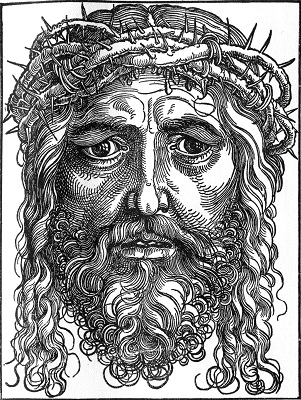 David Field gives a fantastic summary of the notion of a confessionally Christian government in his paper, Samuel Rutherford and the Confessionally Christian State (PDF).
Field asserts a postmillennial perspective, then adds a startling historical observation:
It took 1400 years for 1% of the world’s population to become Christians and then another 360 years for that to double to 2%. Another 170 years saw that grow from 2% to 4% and then, between 1960 and 1990 the proportion of the world’s population made up of Bible-believing Christians rose from 4% to 8%. Now, in 2007, one third of the world’s population confesses that Jesus is Lord and 11% of the world’s population are “evangelical” Christians. The evangelical church is growing twice as fast as Islam and three times as fast as the world’s population. South America is turning Protestant faster than Continental Europe did in the sixteenth century. South Koreans reckon that they can evangelize the whole of North Korea within five years once that country opens up. And then there’s the Chinese church consisting of tens of millions of Christians who have learned to pray, who have confidence in Scripture, who know about spiritual warfare, have been schooled in suffering and are qualified to rule. One day in the next century that Church — tens of millions of Christians trained to die — will be released into global mission and our prayers for the fall of Islam will be answered.
Field then lays out Samuel Rutherford’s vision for Christian constitutional government, and defends it against a number of common objections, concluding that:
Given the purpose, origin, nature, and stuff of the human person, it is clear and important that each human being confess the triune God, recognize Jesus as Lord, and live with the Word of God as his or her supreme authority. To Rutherford and the covenanting tradition, it is no less clear and important, given the purpose, origin, nature, and stuff of human government that each human ruler also confess the triune God, recognize Jesus as Lord, and live with the Word of God as his or her supreme authority.
If you find Field’s essay provocative, here’s some additional reading to consider:
- Abraham Kuyper’s Stone lectures on Calvinism were my first introduction to this viewpoint: the insistence that the nations exist for God, and that the magistrate has a duty to God, whether or not he acknowledges it.
- John Frame lays out some helpful principles in his article, Toward a theology of the state
- Peter Leithart discusses many aspects of a Christian attitude towards the state in his books, Against Christianity, Defending Constantine, and Between Babel and Beast.
- Kuyper introduced the notion of sphere sovereignty, which wrestles with the complementary ways that Jesus’s lordship is expressed in different spheres of life such as the church, family and state. David Koyzis describes how this was developed and advanced by students of Kuyper such as Herman Dooyeweerd.
Hat tip: Uri Brito
Pentecost
 Tomorrow is Pentecost.
Then, God gave us his law. He put it in a chest and wrote it on our hearts. Now, he also fills us with himself, his own spirit.
Then, God taught us to build him a tent-house so that he could live among us. He walked with us for a time in the flesh. Now, he dwells with us through his spirit and one another.
Then, God’s fire engulfed the bush, as a token that the God who keeps his promises would not consume us. Instead, his fire consumed the sacrifice on the altar and rose up as a pleasing memorial to him. Now, God’s fire rests continually upon us, and we consume his body and blood as a pleasing memorial to him.
Some Pentecost reading:
Redeemer
It would be difficult to call a single book my best theological purchase ever, because of the different ways that books can come to us at just the right time and can interact with and build upon each other. Lewis was a particular help to me because I was in a season of doubt. If Van Til hadn’t taught me to be a conscious Calvinist, I would never have needed Carson to steer me out of the hyper-Calvinist ditch, nor would I have been willing to work hard enough at Vos to learn more. And Middle-earth and Narnia are clearly in the running. Plus, I just haven’t read enough to be making such lofty pronouncements.
But realizing this, and even though I’m only partway into it, in my own small way I think the James Jordan audio collection will stand as my best theological purchase ever. Jordan has really incredible insights into the Bible. There are many books worth of material here; five months in and I have only made it through his Genesis lectures and partway into Exodus. But I am hooked, and if nothing else, I feel much better prepared and much more excited for family Bible reading. Jordan has the ability to illuminate many of the “weird” parts of the Bible so that they begin to make sense, and I’m having to give up some patronizing attitudes toward parts of history. It’s exciting to see someone wrestling with why God gave us particular details or obscure passages, even if we don’t have yet have enough information to answer that in every case. Jordan is constantly drawing out vast connections throughout Scripture, including rich symbolism and typology. Here’s a small but surprising example: combining Genesis 39:1, 39:20-23, and 41:10, we see that Joseph never left Potiphar’s house in his imprisonment! It is not clear whether the “keeper of the prison” is Potiphar himself or another of Potiphar’s servants. Regardless, Potiphar seems to have recognized that God blessed him through Joseph, and perhaps even recognized Joseph’s innocence (which would heighten the injustice of Joseph’s imprisonment).
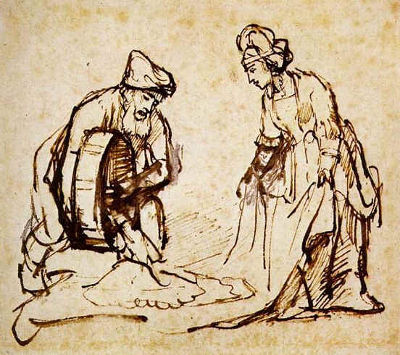 This week I am listening to Jordan’s comments on Exodus 21. While drawing connections to related passages elsewhere in the Pentateuch, he observes that Hebrew uses a single word, goel or ga’al, to convey both the idea of the kinsman redeemer and the avenger of blood. So the word conveys a person’s status as next-of-kin as much as it does these distinct responsibilities attached to it. Jordan has several valuable observations to make on the blood avenger; in particular, he distinguishes it from a mere family feud by showing it to be a real civil responsibility to guard against bloodguilt (Numbers 35:30-34). Otherwise the land itself will rise up to serve as avenger instead (as in Genesis 4:10-12, Leviticus 20:22, Leviticus 26:18-20). Considering the cities of refuge, Jordan points out that the death of the high priest’s cleansing the land (Numbers 35:28) is another type of Jesus.
Jordan also makes the fascinating offhand remark that this dual use for goel lends further support for the doctrine of particular redemption (or limited atonement). First, it is not possible to identify Jesus as redeemer in the abstract: he is the redeemer of particular individuals who share a kinship with him. Second, we cannot separate the office of redeemer from that of avenger: as a redeemer there are others estranged from him who will suffer his vengeance. Like so many other things, it comes back to adoption.
I’m not trying to prove the doctrine of particular redemption in offering this, and if I were I would take pains to guard against the hyper-Calvinist idea that there is simply no sense in which Jesus shows kindness to those who perish, or in which he died for the sins of the whole world. But as someone who holds to particular redemption, this is a neat confirmation, as well as a great example of the sort of depth that Jordan routinely offers even in passing comments.
Picture source: Rembrandt.
Calvin and covenant, again
I previously mentioned Peter Lillback’s book, The Binding of God, on Calvin’s understanding of and contribution to covenant theology. Calvin’s covenant theology was also the subject of Lillback’s Ph.D. thesis, as well as an article he wrote in 1982 showing how Calvin linked covenant theology and infant baptism. This article was previously available online only in scanned form with many OCR errors. I have corrected these and, with Lillback’s permission, the article is available here: “Calvin’s Covenantal Response to the Anabaptist View of Baptism”.
Whatever your view of infant baptism, this article is a helpful overview of Calvin’s covenant theology. Lillback spends time on continuity and discontinuity between the old and new covenants, including distinctions between law and gospel, letter and spirit, and general and special election. He also discusses covenant breaking, although he doesn’t directly address whether and in what sense God’s covenants are conditional and mutual, or the nature of covenant keeping; nor does he cover topics such as adoption and the Lord’s supper.
Eat
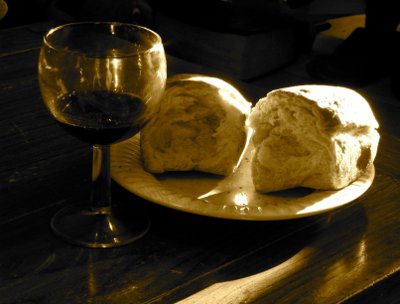 Two years ago I wrote “They preach,” of the Lord’s supper, but it could be improved by turning the comparison on its head. Fellowship over a meal is a much clearer picture of how God relates to his people than preaching, so that preaching is itself a bit of both setting out the feast and also table talk (John 21), and evangelism is an invitation to the feast (Luke 14, Revelation 19). The Lord’s supper is not merely a picture of how God relates to us, but one of the ways that he actually, presently relates to us. It is the family meal, and we eat it in fellowship with him.
Even in Genesis 2 Moses makes much of the fact that God provided Adam and Eve with food to eat. Adam’s sin involved eating, and God’s curse after the fall meant not only that fellowship with God was broken, but also that eating would require pain and toil (Genesis 3). As God’s plan of redemption unfolds in his covenants with man, food and table fellowship are not far, so that we often speak of a covenant meal.
God gave Adam the plants of the field, and to Noah he added living things (Genesis 9): God’s covenants keep getting better! Melchizedek, who we know is a type of Christ, set before Abram a meal of bread and wine (Genesis 14). Later Abraham prepared a meal for the three strangers who visit him (Genesis 18).
The Mosaic covenant is full of covenant meals. Passover commemorates God’s deliverance from Egypt, and Israel was commanded to celebrate it throughout their generations (Exodus 12). God provided water, meat and daily bread for Israel in the wilderness; both the bread and the rock that gave the water are types of Christ. Through Moses God also established Sabbath days and years for feasting and refreshment, and a calendar of other covenant feasts throughout the year. These holy feasts were such times of rejoicing before God that grief and weeping in conviction over sin was to be put aside (Nehemiah 8). Even tithing seems to have been not simply handing things over to the Levites, but also feasting with them before God (Deuteronomy 14). “Whatever you desire” — oxen, sheep, wine, beer. Finally, sacrifices regularly involved the priests’ eating the sacrifice, and sometimes the worshipper’s eating as well (Leviticus 7, 1 Chronicles 16). Covenant meals and feasts are not merely gifts from God, but a real part of regular fellowship with God.
Even among the covenants of men we find covenant meals. Jacob and Laban established their covenant with a meal (Genesis 31). David kept his covenant with Jonathan not simply by preserving Jonathan’s crippled son Mephibosheth, but by ensuring his food was provided for and furthermore bringing him to eat perpetually at his table (2 Samuel 9). David is certainly a type of Christ here.
Jesus was falsely accused of sin over who he shared meals with and how he ate (Luke 7). He declared that “whoever feeds on my flesh and drinks my blood has eternal life” (John 6). Many turned away at this; I wonder if they were offended not so much by the suggestion of cannibalism as by the implication of human sacrifice. John certainly intended for us to connect Jesus’s statement here to the Lord’s supper, which Jesus also explicitly relates to his sacrifice in the new covenant (Luke 14).
Feasting is a deep picture of how God relates to us. Peter Leithart has this to say about covenant meals and the Lord’s supper:
[T]he rite for animal offering ends, in most cases, with a communion meal. Priests and sometimes the worshipper receive a portion of “God’s bread” to eat. Eating together is a way to make a covenant or have fellowship. Throughout the Bible, when people conclude treaties, they eat a meal together to show that they are now friends. Jacob and Laban ate together after they had made a treaty of peace between them (Genesis 31:44-55). so also, when men draw near to God, they eat with Him. The elders of Israel eat and drink in God’s presence, and He does not stretch out His hand against them (Exodus 24:9-11). The end—the goal and the conclusion—of Israelite worship is a fellowship meal with God, and this renews the covenant. Our worship in the church is the same: After we have confessed our sins, heard God’s word, and praised Him, He invites us to His table to share a meal. We don’t eat the flesh of an animal, but the flesh and blood of the perfect sacrifice, Jesus. — A House for My Name, pp. 91-92
In a way, the old debates over “where is Christ in the Lord’s supper?” are asking the wrong question. Where are we in the Lord’s supper? We are feasting together in the presence of the one who clothes us and prepares a table before us.
God welcomes all of us to table fellowship with him, and this means we ought to welcome one another in the same way. Paul is concerned that we do not exclude one another from the Lord’s supper (1 Corinthians 10-11), and that our table fellowship does not become an occasion for despising or judging one another (Romans 14, 1 Corinthians 8-10). He even admonished Peter in this (Galatians 2).
Jesus invites and welcomes you to eat and drink at his table. Take, eat!
And Nehemiah, who was the governor, and Ezra the priest and scribe, and the Levites who taught the people said to all the people, “This day is holy to the Lord your God; do not mourn or weep.” For all the people wept as they heard the words of the Law. Then he said to them, “Go your way. Eat the fat and drink sweet wine and send portions to anyone who has nothing ready, for this day is holy to our Lord. And do not be grieved, for the joy of the Lord is your strength.” So the Levites calmed all the people, saying, “Be quiet, for this day is holy; do not be grieved.” And all the people went their way to eat and drink and to send portions and to make great rejoicing, because they had understood the words that were declared to them. — Nehemiah 8:9-12
Covenant and Adoption
J. I. Packer’s book Knowing God is best known for its chapter on adoption, “Sons of God.” The chapter is outstanding, both as a stirring picture of what a wonderful gift adoption is, but also in how he links our adoption to all of the blessings, privileges and responsibilities we have in Christ. Nothing else is quite as precious or as energizing as our adoption. On p. 201 Packer quotes an article he had written earlier:
You sum up the whole of New Testament teaching in a single phrase, if you speak of it as a revelation of the Fatherhood of the holy Creator. In the same way, you sum up the whole of New Testament religion if you describe it as the knowledge of God as one’s holy Father. If you want to judge how well a person understands Christianity, find out how much he makes of the thought of being God’s child, and having God as his Father. If this is not the thought that prompts and controls his worship and prayers and his whole outlook on life, it means that he does not understand Christianity very well at all. For everything that Christ taught, everything that makes the New Testament new, and better than the Old, everything that is distinctively Christian as opposed to merely Jewish, is summed up in the knowledge of the Fatherhood of God. “Father” is the Christian name for God.
 Peter Lillback, in his book The Binding of God, assembles a picture of John Calvin’s understanding of God’s covenants with man. Throughout the book what I am most struck by is how often Calvin links covenant theology with the doctrine of adoption in order to either make careful and helpful distinctions, or else to illustrate how God’s covenanting with us ought to be a real engine for responsive affections and actions on our part. Probably half of my dog-ears are for adoption-related passages.
So, we see Calvin summarizing the covenant as an adoption (pp. 137-138):
For if God only demanded his due, we should still be required to cling to him and to confine ourselves to his commandments. Moreover, when it pleases him by his infinite goodness to enter into a common treaty, and when he mutually binds himself to us without having to do so, when he enumerates that treaty article by article, when he chooses to be our father and Savior, when he receives us as his flock and his inheritance, let us abide under his protection, filled with its eternal life for us. When all of these things are done, is it proper that our hearts become mollified even if they were at one time stone? When creatures see that the living God humbles himself to that extent, that he wills to enter into covenant that he might say: “Let us consider our situation. It is true that there is an infinite distance between you and me and that I should be able to command of you whatever seems good to me without having anything in common with you, for you are not worthy to approach me and have any dealings with whoever can command of you what he wills, with no further declarations to you except: ‘That is what I will and conceive.’ But behold, I set aside my right. I come here to present myself to you as your guide and savior. I want to govern you. You are like my little family. And if you are satisfied with my Word, I will be your King. Furthermore, do not think that the covenant which I made with your fathers was intended to take anything from you. For I have no need, nor am I indigent in anything. And what could you do for me anyway? But I procure your well-being and your salvation. Therefore on my part, I am prepared to enter into covenant, article by article, and to pledge myself to you.”
And again Calvin summarizes even the old covenant as a gracious act of adoption (p. 140):
The Psalmist addresses himself by name to his own countrymen, whom, as has been stated, God had bound to himself by a special adoption. It was a bond of union still more sacred, that by the mere good pleasure of God they were preferred to all other nations. . . . He expressly states both these truths, first, that before they were born children of Abraham, they were already heirs of the covenant, because they derived their origin from the holy fathers; and, secondly, that the fathers themselves had not acquired this prerogative by their own merit or worth, but had been freely chosen; for this is the reason why Jacob is called God’s chosen.
Lillback moves on to explore several facets of God’s covenants in Calvin’s understanding. We have already seen above that, perhaps unlike Packer, Calvin considers adoption to be a blessing common to both the old and new covenants. First, Lillback explores Calvin’s complex understanding of mutuality and conditionality. Calvin carefully balances an understanding of God’s sovereign working in our salvation with how we as God’s creatures see, understand, receive and respond to his working in time and history. Adoption is a perfect picture of this because it is an undeserved gift that God undertook wholly on his own initiative, but which makes us God’s children and wholly obligates us to him. Lillback quotes Calvin on p. 172:
[Hosea] says that they had acted perfidiously with God, for they had violated his covenant. We must bear in mind what I have said before of the mutual faith which God stipulates with us, when he binds himself to us. God then covenants with us on this condition, that he will be our Father and Husband; but he requires from us such obedience as a son ought to render to his father; he requires from us that chastity which a wife owes to her husband. The Prophet now charges the people with unfaithfulness, because they had despised the true God, and prostituted themselves to idols.
On p. 192 we see how Calvin both distinguishes and weaves together faith and works. The language of sonship and union with Christ serves as a subtle backdrop, underscoring that obedience does not somehow perversely purchase our freedom from slavery and adoption into God’s love (as if it were possible!), but that pleasing our Father is nevertheless a wonderful combination of duty and delight:
When, therefore, we say that the faithful are esteemed just even in their deeds, this is not stated as a cause of their salvation, and we must diligently notice that the cause of salvation is excluded from this doctrine; for, when we discuss the cause, we must look nowhere else but to the mercy of God, and there we must stop. But although works tend in no way to the cause of justification, yet, when the elect sons of God were justified freely by faith, at the same time their works are esteemed righteous by the same gratuitous liberality. Thus it still remains true, that faith without works justifies, although this needs prudence and a sound interpretation; for this proposition, that faith without works justifies is true and yet false, according to the different senses which it bears. The proposition, that faith without works justifies by itself, is false, because faith without works is void. But if the clause “without works” is joined with the word “justifies,” the proposition will be true, since faith cannot justify when it is without works, because it is dead, and a mere fiction. He who is born of God is just, as John says. (I John V. 18) Thus faith can be no more separated from works than the sun from his heat: yet faith justifies without works, because works form no reason for our justification; but faith alone reconciles us to God, and causes him to love us, not in ourselves, but in his only-begotten Son.
Thus good works are not only possible but acceptable to God because, in Lillback’s words, “in the covenant, God ceases to be a strict judge and becomes a father” (p. 196). Quoting Calvin on the same page:
Moreover, we do not deny that for believers uprightness, albeit partial and imperfect, is a step toward immortality. But what is its source except that the Lord does not examine for merits the works of those whom he has received into the covenant of grace but embraces them with fatherly affection?
But this is the peculiar blessing of the new covenant, that the Law is written on men’s hearts, and engraven on their inward parts; whilst that severe requirement is relaxed so that the vices under which believers still labour are no obstacle to their partial and imperfect obedience being pleasant to God.
It is therefore necessary, even when we strive our utmost to serve God, to confess that without his forgiveness whatever we bring deserves rejection rather than his favour. Hence the Prophet says, that when God is reconciled to us, there is no reason to fear that he will reject us, because we are not perfect; for though our works be sprinkled with many spots, they will be acceptable to him, and though we labour under many defects, we shall yet be approved by him. How so? Because he will spare us; for a father is indulgent to his children, and though he may see a blemish in the body of his son, he will not yet cast him out of his house; nay, though he may have a son lame, or squint-eyed, or singular for any other defect, he will yet pity him, and will not cease to love him: so also is the case with respect to God, who, when he adopts us as his children, will forgive our sins. And as a father is pleased with every small attention when he sees his son submissive, and does not require from him what he requires from a servant; so God acts; he repudiates not our obedience, however defective it may be.
This wonderful result is because of our union with Christ the firstborn Son. Quoting Calvin on p. 209:
Yet notwithstanding, the persons of believers being accepted through Christ, their good works are also accepted in him, not as though they were in this life wholly unblamable and unreprovable in God’s sight; but that he, looking upon them in his Son, is pleased to accept and reward that which is sincere, although accompanied with many weaknesses and imperfections.
Nevertheless, there are those who apostatize or break covenant. Calvin depicts this too using familial language: those who break covenant are rebellious children who are disowned, ones who “degenerate from legitimate children to bastards” (Calvin, p. 217). Yet as God’s children we have great assurance of our perseverance, and encouragement to persevere, because our Father who dwells in our midst has pledged himself to us (Calvin, pp. 270-271):
But the inspired writer, calling to remembrance the promises by which God had declared that he would make the Church the object of his special care, and particularly that remarkable article of the covenant, “I will dwell in the midst of you” (Exodus xxv. 8), and, trusting to that sacred and indissoluble bond, has no hesitation in representing all the godly languishing, though they were in a state of suffering and wretchedness, as partakers of this celestial glory in which God dwells. . . . What advantage would we derive from this eternity and immutability of God’s being, unless we had in our hearts the knowledge of him, which, produced by his gracious covenant, begets in us the confidence arising from a mutual relationship between him and us? The meaning then is, “We are like withered grass, we are decaying every moment, we are not far from death, yea rather, we are, as it were, already dwelling in the grave; but since thou, O God! hast made a covenant with us, by which thou hast promised to protect and defend thine own people, and hast brought thyself into a gracious relation to us, giving us the fullest assurance that thou wilt always dwell in the midst of us, instead of desponding, we must be of good courage; and although we may see only ground for despair if we depend upon ourselves, we ought nevertheless to lift up our minds to the heavenly throne, from which thou wilt at length stretch forth thy hand to help us.” . . . . As God continues unchangeably the same — “without variableness or shadow of turning” — nothing can hinder him from aiding us; and this he will do, because we have his word, by which he has laid himself under obligation to us, and because he has deposited with us his own memorial, which contains in it a sacred and indissoluble bond of fellowship.
In seeking to secure our perseverance, God uses both fatherly enticings and fatherly threatenings and discipline. Yet in the end, “the Christian’s life of covenant-keeping, although imperfect before God, is nevertheless a life of encouragement since God is pleased with His adopted children’s faithful efforts” (Lillback, p. 275).
There are some areas of covenant life where Lillback does not quote Calvin in reference to adoption, but where there is a clear link to adoption. One such area is that of “covenant prayer.” The nature of our prayer to God is precisely that of a child appealing to a loving father (Luke 11:1-13).
This is also the case for the sacraments, the covenant signs. Baptism is a pronouncement by God through his church of our adoption and justification. Consider that our baptism is a key beginning of our union with Christ (Romans 6) and Christ’s own baptism was a pronouncement of sonship and acceptance (Matthew 3). (Baptism is of course not the cause of our adoption and justification any more than a minister’s pronouncement of “man and wife” is the cause of a couple’s union.) Similarly, the covenant meal is a family meal. God provides food for us, his children, and we eat before him. This is true of both the Lord’s Supper and also Old Testament meals that priests and often worshippers enjoyed before God after offering sacrifice.
There are, of course, plenty of other ways we can think about God’s covenanting. Adoption showcases the work of God the Father, but we could equally explore the work of Christ or of the Spirit in our salvation. Or we could consider how our children relate to God, explore Calvin’s letter-Spirit distinction over against a Lutheran law-gospel distinction, or consider the many ways in which the old and new covenants are similar yet different.
An advantage of looking at adoption specifically is that it stands up well as a proxy for the kind of questions we want to ask about covenant and sacraments. In particular, it helps us to remember that God’s covenants are not merely legal, but also affective, personal and social. What does it mean to be in covenant with God through Christ and his Spirit? More than anything else, it means to be adopted, named and kept as his own child.
Nothing can hinder him from aiding us
The fullest confidence is available to believers in their suffering because of God’s immutable covenant promise by which He has obliged Himself to believers.
But the inspired writer, calling to remembrance the promises by which God had declared that he would make the Church the object of his special care, and particularly that remarkable article of the covenant, “I will dwell in the midst of you” (Exodus xxv. 8), and, trusting to that sacred and indissoluble bond, has no hesitation in representing all the godly languishing, though they were in a state of suffering and wretchedness, as partakers of this celestial glory in which God dwells. . . . What advantage would we derive from this eternity and immutability of God’s being, unless we had in our hearts the knowledge of him, which, produced by his gracious covenant, begets in us the confidence arising from a mutual relationship between him and us? The meaning then is, “We are like withered grass, we are decaying every moment, we are not far from death, yea rather, we are, as it were, already dwelling in the grave; but since thou, O God! hast made a covenant with us, by which thou hast promised to protect and defend thine own people, and hast brought thyself into a gracious relation to us, giving us the fullest assurance that thou wilt always dwell in the midst of us, instead of desponding, we must be of good courage; and although we may see only ground for despair if we depend upon ourselves, we ought nevertheless to lift up our minds to the heavenly throne, from which thou wilt at length stretch forth thy hand to help us.” . . . . As God continues unchangeably the same — “without variableness or shadow of turning” — nothing can hinder him from aiding us; and this he will do, because we have his word, by which he has laid himself under obligation to us, and because he has deposited with us his own memorial, which contains in it a sacred and indissoluble bond of fellowship.
There is always hope, even in the adversities of life, because “the eyes of the Lord are over the righteous, to confirm His covenant towards them by watching for their safety.”
— Peter Lillback, quoting Calvin in The Binding of God, pp. 270-271.
The Binding of God
. . . the essence of Calvin’s conception of the covenant is the notion of the binding of God. This binding is God’s own act of joining Himself with His creatures. . . . The gracious self-binding of the infinite God whereby He condescends to enter into a mutual covenant with His fallen and unworthy yet sovereignly chosen people is eloquently portrayed by Calvin in his sermon on Deuternonomy 4:44-5:3.
For if God only demanded his due, we should still be required to cling to him and to confine ourselves to his commandments. Moreover, when it pleases him by his infinite goodness to enter into a common treaty, and when he mutually binds himself to us without having to do so, when he enumerates that treaty article by article, when he chooses to be our father and Savior, when he receives us as his flock and his inheritance, let us abide under his protection, filled with its eternal life for us. When all of these things are done, is it proper that our hearts become mollified even if they were at one time stone? When creatures see that the living God humbles himself to that extent, that he wills to enter into covenant that he might say: “Let us consider our situation. It is true that there is an infinite distance between you and me and that I should be able to command of you whatever seems good to me without having anything in common with you, for you are not worthy to approach me and have any dealings with whoever can command of you what he wills, with no further declarations to you except: ‘That is what I will and conceive.’ But behold, I set aside my right. I come here to present myself to you as your guide and savior. I want to govern you. You are like my little family. And if you are satisfied with my Word, I will be your King. Furthermore, do not think that the covenant which I made with your fathers was intended to take anything from you. For I have no need, nor am I indigent in anything. And what could you do for me anyway? But I procure your well-being and your salvation. Therefore on my part, I am prepared to enter into covenant, article by article, and to pledge myself to you.”
The covenant, therefore, highlights God’s grace.
— Peter Lillback, The Binding of God, pp. 137-138.
We are as the prodigal son.
Kuyper on Calvinism
Following are some notes and quotes from Abraham Kuyper’s Lectures on Calvinism.
- A key element of Christian revolutions (Dutch, American) was a gradual undermining of kings, not by lowering esteem, but by raising it; not by opposing God but by worshipping Him (through p. 28)
- 3 fundamental measures of unique world views (p. 31)
- relationship to God – immediate fellowship through Christ + HS
- relationship to man – divine image, intrinsic worth, equality of men
- relationship to world – curse restrained by grace; “discover treasures and develop potencies hidden by God in nature and in human life.”
- common grace – do we define things, relative to power of sin or power of God? Which is more potent: pollution of sin or redemptive movement?
- Kuyper strikes me as being exceptionally enamored with progress (pp. 32, 34, 35, 40)
- God’s authority over, and necessary glorification in, all spheres of life (p. 53)
- “Coram Deo”, no such thing as private religion, … one-ness of all human life
- C.f. Mark Horne, “public relationship with Jesus Christ”
- Importance of Church in God’s redemptive plan; covenant = church
- God’s supreme sovereignty flowing down in sovereignty given to state/society/church (p. 79)
- Assumes one-world gov’t is best in absence of sin (p. 80) … some logic given to this
- “God has instituted the magistrates, by reason of sin.” (p. 81) Nations exist for God (p. 81)
- Calvin regarded republic as best, but not categorically so; others will work. Commends gratitude for privilege of electing magistrates (pp. 83-84)
- Contrasts God’s sovereignty w/ false ideas of popular sovereignty or state sovereignty (as rejection of God) (pp. 85ff)
- Calvinism “makes it easy for us to obey authority, because, in all authority, it causes us to honor the demand of divine sovereignty.” (p. 90)
- “Principal characteristic” of gov’t is “the right of life + death” (p. 93)
- Sword for -> justice, war, order
- Much discussion of self-organization of spheres, natural leadership of “masters” in spheres
- Political sphere should not rightfully interfere in natural God-given operation of these other spheres (family, art, science, education, business) (p. 96)
- The state interferes to (p. 97)
- Mediate clashes between spheres
- Defend the weak against abuse of power in other spheres
- Coerce all to bear personal + financial burdens of maintaining unity of the state
- Government may not take on absolute authority, nor may other spheres overstep their bounds into arena of government
- Pp. 99ff — admission of the propriety of a plurality of churches
- Against the state church (even as expressed by Calvin)
- Proper Calvinism promotes plurality, and understands the government’s role as protecting it.
- Pp. 103ff — magistrates’ duty
- to God – acknowledge and confess authority, rule by God’s ordinances, restrain blasphemy
- magistrate understands God’s law personally, not under authority (strictly speaking) of church
- blasphemy addressed not for religious reasons but as undermining God’s establishment of law and state
- “The sphere of the state is not profane. But both church and state must, each in their own sphere, obey God and serve His honor.” (p. 104)
- to church – may not exercise judgment as to true and false churches
- to individual
- some individual sovereignty exists, but conscience is not entirely liberated from state, church, word, family (p. 107)
- magistrate respects liberty of conscience, ensures church does so (particularly regarding those outside church)
- to God – acknowledge and confess authority, rule by God’s ordinances, restrain blasphemy
- Science
- p. 118, “A dualistic conception of regeneration was the cause of the rupture between the life of nature and the life of grace.”
- p. 125, “Not only the church, but also the world belongs to God.”
- p. 132, is the world normal, or abnormal seeking regeneration? fundamental distinction striking at the heart of the scientific conception
 I gotta have my orange juice.