Archive for the ‘Covenant’ Category
The Binding of God

. . . the essence of Calvin’s conception of the covenant is the notion of the binding of God. This binding is God’s own act of joining Himself with His creatures. . . . The gracious self-binding of the infinite God whereby He condescends to enter into a mutual covenant with His fallen and unworthy yet sovereignly chosen people is eloquently portrayed by Calvin in his sermon on Deuternonomy 4:44-5:3.
For if God only demanded his due, we should still be required to cling to him and to confine ourselves to his commandments. Moreover, when it pleases him by his infinite goodness to enter into a common treaty, and when he mutually binds himself to us without having to do so, when he enumerates that treaty article by article, when he chooses to be our father and Savior, when he receives us as his flock and his inheritance, let us abide under his protection, filled with its eternal life for us. When all of these things are done, is it proper that our hearts become mollified even if they were at one time stone? When creatures see that the living God humbles himself to that extent, that he wills to enter into covenant that he might say: “Let us consider our situation. It is true that there is an infinite distance between you and me and that I should be able to command of you whatever seems good to me without having anything in common with you, for you are not worthy to approach me and have any dealings with whoever can command of you what he wills, with no further declarations to you except: ‘That is what I will and conceive.’ But behold, I set aside my right. I come here to present myself to you as your guide and savior. I want to govern you. You are like my little family. And if you are satisfied with my Word, I will be your King. Furthermore, do not think that the covenant which I made with your fathers was intended to take anything from you. For I have no need, nor am I indigent in anything. And what could you do for me anyway? But I procure your well-being and your salvation. Therefore on my part, I am prepared to enter into covenant, article by article, and to pledge myself to you.”
The covenant, therefore, highlights God’s grace.
— Peter Lillback, The Binding of God, pp. 137-138.
We are as the prodigal son.
Kuyper on Calvinism
Following are some notes and quotes from Abraham Kuyper’s Lectures on Calvinism.
- A key element of Christian revolutions (Dutch, American) was a gradual undermining of kings, not by lowering esteem, but by raising it; not by opposing God but by worshipping Him (through p. 28)
- 3 fundamental measures of unique world views (p. 31)
- relationship to God – immediate fellowship through Christ + HS
- relationship to man – divine image, intrinsic worth, equality of men
- relationship to world – curse restrained by grace; “discover treasures and develop potencies hidden by God in nature and in human life.”
- common grace – do we define things, relative to power of sin or power of God? Which is more potent: pollution of sin or redemptive movement?
- Kuyper strikes me as being exceptionally enamored with progress (pp. 32, 34, 35, 40)
- God’s authority over, and necessary glorification in, all spheres of life (p. 53)
- “Coram Deo”, no such thing as private religion, … one-ness of all human life
- C.f. Mark Horne, “public relationship with Jesus Christ”
- Importance of Church in God’s redemptive plan; covenant = church
- God’s supreme sovereignty flowing down in sovereignty given to state/society/church (p. 79)
- Assumes one-world gov’t is best in absence of sin (p. 80) … some logic given to this
- “God has instituted the magistrates, by reason of sin.” (p. 81) Nations exist for God (p. 81)
- Calvin regarded republic as best, but not categorically so; others will work. Commends gratitude for privilege of electing magistrates (pp. 83-84)
- Contrasts God’s sovereignty w/ false ideas of popular sovereignty or state sovereignty (as rejection of God) (pp. 85ff)
- Calvinism “makes it easy for us to obey authority, because, in all authority, it causes us to honor the demand of divine sovereignty.” (p. 90)
- “Principal characteristic” of gov’t is “the right of life + death” (p. 93)
- Sword for -> justice, war, order
- Much discussion of self-organization of spheres, natural leadership of “masters” in spheres
- Political sphere should not rightfully interfere in natural God-given operation of these other spheres (family, art, science, education, business) (p. 96)
- The state interferes to (p. 97)
- Mediate clashes between spheres
- Defend the weak against abuse of power in other spheres
- Coerce all to bear personal + financial burdens of maintaining unity of the state
- Government may not take on absolute authority, nor may other spheres overstep their bounds into arena of government
- Pp. 99ff — admission of the propriety of a plurality of churches
- Against the state church (even as expressed by Calvin)
- Proper Calvinism promotes plurality, and understands the government’s role as protecting it.
- Pp. 103ff — magistrates’ duty
- to God – acknowledge and confess authority, rule by God’s ordinances, restrain blasphemy
- magistrate understands God’s law personally, not under authority (strictly speaking) of church
- blasphemy addressed not for religious reasons but as undermining God’s establishment of law and state
- “The sphere of the state is not profane. But both church and state must, each in their own sphere, obey God and serve His honor.” (p. 104)
- to church – may not exercise judgment as to true and false churches
- to individual
- some individual sovereignty exists, but conscience is not entirely liberated from state, church, word, family (p. 107)
- magistrate respects liberty of conscience, ensures church does so (particularly regarding those outside church)
- to God – acknowledge and confess authority, rule by God’s ordinances, restrain blasphemy
- Science
- p. 118, “A dualistic conception of regeneration was the cause of the rupture between the life of nature and the life of grace.”
- p. 125, “Not only the church, but also the world belongs to God.”
- p. 132, is the world normal, or abnormal seeking regeneration? fundamental distinction striking at the heart of the scientific conception
Biblical Theology
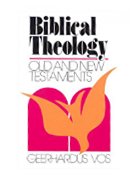 Vos, Geerhardus. Biblical Theology. Carlisle, PA: Banner of Truth, 1996.
In this book Vos presents an expansive summary of Biblical theology. In this case, Biblical theology is a technical term that means the study of the history of theological development in Scripture. Biblical theology as a discipline seeks to understand what Israel understood about God throughout Biblical history, and what God was intending to teach Israel as He progressively revealed himself to them.
Vos is reformed, and he presents a compelling view not simply of a sovereign and glorious Creator and Redeemer, but of a Creator who has had one plan for all of history. Vos demonstrates the continuity of God’s revelation and covenants, showing how each progressive stage fits into God’s revealed eternal plan. I had never seen this demonstrated so powerfully before; this was very encouraging for me to read.
In particular, I was struck by Vos’s presentation of God’s law. Vos reminds us that God has always intended to save by grace alone, and that even in the Old Testament it was not obedience to the law that brought salvation, but rather obedience filled with faith in a God of grace. In Romans Paul discusses his pre-conversion understanding of God’s law. Forgetting Paul’s reminder that Abraham was saved by faith, not works, I sometimes think that Paul’s legalistic pre-conversion understanding of the law was right! But Vos reminds us that law and grace are not at odds; that the law is good and gracious; and that as much as we are now freed from bondage to the law, God never intended to save by anything other than grace.
I understand that Vos had not fully completed this book by the time of his death, and so his treatment of the New Testament is somewhat less extensive than his treatment of the Old Testament. But this book is still a tremendously valuable survey of God’s self-revelation and dealings with man throughout scripture.

