Archive for the ‘Books’ Category
Tolkien, Reading and the Ring
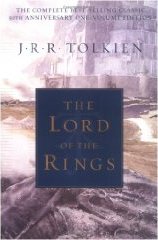 My wife and I have a tradition of watching through The Lord of the Rings at Christmastide. We don’t get to it every year, but we’ve just finished the cycle this time.
It’s been awhile since I read the books, so long that I find myself forgetting things. Most of all I don’t sense the loss of nobility from books to movies as much as I used to. So I’ve decided to re-read Tolkien this year. I’ve started with The Silmarillion, which I haven’t read before. I’ve already read Unfinished Tales and I don’t think I’ll read it through again now, but I will reread both The Hobbit and The Lord of the Rings. Just today, I was pleased to rediscover The Letters of J.R.R. Tolkien on my shelf, one of my wife’s yard sale finds. I think I’ll try to get through that as well. And I’m excited that Mark Horne is working on a Tolkien biography.
Here’s a quote I found while paging through Tolkien’s letters, from a fascinating letter on p. 279 in response to questions about The Lord of the Rings from Miss Rhona Beare:
You cannot press the One Ring too hard, for it is of course a mythical feature, even though the world of the tales is conceived in more or less historical terms. The Ring of Sauron is only one of the various mythical treatments of the placing of one’s life, or power, in some external object, which is thus exposed to capture or destruction with disastrous results to oneself. If I were to ‘philosophize’ this myth, or at least the Ring of Sauron, I should say it was a mythical way of representing the truth that potency (or perhaps rather potentiality) if it is to be exercised, and produce results, has to be externalized and so as it were passes, to a greater or less degree, out of one’s direct control. A man who wishes to exert ‘power’ must have subjects, who are not himself. But he then depends on them.
There’s a lot of food for thought there, with applicability ranging from the inevitable failure of despotism to everything that is bittersweet about parenthood.
Nothing can hinder him from aiding us

The fullest confidence is available to believers in their suffering because of God’s immutable covenant promise by which He has obliged Himself to believers.
But the inspired writer, calling to remembrance the promises by which God had declared that he would make the Church the object of his special care, and particularly that remarkable article of the covenant, “I will dwell in the midst of you” (Exodus xxv. 8), and, trusting to that sacred and indissoluble bond, has no hesitation in representing all the godly languishing, though they were in a state of suffering and wretchedness, as partakers of this celestial glory in which God dwells. . . . What advantage would we derive from this eternity and immutability of God’s being, unless we had in our hearts the knowledge of him, which, produced by his gracious covenant, begets in us the confidence arising from a mutual relationship between him and us? The meaning then is, “We are like withered grass, we are decaying every moment, we are not far from death, yea rather, we are, as it were, already dwelling in the grave; but since thou, O God! hast made a covenant with us, by which thou hast promised to protect and defend thine own people, and hast brought thyself into a gracious relation to us, giving us the fullest assurance that thou wilt always dwell in the midst of us, instead of desponding, we must be of good courage; and although we may see only ground for despair if we depend upon ourselves, we ought nevertheless to lift up our minds to the heavenly throne, from which thou wilt at length stretch forth thy hand to help us.” . . . . As God continues unchangeably the same — “without variableness or shadow of turning” — nothing can hinder him from aiding us; and this he will do, because we have his word, by which he has laid himself under obligation to us, and because he has deposited with us his own memorial, which contains in it a sacred and indissoluble bond of fellowship.
There is always hope, even in the adversities of life, because “the eyes of the Lord are over the righteous, to confirm His covenant towards them by watching for their safety.”
— Peter Lillback, quoting Calvin in The Binding of God, pp. 270-271.
The Binding of God
. . . the essence of Calvin’s conception of the covenant is the notion of the binding of God. This binding is God’s own act of joining Himself with His creatures. . . . The gracious self-binding of the infinite God whereby He condescends to enter into a mutual covenant with His fallen and unworthy yet sovereignly chosen people is eloquently portrayed by Calvin in his sermon on Deuternonomy 4:44-5:3.
For if God only demanded his due, we should still be required to cling to him and to confine ourselves to his commandments. Moreover, when it pleases him by his infinite goodness to enter into a common treaty, and when he mutually binds himself to us without having to do so, when he enumerates that treaty article by article, when he chooses to be our father and Savior, when he receives us as his flock and his inheritance, let us abide under his protection, filled with its eternal life for us. When all of these things are done, is it proper that our hearts become mollified even if they were at one time stone? When creatures see that the living God humbles himself to that extent, that he wills to enter into covenant that he might say: “Let us consider our situation. It is true that there is an infinite distance between you and me and that I should be able to command of you whatever seems good to me without having anything in common with you, for you are not worthy to approach me and have any dealings with whoever can command of you what he wills, with no further declarations to you except: ‘That is what I will and conceive.’ But behold, I set aside my right. I come here to present myself to you as your guide and savior. I want to govern you. You are like my little family. And if you are satisfied with my Word, I will be your King. Furthermore, do not think that the covenant which I made with your fathers was intended to take anything from you. For I have no need, nor am I indigent in anything. And what could you do for me anyway? But I procure your well-being and your salvation. Therefore on my part, I am prepared to enter into covenant, article by article, and to pledge myself to you.”
The covenant, therefore, highlights God’s grace.
— Peter Lillback, The Binding of God, pp. 137-138.
We are as the prodigal son.
Kuyper on Calvinism
Following are some notes and quotes from Abraham Kuyper’s Lectures on Calvinism.
- A key element of Christian revolutions (Dutch, American) was a gradual undermining of kings, not by lowering esteem, but by raising it; not by opposing God but by worshipping Him (through p. 28)
- 3 fundamental measures of unique world views (p. 31)
- relationship to God – immediate fellowship through Christ + HS
- relationship to man – divine image, intrinsic worth, equality of men
- relationship to world – curse restrained by grace; “discover treasures and develop potencies hidden by God in nature and in human life.”
- common grace – do we define things, relative to power of sin or power of God? Which is more potent: pollution of sin or redemptive movement?
- Kuyper strikes me as being exceptionally enamored with progress (pp. 32, 34, 35, 40)
- God’s authority over, and necessary glorification in, all spheres of life (p. 53)
- “Coram Deo”, no such thing as private religion, … one-ness of all human life
- C.f. Mark Horne, “public relationship with Jesus Christ”
- Importance of Church in God’s redemptive plan; covenant = church
- God’s supreme sovereignty flowing down in sovereignty given to state/society/church (p. 79)
- Assumes one-world gov’t is best in absence of sin (p. 80) … some logic given to this
- “God has instituted the magistrates, by reason of sin.” (p. 81) Nations exist for God (p. 81)
- Calvin regarded republic as best, but not categorically so; others will work. Commends gratitude for privilege of electing magistrates (pp. 83-84)
- Contrasts God’s sovereignty w/ false ideas of popular sovereignty or state sovereignty (as rejection of God) (pp. 85ff)
- Calvinism “makes it easy for us to obey authority, because, in all authority, it causes us to honor the demand of divine sovereignty.” (p. 90)
- “Principal characteristic” of gov’t is “the right of life + death” (p. 93)
- Sword for -> justice, war, order
- Much discussion of self-organization of spheres, natural leadership of “masters” in spheres
- Political sphere should not rightfully interfere in natural God-given operation of these other spheres (family, art, science, education, business) (p. 96)
- The state interferes to (p. 97)
- Mediate clashes between spheres
- Defend the weak against abuse of power in other spheres
- Coerce all to bear personal + financial burdens of maintaining unity of the state
- Government may not take on absolute authority, nor may other spheres overstep their bounds into arena of government
- Pp. 99ff — admission of the propriety of a plurality of churches
- Against the state church (even as expressed by Calvin)
- Proper Calvinism promotes plurality, and understands the government’s role as protecting it.
- Pp. 103ff — magistrates’ duty
- to God – acknowledge and confess authority, rule by God’s ordinances, restrain blasphemy
- magistrate understands God’s law personally, not under authority (strictly speaking) of church
- blasphemy addressed not for religious reasons but as undermining God’s establishment of law and state
- “The sphere of the state is not profane. But both church and state must, each in their own sphere, obey God and serve His honor.” (p. 104)
- to church – may not exercise judgment as to true and false churches
- to individual
- some individual sovereignty exists, but conscience is not entirely liberated from state, church, word, family (p. 107)
- magistrate respects liberty of conscience, ensures church does so (particularly regarding those outside church)
- to God – acknowledge and confess authority, rule by God’s ordinances, restrain blasphemy
- Science
- p. 118, “A dualistic conception of regeneration was the cause of the rupture between the life of nature and the life of grace.”
- p. 125, “Not only the church, but also the world belongs to God.”
- p. 132, is the world normal, or abnormal seeking regeneration? fundamental distinction striking at the heart of the scientific conception
Joy at the End of the Tether
 Wilson, Douglas. Joy at the End of the Tether. Moscow, ID: Canon Press, 1999.
This book is a conversational walk through the book of Ecclesiastes. Douglas Wilson helped me to see for the first time the depth of wisdom and truth in Ecclesiastes. It is not exaggeration to say that Wilson has revolutionized my understanding of Ecclesiastes.
Previously I saw Ecclesiastes as portraying a world of emptiness and hopelessness, with an occasional disjointed glimmer of hope that there was some escape from the wasteland. But Wilson shows, conclusively I think, that Ecclesiastes is a unified whole. The world is full of vain repetition. But the message is not that we should become ascetics, forsaking the vain repetition of the world, for to do so rightly we would have to go out of the world! The message, rather, is that we should walk in faith, receive our lot as a gift from God, with appropriate joy and gratefulness. To the one who walks in unbelief, the vain repetition of this life brings nothing but despair. But to the one who walks in faith, trusting in God’s sovereignty and goodness, even the vain repetition of this life is a gift from God to be enjoyed.
This book has been tremendously helpful in encouraging me to walk in faith through difficulty and even tedium, challenging me to cultivate real gratefulness rather than a worldly gritty perseverance. This is part of faith’s growing in seeing all of life as being before the face of God (coram Deo).
I recommend this book very highly.
I’ve also encountered John Reisinger’s series titled “Thoughts on the Book of Ecclesiastes”. I don’t know much about Reisinger, nor have I yet done more than skim these articles. But Reisinger references Kaiser frequently, who was also one of Wilson’s primary sources. I’m retaining links to these articles for my reference; I don’t know yet whether I can recommend them: part 1, part 2, part 3, part 4, part 5, part 6, part 7, part 8.
Redemption Accomplished and Applied
 Murray, John. Redemption Accomplished and Applied. Grand Rapids, MI: William B. Eerdmans Publishing Co., 1984.
The late John Murray presents a brief overview of Jesus’s work of redemption. This book is divided into two parts: Redemption Accomplished, which describes our need of a savior, God’s provision of a savior, and what Jesus accomplished on the cross; and Redemption Applied, which describes how all of redemption is worked out in the life of the believer.
This book was a helpful overview of Jesus’s work on the cross and of God’s work in bringing me to salvation.
Of all of the chapters, the one that was most provocative to me was the chapter on faith and repentance. Murray presents a wonderful reminder of where our assurance of salvation is located — nowhere other than Jesus himself.
Following are this and some other quotes I’ve collected from the book.
On Assurance (pp. 107ff)
Murray reminds us that our assurance does not consist in peering into the secret decrees of God to discern whether he loves us or has elected us unto salvation (see also The Difficult Doctrine of the Love of God), nor does it consist of our subjective sense of nearness to God. It consists in placing our trust here and now wholly in Jesus for mercy:
What warrant does a lost sinner have to commit himself to Christ? How may he know that he will be accepted? How does he know that Christ is able to save? How does he know that this confidence is not misplaced? How does he know that Christ is willing to save him? . . .
From whatever angle we may view [the offer of the gospel], it is full, free, and unrestricted. The appeals of the gospel cover the whole range of divine prerogative and of human interest. God entreats, he invites, he commands, he calls, he presents the overture of mercy and grace, and he does this to all without distinction or discrimination. . . .
When Christ is presented to lost men in the proclamation of the gospel, it is as Savior he is presented, as one who ever continues to be the embodiment of the salvation he has once for all accomplished. It is not the possibility of salvation that is offered to lost men but the Saviour himself and therefore salvation full and perfect. There is no imperfection in the salvation offered and there is no restriction to its overture — it is full, free, and unrestricted. And this is the warrant of faith.
The faith of which we are now speaking is not the belief that we have been saved but [it is] trust in Christ in order that we may be saved. And it is of paramount concern to know that Christ is presented to all without distinction to the end that they may entrust themselves to him for salvation. The gospel offer is not restricted to the elect or even to those for whom Christ died. And the warrant of faith is not the conviction that we are elect or that we are among those for whom, strictly speaking, Christ died but [it is] the fact that Christ, in the glory of his person, in the perfection of his finished work, and in the efficacy of his exalted activity as King and Saviour, is presented to us in the full, free, and unrestricted overture of the gospel. It is not as persons convinced of our election nor as persons convinced that we are the special objects of God’s love that we commit ourselves to him but as lost sinners. We entrust ourselves to him not because we believe we have been saved but as lost sinners in order that we may be saved. It is to us in our lost condition that the warrant of faith is given and the warrant is not restricted or circumscribed in any way. In the warrant of faith the rich mercy of God is proffered to the lost and the promise of grace is certified by the veracity and faithfulness of God. This is the ground upon which a lost sinner may commit himself to Christ in full confidence that he will be saved. And no sinner to whom the gospel comes is excluded from the divine warrant for such confidence.
On Union With Christ (pp. 162-163)
Murray presents an excellent summary of what it means to be in union with Christ. He writes that “if we did not take account of [union with Christ], not only would our presentation of the application of redemption be defective but our view of the Christian life would be gravely distorted. Nothing is more central or basic than union and communion with Christ” (p. 161). He goes on to enumerate what it means to be united with Christ:
The fountain of salvation itself in the eternal election of the Father is “in Christ.” . . . The Father elected from eternity, but he elected in Christ. . . .
It is also because the people of God were in Christ when he gave his life a ransom and redeemed by his blood that salvation has been secured for them; they are represented as united to Christ in his death, resurrection, and exaltation to heaven. . . .
It is in Christ that the people of God are created anew. “We are his workmanship, created in Christ Jesus unto good works” (Eph. 2:10). . . .
But not only does the new life have its inception in Christ; it is also continued by virtue of the same relationship to him. It is in Christ that Christian life and behavior are conducted. . . .
It is in Christ that believers die. They have fallen asleep in Christ or through Christ and they are dead in Christ (1 Thess. 4:14, 16). . . .
Finally, it is in Christ that the people of God will be resurrected and glorified. It is in Christ they will be made alive when the last trumpet will sound and the dead will be raised incorruptible (1 Cor. 15:22). It is with Christ they will be glorified (Rom. 8:17).
Baby Wise
 Ezzo, Gary. On Becoming Baby Wise. Hawks Flight & Association, 2001.
Of all the decisions new parents make, perhaps the most controversial is the style of care and feeding to use. There are a lot of competing ideas out there, some of which are strongly opposed to one another, although at times it seems they have more in common than folks are willing to admit. The two ideas that you will most often encounter are demand feeding and schedule feeding.
We have used schedule feeding for our children, and are very happy with the results. We have no experience with demand feeding, though I have heard cogent criticism of it. There is also criticism of schedule feeding, though I think much of it misses the point. Schedule feeding is not blindly clock-driven, but appropriately moderates regularity in service of the baby’s needs. Much of the underlying difference between the two methods is the question of whether babies are autonomous and able to accurately judge their needs; or whether babies are under the authority of parents who are able to wisely balance their child’s felt needs and desires with their child’s actual needs, the family’s needs, and the goal of developing good habits. Schedule feeding is the method that is presented in Baby Wise.
Some caution is needed in approaching Baby Wise. Ezzo frames schedule feeding as the only proper way to parent, which I think is an overstatement. Feeding style is an important decision that has broad influence, including even character development. But it is nonetheless a matter of personal preference, not a matter of religious importance.
Baby Wise has a lot of ideas to digest. We found three points to be of central importance:
- No snack/pacify feeding. This generally means to feed on a schedule, but with some flexibility.
- Follow a pattern of feed, wake, sleep. Avoid letting feeding becoming a crutch for sleeping.
- Establish a fairly consistent morning feeding time.
There are three corollaries that we also found helpful:
- It’s ok for a baby to cry, provided their diaper is clean and it’s not time to eat.
- This approach requires significant discipline, patience, and consistency on the parents’ part. In particular, the father should be committed to leading, encouraging, and helping through this.
- It does not matter whether you are breastfeeding or bottle feeding. We only have experience with bottle feeding, but we know families that have successfully used these methods when breastfeeding. The main challenge with breastfeeding is that it’s more difficult to know how much food the baby is receiving.
While using these principles, all of our children slept through the night by about 12 weeks, and as babies were always at least 80th percentile in weight. Even more importantly, they have been generally sweet and submissive. While we cannot know how much of this is due to schedule feeding, this is what we practice and recommend.
Lisa has also read and recommends Tracy Hogg’s Secrets of the Baby Whisperer, whose approach is similar to the above.
Holy Trinity
 Letham, Robert. The Holy Trinity: In Scripture, History, Theology and Worship. Phillipsburg, NJ: P & R Publishing, 2005.
This is an outstanding book. Letham begins with an overview of the Biblical doctrine of the trinity. He then describes the historical development of the doctrine of the trinity from the early church to the present, covering both the orthodox and heterodox. The book closes with an excellent overview of how the trinity ought to inform our life and worship.
While the entire book is very good, this closing section is the best part. Christianity is inescapably trinitarian: God’s nature is fundamentally triune, and His relation to man, through creation, revelation, salvation and glorification, is an unavoidable expression of His triunity. Yet so often our life and worship is practically unitarian. Letham wants to see the church recover an essential trinitarian life and worship, and this God-glorifying focus is very refreshing. Letham develops how this appropriate focus on the trinity will have vital practical outworking in our salvation, sanctification, worship, prayer, evangelism, and sacrificial love for fellow believers with whom we are united to Jesus.
Letham encourages us to see the trinity as expressed through all of reality, and to enjoy unity in diversity and diversity in unity. This contrasts on the one hand with postmodernism’s diversity without unity, and on the other hand Islam’s unity without diversity. Only Trinitarianism can understand a reality that is both united and diverse. (This echoes Van Til’s apologetic emphasis on the problem of the one and the many, to which only Trinitarian Christianity has an answer.)
It seems to me that an appropriate focus on the gospel must result in an appropriate understanding and focus on the trinity. Even more clearly than in creation, the gospel showcases both the unified and diverse act of God in saving us. Each person of the trinity plays a distinct role in our salvation, but the unity of God’s purpose and action in saving us is also clear.
Following are several quotes that struck me while reading this book:
Quoting Gregory Nazianzen, Oration on Holy Baptism:
This I give you to share, and to defend all your life, the one Godhead and power, found in the three in unity, and comprising the three separately; not unequal, in substances or natures, neither increased nor diminished by superiorities or inferiorities; in every respect equal, in every respect the same; just as the beauty and the greatness of the heavens is one; the infinite conjunction of three infinite ones, each God when considered in himself; as the Father, so the Son; as the Son, so the Holy Spirit; the three one God when contemplated together; each God because consubstantial; one God because of the monarchia. No sooner do I conceive of the one than I am illumined by the splendour of the three; no sooner do I distinguish them than I am carried back to the one. When I think of any one of the three I think of him as the whole, and my eyes are filled, and the greater part of what I am thinking escapes me. I cannot grasp the greatness of that one so as to attribute a greater greatness to the rest. When I contemplate the three together, I see but one torch, and cannot divide or measure out the undivided light.
On the filioque and Jesus’ eternal submission (but not subordination) to the Father (p. 401), reminding us that God is who He has objectively revealed Himself to be:
The economic Trinity is a reliable gauge of the immanent trinity, owing to the faithfulness of God [emphasis mine]. [Quoting Jurgen Moltmann], “One cannot say, therefore, that something holds true in God’s revelation, but not in God’s being.”
Quoting Sergius Bulgakov, The Orthodox Church:
The dogma of the Holy Trinity is not only a doctrinal form, but a loving Christian experience which is constantly developing; it is a fact of the Christian life. For life in Christ unites with the Holy Trinity, gives a knowledge of the Father’s love and the gifts of the Holy Spirit. There is no truly Christian life, apart from knowledge of the Trinity; this is abundantly witnessed in Christian literature.
Gödel, Escher, Bach: an Eternal Golden Braid
 Hofstadter, Douglas. Gödel, Escher, Bach: an Eternal Golden Braid. New York: Basic Books, 1999.
This book is an excellent and fun, if lengthy, romp through art (visual, literary, and musical), mathematics, logic, provability and computability, linguistics, cognitive science and artificial intelligence, and more. Hofstadter cleverly explores a myriad of amazing connections between all these fields. And while he ends up drawing no substantive conclusions about his final hypothesis of emergent intelligence, the journey is no less exciting.
I disagree with Hofstadter’s opinion of the nature of intelligence. But I thoroughly enjoyed this book for a number of reasons. First, despite its imposing size, it is accessible; Hofstadter presents mathematical proofs in an easily understood way, using examples, analogies, and much explanatory prose. Second, despite its imposing size, it is delightfully fun; this book is brimming with humor, wit, cleverness, and exciting coincidences. Lastly, it is an excellent introduction to a broad variety of topics.
I first read this book in eighth grade and deeply enjoyed it. In part this book served as my introduction to the exciting fields of logic, mathematics, and computer science.
Biblical Theology
 Vos, Geerhardus. Biblical Theology. Carlisle, PA: Banner of Truth, 1996.
In this book Vos presents an expansive summary of Biblical theology. In this case, Biblical theology is a technical term that means the study of the history of theological development in Scripture. Biblical theology as a discipline seeks to understand what Israel understood about God throughout Biblical history, and what God was intending to teach Israel as He progressively revealed himself to them.
Vos is reformed, and he presents a compelling view not simply of a sovereign and glorious Creator and Redeemer, but of a Creator who has had one plan for all of history. Vos demonstrates the continuity of God’s revelation and covenants, showing how each progressive stage fits into God’s revealed eternal plan. I had never seen this demonstrated so powerfully before; this was very encouraging for me to read.
In particular, I was struck by Vos’s presentation of God’s law. Vos reminds us that God has always intended to save by grace alone, and that even in the Old Testament it was not obedience to the law that brought salvation, but rather obedience filled with faith in a God of grace. In Romans Paul discusses his pre-conversion understanding of God’s law. Forgetting Paul’s reminder that Abraham was saved by faith, not works, I sometimes think that Paul’s legalistic pre-conversion understanding of the law was right! But Vos reminds us that law and grace are not at odds; that the law is good and gracious; and that as much as we are now freed from bondage to the law, God never intended to save by anything other than grace.
I understand that Vos had not fully completed this book by the time of his death, and so his treatment of the New Testament is somewhat less extensive than his treatment of the Old Testament. But this book is still a tremendously valuable survey of God’s self-revelation and dealings with man throughout scripture.
 I gotta have my orange juice.