Surrounded
The book of Job is, in effect, an immense psalm. (René Girard, I See Satan Fall Like Lightning, 117)
The interpretive key to the book of Job is that he is a type of Jesus.
Even among those who recognize this, Elihu is often seen as an enigma, partly because God does not call him out in Job 42. Obviously some of the things Elihu says are true—as with Job’s other accusers—but I think that that a close reading of how he applies these principles to Job makes it obvious that Elihu is among the bulls and dogs of Bashan that surround Job. Consider:
- Elihu’s burden is like wine ready to burst (32:19), and trips all over himself in his rush to judgment (“and Elihu answered [Elihu] and said . . .”), just as wine was thrust in Jesus’s face on the cross
- Elihu accuses Job of being unrighteous (32) or in relying excessively on his own righteousness (34, 35). Jesus on the cross was recognized as righteous (Luke 23), and in his high priestly prayer Jesus petitions his righteous father (John 17) for his well-deserved glorification—which is obviously a kind of vindication.
- Elihu observes that Job drinks scorn with water (34:7); Jesus is subject to all kinds of mocking on the cross
- Elihu accuses Job of going in the company of the workers of iniquity (34:8); Jesus is crucified with brigands
- Elihu accuses Job of complaining that righteousness is not profitable (34:9). Although this is not explicitly echoed on the cross beyond “why have you forsaken me,” such a complaint is within the scope of righteous speech. All we have to do is follow Girard’s pointing finger and examine Psalm 77.
- Elihu wishes for Job to be tried for rebellion (34:36-37). This is exactly what happened to Jesus.
Elihu is perhaps spared the worse condemnation because he is a young man imitating Job’s older counselors, who have a greater responsibility; or else because he repented while their hearts remained hardened.
Proper
From the vault of the evening sky, from the countryside beneath her gaze came the murmur of the mass intoned as she had heard it thousands of times before, in the voice of her father, who had explained the words to her when she was a child and stood at his knee: Then Sira Eirik sings the Præfatio when he turns toward the altar, and in Norwegian it means:
Truly it is right and just, proper and redemptive that we always and everywhere should thank Thee, Holy Lord, Almighty Father, eternal God. . . .
When she lifted her face from her hands, she saw Gaute coming up the hillside. Kristin sat quietly and waited until the boy stood before her; then she reached out to take his hand. There was grassy meadow all around and not a single place to hide anywhere near the rock where she sat.
“How have you carried out your father’s errand, my son?” she asked him softly. (Sigrid Undset, Kristin Lavransdatter, Kindle Edition, loc 11196)
Seven hundred years later my children hear this same declaration as they enter into worship:
Truly it is proper and right that we should at all times and in all places give thanks to You, O Lord, Holy Father, Almighty and Everlasting King, . . .
Edward
Sources:
- Waalwijk Wiki, Eduardus Constantinus Josephus Moonen, via the Internet Archive
- Waalwijk Wiki, Oorlogsmonument, via the Internet Archive
- Google Translate
Eduardus Constantinus Josephus Moonen
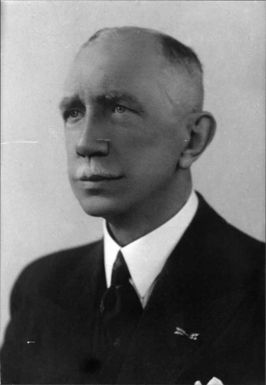
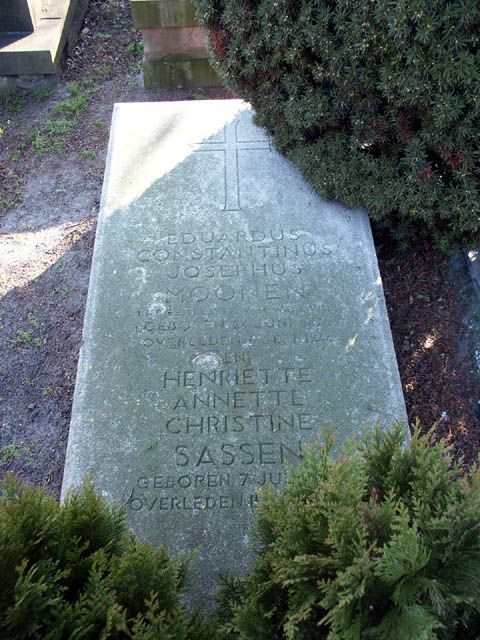
Eduardus Constantinus Josephus Moonen (Strijp, 24 June 1876 – Waalwijk, 6 September 1944) was married to Henriëtte Antonette Christine Sassen. He was mayor of Waalwijk from 1 March 1924 (Royal Decree 12 February 1924, no. 12) to 1 February 1944 and then acting mayor from 19 May 1944 to 6 September 1944. From 1924 to 1933 he was also deputy district judge.
Mayor
Moonen started his career in 1901 as a second lieutenant of the infantry and ended his military career as captain-adjutant in Breda. From this rank he was appointed mayor of Waalwijk quite unexpectedly. He was 48 years old at the time.
At the inauguration Moonen spoke the following words, in which he made his policy known: ‘It is entirely in line with my aim to be a good mayor for everyone, without exception for the entire population of Waalwijk’ and ‘from that source I will draw the strength to remain true to the motto that I want to make mine, even under difficult circumstances: everything for everyone.’
He became the binding force that tried to give shape to the trinity of the places that were merged in 1922. An expression of this was the way in which his twelve and a half years as mayor were celebrated. The entire population of Waalwijk, associations and institutions from Baardwijk, Waalwijk and Besoijen were present to honor their mayor.
Moonen’s term of office was characterised by more lows than highs. High unemployment, especially in the shoe and leather industry, caused the municipality concern. Support schemes were introduced. The shoe law brought some relief. The housing shortage increased and there were many slum dwellings. A development plan was drawn up for the area between Grotestraat and the railway line. The St. Crispijnstraat and surroundings were constructed, as well as the Besoijensche Steeg. The backlog of public facilities in Baardwijk was tackled. A public slaughterhouse was established. The harbor plans were continued and through Moonen’s persuasiveness the construction of the new town hall was assigned to Kropholler and carried out.
That he wanted to live up to his inauguration speech became apparent at the farewell of an alderman in 1926, when he pointed out the attitude that council members should have, namely to subordinate their own interests to the municipal interest. Genuine civic spirit, he stated, is the only basis on which an impartial treatment of public affairs can and may be based. Apparently other views existed during his term of office. For him, ‘omnibus idem’ (the same for everyone) applied.
As of 15 April 1924, Moonen was appointed deputy district judge. As a result of the abolition of the Waalwijk district court, he was honourably discharged from this office as of 1 January 1934.
He was faced with major decisions of conscience, he could no longer rely on the council, during the war years in the implementation of the measures imposed by the occupier. When Moonen retired in February 1944, he was called upon to take up the office again a few months later, as his deputies (the aldermen) were not available due to illness and busy work, and an NSB member apparently no longer wanted to come to the fore at that time.
On 6 September he died before the firing squad of Dutch SS members. His honorable discharge granted to him by the occupier in February 1944 was converted into an honorable discharge from K.B.
War victim
Mayor Moonen got up early on Wednesday, September 6, 1944. Like most people, he wondered where the liberators were; the reports about their advance were rather contradictory. He walked up and down in front of the town hall and accosted two resistance fighters who unfortunately knew just as little as he did. Around nine o’clock, Moonen entered the town hall, followed shortly afterwards by two women who wanted to talk to him. The tragedy had begun.
The previous day, a number of NSB members and Landwachters had been arrested. One woman was married, the other engaged to a Landwachter. They were naturally very worried about the two men. After all, they had also heard the stories about what would happen to the ‘traitors’ and they feared the worst. They turned to Mayor Moonen, but he could not help them any further (the two had been locked up in Sprang together with ten others). Disappointed, the women walked outside again. It was now half past nine.
Camouflaged vehicles drove into Waalwijk. It was the vanguard of the Landstorm Nederland. This battalion of Dutch SS men, the cadre of which was largely German, was on its way to the front near Antwerp. The SS men were in a grim mood. Furious about the flags they had seen on the way, they had shot at a crowd in Vlijmen and in doing so had killed three people, including a boy of barely seven.
In Waalwijk too, flags were hanging everywhere and the SS men stopped at the town hall to have them removed. That’s when the two women stepped outside. They accosted the first Dutch officer they saw and told their story. The SS man promised to help them. He stormed into the mayor’s office with his pistol drawn and demanded that the flags be taken inside and the two men returned to their wives. Moonen could do something about the first, but not about the second. The Dutch officer waited a while until most of the flags had been taken inside and then wanted to drive away again, because he also saw that the mayor had nothing to do with the kidnapping. At that moment his superior, Hauptsturmführer Maasz, arrived. The women also complained to him.
Maasz had a completely different character than his colleague. He was a typical arrogant Nazi for whom a human life was worth little. A few days earlier, he had had a soldier shot dead because he had stolen some petrol. He promised the women that he would wash the pig (i.e., do the job quickly). He approached Moonen, who had come outside and demanded the return of the land guards. He waved away protests: Moonen was mayor after all, he should know where the two were. He gave Moonen half an hour to find the men. The mayor went inside and called the leader of the Waalwijk OD for advice. But he did not know where the land guards were either.
Maasz’s patience was running out. He asked the women if they knew anything more about the kidnapping. ‘Yes,’ said one of them, ‘there was also a boy from Hoffmans there.’ The SS men then went to the house of the Hoffmans family, which had been pointed out by the women. There they dragged the 25-year-old Vincent and his 18-year-old brother Joop out of the house. Unfortunately, the women had been wrong. A cousin of the two brothers was involved in the kidnapping, but the brothers were completely innocent and did not know where the land guards were. Maasz did not care. He put the boys and the mayor under the lantern in the middle of the Raadhuisplein. It was now half past eleven. Maasz gave an ultimatum: he would wait until one o’clock, then the missing land guards had to be back. If not, the three would be shot dead.
Half an hour later, the SS men started to make preparations for the execution, presumably to scare the three men. Vincent now really got anxious and told the SS men that he had heard that the kidnapped men were somewhere in the municipality of Sprang-Capelle; he did not know where. Maasz sent a car, with Vincent as a guide, to Sprang. After half an hour, the car returned to Waalwijk empty-handed. Then a fourth person had to stand under the lantern, doctor Piet Lenglet. Lenglet had heard from an agent that the land guards might be released and he passed the message on to Maasz. When nothing happened, Maasz wanted to know from whom he had heard it. Lenglet did not want to betray his source and as punishment he was put with the others. It was about a quarter to one.
The clock ticked on relentlessly. The autumn sun beat down mercilessly on the heads of the four waiting men: doctor Lenglet, his face contorted with fear; Vincent Hoffmans, seemingly unmoved; his brother Joop with his hands hanging listlessly at his sides and mayor Moonen, the former officer, standing upright and with his head held high. The ultimatum had expired, but apparently Maasz was not happy either, because the time passed without anything happening. Mayor Moonen again pleaded for the three others. He pointed out that doctor Lenglet, as leader of a Red Cross team, was protected by international law. Maasz finally gave in and let Lenglet go. It was a quarter past one.
Maasz’s patience was now really at an end. Once again, after much insistence from Moonen, a priest was allowed to join them. Dean Heezemans tried to encourage the three condemned to death. Joop, the youngest, in particular, had a hard time. He tried to hold on to the priest. Then the dreaded order sounded: ‘Go ahead, it’s time.’
Because Mayor Moonen’s wife could follow everything from the window of the house on Raadhuisplein, Moonen asked as a last favor to have the execution take place behind the town hall. Maasz agreed. Together with two Dutch SS men, he accompanied the three men to the place of execution. The three Waalwijkers had to stand next to each other, facing the wall of the town hall. The two SS men picked up their weapons. Then Maasz shouted: ‘Feuer’ and the machine pistols crackled. It was exactly seven minutes past half past one.
The two non-commissioned officers turned out to be poor marksmen and only after a coup de grace were the mayor and Joop dead. Vincent miraculously survived the execution and the coup de grace. While dean Heezemans, who had seen that the coup de grace missed its target, distracted the SS men, he managed to scramble to his feet and run away. He was picked up and taken to ‘s-Hertogenbosch where an operation ultimately saved his life.
Oorlogsmonument (war monument)
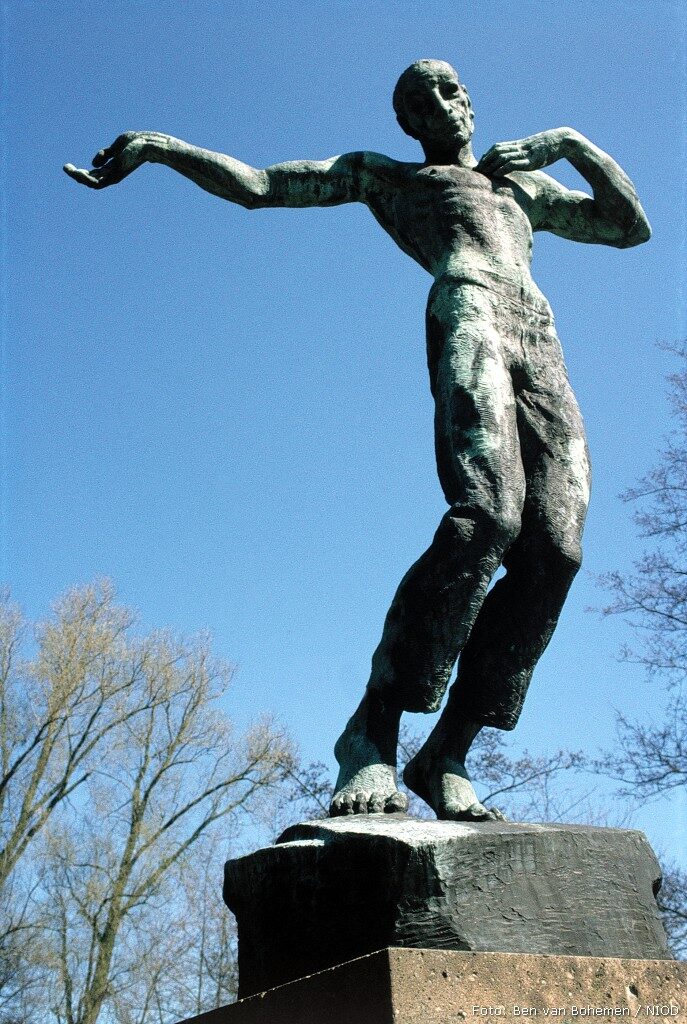
The War Memorial on Burg. Moonenlaan is a monument in memory of all Waalwijkers who died during the occupation and in particular of mayor Moonen, who was shot by the occupiers during the war. On October 30, 1949, the monument was unveiled by Mrs. H.A.C. Moonen-Sassen (1876-1957).
The commemoration takes place at the monument every year on 4 May.
Design
The monument, made by the Binder company from Haarlem, was designed by J.A. Raedecker. It is a statue of a male figure, collapsing after a firing squad. G.H. Holt designed the substructure and entourage.
Execution
The pedestal bears the dates ‘1940-1945’, the names of the Waalwijk war victims are engraved in the hard stone slabs that are placed around this pedestal, as well as a poem by Mrs. H. de Kat-van Zijl:
THEY FELL TO EARTH BEFORE THE GLOWING OF THE GOLDEN SUN,
FREEDOM DROVE AWAY THE LONG NIGHT OF WAR, FOR US, SPARED.
A MORE BEAUTIFUL MORNING SURROUNDED THEM, FALLEN TO HEAVENLY GARDEN,
WITH THE LIFE GIVEN TO THE BROTHERS, WOVEN FROM ETERNAL JOY.
The statue of cast bronze is 2.75 meters high. It stands on a 2-metre-high limestone column, which measures 1 x 1 meter at the top. The 4 x 4 meter pedestal is made of limestone with plates of bluestone. Bluestone boulders have been placed around the monument in a circle with a diameter of 16 m.
Special features
In 1965, art critic Pierre Janssen described the deeper meaning of this monument in the book ‘Two minutes is it quiet,’ referring to the gruesome and senseless execution by the Germans of mayor Moonen and Joop Hoffmans on 6 September 1944, with the following words:
Then they were captured and one day their lives suddenly ended. The man is just barely standing. But he will fall in a moment. Just look at his feet and his knees. Look, he is very lonely. He’s not angry. He does not resist anymore. He stretches out his arms and gives away his life. Just look at his face. It is a calm face. He sacrifices himself. This statue is there to help us remember that freedom is precious. A lot has been paid for it. Not with money, but with human lives.
Immediately after the liberation, De Echo van het Zuiden started collecting funds for the erection of a monument. Later, at the suggestion of the Waalwijks Belang association, it was decided that it should be a statue that would keep alive the memory of all Waalwijkers who died during the occupation.
The Waalwijk war monument was depicted on a postage stamp in 1965.
Raedecker is also the designer of the statues that are part of the National Monument on Dam Square in Amsterdam.
Gehenna
There are a surprising number of references to the practice of child sacrifice in the Bible, to its demon-idols, and to the places of sacrifice. I’ve tried to collect here all those that I can find. I have left off occurrences of Gehenna, but the background is obviously a strong one.
And you shall not let any of your descendants pass through the fire to Molech, nor shall you profane the name of your God: I am Yahweh. (Leviticus 18:21)
Then Yahweh spoke to Moses, saying, “Again, you shall say to the children of Israel: ‘Whoever of the children of Israel, or of the strangers who dwell in Israel, who gives any of his descendants to Molech, he shall surely be put to death. The people of the land shall stone him with stones. I will set my face against that man, and will cut him off from his people, because he has given some of his descendants to Molech, to defile my sanctuary and profane my holy name. And if the people of the land should in any way hide their eyes from the man, when he gives some of his descendants to Molech, and they do not kill him, then I will set my face against that man and against his family; and I will cut him off from his people, and all who prostitute themselves with him to commit harlotry with Molech. (Leviticus 20:1-5)
For fire went out from Heshbon,
A flame from the city of Sihon;
It consumed Ar of Moab,
The lords of the heights of the Arnon.
Woe to you, Moab!
You have perished, O people of Chemosh!
He has given his sons as fugitives,
And his daughters into captivity,
To Sihon king of the Amorites. (Numbers 21:28-29)
“When Yahweh your God cuts off from before you the nations which you go to dispossess, and you displace them and dwell in their land, take heed to yourself that you are not ensnared to follow them, after they are destroyed from before you, and that you do not inquire after their gods, saying, ‘How did these nations serve their gods? I also will do likewise.’ You shall not worship Yahweh your God in that way; for every abomination to Yahweh which He hates they have done to their gods; for they burn even their sons and daughters in the fire to their gods. (Deuteronomy 12:29-31)
“When you come into the land which Yahweh your God is giving you, you shall not learn to follow the abominations of those nations. There shall not be found among you anyone who makes his son or his daughter pass through the fire, or one who practices witchcraft, or a soothsayer, or one who interprets omens, or a sorcerer, or one who conjures spells, or a medium, or a spiritist, or one who calls up the dead. For all who do these things are an abomination to Yahweh, and because of these abominations Yahweh your God drives them out from before you. You shall be blameless before Yahweh your God. For these nations which you will dispossess listened to soothsayers and diviners; but as for you, Yahweh your God has not appointed such for you. (Deuteronomy 18:9-14)
“But it shall come to pass, if you do not obey the voice of Yahweh your God, . . . they shall besiege you at all your gates until your high and fortified walls, in which you trust, come down throughout all your land; and they shall besiege you at all your gates throughout all your land which Yahweh your God has given you. You shall eat the fruit of your own body, the flesh of your sons and your daughters whom Yahweh your God has given you, in the siege and desperate straits in which your enemy shall distress you. The sensitive and very refined man among you will be hostile toward his brother, toward the wife of his bosom, and toward the rest of his children whom he leaves behind, so that he will not give any of them the flesh of his children whom he will eat, because he has nothing left in the siege and desperate straits in which your enemy shall distress you at all your gates. The tender and delicate woman among you, who would not venture to set the sole of her foot on the ground because of her delicateness and sensitivity, will refuse to the husband of her bosom, and to her son and her daughter, her placenta which comes out from between her feet and her children whom she bears; for she will eat them secretly for lack of everything in the siege and desperate straits in which your enemy shall distress you at all your gates. (Deuteronomy 28)
And the border [of the tribe of Judah] went up by the Valley of the Son of Hinnom to the southern slope of the Jebusite city (which is Jerusalem). The border went up to the top of the mountain that lies before the Valley of Hinnom westward, which is at the end of the Valley of Rephaim northward. (Joshua 15:8)
Then the border [of the tribe of Benjamin] came down to the end of the mountain that lies before the Valley of the Son of Hinnom, which is in the Valley of the Rephaim on the north, descended to the Valley of Hinnom, to the side of the Jebusite city on the south, and descended to En Rogel. (Joshua 18:16)
‘And now Yahweh God of Israel has dispossessed the Amorites from before His people Israel; should you then possess it? Will you not possess whatever Chemosh your god gives you to possess? So whatever Yahweh our God takes possession of before us, we will possess. (Judges 11:23-24)
For Solomon went after Ashtoreth the goddess of the Sidonians, and after Milcom the abomination of the Ammonites. Solomon did evil in the sight of Yahweh, and did not fully follow Yahweh, as did his father David. Then Solomon built a high place for Chemosh the abomination of Moab, on the hill that is east of Jerusalem, and for Molech the abomination of the people of Ammon. And he did likewise for all his foreign wives, who burned incense and sacrificed to their gods. So Yahweh became angry with Solomon, because his heart had turned from Yahweh God of Israel, who had appeared to him twice, and had commanded him concerning this thing, that he should not go after other gods; but he did not keep what Yahweh had commanded. (1 Kings 11:7-10)
And [Ahijah] said to Jeroboam, “Take for yourself ten pieces, for thus says Yahweh, the God of Israel: ‘Behold, I will tear the kingdom out of the hand of Solomon and will give ten tribes to you (but he shall have one tribe for the sake of my servant David, and for the sake of Jerusalem, the city which I have chosen out of all the tribes of Israel), because they have forsaken me, and worshiped Ashtoreth the goddess of the Sidonians, Chemosh the god of the Moabites, and Milcom the god of the people of Ammon, and have not walked in my ways to do what is right in my eyes and keep my statutes and my judgments, as did his father David. (1 Kings 11:31-33)
In his days Hiel of Bethel built Jericho. He laid its foundation with Abiram his firstborn, and with his youngest son Segub he set up its gates, according to the word of Yahweh, which He had spoken through Joshua the son of Nun. (1 Kings 16:34)
Then [the king of Moab] took his eldest son who would have reigned in his place, and offered him as a burnt offering upon the wall; and there was great indignation against Israel. So they departed from him and returned to their own land. (2 Kings 3:27)
And it happened after this that Ben-Hadad king of Syria gathered all his army, and went up and besieged Samaria. And there was a great famine in Samaria; and indeed they besieged it until a donkey’s head was sold for eighty shekels of silver, and one-fourth of a kab of dove droppings for five shekels of silver.
Then, as the king of Israel was passing by on the wall, a woman cried out to him, saying, “Help, my lord, O king!”
And he said, “If Yahweh does not help you, where can I find help for you? From the threshing floor or from the winepress?” Then the king said to her, “What is troubling you?”
And she answered, “This woman said to me, ‘Give your son, that we may eat him today, and we will eat my son tomorrow.’ So we boiled my son, and ate him. And I said to her on the next day, ‘Give your son, that we may eat him’; but she has hidden her son.” (2 Kings 6:24-29)
But [Ahaz king of Judah] walked in the way of the kings of Israel; indeed he made his son pass through the fire, according to the abominations of the nations whom Yahweh had cast out from before the children of Israel. (2 Kings 16:3)
And they caused their sons and daughters to pass through the fire, practiced witchcraft and soothsaying, and sold themselves to do evil in the sight of Yahweh, to provoke Him to anger. Therefore Yahweh was very angry with Israel, and removed them from His sight; there was none left but the tribe of Judah alone. (2 Kings 17:17-18)
Then one of the priests whom they had carried away from Samaria came and dwelt in Bethel, and taught them how they should fear Yahweh. However, every nation continued to make gods of its own, and put them in the shrines on the high places which the Samaritans had made, every nation in the cities where they dwelt. The men of Babylon made Succoth Benoth, the men of Cuth made Nergal, the men of Hamath made Ashima, and the Avites made Nibhaz and Tartak; and the Sepharvites burned their children in fire to Adrammelech and Anammelech, the gods of Sepharvaim. (2 Kings 17:28-31)
Also [Manasseh king of Judah] made his son pass through the fire, practiced soothsaying, used witchcraft, and consulted spiritists and mediums. He did much evil in the sight of Yahweh, to provoke Him to anger. (2 Kings 21:6)
And [Josiah] defiled Topheth, which is in the Valley of the Son of Hinnom, that no man might make his son or his daughter pass through the fire to Molech. Then he removed the horses that the kings of Judah had dedicated to the sun, at the entrance to the house of Yahweh, by the chamber of Nathan-Melech, the officer who was in the court; and he burned the chariots of the sun with fire. The altars that were on the roof, the upper chamber of Ahaz, which the kings of Judah had made, and the altars which Manasseh had made in the two courts of the house of Yahweh, the king broke down and pulverized there, and threw their dust into the Brook Kidron. Then the king defiled the high places that were east of Jerusalem, which were on the south of the Mount of Corruption, which Solomon king of Israel had built for Ashtoreth the abomination of the Sidonians, for Chemosh the abomination of the Moabites, and for Milcom the abomination of the people of Ammon. And he broke in pieces the sacred pillars and cut down the wooden images, and filled their places with the bones of men. (2 Kings 23:10-14)
[Ahaz king of Judah] burned incense in the Valley of the Son of Hinnom, and burned his children in the fire, according to the abominations of the nations whom Yahweh had cast out before the children of Israel. (2 Chronicles 28:3)
Also [Manasseh king of Judah] caused his sons to pass through the fire in the Valley of the Son of Hinnom; he practiced soothsaying, used witchcraft and sorcery, and consulted mediums and spiritists. He did much evil in the sight of Yahweh, to provoke Him to anger. (2 Chronicles 33:6)
And as for the villages with their fields, some of the children of Judah dwelt in Kirjath Arba and its villages, . . . in Azekah and its villages. They dwelt from Beersheba to the Valley of Hinnom. (Nehemiah 11)
They even sacrificed their sons
And their daughters to demons,
And shed innocent blood,
The blood of their sons and daughters,
Whom they sacrificed to the idols of Canaan;
And the land was polluted with blood. (Psalm 106:37-38)
For through the voice of Yahweh
Assyria will be beaten down,
As He strikes with the rod.
And in every place where the staff of punishment passes,
Which Yahweh lays on him,
It will be with tambourines and harps;
And in battles of brandishing He will fight with it.
For Tophet was established of old,
Yes, for the king it is prepared.
He has made it deep and large;
Its pyre is fire with much wood;
The breath of Yahweh, like a stream of brimstone,
Kindles it. (Isaiah 30:31-33)
For the children of Judah have done evil in My sight,” says Yahweh. “They have set their abominations in the house which is called by My name, to pollute it. And they have built the high places of Tophet, which is in the Valley of the Son of Hinnom, to burn their sons and their daughters in the fire, which I did not command, nor did it come into My heart.
“Therefore behold, the days are coming,” says Yahweh, “when it will no more be called Tophet, or the Valley of the Son of Hinnom, but the Valley of Slaughter; for they will bury in Tophet until there is no room. The corpses of this people will be food for the birds of the heaven and for the beasts of the earth. And no one will frighten them away. Then I will cause to cease from the cities of Judah and from the streets of Jerusalem the voice of mirth and the voice of gladness, the voice of the bridegroom and the voice of the bride. For the land shall be desolate. (Jeremiah 7:30-34)
“Because they have forsaken me and made this an alien place, because they have burned incense in it to other gods whom neither they, their fathers, nor the kings of Judah have known, and have filled this place with the blood of the innocents (they have also built the high places of Baal, to burn their sons with fire for burnt offerings to Baal, which I did not command or speak, nor did it come into my mind), therefore behold, the days are coming,” says Yahweh, “that this place shall no more be called Tophet or the Valley of the Son of Hinnom, but the Valley of Slaughter.
And I will make void the counsel of Judah and Jerusalem in this place, and I will cause them to fall by the sword before their enemies and by the hands of those who seek their lives; their corpses I will give as meat for the birds of the heaven and for the beasts of the earth. I will make this city desolate and a hissing; everyone who passes by it will be astonished and hiss because of all its plagues. And I will cause them to eat the flesh of their sons and the flesh of their daughters, and everyone shall eat the flesh of his friend in the siege and in the desperation with which their enemies and those who seek their lives shall drive them to despair.” ’
“Then you shall break the flask in the sight of the men who go with you, and say to them, ‘Thus says Yahweh of hosts: “Even so I will break this people and this city, as one breaks a potter’s vessel, which cannot be made whole again; and they shall bury them in Tophet till there is no place to bury. Thus I will do to this place,” says Yahweh, “and to its inhabitants, and make this city like Tophet. And the houses of Jerusalem and the houses of the kings of Judah shall be defiled like the place of Tophet, because of all the houses on whose roofs they have burned incense to all the host of heaven, and poured out drink offerings to other gods.” ’ ”
Then Jeremiah came from Tophet, where Yahweh had sent him to prophesy; and he stood in the court of the Lord’s house and said to all the people, “Thus says Yahweh of hosts, the God of Israel: ‘Behold, I will bring on this city and on all her towns all the doom that I have pronounced against it, because they have stiffened their necks that they might not hear My words.’ ” (Jeremiah 19)
And they have turned to me the back, and not the face; though I taught them, rising up early and teaching them, yet they have not listened to receive instruction. But they set their abominations in the house which is called by my name, to defile it. And they built the high places of Baal which are in the Valley of the Son of Hinnom, to cause their sons and their daughters to pass through the fire to Molech, which I did not command them, nor did it come into my mind that they should do this abomination, to cause Judah to sin.’ (Jeremiah 32:33-35)
Against Moab.
Thus says Yahweh of hosts, the God of Israel: . . .
“Moab is destroyed;
Her little ones have caused a cry to be heard; . . .
For because you have trusted in your works and your treasures,
You also shall be taken.
And Chemosh shall go forth into captivity,
His priests and his princes together. . . .
Moab shall be ashamed of Chemosh,
As the house of Israel was ashamed of Bethel, their confidence. . . .
Woe to you, O Moab!
The people of Chemosh perish;
For your sons have been taken captive,
And your daughters captive.
“Yet I will bring back the captives of Moab
In the latter days,” says Yahweh.
Thus far is the judgment of Moab. (Jeremiah 48)
Against the Ammonites.
Thus says Yahweh:
“Has Israel no sons?
Has he no heir?
Why then does Milcom inherit Gad,
And his people dwell in its cities?
Therefore behold, the days are coming,” says Yahweh,
“That I will cause to be heard an alarm of war
In Rabbah of the Ammonites;
It shall be a desolate mound,
And her villages shall be burned with fire.
Then Israel shall take possession of his inheritance,” says Yahweh.
“Wail, O Heshbon, for Ai is plundered!
Cry, you daughters of Rabbah,
Gird yourselves with sackcloth!
Lament and run to and fro by the walls;
For Milcom shall go into captivity
With his priests and his princes together. (Jeremiah 49:1-3)
“Moreover you took your sons and your daughters, whom you bore to Me, and these you sacrificed to them to be devoured. Were your acts of harlotry a small matter, that you have slain My children and offered them up to them by causing them to pass through the fire? (Ezekiel 16:20-21)
“Therefore I also gave them up to statutes that were not good, and judgments by which they could not live; and I pronounced them unclean because of their ritual gifts, in that they caused all their firstborn to pass through the fire, that I might make them desolate and that they might know that I am Yahweh.” ’ . . . Therefore say to the house of Israel, ‘Thus says the Lord Yahweh: “Are you defiling yourselves in the manner of your fathers, and committing harlotry according to their abominations? For when you offer your gifts and make your sons pass through the fire, you defile yourselves with all your idols, even to this day. So shall I be inquired of by you, O house of Israel? As I live,” says the Lord Yahweh, “I will not be inquired of by you. (Ezekiel 20)
Yahweh also said to me: “Son of man, will you judge Oholah and Oholibah? Then declare to them their abominations. For they have committed adultery, and blood is on their hands. They have committed adultery with their idols, and even sacrificed their sons whom they bore to Me, passing them through the fire, to devour them. Moreover they have done this to Me: They have defiled My sanctuary on the same day and profaned My Sabbaths. For after they had slain their children for their idols, on the same day they came into My sanctuary to profane it; and indeed thus they have done in the midst of My house. (Ezekiel 23:36-39)
“Did you offer Me sacrifices and offerings
In the wilderness forty years, O house of Israel?
You also carried Sikkuth your king [alt: tabernacle of Molech]
And Chiun, your idols,
The star of your gods,
Which you made for yourselves. (Amos 5:25-26)
“I will stretch out My hand against Judah,
And against all the inhabitants of Jerusalem.
I will cut off every trace of Baal from this place,
The names of the idolatrous priests with the pagan priests—
Those who worship the host of heaven on the housetops;
Those who worship and swear oaths by Yahweh,
But who also swear by Milcom;
Those who have turned back from following Yahweh,
And have not sought Yahweh, nor inquired of Him.” (Zephaniah 1:4-6)
Then God turned and gave them up to worship the host of heaven, as it is written in the book of the Prophets:
‘Did you offer Me slaughtered animals and sacrifices during forty years in the wilderness,
O house of Israel?
You also took up the tabernacle of Moloch,
And the star of your god Remphan,
Images which you made to worship;
And I will carry you away beyond Babylon.’ (Acts 7:42-43, quoting Amos 5)
This cup
Moses flees to a mountain and is given food by a “bird” to sustain him for the 40 years of work ahead of him, where he would meet with God.
So Moses feared and said, “Surely this thing is known!” When Pharaoh heard of this matter, he sought to kill Moses. But Moses fled from the face of Pharaoh and dwelt in the land of Midian; and he sat down by a well.
Now the priest of Midian had seven daughters. And they came and drew water, and they filled the troughs to water their father’s flock. Then the shepherds came and drove them away; but Moses stood up and helped them, and watered their flock.
When they came to Reuel their father, he said, “How is it that you have come so soon today?” And they said, “An Egyptian delivered us from the hand of the shepherds, and he also drew enough water for us and watered the flock.” So he said to his daughters, “And where is he? Why is it that you have left the man? Call him, that he may eat bread.” Then Moses was content to live with the man, and he gave Zipporah his daughter to Moses. (Exodus 2)
Elijah fled and was given food and water by angels for the forty days’ journey ahead of him, to meet God at the same mountain.
But he himself went a day’s journey into the wilderness, and came and sat down under a broom tree. And he prayed that he might die, and said, “It is enough! Now, Yahweh, take my life, for I am no better than my fathers!”
Then as he lay and slept under a broom tree, suddenly an angel touched him, and said to him, “Arise and eat.” Then he looked, and there by his head was a cake baked on coals, and a jar of water. So he ate and drank, and lay down again. And the angel of Yahweh came back the second time, and touched him, and said, “Arise and eat, because the journey is too great for you.” So he arose, and ate and drank; and he went in the strength of that food forty days and forty nights as far as Horeb, the mountain of God. (1 Kings 19)
Earlier Elijah had been fed by ravens (1 Kings 17).
Jesus is sustained by angels on the Mount of Olives for the exodus (Luke 9:31) that he was about to accomplish.
Coming out, he went to the Mount of Olives, as he was accustomed, and his disciples also followed him. When he came to the place, he said to them, “Pray that you may not enter into temptation.”
And he was withdrawn from them about a stone’s throw, and he knelt down and prayed, saying, “Father, if it is Your will, take this cup away from me; nevertheless not my will, but yours, be done.” Then an angel appeared to him from heaven, strengthening him. And being in agony, he prayed more earnestly. Then his sweat became like great drops of blood falling down to the ground.
When he rose up from prayer, and had come to his disciples, he found them sleeping from sorrow. Then he said to them, “Why do you sleep? Rise and pray, lest you enter into temptation.” (Luke 22)
Moses and Elijah are obviously types of Jesus in these episodes. As a result, I think we should read these passages as mutually interpreting one another. In particular, I do not think that we should over-psychologize the fear that Moses experienced or the supposed depression that Elijah experienced. Whatever Jesus experienced was a commendable, righteous, faith-ful emotion. Therefore I believe we ought to read Elijah’s words, “it is enough; take my life” as being another way of expressing Jesus’s words, “if it is your will, take this cup.”
Let him pray that he may interpret
Twice Paul commands us to sing Psalms: Ephesians 5, Colossians 3. James commands us to sing Psalms as well.
These commands from God are commands for us to develop a biblical typology, a biblical theology, and a covenant theology. Why is that? Because otherwise we might as well be singing Psalms in an unfamiliar language. We would be, so to speak, unfruitful—out of our minds.
“Son, isn’t it too bad that there is no longer any holy temple where we can meet with God?” “Sweetheart, isn’t it too bad that babies no longer trust in God?”
Seven thousand
Then [Abraham] said, “Let not the Lord be angry, and I will speak but once more: Suppose ten should be found there?”
And He said, “I will not destroy it for the sake of ten.” (Genesis 18:32)
And [Elijah] said, “I have been very zealous for Yahweh God of hosts; because the children of Israel have forsaken Your covenant, torn down Your altars, and killed Your prophets with the sword. I alone am left; and they seek to take my life.”
Then Yahweh said to him: “. . . Yet I have reserved seven thousand in Israel, all whose knees have not bowed to Baal, and every mouth that has not kissed him.” (1 Kings 19:14-18)
Suddenly a prophet approached Ahab king of Israel, saying, “Thus says Yahweh: ‘Have you seen all this great multitude? Behold, I will deliver it into your hand today, and you shall know that I am Yahweh’ ”
So Ahab said, “By whom?”
And he said, “Thus says Yahweh: ‘By the young leaders of the provinces.’ ”
Then he said, “Who will set the battle in order?”
And he answered, “You.”
Then he mustered the young leaders of the provinces, and there were two hundred and thirty-two; and after them he mustered all the people, all the children of Israel—seven thousand. (1 Kings 20:13-15)
For the sake of seven thousand faithful—no, rather, by means of the faithfulness of seven thousand, and nothing else—God’s judgment is stayed.
For they are not all Israel who are of Israel. (Romans 9:6)
But you have come to Mount Zion
We saw that Jesus is the sense of the word.
And we know that the church is his body, totus Christus.
Now you are the body of Christ, and members individually. (1 Cor 12:27)
Saul, Saul, why are you persecuting me? (Acts 26:14)
Therefore the church is the sense of the word.
The Spirit of the Lord is upon me,
Because He has anointed me
To preach the gospel to the poor;
He has sent me to heal the brokenhearted,
To proclaim liberty to the captives
And recovery of sight to the blind,
To set at liberty those who are oppressed;
To proclaim the acceptable year of the Lord. (Luke 4:18-19)
They gave the sense
Also Jeshua, . . . and the Levites, helped the people to understand the law; and the people stood in their place. So they read distinctly from the book, in the law of God; and they gave the sense, and helped them to understand the reading. (Nehemiah 8:7–8)
So he came to Nazareth, where he had been brought up. And as his custom was, he went into the synagogue on the Sabbath day, and stood up to read. And he was handed the book of the prophet Isaiah. And when he had opened the book, he found the place where it was written:
“The spirit of the Lord is upon me,
Because he has anointed me
To preach the gospel to the poor;
He has sent me to heal the brokenhearted,
To proclaim liberty to the captives
And recovery of sight to the blind,
To set at liberty those who are oppressed;
To proclaim the acceptable year of the Lord.”Then he closed the book, and gave it back to the attendant and sat down. And the eyes of all who were in the synagogue were fixed on Him. And he began to say to them, “Today this scripture is fulfilled in your hearing.” (Luke 4:16–21)
Jesus the living word is the sense of the word.
Asked of God
Mary’s song in Luke 1 obviously echoes that of Hannah in 1 Samuel 2.
Samuel and Jesus both ministered in a time of faithless priests, a time when the word of God was disregarded.
And the child Samuel grew in stature, and in favor both with Yahweh and men. (1 Sam 2:26)
And Jesus increased in wisdom and stature, and in favor with God and men. (Luke 2:52)
During these times, and as a result of the work of Samuel-David-Solomon/Jesus, God abandoned his house, used his enemies to tear apart that house, then established a new house and subjugated those same enemies.
 I gotta have my orange juice.