Fair and excellent
“All things are hard which are fair and excellent.” (Dedication to Queen Elizabeth, The Geneva Bible, 1560 edition)
Silence the avenger
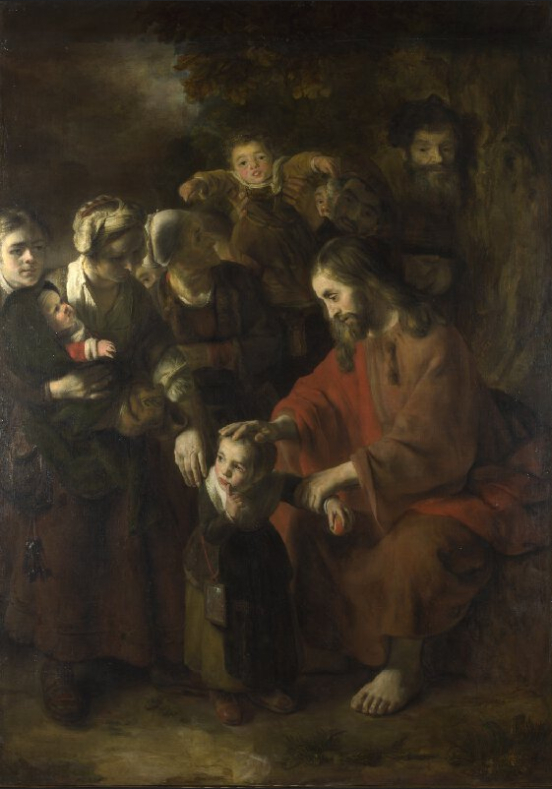
Twice in the last few months I have checked myself when quoting Psalm 8:
Out of the mouth of babes and nursing infants
You have ordained strength,
Because of your enemies,
That you may silence the enemy and the avenger.
The word “avenger” feels out of place. Why would it be necessary for infants to silence the kinsman redeemer-avenger? As it turns out, the word for avenger here is a more general term, possibly even conveying the idea of self-vengeance.
Jesus quotes Psalm 8 in Matthew 21:
But when the chief priests and scribes saw the wonderful things that he did, and the children crying out in the temple and saying, “Hosanna to the Son of David!” they were indignant and said to him, “Do you hear what these are saying?”
And Jesus said to them, “Yes. Have you never read, ‘Out of the mouth of babes and nursing infants you have perfected praise’? ”
Jesus leaves off the latter part of the verse, but we cannot avoid hearing its echo. Jesus is accusing the chief priests and scribes of having become God’s enemies, of seeking to avenge themselves against him and his people.
Likewise those who bar little ones from Jesus’s table. Many of them do so heedlessly rather than high-handedly. But there is still a rightful sting and shame they ought to feel as these little ones otherwise participate fully in Jesus’s worship.
Do not marvel
There was a man of the Pharisees named Nicodemus, a ruler of the Jews. This man came to Jesus by night and said to Him, “Rabbi, we know that you are a teacher come from God; for no one can do these signs that you do unless God is with him.”
Jesus answered and said to him, “Most assuredly, I say to you, unless one is born again, he cannot see the kingdom of God.”
Nicodemus said to Him, “How can a man be born when he is old? Can he enter a second time into his mother’s womb and be born?”
Jesus answered, “Most assuredly, I say to you, unless one is born of water and the Spirit, he cannot enter the kingdom of God. That which is born of the flesh is flesh, and that which is born of the Spirit is spirit. Do not marvel that I said to you, ‘You must be born again.’ The wind blows where it wishes, and you hear the sound of it, but cannot tell where it comes from and where it goes. So is everyone who is born of the Spirit.”
Nicodemus answered and said to Him, “How can these things be?”
Jesus answered and said to him, “Are you the teacher of Israel, and do not know these things?” (John 3)
Let’s see how Nicodemus ought to have derived this from Genesis. We know that God intended to give every gift to mankind, but he held one gift in temporary reserve until they matured:
And God said, “See, I have given you every herb that yields seed which is on the face of all the earth, and every tree whose fruit yields seed; to you it shall be for food. . . .”
And Yahweh God commanded the man, saying, “Of every tree of the garden you may freely eat; but of the tree of the knowledge of good and evil you shall not eat, for in the day that you eat of it you shall surely die.” (Genesis 1-2)
The serpent accused God of withholding a good gift, reserving it for himself:
Then the serpent said to the woman, “You will not surely die. For God knows that in the day you eat of it your eyes will be opened, and you will be like God, knowing good and evil.” (Genesis 3)
Let God be true but every man a liar. In order to receive God’s good gifts, there is now no other possible pathway except for mankind to pass through the the death that God prescribed.
One man passed through this death and was reborn from the grave: “even so must the Son of Man be lifted up.” (John 3) This is the birth that Jesus tells “you” (Nicodemus, singular) that “you” (mankind, plural) can now participate in by means of union with him. We are reborn by believing in him (John 3:16)—that is, by entrusting ourselves to him, allying ourselves to him.
Every nation
On the face of it, it is easy to recognize that the purpose of the gift of tongues was to bring God’s kingdom, in the words of Revelation, to every nation, tribe, tongue and people. You can see this in Acts 2 mentioning “every nation under heaven” and in the fact that Pentecost is a mirror image of Babel. Instead of reversing Babel, Jesus subverts it, or in the words of Michael Heiser, “infiltrates” it; without destroying nations as such, he orchestrates to bring every nation and language under his rule.
There are a few less obvious ways in which Scripture highlights this. Michael Heiser points out that God is not simply bringing the gospel into every language, but also transferring every nation from the elementary principles and powers back to Jesus. In doing so, Luke presents a litany of nations that mirrors the exhaustive list of seventy nations of Genesis 10. Of course, it is “every nation,” but it is also structured from east to west just as it is in Genesis 10. And while Heiser does not call attention to this, Luke’s list covers a total of seventeen nations and people groups. This is significant because seventeen (10+7) is often a Biblical analog for seventy (10*7). The number seventeen is significant in the structure of the Psalms, and is the backdrop for the 153 fish of John 21, since 153 is the triangle of 17. This is another way of indicating that the purpose of the gift of tongues was to thoroughly distribute the wonderful works of God to every human language and nation.
Heiser also suggests that the word for “divided” in verse 3 is a significant allusion to this fact, since it can also be taken to mean “distributed.” The gifts of the kingdom are distributed to every language.
Anxious
Usually when I use the word “anxious” I have Edwin Friedman in mind. However, following are quotes and reflections from John Williamson Nevin’s The Anxious Bench.
My friend Jon observes that, while the anxious bench and even the altar call may have disappeared from many churches, reformed charismatic churches have an “anxious mic,” that is, the “prophecy mic.” In my experience, the absence of a confession and absolution from worship leaves a gap that needs filling. If there is a prophecy mic then it is frequently filled by the most anxious church members reassuring one another. By this means women often preach to the church.
I think it is interesting that the modern answer proposed for dead formalism is an equally dead emotionalism. Both are dead externalisms. Perfume will not awaken a dead body.
Study, and the retired cultivation of personal holiness, will seem to their zeal an irksome restraint; and making their lazy, heartless course of preparation as short as possible, they will go out with the reputation of educated ministers, blind leaders of the blind, to bring the ministry into contempt, and fall themselves into the condemnation of the devil. Whatever arrangements may exist in favor of a sound and solid system of religion, their operation will be to a great extent frustrated and defeated, by the predominant influence of a sentiment, practically adverse to the very object they are designed to reach. . . .
False views of religion abound. Conversion is everything, sanctification nothing. Religion is not regarded as the life of God in the soul, that must be cultivated in order that it may grow, but rather as a transient excitement to be renewed from time to time by suitable stimulants presented to the imagination. A taste for noise and rant supersedes all desire for solid knowledge. The susceptibility of the people for religious instruction is lost on the one side, along with the capacity of the ministry to impart religious instruction on the other. The details of christian duty are but little understood or regarded. Apart from its seasons of excitement, no particular church is expected to have much power. Family piety, and the religious training of the young, are apt to be neglected. (63-64)
It is certainly a little strange, that the class of persons precisely who claim to be the most strenuous, in insisting upon unconditional, immediate submission to God, scarcely tolerating that a sinner should be urged to pray or read the bible, lest his attention should be diverted from that one point, are as a general thing nevertheless quite ready to interpose this measure in his way to the foot of the cross, as though it included in fact the very thing itself. And yet a pilgrimage to the Anxious Bench, is in its own nature as much collateral to the duty of coming to Christ, as a pilgrimage to Jerusalem. In either case a false issue is presented to the anxious soul, by which for the time a true sight of its circumstances is hindered rather than promoted. (68)
A low, shallow, pelagianizing theory of religion, runs through it from beginning to end. The fact of sin is acknowledged, but not in its true extent. The idea of a new spiritual creation is admitted, but not in its proper radical and comprehensive form. The ground of the sinner’s salvation is made to lie at last in his own separate person. The deep import of the declaration, That which is born of the flesh is flesh, is not fully apprehended; and it is vainly imagined accordingly, that the flesh as such may be so stimulated and exalted notwithstanding, as to prove the mother of that spiritual nature, which we are solemnly assured can be born only of the Spirit Hence all stress is laid upon the energy of the individual will, (the self-will of the flesh,) for the accomplishment of the great change in which regeneration is supposed to consist. . . .
Religion does not get the sinner, but it is the sinner who “gets religion.” Justification is taken to be in fact by feeling, not by faith; and in this way falls back as fully into the sphere of self-righteousness, as though it were expected from works under any other form. In both the views which have been mentioned, as grounded either in a change of purpose or a change of feeling, religion is found to be in the end the product properly of the sinner himself. It is wholly subjective, and therefore visionary and false. The life of the soul must stand in something beyond itself. Religion involves the will; but not as self-will, affecting to be its own ground and centre. Religion involves feeling; but it is not comprehended in this as its principle. Religion is subjective also, fills and rules the individual in whom it appears; but it is not created in any sense by its subject or from its subject. The life of the branch is in the trunk. (114-116)
To acquire, in any case, true force, [the will] must fall back on a power more general than itself. And so it is found, that in the sphere of religion particularly, the pelagian theory is always vastly more impotent for practical purposes, than that to which it stands opposed. The action which it produces may be noisy, fitful, violent; but it can never carry with it the depth, the force, the fullness, that are found to characterize the life of the soul, when set in motion by the other view. (127)
This spiritual constitution is brought to bear upon [man] in the Church, by means of institutions and agencies which God has appointed, and clothed with power, expressly for this end. . . . Due regard is had to the idea of the Church as something more than a bare abstraction, the conception of an aggregate of parts mechanically brought together. It is apprehended rather as an organic life, springing perpetually from the same ground, and identical with itself at every point. In this view, the Church is truly the mother of all her children. They do not impart life to her, but she imparts life to them. Here again the general is felt to go before the particular, and to condition all its manifestations. The Church is in no sense the product of individual christianity, as though a number of persons should first receive the heavenly fire in separate streams, and then come into such spiritual connection comprising the whole; but individual christianity is the product, always and entirely, of the Church, as existing previously and only revealing its life in this way. Christ lives in the Church, and through the Church in its particular members. . . .
Where it prevails, a serious interest will be taken in the case of children, as proper subjects for the Christian salvation, from the earliest age. Infants born in the Church, are regarded and treated as members of it from the beginning, and this privilege is felt to be something more than an empty shadow. The idea of infant conversion is held in practical honor; and it is counted not only possible but altogether natural, that children growing up in the bosom of the Church, under the faithful application of the means of grace, should be quickened into spiritual life in a comparatively quiet way, and spring up numerously, “as willows by the water-courses,” to adorn the Christian profession, without being able at all to trace the process by which the glorious change has been effected. Where the Church has lost all faith in this method of conversion, either not looking for it at all, or looking for it only in rare and extraordinary instances, it is an evidence that she is under the force of a wrong religious theory, and practically subjected, at least in some measure, to the false system whose symbol is the Bench. If conversion is not expected nor sought in this way among infants and children, it is not likely often to occur. All is made to hang methodistically on sudden and violent experiences, belonging to the individual separately taken, and holding little or no connection with his relations to the Church previously. Then as a matter of course, baptism becomes a barren sign, and the children of the Church are left to grow up like the children of the world, under general most heartless, most disastrous neglect. The exemplifications of such a connection between wrong theory and wrong practice, in this case, are within the reach of the most common observation. (129-132)
How prophetic.
Nazirite
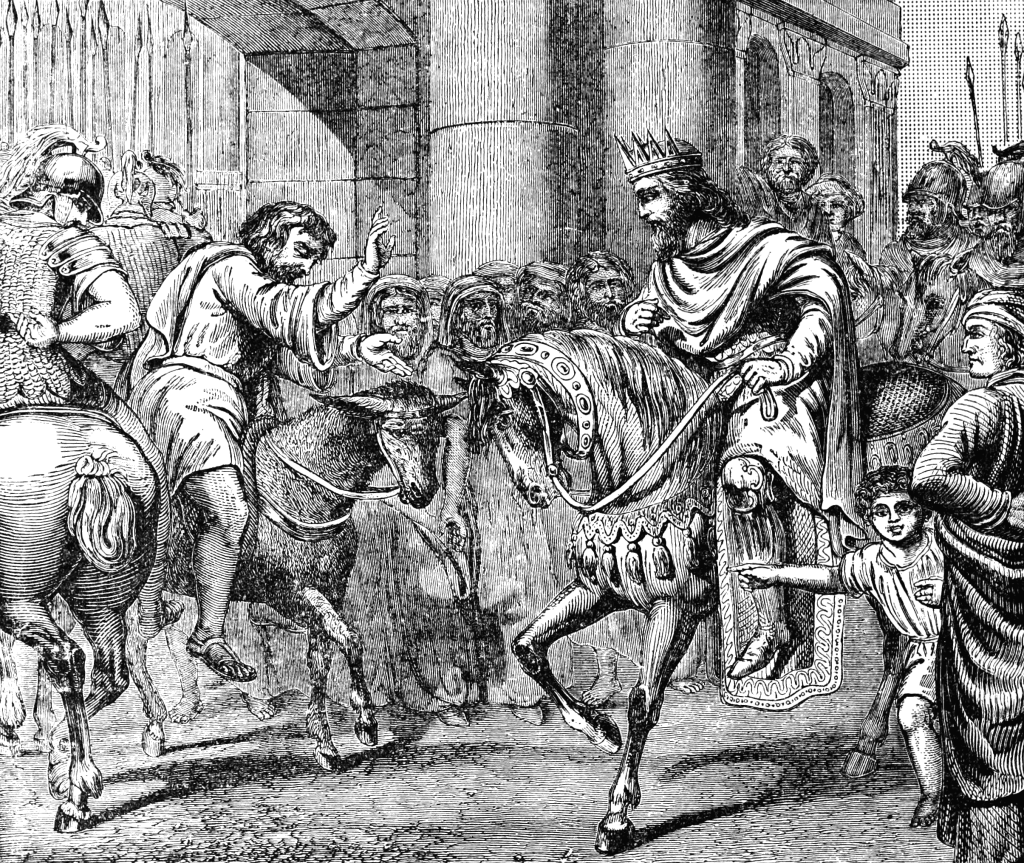
There is a sense in which God’s covenant with David, and David’s kingship, are exemplary of the new covenant and of Jesus’s kingship in ways that exceed later covenants. Peter Leithart works to demonstrate some of the ways in which this is true in his outstanding book From Silence to Song.
I especially like to highlight a few aspects of this. The so-called “Messianic Secret” is a fruitful parallel between the ministry of Jesus and the life of David. Related to this, the seven-year period in which Israel was gathered from Ish-bosheth to David is a significant parallel to the forty-year period in which old Israel was called to change her allegiance to Jesus. I especially like to reflect on the water crossings during the time Absalom drove David into the wilderness. Everyone who crossed the Kidron with David into the wilderness—including Ittai and his little ones (2 Sam. 15)—was baptized into David and enjoyed a union with David and all of the blessings of his kingship, victory, and vindication. In fact, on David’s return, it was necessary for the leaders to welcome David back by entering into his exile and crossing over the Jordan to bring him back (2 Sam. 19). These are clear analogs to our baptism into Jesus as well as our children’s baptism.
Mephibosheth was unable to join in this ministry to David. Instead, he allowed his hair to grow long (2 Sam. 19). Mephibosheth was thus to David what the Nazirite is to God. Earlier Nazirites had conducted a ministry of holy warfare; Mephibosheth’s ministry was instead a ministry of spiritual warfare, of prayer and fasting. This is instructive for Christians today. Today, all Christians are baptized; we are all priests (as well as being sons and prophets). There is therefore no more Nazirite, no need for a temporary priest or holy warrior. But the ministry of prayer—especially prayer in corporate worship—is how we fulfill the offices of priest and Nazirite today.
The fire that sat upon the heads of Christians in Acts 2 is equally instructive. This is not just the making of every Christian into a sacrifice and offering; it is also the making of every Christian’s head into a sacrifice and offering, just like the Nazritie. In terms of Pentecost, the work of speech, prayer, and worship is once again a significant characteristic of our service to God and his house.
Tongues redux
I heard it suggested that a straightforward way of reading “tongues of men and of angels” in 1 Cor 13 is referring to Greek and Hebrew. I’m not convinced that Hebrew is special in this way, but if so, this is consistent with my thesis that Paul is referring to Hebrew in the following chapter. It also implies the passing away of Hebrew as angels give way to men in the government of the church and the world. This coincides with the passing away of the language of the stars, as Gentile nations and rulers are called to recognize Jesus as well.
If you had to discern whether the New Testament commended ongoing prophecy only in the sense of foretelling, only in the sense of forthtelling, or both, on what basis could you do so? It does not seem to me that there is a distinguishing principle for this. Likewise for tongues, if you had to discern whether we should expect ongoing flames of fire, ongoing miraculous public speech in known languages, ongoing public speech in supposed unknown languages, ongoing private speech in supposed unknown languages, or some combination of these, on what basis could you do so? In particular: how could you possibly be content with one and not the others? Why would one be considered almost normative, and the others exceptional?
God appeared to Moses in a flame of fire from the midst of a bush which was not consumed (Exodus 3), and then later lit the fire on the altar himself (Leviticus 9). God thereby inaugurated his church with heavenly fire and expected the fire to be preserved by the faithful ordinary ministry of men (Leviticus 6); and it would have been disobedient and faithless for Moses to seek to re-create his earlier experience. “See, Lord, I let your fire run out. I buried your talent. Show us your power! Descend on us!” It is true that with successive covenant administrations, God re-established this fire, often after the sin of his church had extinguished it (2 Chronicles 7, 1 Kings 18, Acts 2); but each time he expected it to be preserved by the faithful ordinary worship of his ministers and people.
It shall never go out. (Leviticus 6)
Up to the throne
My friend James Lawrence pointed out that the date the movie 1917 takes place, April 6, is Good Friday of that year. This is also the date the US entered the war. This brings up some fascinating parallels to Holy Week, many of which seem to me to be clearly intentional.
General Erinmore underscores this parallel in a striking way with his quote from Kipling: “Down to Gehenna, or up to the Throne, He travels the fastest who travels alone.” Jesus’s own journey was one of a descent to the dead and an ascent to the Father’s throne. Tom Blake and Will Scofield’s journey is similar; Blake actually dies, and Scofield travels at night through the town of Ecoust with its burning church, even to the point of traveling underground. Both of these men’s movements are a kind of descent into hell, preceding Scofield’s ascension to the presence of Colonel Mackenzie and then his rest under the great tree.
At the opening of the movie, Blake and Scofield are chided and woken from sleep, much like the disciples at Gethsemane. Echoing Jesus’s cries at Gethsemane, Scofield later laments, “Why in God’s name did you have to choose me?”
Various times seem significant in the movie: the men are told to expect no resistance in daylight; the afternoon is “bloody quiet;” Scofield experiences a time of darkness as he passes out; and the denouement takes place at dawn. Some of the names are also significant. We see Blake and Scofield passing through Church Avenue, and they later make their way to Paradise Alley, where they meet Lieutenant Leslie, whose name means “holly garden.” Croisilles Wood recalls the cross. The men climb several hills.
There are significant mentions of food. Scofield shares a piece of bread with Blake. Later Scofield recalls trading a medal for a bottle of wine. Significantly, he drank this wine because “I was thirsty.” Later, Scofield shares his food with Lauri and the baby, a kind of midnight Passover meal.
There are telling injuries. Blake tells the story of a man named Wilco who loses his ear entirely, much like Malchus. You could also say that, in a manner of speaking, Wilco had been anointed with oil. Blake’s brother Joseph also has an ear injury, and the town of Ecoust is named for hearing. Scofield is wounded in his hand by a kind of a nail; Blake is pierced in his side. There are several other occasions where hearing and word are significant: the men have a direct order to convey; Scofield is exhorted to ensure there are witnesses. Blake is remembered by Scofield as always telling funny stories—parables.
Scofield experienced a kind of resurrection in the German bunker, where “they wanted to bury us.” He was temporarily blinded; recall that Jesus heals two blind men on his way to Jerusalem, one of which is healed by means of mud in his eyes. Blake urges Scofield to “wake up” and “stand up;” this calls to mind Ephesians 5:14, which has long been a part of the church’s Easter reading and song.
There are further deaths and resurrections. Scofield experiences a second resurrection after he is shot. He is tended-visited by a woman after this. In a manner of speaking, you could say that he gives this woman and the baby that she has found to one another, much like Jesus with Mary and John.
Most significantly, the two men together by their work save Joseph Blake and 1,600 men at sunrise. There is a more subtle resurrection in that we see chopped down cherry trees on Friday, but Scofield encounters cherry blossoms after his third death and resurrection in the river. Remember, too, that the earlier cherry trees were without fruit, just as the fig tree that Jesus encountered. Blake remarks that the trees will grow again when the stones rot; by comparison, Jesus, weeping over Jerusalem that is about to be cut down, proclaims that the stones will praise him if it will not.
In spite of these many resurrections, the significance of this day is hidden from most of the weary men who participate in it. Colonel Mackenzie had “hoped today might be a good day,” not realizing that this day not only secured the life of his men but also, from a great distance, the end of the war.
You could say that the two men do the work of their father; Erinmore is a fatherly figure, and Major Hepburn commends Scofield at the end with a “well done, lad.”
There are some less likely allusions as well, or ones that are more broadly Christian and not necessarily tied to Holy Week. For better or worse, the name of Jesus appears ten times in the movie. Blake and Scofield give water to their enemy. There is a “bowing chap;” Blake jokes that he considered entering the priesthood; nearly angelic helpers carry the body of Blake; and Lieutenant Leslie offers pardon for Blake and Scofield’s sins. As Blake and Scofield pass through the bunker, they are lights shining in darkness. In Croisilles Wood, a significant wind passes through the trees, and the men sing of their passage to heaven.
Some have suggested that the movie intends to mirror Dante’s Divine Comedy. In terms of the division of time, this does not at first glance seem very compelling, as Scofield’s beatific vision is very condensed. However, it is significant that the Divine Comedy itself mirrors Easter. And we also see at several points that Scofield is profoundly moved and motivated by his wife and daughters. So this motif also has some merit.
Christos anesti!
Persuasion
Some favorite quotes from Jane Austen’s Persuasion:
Anne’s object was, not to be in the way of anybody; and where the narrow paths across the fields made many separations necessary, to keep with her brother and sister. Her pleasure in the walk must arise from the exercise and the day, from the view of the last smiles of the year upon the tawny leaves, and withered hedges, and from repeating to herself some few of the thousand poetical descriptions extant of autumn, that season of peculiar and inexhaustible influence on the mind of taste and tenderness, that season which had drawn from every poet, worthy of being read, some attempt at description, or some lines of feeling. She occupied her mind as much as possible in such like musings and quotations . . .
As soon as she could, she went after Mary, and having found, and walked back with her to their former station, by the stile, felt some comfort in their whole party being immediately afterwards collected, and once more in motion together. Her spirits wanted the solitude and silence which only numbers could give.
Anne, judging from her own temperament, would have deemed such a domestic hurricane a bad restorative of the nerves, which Louisa’s illness must have so greatly shaken. But Mrs Musgrove, who got Anne near her on purpose to thank her most cordially, again and again, for all her attentions to them, concluded a short recapitulation of what she had suffered herself by observing, with a happy glance round the room, that after all she had gone through, nothing was so likely to do her good as a little quiet cheerfulness at home. . . .
Everybody has their taste in noises as well as in other matters; and sounds are quite innoxious, or most distressing, by their sort rather than their quantity. When Lady Russell not long afterwards, was entering Bath on a wet afternoon, and driving through the long course of streets from the Old Bridge to Camden Place, amidst the dash of other carriages, the heavy rumble of carts and drays, the bawling of newspapermen, muffin-men and milkmen, and the ceaseless clink of pattens, she made no complaint. No, these were noises which belonged to the winter pleasures; her spirits rose under their influence; and like Mrs Musgrove, she was feeling, though not saying, that after being long in the country, nothing could be so good for her as a little quiet cheerfulness.
She was deep in the happiness of such misery, or the misery of such happiness, instantly.
“It is a sort of pain, too, which is new to me. I have been used to the gratification of believing myself to earn every blessing that I enjoyed. I have valued myself on honourable toils and just rewards. Like other great men under reverses,” he added, with a smile. “I must endeavour to subdue my mind to my fortune. I must learn to brook being happier than I deserve.”
In this manner
How often should we pray for our daily bread—or our coming bread, as some would say? We should pray “this day”—that is, every day. Wouldn’t it be strange if, on such a day, the congregation assembled for worship, but the coming bread was not set out for her? We would be declaring that God was the kind of father who, if his son asks for bread, gives him something else.
And isn’t worship itself, in a sense, a kind of prayer? Wouldn’t it be strange if, in this prayer, we did not confess our sins and ask forgiveness? We would be declaring that it was not necessary to obey Jesus’s instruction to pray “in this manner.”
 I gotta have my orange juice.