Cinematic confessions
I am fond of dunking on Peter Jackson for demeaning the The Lord of the Rings. (We will not mention The Hobbit.) But I must confess that he portrayed Boromir perfectly, especially in his death. I am more fond of the movie here than the book.
They Shall Not Grow Old was also wonderful. And while it has nothing to do with Jackson, I’m looking forward to seeing 1917.
Growing up, I saw snippets of The Black Hole in a hotel, while we were house hunting prior to a move. I was captivated. Years later I finished the movie with my kids. Ha! Daddy’s judgment is now seriously called into question.
Catastrophe
Gentlemen, wherever you come in touch with catastrophe, with violent change: fire, earthquake, storm, hurricanes, war, revolution, . . . there the whole of creation and the whole of human society is at stake. And therefore you decide . . . whether you have attachment to the whole of the problem of life, or whether you have singled out yourself a little private religion, . . . a minority religion. That wouldn’t be a world religion. The problem of your belonging . . . is always to be decided, either all men and the whole world or my little world and my little group against the whole world. That is, whether the Russians say they are only interested in Russians, or whether the Americans say they are only interested in Americans, . . . this is always a pseudo-religion, because it decides [that] one man’s poison is the other man’s meat. . . .
Gentlemen, [this sphere of life] always poses the question: is my enemy and myself under the same god, or is my happiness the other man’s unhappiness and vice versa? If you cannot see that it is more important what to Russia and we are now undergoing together than what keeps us apart, then you have no religion. The purely secular statesman says, “I am only interested in weakening the Russians.” If he had one grain of religion, he would know that no secular statesman must ever be allowed to be just secular or to follow his secular policy out, because the Russians and we have something bigger in common. Isn’t that true? This is the question between secular and religious, gentlemen, in [this] sphere. . . .
Perhaps you take this down. It’s quite important. It’s unknown today. The secular mind sees in any catastrophe only the separate interests of those who benefit and those who suffer. The religious mind sees in the suffering itself the great problem: all suffer, or all benefit. So [this sphere of life] poses the problem of the solidarity of the whole human race and the unity of the whole universe. According to your decision in the experience of a catastrophe, gentlemen, you become a pagan or a believer in the living God. Paganism means to answer . . . by a division of loyalty, by a division of interests. If you are a pagan, you say, “What’s good for Rome must be bad for Carthage. Therefore I rejoice that the gods of Rome . . . are favoring us, . . . and the gods of Carthage are weak.” That’s paganism. Now the same is true of capitalism and labor. If labor rejoices because capitalism doesn’t reap any dividends, you see, it’s pagan. If it can see that the golden goose cannot be slaughtered, that the Port of New York must not decay because otherwise there is no longshore union which can benefit by a contract any more, because the exports and imports no longer touch the Port of New York, then you have Christianity, or religion, you see. Can you see? It’s very simple. The secular mind, gentlemen, meets an emergency with its partial interest. The religious mind is forced by the catastrophe to change its own mind. . . . You can take it down this way. The secular mind is that mind which must be changed by catastrophe, or out goes that purpose which the secular mind has tried to defend. There are, of course, idiots who do not want to see the common interest, and prolong the agony. And they are the real devils. . . .
Gentlemen, how do we realize catastrophe? This is a question of all questions. It’s the question of the prophets. It’s the question of Christianity. It’s the question of paganism. The pagan does not want to realize emergency. He wants to deprecate it. And he wants to say, “It won’t be that bad.” That’s your attitude. The Jew, the prophetic Jew, the messianic Jew, that is, the believing Jew has brought into the world the tremendous power of sensing catastrophe, far ahead, of saying, “It smells fishy. This order of things has to go. It won’t last.” And gentlemen, the middle attitude, the Christian attitude is not to sense it in general, but to determine the hour in which we must let go. The Jew has no country of his own for the last 2,000 years, as you know. He didn’t have it in Babylon. That is, the Jew has discarded loyalties in anxiousness to meet the next catastrophe, to be free when the prophetic voice sounds, you see. So the Jew has less loyalties than he could have. The pagan has more than is good for him. The Christian tries to sacrifice the loyalty that has to go now and to persuade his pagan confrères, with whom he is in the same boat, to let go. That is, the Jew is in general disloyal to the order that it is now, because he says, “Somebody has to prepare the future.” The pagans tries to forget the emergency. The Christian tries to persuade or to preach or to enact himself that sacrifice that at this moment is necessary for meeting the emergency.
Eugen Rosenstock-Huessy, Comparative Religion, 1954
Spirit
. . . in the tradition of Western philosophy, the capacity for spiritual knowledge has always been understood to mean the power of establishing relations with the whole of reality, with all things existing; that is how it has been defined, and it is conceived as a definition more than as a description. Spirit, it might be said, is not only defined as incorporeal, but as the power and capacity to relate itself to the totality of being. Spirit, in fact, is a capacity for relations of such all-embracing power that its field of relations transcends the frontiers of all and any “environment.” To talk of “environment” where spirit is concerned, is a misunderstanding, for its field of relations is “the world,” and by its very nature it breaks the bounds of any “environment;” it abolishes both adaptation and imprisonment. Therein lies, at one and the same time, the liberating force and the danger inherent in the nature of spirit.
Josef Pieper, The Philosophical Act
Leisure
No, the contrary of acedia is not the spirit of work in the sense of the work of every day, of earning one’s living; it is man’s happy and cheerful affirmation of his own being, his acquiescence in the world and in God—which is to say love. Love that certainly brings a particular freshness and readiness to work along with it, but that no one with the least experience could conceivably confuse with the tense activity of the fanatical “worker.”
Who would guess, unless he were expressly told so, that Aquinas regarded acedia as a sin against the third commandment? He was in fact so far from considering idleness as the opposite of the ethos of work that he simply interprets it as an offense against the commandment in which we are called upon to have “the peace of the mind of God.” . . .
Idleness, in the old sense of the word, so far from being synonymous with leisure, is more nearly the inner prerequisite which renders leisure impossible: it might be described as the utter absence of leisure, or the very opposite of leisure. Leisure is only possible when a man is at one with himself, when he acquiesces in his own being, whereas the essence of acedia is the refusal to acquiesce in one’s own being. Idleness and the incapacity for leisure correspond with one another. Leisure is the contrary of both.
Leisure, it must be clearly understood, is a mental and spiritual attitude—it is not simply the result of external factors, it is not the inevitable result of spare time, a holiday, a weekend or a vacation. It is, in the first place, an attitude of mind, a condition of the soul, and as such utterly contrary to the ideal of “worker” . . . .
In the foregoing sections leisure was tentatively defined and outlined in its ideal form. It now remains to consider the problem of realizing its “hopes,” of its latent powers of gaining acceptance, and its possible impetus in history. The practical problem involved might be stated thus: Is it possible, from now on, to maintain and defend, or even to reconquer, the right and claims of leisure, in face of the claims of “total labor” that are invading every sphere of life? Leisure, it must be remembered, is not a Sunday afternoon idyll, but the preserve of freedom, of education and culture, and of that undiminished humanity which views the world as a whole. In other words, is it going to be possible to save men from becoming officials and functionaries and “workers” to the exclusion of all else? Can that possibly be done, and if so in what circumstances? There is no doubt of one thing: the world of the “worker” is taking shape with dynamic force—with such a velocity that, rightly or wrongly, one is tempted to speak of demonic force in history. . . .
There is, however, a fact which from the vantage-point we have now reached must be strikingly clear and significant, and it is this: whereas the “total work” State declares all un-useful work “undesirable,” and even expropriates free time in the service of work, there is one Institution in the world which forbids useful activity, and servile work, on particular days, and in this way prepares, as it were, a sphere for a non-proletarian existence.
Josef Pieper, Leisure: The Basis of Culture
Critique
Aleksandr Solzhenitsyn’s three-volume opus, The Gulag Archipelago, which some have called the most important masterpiece of the twentieth century, is subtitled: “An Experiment in Literary Investigation.” Consider how odd that is. No Westerner would call such a work “literary,” lest someone discount its documentary value. Literature is one thing, truth another, isn’t that correct? But Solzhenitsyn insists that absolutely everything included is strictly factual, a claim validated when the Soviet Union fell and archives were opened. What, then, is literary about the book? It is worth noting that Russia’s most recent winner of the Nobel Prize for literature, Svetlana Alexievich, also produced literary works that were purely factual. With these two writers we encounter something essential to the Russian tradition. . . .
Gary Saul Morsen, How the Great Truth Dawned
In Russia, literature critiques you.
A third difficulty
There is first to note that, whereas in other businesses the ambition of the customers and the insolence of the laborers only have to be contended with, the Roman captains of industry had a third difficulty in having to put up with the cruelty and avarice of their shareholders, a matter so beset with difficulties that it was the ruin of many; for it was a hard thing to give satisfaction both to shareholders and laborers; because the laborers loved peace, and for this reason they loved the unaspiring CEO, whilst the shareholders loved the warlike CEO who was bold, cruel, and rapacious, which qualities they were quite willing he should exercise upon the laborers, so that they could get double dividends and give vent to their greed and cruelty.
With sincere apology to Niccolò Machiavelli for misappropriating The Prince, Chapter 19
Prudence
Never let any Government imagine that it can choose perfectly safe courses; rather let it expect to have to take very doubtful ones, because it is found in ordinary affairs that one never seeks to avoid one trouble without running into another; but prudence consists in knowing how to distinguish the character of troubles, and for choice to take the lesser evil.
Niccolò Machiavelli, The Prince, Chapter 21
It is not unknown to me how many men have had, and still have, the opinion that the affairs of the world are in such wise governed by fortune and by God that men with their wisdom cannot direct them and that no one can even help them; and because of this they would have us believe that it is not necessary to labour much in affairs, but to let chance govern them. This opinion has been more credited in our times because of the great changes in affairs which have been seen, and may still be seen, every day, beyond all human conjecture. Sometimes pondering over this, I am in some degree inclined to their opinion. Nevertheless, not to extinguish our free will, I hold it to be true that Fortune is the arbiter of one-half of our actions, but that she still leaves us to direct the other half, or perhaps a little less.
Niccolò Machiavelli, The Prince, Chapter 25
Magi, did you know?
Now after Jesus was born in Bethlehem of Judea in the days of Herod the king, behold, wise men from the east came to Jerusalem, saying, “Where is he who has been born king of the Jews? For we saw his star when it rose and have come to worship him.” When Herod the king heard this, he was troubled, and all Jerusalem with him; and assembling all the chief priests and scribes of the people, he inquired of them where the Christ was to be born. They told him, “In Bethlehem of Judea, for so it is written by the prophet:
‘And you, O Bethlehem, in the land of Judah,
are by no means least among the rulers of Judah;
for from you shall come a ruler
who will shepherd my people Israel.’Then Herod summoned the wise men secretly and ascertained from them what time the star had appeared. And he sent them to Bethlehem, saying, “Go and search diligently for the child, and when you have found him, bring me word, that I too may come and worship him.” After listening to the king, they went on their way. And behold, the star that they had seen when it rose went before them until it came to rest over the place where the child was. When they saw the star, they rejoiced exceedingly with great joy. And going into the house, they saw the child with Mary his mother, and they fell down and worshiped him. Then, opening their treasures, they offered him gifts, gold and frankincense and myrrh. And being warned in a dream not to return to Herod, they departed to their own country by another way. (Matthew 2:1–12 ESV)
This is the word of the Lord.
Brothers and sisters, this story is true.
I wish we had time to reflect on everything interesting here. I don’t know what it means for a star to stoop to earth, although I think C. S. Lewis came close to the truth. However, tonight let’s focus our attention on the greater miracle of God’s stooping to earth.
To help us, let’s consider what brought these men here. Our translation calls them wise men; you may also know them as magi, or as three kings “of Orient” (even though the number three is a complete guess). The scope of their wisdom could well extend to dreams, magic, astrology, and sorcery. They come from the east, from Persian lands. All of this may remind you of the Old Testament prophet Daniel and his run–ins five hundred years earlier with Babylonian magicians, enchanters, and astrologers over the matter of dreams and worship—these were the Babylonian magi. Daniel went on to serve the kings of Media and Persia who conquered Babylon. Wise men are record–keepers; they do not forget. It seems likely that Matthew’s wise men had a connection with Daniel the wise man. Were they taught by him to look for and hope in a king of the Jews? Let’s see what they might have learned from Daniel.
The wise men were seeking the king of the Jews. Jew literally means someone from Judah. Since the tribes of Israel returned from their exile in Babylon, they all carried the name of this one tribe from which the great king David came. Daniel knew that God promised Judah would be first among his brothers and would have an unending kingship. From Genesis 49:
“Judah, your brothers shall praise you;
your hand shall be on the neck of your enemies;
your father’s sons shall bow down before you.
Judah is a lion’s cub;
from the prey, my son, you have gone up.
He stooped down; he crouched as a lion
and as a lioness; who dares rouse him?
The scepter shall not depart from Judah,
nor the ruler’s staff from between his feet,
until tribute comes to him;
and to him shall be the obedience of the peoples.” (Genesis 49:8–10 ESV)
Daniel might also have taught the wise men of Babylon the prophecy of Balaam, who declared in Numbers 24 that a victorious star would come out of Judah’s father Jacob:
“I see him, but not now;
I behold him, but not near:
a star shall come out of Jacob,
and a scepter shall rise out of Israel;
it shall crush the forehead of Moab
and break down all the sons of Sheth.” (Numbers 24:17 ESV)
God’s sending a star is a fitting announcement of the coming of the king of the Jews.
Interestingly, even though the prophet Micah came before Daniel, the wise men do not seem to have had his prophecy or did not connect it with their mission. Matthew makes Micah’s prophecy the centerpiece of this little story; it is a second witness that confirms the words of the wise men. A ruler and shepherd will be born for Israel in Bethlehem of Judah. This is just what the wise men are seeking: the king of the Jews.
The prophet Isaiah lived about the same time as Micah, and Daniel was much more likely aware of his writings. Isaiah says that the nations will stream to Israel and her king. He has such a rich set of passages to choose from, but here is one where he shows the nations bringing gold and frankincense, so that Matthew’s wise men are perhaps very deliberately walking right into this prophecy!
Lift up your eyes all around, and see;
they all gather together, they come to you;
your sons shall come from afar,
and your daughters shall be carried on the hip.
Then you shall see and be radiant;
your heart shall thrill and exult,
because the abundance of the sea shall be turned to you,
the wealth of the nations shall come to you.
A multitude of camels shall cover you,
the young camels of Midian and Ephah;
all those from Sheba shall come.
They shall bring gold and frankincense,
and shall bring good news, the praises of the LORD.
All the flocks of Kedar shall be gathered to you;
the rams of Nebaioth shall minister to you;
they shall come up with acceptance on my altar,
and I will beautify my beautiful house. (Isaiah 60:4–7 ESV)
This sounds wonderful for the people of Israel, but why should Persians gladly go out of their way to honor and serve the king of the Jews? These are not even the first Persians to show such interest; emperors Cyrus and Ahasuerus and Artaxerxes showed great interest in Israel and Jerusalem and in God’s temple. What would they have learned from the wise man Daniel, the man who also taught Nebuchadnezzar the ways of God? Could it be that these promises are for us too?
Yes! Daniel knew that God’s promises are for the world and not just for Israel. God’s first promise of salvation from sin and evil was to Adam and Eve, long before the founding of Israel. At the very beginning of Genesis, God cursed the evil serpent, declaring that someone was coming who would wound him. Later, God promised to Abraham that through him “all the families of the earth shall be blessed.” What’s good for Israel is good for the world. We see an early example of this in Genesis when God gave Joseph the Hebrew insight and wisdom to feed “all the earth” during a famine.
Daniel first served the great emperor Nebuchadnezzar, and so Daniel became another blessing to the families of the earth at that time. Nebuchadnezzar had a vision of a great king and kingdom to come that would shatter the kingdoms that came before, that would cover the earth and “never be destroyed.” Later Daniel himself had a vision that this great change would begin in about 500 years. So, the wise men were prepared to wait for just this moment. It seems that little Israel is going to become pretty important.
But something interesting happened to Daniel. An angel told him that part of his vision was to be shut up and sealed: a mystery. Daniel’s mystery is the same mystery that we see ripped wide open much later in the New Testament. The mystery is this: Jesus is not just taking the old ways and the old Israel and setting up Israel in charge of everyone else. Instead, Jesus is making a new kingdom out of and over all nations: his church. The apostle Paul says that Jesus is making a “new man” of the church by uniting Jew and Gentile. He calls the church the “Israel of God,” and the author of Hebrews calls the church the “heavenly Jerusalem.” Paul says that God counts someone a son of Abraham not by genealogy but by faith. The king of the Jews turns out to be the king of kings. What’s good for the church is now good for the world.
Matthew’s wise men may not have understood this mystery of Jesus making a new kind of kingdom, but they did understand from Daniel that Jesus would be king of the world, that the world owes its allegiance to him, and that the world can only find happiness in him. The great irony here is that Herod and all Jerusalem, especially God’s priests, should have known this; in fact, Matthew shows us that they did know it without acknowledging it. In a strange mix of fear and pride, they rejected the king and his blessings and his warnings, clutching their current way of life.
But this baby Jesus, this king Jesus, must have our complete allegiance. Everything is his, so anything that we treasure more than him or apart from him is not ours to have and keep. Herod lost what he tried to keep.
Jesus himself says that everyone who is not against him is for him, and everyone who is not for him is against him. It is not possible to be neutral or indifferent; we are always walking in allegiance or defiance of him. Psalm 2 underscores this test that is set before all of us:
Now therefore, O kings, be wise;
be warned, O rulers of the earth.
Serve the LORD with fear,
and rejoice with trembling.
Kiss the Son,
lest he be angry, and you perish in the way,
for his wrath is quickly kindled.
Blessed are all who take refuge in him. (Psalm 2:10–12 ESV)
There is a high cost but also a rich blessing set before us. We give our very lives to Jesus, day after day after day; he gives us the real blessings of Psalm 2 and Isaiah 60 and so many other passages. The first and greatest blessing is that he forgives all our rebellion. This is why the Christmas angels announce to the shepherds the good news that Jesus is a Savior. And this salvation is the foundation of all his other blessings. All the best Advent and Christmas carols are true! We begin to taste them now through Jesus and his church, and we will eventually receive them in totality. God does not promise bread to his children and give us stones.
It is an open secret that this king is right now sitting on his throne and has infiltrated his enemies’ dominions from the highest to the lowest places. His people enjoy constant communication with him in prayer and by the presence of his Holy Spirit; and we have a special audience with him every week. He has us on a special mission which includes suffering and sacrifice, and this is why we do not yet see all the promises coming true. It is because, through us, he wants to flash his light into every possible darkness, to win more people to himself, and to share his blessings more widely.
It is good to belong to Jesus!
If you do not yet belong to him, I promise you will not regret giving your allegiance to him.
If you do belong to him, then let the great faith of the wise men remind and encourage you that it is good to give your allegiance to Jesus. Your allegiance will be tested, but you will not regret serving him wholeheartedly and unashamedly. Daniel and the wise men show us that we can still serve earthly kingdoms, but Herod is a lesson to us not to make our homes there. Your home is in the house of God.
It is good to belong to Jesus!
Let’s pray.
Father, you gave your only–begotten Son to take our nature upon him. You caused us to be born again and made us your children by adoption and grace. Renew and refresh us by your Holy Spirit, through Jesus Christ our Lord. To you and Jesus and the Holy Spirit be all honor and glory, now and forever. Amen.
Various
Of the Father’s Love Begotten is a new carol to me; I’m liking it very much. The Wexford Carol is not new to me but it is also wonderful.
Another annual treat: Chesterton’s “Gloria in Profundis.”
Duane Garner recently finished a sermon series on the Song of Songs, and now has launched into Revelation.
Some quotes from Eugen Rosenstock–Huessy’s 1954 Comparative Religion class, lecture 16:
Once you have disturbed a holy experience, you have destroyed it. . . . If you and another person go to a grave, and you make a silly remark on the way to the grave, as most people do who go to a funeral, and you are ashamed of your tears, you destroy also the faith and the love of this other person. She has to listen to this silly remark which you make there. . . .
There’s more destruction, gentlemen, done by the people with good intentions and rational philosophy than by anybody else in the world. You do the mischief with your wrong philosophy. Not the “weak” people who cry and laugh and so on. They may be silly, certainly, . . . stupidity is in itself not a merit, gentlemen. But the people who think by their cleverness to be superior, they are much more dangerous. Much more. And the country—the world—America is dying from their silliness.
Did I tell you my story about Scipio? . . . As you know, the Roman Empire has still has quite a ring, even in your ears, as the empire that lasted longer than anything else. The empire only ceased to exist in 1805, and it began in this year 146 before Christ, when Scipio conquered Carthage and Corinth, the last Greek province and the African coast. At that time, the Roman Empire was established as the governess and mistress of the Mediterranean world. Well, to make a very long story short, the gist of the matter was that Scipio wept on the day of the surrender of Carthage. And when he was asked by his best friend and tutor and professor of philosophy why he did weep, . . . he said, “Because when the queen of Carthage perpetrated her unconditional surrender to me, I foresaw the day on which Rome would fall, too.” . . . If you weep, gentlemen, in such a situation, you will prolong the existence of your empire for untold centuries. The Roman Empire has lasted so long, because Scipio wept. And the United States of America will not last, will not last 600 years. It’s impossible, because of the behavior of the Americans in the year of the Lord 1945. They did not weep. They just had a rational philosophy. . . We have carried out our policy. That’s not good enough, gentlemen. . . . Gentlemen, these were people out of which the United States drew all their human reserves for 300 years. Therefore, Europe cannot be treated according to plan. That’s a different story. That’s your family. Maybe the wicked part of the family, but still your own family. . . .
Gentlemen, . . . the condition of the life everlasting is your and my not thinking that we make it. As soon as you think that we make our lives, that we make our policies, that we win our wars, this life will not last long, because you exaggerate the place of plan. . . .
and lecture 17:
And I always feel that many men in this country are so ridiculously intimidated by the girl, and they are so grateful that this girl condescends to marry them, that they sacrifice too much. You sacrifice the better man in you [together with the child–playboy]. This you must never do, because the man in you is the only power that can make this girl happy. She can never rest, when she gets you without your real inner growth, without the stage in which you have reached a decision. Do I make myself clear? And wherever I look, I see this, gentlemen, and it’s so many tragedies in this country—all live between 20 and 30 and after this, no life whatsoever left. This country, which has abolished tragedy, is full of tragedy. It is terrible, and tragedy that can never be healed. Because once a woman has stepped in this sense on your sanctuary and says, “That’s all over now. We get married and that’s all just the past,” she has declined to allow you to grow. And once this is capped, once this is cut, this growing point is seared and cauterized for the rest of your life, you may be the breadwinner of your family, and you may be a little rooster, but that’s all. . . .
Playboy religion is always pluralistic, because they are all short-lived pleasures. They are all shorter than the real life. You can have 10 amours. You can have 20 dates. But you can have only one wife. And you can have 20 drunken parties, you see. But you can have only one wedding, or one great occasion in which your candidacy for office is celebrated or not. But that’s all much more limited. One. But all the pleasures you can multiply. That’s why playboy religion is always multifarious. You can go on from one party to the next, swimming and canoeing and tennis-playing and football, and on it goes. And these pleasures are innumerable. . . .
Gentlemen, that’s why it is necessary to have the Bible. The one book—the Bible is the book of books, as you know. There had to be one book which is only once, in order to make clear to you that you are all apt to get stuck with the best-sellers. That’s the playboy religion, that you go on from one book to the next, and to the next, in endless succession. As long as you play with these books, it’s all right. But it’s the great saving of your orientation that you must know there is one book that is not read for pleasure, and therefore it’s only one. . . . Anybody who wants to abolish religion says that the Bible is literature. Literature is playboy religion, Muses, liberal arts, plural, many, you see. Literature means that one book can take the place of another book. And the Bible means that no book can take the place of this book. There is only one Bible, or there is no Bible. But if there’s no Bible, don’t read it. That is, you can never treat the Bible as literature. You can decide not to read the Bible, because it’s just old stuff and superstition. Nobody can force you to take to the Bible. But never mistake it to be what it is not. The Bible is not one book out of many.
A Failure of Nerve
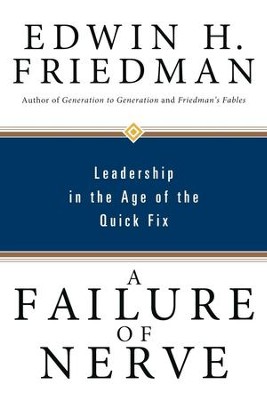 For several years now I’ve appreciated and benefited from Edwin Friedman’s book on leadership, A Failure of Nerve. I enjoy thinking about big ideas that help to make sense of God’s world. For example, it is helpful to think of all sin as being a form of idolatry, or a form of pride, or arising from a kind of covetousness. We look for a structure of conflict and climax in most of our stories. René Girard teaches us to look for imitation and scapegoating in all of the crises of story and history, and points us to the one scapegoat who alone can cover mankind’s sin.
Edwin Friedman’s organizing big idea revolves around anxiety. He was a student of organizational behavior, ranging from families and churches to businesses and nations. He suggests that all of the ways that an organization can break down involve a kind of anxiety on the part of the group or the leader or both. And from this he draws a program of non-anxious leadership.
Friedman sees anxiety behind how a group or organization becomes stagnant, resistant or even hostile to change and growth; and also behind leaders’ addictions to either quick fixes or to data rather then decisive action. He suggests that a non-anxious approach to leadership is crucial, that the “calm presence” of a leader matters more to calming an organization’s anxiety than almost anything else the leader says or does. He develops this into an idea of what he calls “differentiation,” which is the leader’s own focus on his integrity and stability. Out of this non-anxious differentiation, he charges leaders to allow their organizations to experience a healthy dose of their own learning experience and even pain so that they can mature; what you might call a sort of non-anxious “tough love” that is appropriately sympathetic but does not devolve into the kind of empathy that is powerless to help others grow. In Friedman’s model, the leader functions both as a kind of anxiety absorber and also an immune system.
Although Friedman was not a Christian, many of his ideas have Christian parallels. Jesus charges us not to be anxious, and the fact that Jesus himself is not anxious is perhaps the greatest boost to our own faith. It is faith, after all, that is the true antidote to fear and anxiety, and Jesus invites us to bring our cares to him. Perhaps a way of expressing Friedman’s differentiated self is to say that it is a faith-filled, wise, mature, patient, and Spirit-governed self. This integrity of a leader includes the careful watching of his life and doctrine, and the taking of logs out of our own eyes before we address the specks in others’ eyes.
There is a superficial way of reading Friedman that suggests that leaders should be aloof and uncaring. I don’t think this is what he is saying, but in any case we want to be careful not to swing the pendulum that far. And while anxious leadership may be the problem of our time, we should also be on guard for a sinful complacency.
Additional reading:
- Friedman’s outline
- Challenging presence
- Alastair Roberts’ lengthy review and interaction
 I gotta have my orange juice.