Archive for the ‘Union with Christ’ Category
Far as the curse is found
In his chapter in The Glory of Kings, “Holy War Fulfilled and Transformed,” Rich Lusk deals with the unique way in which God led Israel to prosecute war in the conquest of Canaan. Lusk contrasts Israel’s conquest of Canaan against the much more restrictive demands God placed on their ordinary warfare. He goes on to establish how the conquest is typological for Jesus’s conquest of the world through the cross and the church. The church engages in battle and wrestling through our worship, prayer, sacrifice, evangelism, discipleship and ministries of mercy.
 There is a kind of double meaning in the idea of something being devoted to God: it may entail either punishment or acceptance, judgment or justification. While cities were sent up in smoke as a mark of God’s judgment, the system of offerings shows a positive meaning of ascension in smoke. The penalty and judgment for sin came into play when the animal was put to death. After its death, the animal’s ascension in smoke was a positive figure of its entering into God’s presence on behalf of the worshipper. The underlying Hebrew for “whole burnt offering,” in fact, literally means “ascension offering.” Likewise, Jesus, our offering for sin, in his ascension brings us to the Father in union with him as our representative. So, today, the church wields the sword of the Spirit, the word (Eph. 6:17; Heb. 4:12), waging a campaign of devoting the world to God by spreading the fire of the Holy Spirit, life born out of repentance. Since Pentecost, we are living sacrifices.
What struck me in thinking about this was Israel’s refusal to enter into Canaan, and how this may serve as a caution for the church. Consider Numbers 13:25-14:38. Clearly God promised to give them the land, and they saw firsthand his power to fight for them. And yet they still did not believe. Ultimately, God forgave their sin, but they had to endure the consequence of their unbelief through forty years of wandering and death. In a way, they were given only as much as they believed God for: they did not believe God could or would fight for them, so they do not enjoy the victory that God had promised.
What does this mean for the church? Jesus is the high priest whose death brings about an atoning transition from judgment to grace (Numbers 20, 35), and immediately opens the way to the gospel’s conquest of the world (Numbers 20:29-21:3). Jesus’s ascension is his coronation; the Father has now put everything in subjection under his feet (Ps. 8, Heb. 2). Here are a few ways we can work at walking in faith in Jesus’s lordship:
- Jesus is lord of nations, kings and magistrates, so our responsibility as citizens does not stop at voting and prayer: we call them to account to Jesus and seek to disciple them
- Our children belong to Jesus and his Spirit is at work in them, so our parenting owes as much to the pattern of discipleship as to evangelism
- Jesus is lord of our work, so we can work in any lawful vocation “as for the Lord,” knowing that he is beginning a new work of subduing the earth regardless of the seeming futility we see on our own time horizons
- Jesus is lord of all, so we can confidently appeal to unbelievers on the basis that they live under his rule in his realm, that everything they enjoy is a blessing from him, and that true joy and blessing is to be found in welcoming him and his lordship rather than despising him.
And belt out some Christmas songs this holiday season. Joy to the world!
Pentecost
 Tomorrow is Pentecost.
Then, God gave us his law. He put it in a chest and wrote it on our hearts. Now, he also fills us with himself, his own spirit.
Then, God taught us to build him a tent-house so that he could live among us. He walked with us for a time in the flesh. Now, he dwells with us through his spirit and one another.
Then, God’s fire engulfed the bush, as a token that the God who keeps his promises would not consume us. Instead, his fire consumed the sacrifice on the altar and rose up as a pleasing memorial to him. Now, God’s fire rests continually upon us, and we consume his body and blood as a pleasing memorial to him.
Some Pentecost reading:
Redeemer
It would be difficult to call a single book my best theological purchase ever, because of the different ways that books can come to us at just the right time and can interact with and build upon each other. Lewis was a particular help to me because I was in a season of doubt. If Van Til hadn’t taught me to be a conscious Calvinist, I would never have needed Carson to steer me out of the hyper-Calvinist ditch, nor would I have been willing to work hard enough at Vos to learn more. And Middle-earth and Narnia are clearly in the running. Plus, I just haven’t read enough to be making such lofty pronouncements.
But realizing this, and even though I’m only partway into it, in my own small way I think the James Jordan audio collection will stand as my best theological purchase ever. Jordan has really incredible insights into the Bible. There are many books worth of material here; five months in and I have only made it through his Genesis lectures and partway into Exodus. But I am hooked, and if nothing else, I feel much better prepared and much more excited for family Bible reading. Jordan has the ability to illuminate many of the “weird” parts of the Bible so that they begin to make sense, and I’m having to give up some patronizing attitudes toward parts of history. It’s exciting to see someone wrestling with why God gave us particular details or obscure passages, even if we don’t have yet have enough information to answer that in every case. Jordan is constantly drawing out vast connections throughout Scripture, including rich symbolism and typology. Here’s a small but surprising example: combining Genesis 39:1, 39:20-23, and 41:10, we see that Joseph never left Potiphar’s house in his imprisonment! It is not clear whether the “keeper of the prison” is Potiphar himself or another of Potiphar’s servants. Regardless, Potiphar seems to have recognized that God blessed him through Joseph, and perhaps even recognized Joseph’s innocence (which would heighten the injustice of Joseph’s imprisonment).
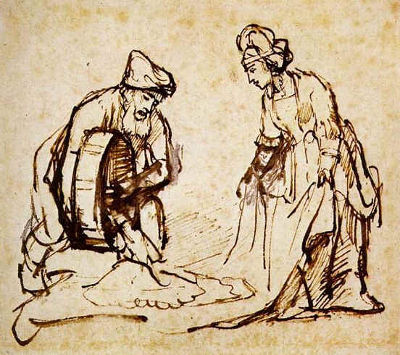 This week I am listening to Jordan’s comments on Exodus 21. While drawing connections to related passages elsewhere in the Pentateuch, he observes that Hebrew uses a single word, goel or ga’al, to convey both the idea of the kinsman redeemer and the avenger of blood. So the word conveys a person’s status as next-of-kin as much as it does these distinct responsibilities attached to it. Jordan has several valuable observations to make on the blood avenger; in particular, he distinguishes it from a mere family feud by showing it to be a real civil responsibility to guard against bloodguilt (Numbers 35:30-34). Otherwise the land itself will rise up to serve as avenger instead (as in Genesis 4:10-12, Leviticus 20:22, Leviticus 26:18-20). Considering the cities of refuge, Jordan points out that the death of the high priest’s cleansing the land (Numbers 35:28) is another type of Jesus.
Jordan also makes the fascinating offhand remark that this dual use for goel lends further support for the doctrine of particular redemption (or limited atonement). First, it is not possible to identify Jesus as redeemer in the abstract: he is the redeemer of particular individuals who share a kinship with him. Second, we cannot separate the office of redeemer from that of avenger: as a redeemer there are others estranged from him who will suffer his vengeance. Like so many other things, it comes back to adoption.
I’m not trying to prove the doctrine of particular redemption in offering this, and if I were I would take pains to guard against the hyper-Calvinist idea that there is simply no sense in which Jesus shows kindness to those who perish, or in which he died for the sins of the whole world. But as someone who holds to particular redemption, this is a neat confirmation, as well as a great example of the sort of depth that Jordan routinely offers even in passing comments.
Picture source: Rembrandt.
My Song is Love Unknown
Toby Sumpter considers the wonder of God’s love. Audio below, text here.
My song is love unknown
My Savior’s love to me
Love to the loveless shown
That we might lovely be.
Baptized
 Or, as Asher says, “bathtized.”
I was sprinkled as a baby and dunked at the age of 14. I expected that to be a pretty powerful spiritual experience but ended up feeling unchanged. Partly because of that, and partly because I kept coming to a better understanding of the good news, I often wished I had waited longer to be baptized. Several years ago I read something from John Piper that changed my thinking:
Many of us came to faith and were baptized at a point when we did not know very much. This is good. It is expected that baptism happens early in the Christian walk when you do not know very much. So it is also expected that you will learn later more and more of what it means. Don’t think, “Oh, I must go back and get baptized again. I didn’t know it had all this meaning.” No. No. That would mean you would be getting re-baptized with every new course you take in Biblical theology. Rather, rejoice that you expressed your simple faith in obedience to Jesus and now are learning more and more of what it all meant.
This is very comforting: God accepts us in our immaturity, and maturity is not at all what will secure our salvation. But why didn’t baptism seem to change anything? Perhaps it did, in a different way than I was expecting? What is baptism and what does it do?
I married Lisa ten years ago this month. I expected it to change me and I was not disappointed. Sandy Young pronounced us man and wife, and we became man and wife! What did that pronouncement do?
Linguists call something a performative utterance if its accomplishment is wrapped up in the declaration of that accomplishment. If I say “I promise I will pay you,” my speaking is my promise. If Queen Elizabeth declares someone to be a knight, so they are! Declaring is part of a performative utterance, but so is authority: you cannot promise anyone my money; and no one but Queen Elizabeth can dub a British knight.
This is what happens in a pronouncement of marriage: a minister of God’s church, under God’s authority declares a couple man and wife, and this declaration itself accomplishes the marriage. Neither the declaration nor the exchanging of rings or vows actually causes the marriage, but altogether they do accomplish it. This, too, is what happens in baptism: a minister of God’s church, under God’s authority declares a person to belong to God and to be part of God’s family. Baptism doesn’t cause anything; we have a risen Savior and King who does that! But baptism is normally part of how God visibly accomplishes joining us to Christ.
In one sense, baptism is something we do — part of submitting ourselves to Christ. But baptism is much more God’s declaring and doing than our declaring and doing. Consider:
- Baptism takes place in the Triune name; it is done under authority.
- Baptism is done to someone. The one being baptized is not the subject but the object.
- Baptism is spoken of as accomplishing something or bringing us somewhere, in terms that seem very bold to us: it kills us, buries us, washes us, puts on, unites us, saves us. We are baptized into Christ, into his church.
- Finally, if baptism unites us to Christ (Romans 6), and if God declared over Christ that “you are my beloved son; with you I am well pleased” — at his baptism, no less — then our own baptism is certainly God’s declaration of his acceptance of and pleasure in us, in Christ.
Surely a dip in the water cannot cause all this! No, but it accomplishes it, since God has ordained to use baptism to speak and do through his church.
Are you baptized? God wants you to remember and believe and live in this truth: God loves you as his child and is pleased with you. Our Father has finalized our adoption by publicly announcing it. That is a powerful experience!
Pruning
John 15 speaks of the Father’s pruning fruitful branches. One thing we draw from this is that our sufferings have wise and loving intentions and good ends. But there’s something deeper here: Trinitarian life. Abiding and pruning go hand in hand; the Father’s pruning is not separate from our union with the Son, and the fullness of life, love and joy that we have in him by his Spirit and through one another.
Redemption Accomplished and Applied
 Murray, John. Redemption Accomplished and Applied. Grand Rapids, MI: William B. Eerdmans Publishing Co., 1984.
The late John Murray presents a brief overview of Jesus’s work of redemption. This book is divided into two parts: Redemption Accomplished, which describes our need of a savior, God’s provision of a savior, and what Jesus accomplished on the cross; and Redemption Applied, which describes how all of redemption is worked out in the life of the believer.
This book was a helpful overview of Jesus’s work on the cross and of God’s work in bringing me to salvation.
Of all of the chapters, the one that was most provocative to me was the chapter on faith and repentance. Murray presents a wonderful reminder of where our assurance of salvation is located — nowhere other than Jesus himself.
Following are this and some other quotes I’ve collected from the book.
On Assurance (pp. 107ff)
Murray reminds us that our assurance does not consist in peering into the secret decrees of God to discern whether he loves us or has elected us unto salvation (see also The Difficult Doctrine of the Love of God), nor does it consist of our subjective sense of nearness to God. It consists in placing our trust here and now wholly in Jesus for mercy:
What warrant does a lost sinner have to commit himself to Christ? How may he know that he will be accepted? How does he know that Christ is able to save? How does he know that this confidence is not misplaced? How does he know that Christ is willing to save him? . . .
From whatever angle we may view [the offer of the gospel], it is full, free, and unrestricted. The appeals of the gospel cover the whole range of divine prerogative and of human interest. God entreats, he invites, he commands, he calls, he presents the overture of mercy and grace, and he does this to all without distinction or discrimination. . . .
When Christ is presented to lost men in the proclamation of the gospel, it is as Savior he is presented, as one who ever continues to be the embodiment of the salvation he has once for all accomplished. It is not the possibility of salvation that is offered to lost men but the Saviour himself and therefore salvation full and perfect. There is no imperfection in the salvation offered and there is no restriction to its overture — it is full, free, and unrestricted. And this is the warrant of faith.
The faith of which we are now speaking is not the belief that we have been saved but [it is] trust in Christ in order that we may be saved. And it is of paramount concern to know that Christ is presented to all without distinction to the end that they may entrust themselves to him for salvation. The gospel offer is not restricted to the elect or even to those for whom Christ died. And the warrant of faith is not the conviction that we are elect or that we are among those for whom, strictly speaking, Christ died but [it is] the fact that Christ, in the glory of his person, in the perfection of his finished work, and in the efficacy of his exalted activity as King and Saviour, is presented to us in the full, free, and unrestricted overture of the gospel. It is not as persons convinced of our election nor as persons convinced that we are the special objects of God’s love that we commit ourselves to him but as lost sinners. We entrust ourselves to him not because we believe we have been saved but as lost sinners in order that we may be saved. It is to us in our lost condition that the warrant of faith is given and the warrant is not restricted or circumscribed in any way. In the warrant of faith the rich mercy of God is proffered to the lost and the promise of grace is certified by the veracity and faithfulness of God. This is the ground upon which a lost sinner may commit himself to Christ in full confidence that he will be saved. And no sinner to whom the gospel comes is excluded from the divine warrant for such confidence.
On Union With Christ (pp. 162-163)
Murray presents an excellent summary of what it means to be in union with Christ. He writes that “if we did not take account of [union with Christ], not only would our presentation of the application of redemption be defective but our view of the Christian life would be gravely distorted. Nothing is more central or basic than union and communion with Christ” (p. 161). He goes on to enumerate what it means to be united with Christ:
The fountain of salvation itself in the eternal election of the Father is “in Christ.” . . . The Father elected from eternity, but he elected in Christ. . . .
It is also because the people of God were in Christ when he gave his life a ransom and redeemed by his blood that salvation has been secured for them; they are represented as united to Christ in his death, resurrection, and exaltation to heaven. . . .
It is in Christ that the people of God are created anew. “We are his workmanship, created in Christ Jesus unto good works” (Eph. 2:10). . . .
But not only does the new life have its inception in Christ; it is also continued by virtue of the same relationship to him. It is in Christ that Christian life and behavior are conducted. . . .
It is in Christ that believers die. They have fallen asleep in Christ or through Christ and they are dead in Christ (1 Thess. 4:14, 16). . . .
Finally, it is in Christ that the people of God will be resurrected and glorified. It is in Christ they will be made alive when the last trumpet will sound and the dead will be raised incorruptible (1 Cor. 15:22). It is with Christ they will be glorified (Rom. 8:17).
 I gotta have my orange juice.