Archive for the ‘Quotations’ Category
Enough
Brothers! People! Why has life been given you? In the deep, deaf stillness of midnight, the doors of the death cells are being swung open—and great–souled people are being dragged out to be shot. On all the railroads of the country this very minute, right now, people who have just been fed salt herring are licking their dry lips with bitter tongues. They dream of the happiness of stretching out one’s legs and of the relief one feels after going to the toilet. In Orotukan the earth thaws only in summer and only to the depth of three feet—and only then can they bury the bones of those who died during the winter. And you have the right to arrange your own life under the blue sky and the hot sun, to get a drink of water, to stretch, to travel wherever you like without a convoy. So what’s this about unwiped feet? And what’s this about a mother–in–law? What about the main thing in life, all its riddles? If you want, I’ll spell it out for you right now. Do not pursue what is illusory—property and position: all that is gained at the expense of your nerves decade after decade, and is confiscated in one fell night. Live with a steady superiority over life—don’t be afraid of misfortune, and do not yearn after happiness; it is, after all, all the same: the bitter doesn’t last forever, and the sweet never fills the cup to overflowing. It is enough if you don’t freeze in the cold and if thirst and hunger don’t claw at your insides. If your back isn’t broken, if your feet can walk, if both arms can bend, if both eyes see, and if both ears hear, then whom should you envy? And why? Our envy of others devours us most of all. Rub your eyes and purify your heart—and prize above all else in the world those who love you and who wish you well. Do not hurt them or scold them, and never part from any of them in anger; after all, you simply do not know; it might be your last act before your arrest, and that will be how you are imprinted in their memory! (Aleksandr Solzhenitsyn, The Gulag Archipelago, Vol. 1, 591–592)
Metábasis eis állo génos (12)
What is Canada doing right about forest management? Or addressing arson? Or both? Maybe all is well as long as Trudeau remains in power?
This was thought provoking:
Man, Peterson’s 12 Rules is not very good. His view of the world is that of a scared little boy. It’s this terrible brutal scary place but you’ve got to overcome your fear of it or you’ll be paralyzed. It makes sense that this would resonate with men primarily raised by women.
Raise your sons to be explorers, adventurers, overcomers, and conquerors. Tell them that though there is wildness and danger in this world, God still made it for us to subdue and rule.
There are “dragons” in the world… The mother says be careful, son. The father says bring back the head of a dragon, son.
— Michael Foster [1], [2], [3]
My mind immediately jumped to “This is my Father’s world.” We are sons of the king (Matthew 17:24ff) and heirs of this world (Romans 4:13). ND Wilson recently had similar bracing words (thanks to Brad for the find) on how we should live in 2020 or any year whatsoever.
I saw Trump compared to king Saul this week as a self-important godless failure. Perhaps Trump thinks of himself as a king David. (I suspect it’s a typical serpentine slander that there are many evangelicals who think of Trump as a David.) I think it is better to think of him as a potential Nebuchadnezzar or Pharaoh. We don’t trust in chariots or horses, but we can pray that God will send bad dreams, or use him to protect us from a Zedekiah or a famine.
Big Eva would have us believe it is a tortured question whether to serve Zedekiah or Nebuchadnezzar. (I realize all of the ways the analogy is imperfect, but let the reader understand.) After all, who is to say which chariot or horse God will use? (O Keller!) But it is only tortured if you love the glory that comes from man. Gotta appear thoughtful, and make sure your name is not in the papers for the Wrong Reasons™ (O Greear!). It’s going to keep getting worse, you know, all because we thought we should pay attention to the serpentine slander. That is a treadmill that keeps going faster and faster.
I’m so grateful that John MacArthur hasn’t paid attention to any of it. God is the one who checks to see if our hands and heart are clean, not the accuser.
Mark Horne was on Canon Calls this week to discuss the book of Proverbs and his recent book. Check it out.
I had a couple of occasions to revisit Matthew 18 this week. I’m freshly struck by the interconnectedness of this chapter on body life. It especially struck me that little children are present all the way up through verse 14. Although verses 3 and 4 invite us to expand the application beyond children, certainly the first application is to children. I was previously aware of that for verses 7–9, but not for verses 10–14; these two passages form a kind of mirror image to one another: don’t lead children into temptation, but preserve and protect them.
I hold that most passages and parables like this are to be read first as a critique of the shepherds of Israel. Thus, the leaders of Israel failed utterly in their role as shepherds to the children, and sheep, of Israel (see also Matthew 23:13–15). Moving to application, I’ve long held that verses 1–9 urge us to paedobaptism and paedocommunion. But I think this application continues into verses 10–14. So far from chasing down our little ones, evangelicalism has for a very long time been chasing them away from the table.
I remarked briefly on Biblical chronology last week. My reference to Paul’s 14 years is an insight from James Jordan, of course. I checked to see whether Jordan had anything to say about Tiberius or the 46 years, but found nothing. Interestingly, he did observe that there were likely 46 years between Josiah seeking God’s face (2 Chron 34:3) and the destruction of Jerusalem. If so, that is a neat mirror image to the 46 years in John 2.
I also mentioned Jephthah’s daughter. There is an interesting parallel in the story of Abraham and Isaac, where God commands Abraham to conduct just such an offering-up. God’s substitution for Isaac I think shapes how we want to read this word going forward into Jephthah’s case. I looked at the law for other connections, but in my brief search I found only mention of enemies devoted to God (destroyed) or gifts (which are redeemed).
I finished Leithart’s Theopolitan Reading. One more quote:
If you don’t know Adam thoroughly, you won’t spot the meaningful variations on the theme. You won’t recognize Noah as an improved Adam. You won’t realize that Yahweh’s promises to make Abraham “fruitful” is a promise to fulfill Adam’s vocation in Abraham’s seed. You won’t see the Adamic features of Aaron the priest. You won’t sense that Solomon has what Adam doesn’t, namely, knowledge of good and evil. You won’t recognize the prophets as Adams who have reached a stage of maturity that Adam never reached.
Most importantly, if you misconstrue how Jesus is the Last Adam, you’ll miss the heart of the gospel. You might think Jesus comes to whisk us from earth to heaven. In fact, the gospel presents Jesus as the Last Adam, who has fulfilled the human vocation and is now fulfilling it on earth, by His Spirit, through the church. If your palate isn’t trained to savor the Adams of the Bible, you won’t have any good sense of who you are: a priest, king, and prophet, co-member of a community of priests, kings, and prophets joined to the great Priest, King, and Prophet. (93)
Adventure
We are reading The Last Battle aloud. Some choice quotes:
Jewel, to Tirian: “Farewell. We have known great joys together. If Aslan gave me my choice I would choose no other life than the life I have had and no other death than the one we go to.”
Jill, to Eustace: “I’d rather be killed fighting for Narnia than grow old and stupid at home and perhaps go about in a bath-chair and then die in the end just the same.”
Jewel, to Tirian’s little band: “Nothing now remains for us seven but to go back to Stable Hill, proclaim the truth, and take the adventure that Aslan sends us.”
Not at all an enchanting smell
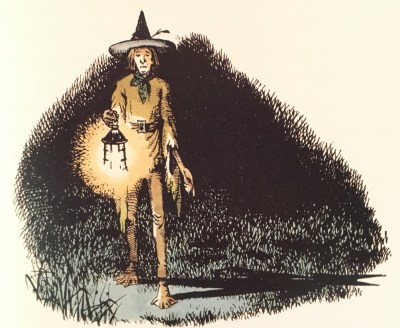
“Come, all of you. Put away these childish tricks. I have work for you all in the real world. There is no Narnia, no Overworld, no sky, no sun, no Aslan. And now, to bed all. And let us begin a wiser life tomorrow. But, first, to bed; to sleep; deep sleep, soft pillows, sleep without foolish dreams.”
The Prince and the two children were standing with their heads hung down, their cheeks flushed, their eyes half closed; the strength all gone from them; the enchantment almost complete. But Puddleglum, desperately gathering all his strength, walked over to the fire. Then he did a very brave thing. He knew it wouldn’t hurt him quite as much as it would hurt a human; for his feet (which were bare) were webbed and hard and cold-blooded like a duck’s. But he knew it would hurt him badly enough; and so it did. With his bare foot he stamped on the fire, grinding a large part of it into ashes on the flat hearth. And three things happened at once.
First, the sweet, heavy smell grew very much less. For though the whole fire had not been put out, a good bit of it had, and what remained smelled very largely of burnt Marsh-wiggle, which is not at all an enchanting smell. This instantly made everyone’s brain far clearer. The Prince and the children held up their heads again and opened their eyes.
Secondly, the Witch, in a loud, terrible voice, utterly different from all the sweet tones she had been using up till now, called out, “What are you doing? Dare to touch my fire again, mud-filth, and I’ll turn the blood to fire inside your veins.”
Thirdly, the pain itself made Puddleglum’s head for a moment perfectly clear and he knew exactly what he really thought. There is nothing like a good shock of pain for dissolving certain kinds of magic.
“One word, Ma’am,” he said, coming back from the fire; limping, because of the pain. “One word. All you’ve been saying is quite right, I shouldn’t wonder. I’m a chap who always liked to know the worst and then put the best face I can on it. So I won’t deny any of what you said. But there’s one thing more to be said, even so. Suppose we have only dreamed, or made up, all those things—trees and grass and sun and moon and stars and Aslan himself. Suppose we have. Then all I can say is that, in that case, the made-up things seem a good deal more important than the real ones. Suppose this black pit of a kingdom of yours is the only world. Well, it strikes me as a pretty poor one. And that’s a funny thing, when you come to think of it. We’re just babies making up a game, if you’re right. But four babies playing a game can make a play-world which licks your real world hollow. That’s why I’m going to stand by the play-world. I’m on Aslan’s side even if there isn’t any Aslan to lead it. I’m going to live as like a Narnian as I can even if there isn’t any Narnia. So, thanking you kindly for your supper, if these two gentlemen and the young lady are ready, we’re leaving your court at once and setting out in the dark to spend our lives looking for Overland. Not that our lives will be very long, I should think; but that’s small loss if the world’s as dull a place as you say.”
C. S. Lewis, The Silver Chair, 189-191
Difficult
Interviewer: Then is writing easy for you? Or do you find it difficult?
Chinua Achebe: The honest answer is, it’s difficult. But the word difficult doesn’t really express what I mean. It is like wrestling; you are wrestling with ideas and with the story. There is a lot of energy required. At the same time, it is exciting. So it is both difficult and easy. What you must accept is that your life is not going to be the same while you are writing. I have said in the kind of exaggerated manner of writers and prophets that writing, for me, is like receiving a term of imprisonment—you know that’s what you’re in for, for whatever time it takes. So it is both pleasurable and difficult.
The Paris Review, Chinua Achebe, The Art of Fiction No. 139
Metábasis eis állo génos
Desiring God is faring better than TGC at being sons of Issachar. As an essayist at least, Greg Morse is a more admirable man than Shai Linne. Greg’s insight is applicable in so many other contexts too; do not assume why someone is not . . . or is . . . wearing a mask. Speaking of masks, some helpful thoughts from Toby Sumpter on being cheerfully difficult, and likewise from Doug Wilson. Meanwhile, Alex Berenson continues to go to bat for Team Reality.
This week was the first time that AAA did not bother to ask us if we were in a safe place (after a long hold, I must add). Instead they asked us if they were in a safe place if we or anyone we knew had symptoms.
Food for thought:
Doesn’t Vincent Cassel remind you of Joel Osteen? And Philip Sasser?
Mark Horne is thinking about hereditary guilt and the character of God:
I quoted this passage in full because there’s no way to summarize its passion. It is one of the most moving declarations in all Scripture.
To just mention one point in case it is relevant: notice how keenly God’s mind is set on not finding a reason to punish people. The idea that he would remember a person’s ancestors so that he could punish a descendant who had not continued in the sinful behavior is abhorrent to him.
Go and do likewise. You should abhor such slanders against God’s character as well.
I spoke recently of our time in Egypt. We should think of the history of Israel as our history. This is true because we have been grafted into a tree while other branches have been broken off (Romans 11). Abraham is now our father (Romans 4:11–12). The church is the actual continuation of this history; what remains in modern Judaism is just that: a modern–gnostic corruption of the true faith.
Alan Jacobs reflects on the humanities:
Here’s how we’ll know that things have gotten really bad in our society: People will start turning to Homer and Dante and Bach and Mozart. Czeslaw Milosz—like Kołakowski, a Pole, perhaps not a trivial correspondence—wrote that “when an entire community is struck by misfortune, for instance, the Nazi occupation of Poland, the ‘schism between the poet and the great human family’ disappears and poetry becomes as essential as bread.”
I’m still reflecting on what a treasure of spiritual formation the Psalms are to us. The Psalms present us with a grand category including the wicked, sinner, scoffer, enemy, evildoer, boastful, liar, rebel, fool. This category stands over against the righteous, godly, innocent. These categories are overwhelmingly used by David and his great host, yet they are virtually absent from our speech and prayer and song. Why?
I’ve also been reflecting on the role of the prophet in ushering in a transformation, a new creation. Rich Bledsoe has some helpful thoughts on this. As James Jordan says, the prophet’s main role is not merely to speak God’s words to the people; that is an essentially priestly role (c.f., Ezra–Nehemiah). Rather, the prophet’s role is to stand in the heavenly council and speak, pray, or even wrestle with God as in the case of Abraham, Moses, and Habakkuk. Out of this, the prophet sees and speaks into existence a new creation. The future that prophets speak into existence is an inevitable one; the repentance and faithfulness that prophets often call us to is not the way to avoid a future (in some cases it is delayed), but the way to pass into it as through death and resurrection.
The connection to Kuhn is insightful. Is the prophet ever anything other than a Cassandra? Maybe, but only if it is the king himself who heeds the prophet, often after a bad dream, eating grass, or reading an old book (but: Nineveh’s king simply heeds the prophet!).
More often, the gestalt shift requires the passing of a generation. Thus: spiritual formation! Three cheers for thoroughgoing covenant renewal worship, weekly and robust communion, Psalm singing, and baptized babies!
Turmoil
We have to remind our readers once again that this chapter does not attempt by any means to list all the waves which fertilized Gulag—but only those which had a political coloration. And just as, in a course in physiology, after a detailed description of the circulation of the blood, one can begin over again and describe in detail the lymphatic system, one could begin again and describe the waves of nonpolitical offenders and habitual criminals from 1918 to 1953. And this description, too, would run long. It would bring to light many famous decrees, now in part forgotten (even though they have never been repealed), which supplied abundant human material for the insatiable Archipelago. One was the Decree on Absenteeism. One was the Decree on Production of Bad Quality Goods. Another was on samogon [moonshine] distilling. Its peak period was 1922—but arrests for this were constant throughout the twenties. And the Decree on the Punishment of Collective Farmers for Failure to Fulfill the Obligatory Norm of Labor Days. And the Decree on the Introduction of Military Discipline on Railroads, issued in April, 1943—not at the beginning of the war, but when it had already taken a turn for the better.
In accordance with the ancient Petrine tradition, these decrees always put in an appearance as the most important element in all our legislation, but without any comprehension of or reference to the whole of our previous legislation. Learned jurists were supposed to coordinate the branches of the law, but they were not particularly energetic at it, nor particularly successful either.
This steady pulse of decrees led to a curious national pattern of violations and crimes. One could easily recognize that neither burglary, nor murder, nor samogon distilling, nor rape ever seemed to occur at random intervals or in random places throughout the country as a result of human weakness, lust, or failure to control one’s passions. By no means! One detected, instead, a surprising unanimity and monotony in the crimes committed. The entire Soviet Union would be in a turmoil of rape alone, or murder alone, or samogon distilling alone, each in its turn—in sensitive reaction to the latest government decree. Each particular crime or violation seemed somehow to be playing into the hands of the latest decree so that it would disappear from the scene that much faster! At that precise moment, the particular crime which had just been foreseen, and for which wise new legislation had just provided stricter punishment, would explode simultaneously everywhere.
Aleksandr Solzhenitsyn, The Gulag Archipelago Volume 1, 86–87
A confusion of terms
Socialism, like the ancient ideas from which it springs, confuses the distinction between government and society. As a result of this, every time we object to a thing being done by government, the socialists conclude that we object to its being done at all.
We disapprove of state education. Then the socialists say that we are opposed to any education. We object to a state religion. Then the socialists say that we want no religion at all. We object to a state-enforced equality. Then they say that we are against equality. And so on, and so on. It is as if the socialists were to accuse us of not wanting persons to eat because we do not want the state to raise grain.
Frederic Bastiat, The Law
 I gotta have my orange juice.
Metábasis eis állo génos (8)
leave a comment »
A week at the beach with cousins:
This afforded some time for Solzhenitsyn:
I haven’t found a video with all three verses, but isn’t this deeply wonderful:
Thanks to Uri Brito for the find. I must say, this is far better than Toto’s version, which unfortunately is making the rounds of my household.
Isn’t it interesting that we love the beginning of Psalm 139 but not so much the end?
Something is out of balance if we struggle to find appropriate objects for this prayer, or, worse, struggle to see it as appropriate at all. Somewhat related, I was reflecting on Ruth this week:
Isn’t it remarkable that conversion and loyalty to God is inseparable from conversion and loyalty to God’s people? Ruth and Naomi remind me as well of of Jacob’s blessing Pharaoh in spite of the few and evil days of his life. Isn’t it equally remarkable that these testimonies of God’s faithfulness and purpose in suffering would result in robust conversion?
Sadly, in days when suffering and sacrifice are rare, a husband is not always a protection against this:
Fascinating: the lost colony was never lost, just not found.
Way too many good tweets this week to do a practical roundup. You should follow: Hans Fiene, Michael Foster, Andrew Isker, Alex Berenson.
If a church sees new visitors during this season of rona, is it really wise to encourage them to return to their original home when it is all over? Why would you encourage someone to return to shepherds who practically abandoned them? Related, I wonder if the church is experiencing a rise in separations and divorces in this year of spiritual distancing. Body must body!
Also related, it seems to me that we have developed today a functional theology of the “real absence” of Jesus at his covenant meal. The Lord’s supper is no longer seen as an entry into the heavenly marriage supper, nor even a joyful and eucharistic foretaste of it. This explains why the supper is often so bland and solemn and infrequent. But it also explains how we have arrived at the conclusion that our own absence at that meal is a matter of little consequence.
Considering also how we arrive at the supper, I’m intrigued by the fact that the Lord’s prayer does not open with an early confession of sin. In fact, its appeal for forgiveness does not even really constitute a confession. Although repentance is a way of life for the Christian, and is liturgically appropriate, repentance is not the fundamental flavor of that festive life.
Speaking of the marriage supper, last week I mentioned Galileo. Considering the book of Revelation, and both our present worship and eternity, it is clear that in the most important sense of the word, the earth is the center of the universe.
Written by Scott Moonen
August 21, 2020 at 9:09 pm
Posted in Commentary, Miscellany, Quotations, Suffering, Union with Christ, Worship