Archive for the ‘Personal’ Category
Years in books
I usually feel like I have little time to read, but my Goodreads “year in books” report at the end of every year consistently surprises me. In recent years I have increased my audio book consumption. This has redoubled in the last couple of years as I traded more podcast time for book time during my commute to work, and also as our family read-aloud time shifted toward audio book consumption.
I joined Goodreads in mid-2009. Here is my year in books summary since then:
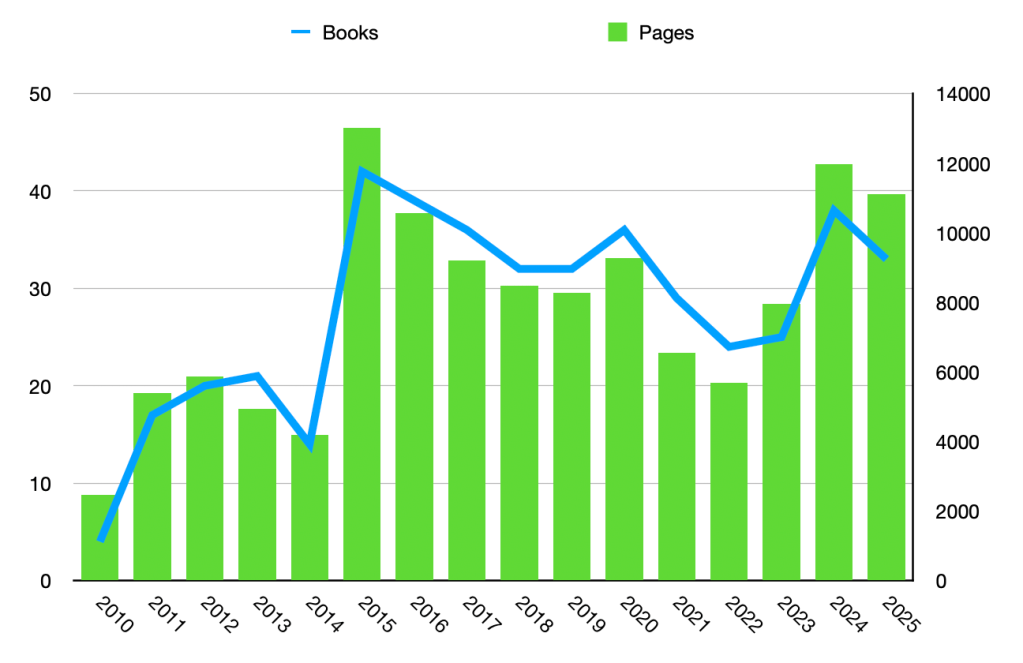
Of the 33 books I read in 2025, 28 were audiobooks. Four of the books were re-reads (all of these were audiobooks). Six of my books were listen-alouds with the kids.
Edward
Sources:
- Waalwijk Wiki, Eduardus Constantinus Josephus Moonen, via the Internet Archive
- Waalwijk Wiki, Oorlogsmonument, via the Internet Archive
- Google Translate
Eduardus Constantinus Josephus Moonen
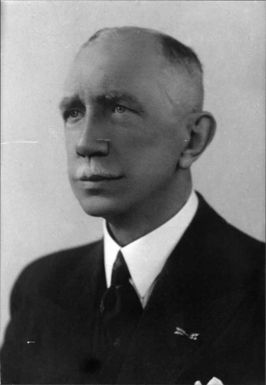
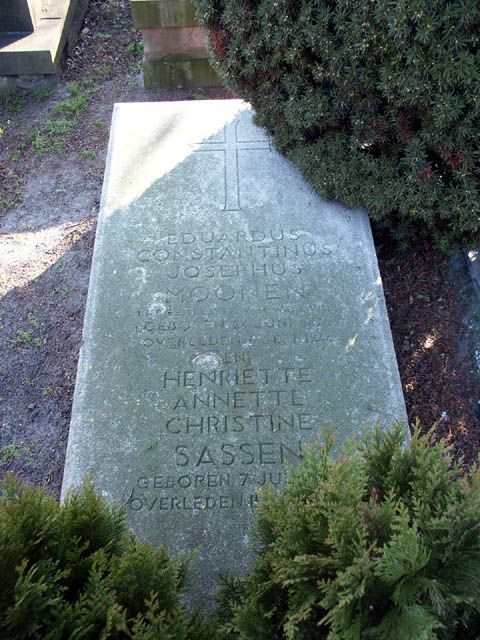
Eduardus Constantinus Josephus Moonen (Strijp, 24 June 1876 – Waalwijk, 6 September 1944) was married to Henriëtte Antonette Christine Sassen. He was mayor of Waalwijk from 1 March 1924 (Royal Decree 12 February 1924, no. 12) to 1 February 1944 and then acting mayor from 19 May 1944 to 6 September 1944. From 1924 to 1933 he was also deputy district judge.
Mayor
Moonen started his career in 1901 as a second lieutenant of the infantry and ended his military career as captain-adjutant in Breda. From this rank he was appointed mayor of Waalwijk quite unexpectedly. He was 48 years old at the time.
At the inauguration Moonen spoke the following words, in which he made his policy known: ‘It is entirely in line with my aim to be a good mayor for everyone, without exception for the entire population of Waalwijk’ and ‘from that source I will draw the strength to remain true to the motto that I want to make mine, even under difficult circumstances: everything for everyone.’
He became the binding force that tried to give shape to the trinity of the places that were merged in 1922. An expression of this was the way in which his twelve and a half years as mayor were celebrated. The entire population of Waalwijk, associations and institutions from Baardwijk, Waalwijk and Besoijen were present to honor their mayor.
Moonen’s term of office was characterised by more lows than highs. High unemployment, especially in the shoe and leather industry, caused the municipality concern. Support schemes were introduced. The shoe law brought some relief. The housing shortage increased and there were many slum dwellings. A development plan was drawn up for the area between Grotestraat and the railway line. The St. Crispijnstraat and surroundings were constructed, as well as the Besoijensche Steeg. The backlog of public facilities in Baardwijk was tackled. A public slaughterhouse was established. The harbor plans were continued and through Moonen’s persuasiveness the construction of the new town hall was assigned to Kropholler and carried out.
That he wanted to live up to his inauguration speech became apparent at the farewell of an alderman in 1926, when he pointed out the attitude that council members should have, namely to subordinate their own interests to the municipal interest. Genuine civic spirit, he stated, is the only basis on which an impartial treatment of public affairs can and may be based. Apparently other views existed during his term of office. For him, ‘omnibus idem’ (the same for everyone) applied.
As of 15 April 1924, Moonen was appointed deputy district judge. As a result of the abolition of the Waalwijk district court, he was honourably discharged from this office as of 1 January 1934.
He was faced with major decisions of conscience, he could no longer rely on the council, during the war years in the implementation of the measures imposed by the occupier. When Moonen retired in February 1944, he was called upon to take up the office again a few months later, as his deputies (the aldermen) were not available due to illness and busy work, and an NSB member apparently no longer wanted to come to the fore at that time.
On 6 September he died before the firing squad of Dutch SS members. His honorable discharge granted to him by the occupier in February 1944 was converted into an honorable discharge from K.B.
War victim
Mayor Moonen got up early on Wednesday, September 6, 1944. Like most people, he wondered where the liberators were; the reports about their advance were rather contradictory. He walked up and down in front of the town hall and accosted two resistance fighters who unfortunately knew just as little as he did. Around nine o’clock, Moonen entered the town hall, followed shortly afterwards by two women who wanted to talk to him. The tragedy had begun.
The previous day, a number of NSB members and Landwachters had been arrested. One woman was married, the other engaged to a Landwachter. They were naturally very worried about the two men. After all, they had also heard the stories about what would happen to the ‘traitors’ and they feared the worst. They turned to Mayor Moonen, but he could not help them any further (the two had been locked up in Sprang together with ten others). Disappointed, the women walked outside again. It was now half past nine.
Camouflaged vehicles drove into Waalwijk. It was the vanguard of the Landstorm Nederland. This battalion of Dutch SS men, the cadre of which was largely German, was on its way to the front near Antwerp. The SS men were in a grim mood. Furious about the flags they had seen on the way, they had shot at a crowd in Vlijmen and in doing so had killed three people, including a boy of barely seven.
In Waalwijk too, flags were hanging everywhere and the SS men stopped at the town hall to have them removed. That’s when the two women stepped outside. They accosted the first Dutch officer they saw and told their story. The SS man promised to help them. He stormed into the mayor’s office with his pistol drawn and demanded that the flags be taken inside and the two men returned to their wives. Moonen could do something about the first, but not about the second. The Dutch officer waited a while until most of the flags had been taken inside and then wanted to drive away again, because he also saw that the mayor had nothing to do with the kidnapping. At that moment his superior, Hauptsturmführer Maasz, arrived. The women also complained to him.
Maasz had a completely different character than his colleague. He was a typical arrogant Nazi for whom a human life was worth little. A few days earlier, he had had a soldier shot dead because he had stolen some petrol. He promised the women that he would wash the pig (i.e., do the job quickly). He approached Moonen, who had come outside and demanded the return of the land guards. He waved away protests: Moonen was mayor after all, he should know where the two were. He gave Moonen half an hour to find the men. The mayor went inside and called the leader of the Waalwijk OD for advice. But he did not know where the land guards were either.
Maasz’s patience was running out. He asked the women if they knew anything more about the kidnapping. ‘Yes,’ said one of them, ‘there was also a boy from Hoffmans there.’ The SS men then went to the house of the Hoffmans family, which had been pointed out by the women. There they dragged the 25-year-old Vincent and his 18-year-old brother Joop out of the house. Unfortunately, the women had been wrong. A cousin of the two brothers was involved in the kidnapping, but the brothers were completely innocent and did not know where the land guards were. Maasz did not care. He put the boys and the mayor under the lantern in the middle of the Raadhuisplein. It was now half past eleven. Maasz gave an ultimatum: he would wait until one o’clock, then the missing land guards had to be back. If not, the three would be shot dead.
Half an hour later, the SS men started to make preparations for the execution, presumably to scare the three men. Vincent now really got anxious and told the SS men that he had heard that the kidnapped men were somewhere in the municipality of Sprang-Capelle; he did not know where. Maasz sent a car, with Vincent as a guide, to Sprang. After half an hour, the car returned to Waalwijk empty-handed. Then a fourth person had to stand under the lantern, doctor Piet Lenglet. Lenglet had heard from an agent that the land guards might be released and he passed the message on to Maasz. When nothing happened, Maasz wanted to know from whom he had heard it. Lenglet did not want to betray his source and as punishment he was put with the others. It was about a quarter to one.
The clock ticked on relentlessly. The autumn sun beat down mercilessly on the heads of the four waiting men: doctor Lenglet, his face contorted with fear; Vincent Hoffmans, seemingly unmoved; his brother Joop with his hands hanging listlessly at his sides and mayor Moonen, the former officer, standing upright and with his head held high. The ultimatum had expired, but apparently Maasz was not happy either, because the time passed without anything happening. Mayor Moonen again pleaded for the three others. He pointed out that doctor Lenglet, as leader of a Red Cross team, was protected by international law. Maasz finally gave in and let Lenglet go. It was a quarter past one.
Maasz’s patience was now really at an end. Once again, after much insistence from Moonen, a priest was allowed to join them. Dean Heezemans tried to encourage the three condemned to death. Joop, the youngest, in particular, had a hard time. He tried to hold on to the priest. Then the dreaded order sounded: ‘Go ahead, it’s time.’
Because Mayor Moonen’s wife could follow everything from the window of the house on Raadhuisplein, Moonen asked as a last favor to have the execution take place behind the town hall. Maasz agreed. Together with two Dutch SS men, he accompanied the three men to the place of execution. The three Waalwijkers had to stand next to each other, facing the wall of the town hall. The two SS men picked up their weapons. Then Maasz shouted: ‘Feuer’ and the machine pistols crackled. It was exactly seven minutes past half past one.
The two non-commissioned officers turned out to be poor marksmen and only after a coup de grace were the mayor and Joop dead. Vincent miraculously survived the execution and the coup de grace. While dean Heezemans, who had seen that the coup de grace missed its target, distracted the SS men, he managed to scramble to his feet and run away. He was picked up and taken to ‘s-Hertogenbosch where an operation ultimately saved his life.
Oorlogsmonument (war monument)
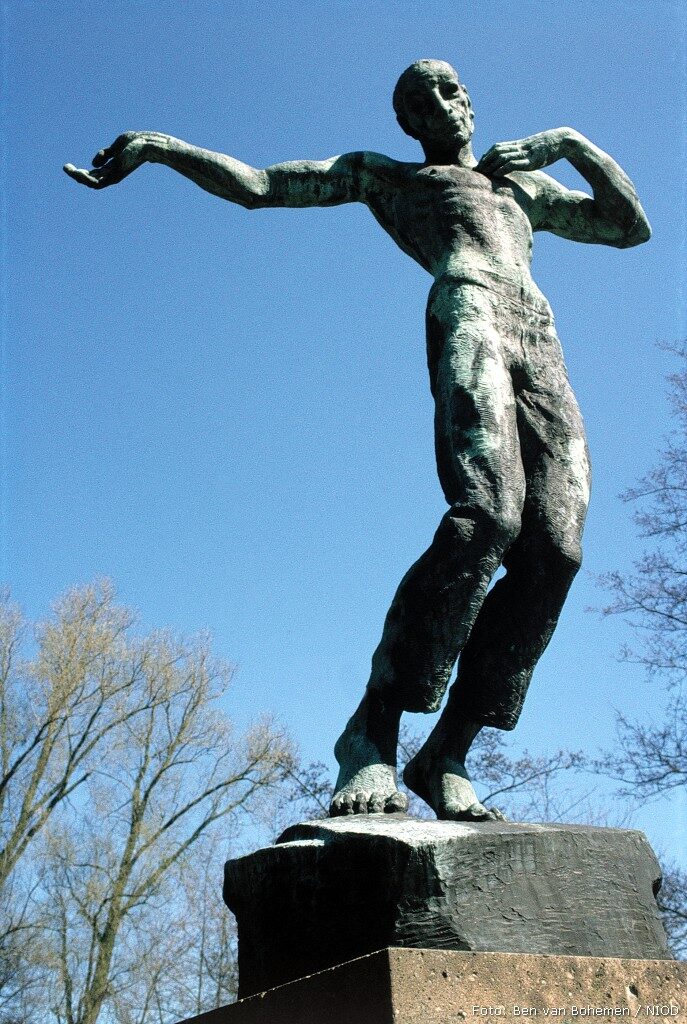
The War Memorial on Burg. Moonenlaan is a monument in memory of all Waalwijkers who died during the occupation and in particular of mayor Moonen, who was shot by the occupiers during the war. On October 30, 1949, the monument was unveiled by Mrs. H.A.C. Moonen-Sassen (1876-1957).
The commemoration takes place at the monument every year on 4 May.
Design
The monument, made by the Binder company from Haarlem, was designed by J.A. Raedecker. It is a statue of a male figure, collapsing after a firing squad. G.H. Holt designed the substructure and entourage.
Execution
The pedestal bears the dates ‘1940-1945’, the names of the Waalwijk war victims are engraved in the hard stone slabs that are placed around this pedestal, as well as a poem by Mrs. H. de Kat-van Zijl:
THEY FELL TO EARTH BEFORE THE GLOWING OF THE GOLDEN SUN,
FREEDOM DROVE AWAY THE LONG NIGHT OF WAR, FOR US, SPARED.
A MORE BEAUTIFUL MORNING SURROUNDED THEM, FALLEN TO HEAVENLY GARDEN,
WITH THE LIFE GIVEN TO THE BROTHERS, WOVEN FROM ETERNAL JOY.
The statue of cast bronze is 2.75 meters high. It stands on a 2-metre-high limestone column, which measures 1 x 1 meter at the top. The 4 x 4 meter pedestal is made of limestone with plates of bluestone. Bluestone boulders have been placed around the monument in a circle with a diameter of 16 m.
Special features
In 1965, art critic Pierre Janssen described the deeper meaning of this monument in the book ‘Two minutes is it quiet,’ referring to the gruesome and senseless execution by the Germans of mayor Moonen and Joop Hoffmans on 6 September 1944, with the following words:
Then they were captured and one day their lives suddenly ended. The man is just barely standing. But he will fall in a moment. Just look at his feet and his knees. Look, he is very lonely. He’s not angry. He does not resist anymore. He stretches out his arms and gives away his life. Just look at his face. It is a calm face. He sacrifices himself. This statue is there to help us remember that freedom is precious. A lot has been paid for it. Not with money, but with human lives.
Immediately after the liberation, De Echo van het Zuiden started collecting funds for the erection of a monument. Later, at the suggestion of the Waalwijks Belang association, it was decided that it should be a statue that would keep alive the memory of all Waalwijkers who died during the occupation.
The Waalwijk war monument was depicted on a postage stamp in 1965.
Raedecker is also the designer of the statues that are part of the National Monument on Dam Square in Amsterdam.
A blessing in disguise
- Vehicle engine is throbbing badly, bring to shop
- Sorry, sir, you need a replacement engine, something broke badly inside; this is understandable at 290k miles. Authorize repair.
- Repair completed. I’m very sorry, sir, we made a bad mistake, it was not the engine but the catalytic converter.
- Free engine! Catalytic converter back ordered indefinitely but go ahead and pay for it.
- Inspection and registration due; failed inspection. (I live in one of the 22% of counties in my state that require an emissions test.)
- DMV website allows for cases of (1) part not available and (2) repair attempted, but I do not quite fit either case.
- Show up at license office, sorry sir, we can’t help you until your registration is overdue (?!)
- Return to license office, sorry sir, I don’t know why they told you that, but you need to talk to the license and theft bureau
- Sorry sir, you need a second failed inspection to get the attempted repair waiver, even though we all know nothing has changed with your vehicle since your last inspection
- Second failed inspection
- Meet officer and receive waiver code
- Bring waiver code to inspection station; code does not work
- Delays waiting for DMV to return calls to inspection station
- License and theft officer works with inspection station and advises them I should take vehicle to license office
- License and theft officer advises me that I should work with inspection station
- License and theft officer advises inspection station that I should take vehicle to license office
- License office — sorry, sir, we can’t help you with a waiver code, you need to work with inspection station
- License office confirms with license and theft officer this is the case
- License and theft officer advises me to work with inspection station . . . oh, wait, that inspection station? You are good to go, I overrode your inspection manually.
- Pay registration at license office
Metábasis eis állo génos (3-13)
Leading up to 2020, Asher was seeking something to own and do beyond keeping chickens, which he shared with Charlotte but was largely her domain. I rejected backyard goat–keeping, but bees were an intriguing option as our town allows you to keep bees provided you have taken a class. So we took a class (online, sadly) from our county beekeeping association over the winter of 2020-2021. We spent about 8 hours in class, and later in the spring several hours at a practical exam and a paper exam. Of all our time in class, the practical exam was the most beneficial. Several of the seasoned beekeepers conveyed to us a vision of what I call “low-anxiety” beekeeping. Excessive anxiety over questions such as whether and when you need to feed your bees, or whether and how you can head them off from swarming, is generally counter–productive and can steal a lot of the joy of beekeeping.
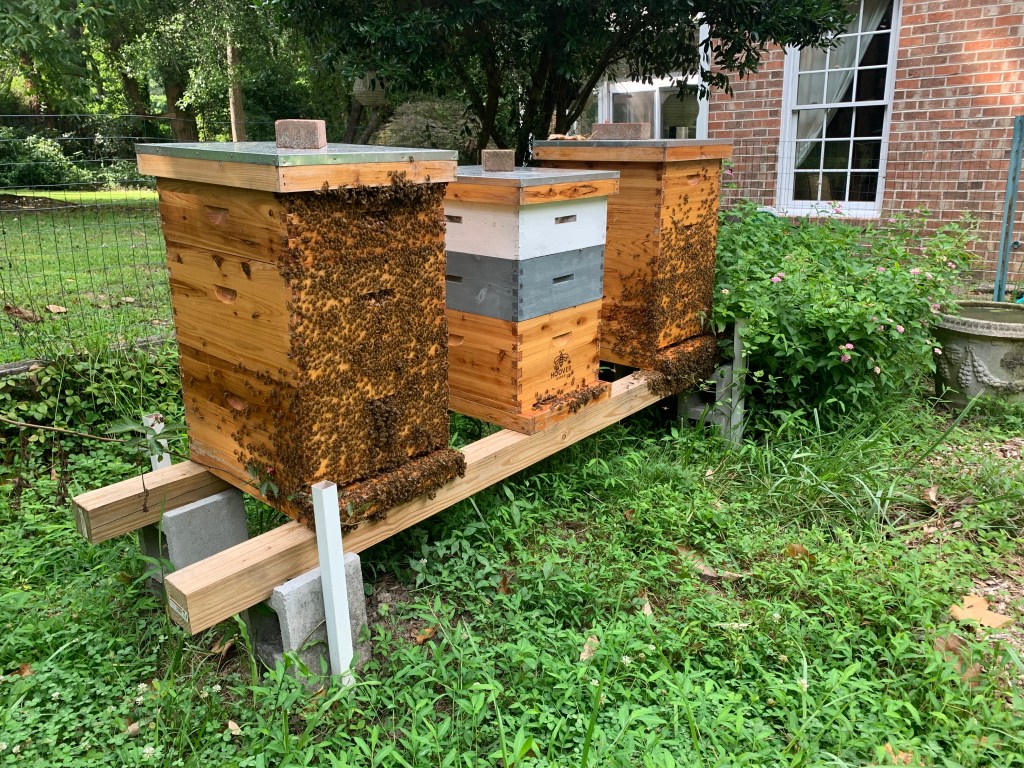
Late in winter we ordered all of our equipment. We spent a little more money on the nice–looking Hoover hives, got our initial frames, nails, foundation wax, and other equipment (feeders, hats, gloves, smoker, hive tool, wire embedder) from the local Bailey Bee Supply, and ultimately found cheaper frames (deep, medium) and foundation (medium) from Western Bee Supplies. By the end of the year we had the materials to equip three hives each with two deep bodies and two medium supers, and had spent about $1700 on the trio including supplies from Home Depot to make an elevated stand. Assembling frames is a time–consuming but satisfying task.

Placement of the hives was tricky! Our property has a lot of shade, but we found some space in the back of our garden that was relatively sunny, open, and also faced towards the south. This worked fairly well, although it is sometimes a little nerve-wracking to work in the garden. Generally the bees have kept to themselves; only twice have we had innocent bystanders standing near the garden get stung.

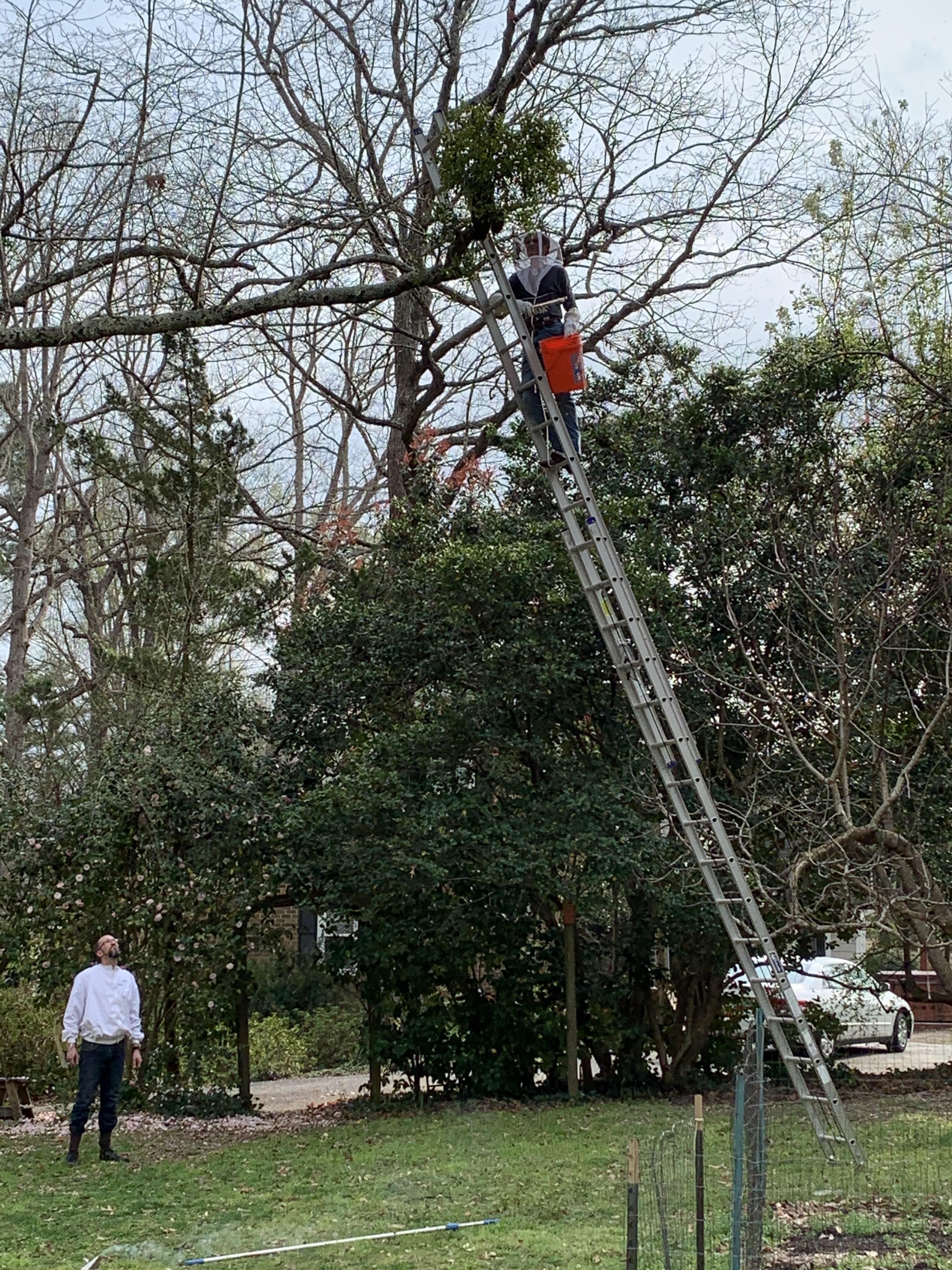
We started out with two nucleuses from our friendly local Garden Supply Company, at the time each costing $195. We had a much more exciting ride with our two hives than I ever expected for first–year beekeeping. Over the course of six months, we had: (1) one hive send off a swarm high in a tree, which Asher captured in the face of a coming rainstorm to form a third hive; (2) evidently we failed to capture the queen, or she later died, so we recombined this hive with the other hive; (3) which later sent off a swarm that we failed to capture; (4) a friend found a feral swarm in an abandoned hive of his, which we brought back to our house; but (5) in the dearth of fall I believe this hive robbed both of our other two hives, resulting in only one hive entering into winter. We purchased another nucleus this spring ($215) and are starting out our second year once again with two hives.
I remember remarking that it would be good for Asher to experience husbandry, to be responsible for something which was under his influence but not completely under his control. It turned out to be a great lesson for me as well!

Another thing that I didn’t expect as a first–year beekeeper was the degree to which we had to wrestle with varroa mites. Twice in our first year we had to treat our hives for varroa mites ($100 for two formic acid treatments and personal protection equipment) when at least one hive had extremely high mite load.
Some of the most interesting bee behaviors we observed were swarming, washboarding, bearding, and orienting flights.
Home schooling
Here is my philosophy of home schooling; if you are home schooling or are considering it, I hope you will find it encouraging.
- I love the Christ Church statement that “Christian children deserve a Christian education. The problem with secular education is not so much that our children receive bad information, but bad formation. We desire education for our children that rejects the formational liturgies of secular schools, which include nationalist liturgies, radical environmentalist liturgies, sexual revolution liturgies, which all warp and twist them into faithful disciples of the state. We pursue for our children an education that will provide for them Christian formation, so that they will be above all disciples of the Lord Jesus.”
- I’ve not read all the way through The Well-Trained Mind, but I have found the prologue to be very helpful and encouraging, something to come back to from time to time. We’ve also heard good things about Anyone Can Homeschool.
- Most of home schooling is parenting. Curriculum is a context for working on obedience, self-governance, the fruit of the Spirit (in you and them!), scrappiness. When all curriculum is forgotten, those things will carry them through their adult life and its variety of vocations. This is a long and graduated process; some kids may need to do their work at the kitchen table for a long time, and everyone needs some amount of checkup and accountability even once they reach the point they are doing most of their own objective grading.
- There are a lot of options and everyone does it a little bit differently. Don’t feel you must do it one particular way. In particular, some folks feel that you must supplement with online options or things outside of the home. Certainly that’s a fine option, but it’s not necessary—even for subjects that you don’t feel up to teaching. Your goal is to reach the point where they are self-motivated and self-coaching learners. Always feel free to experiment but also remember that curriculum choices aren’t likely to solve problems so much as amplify or dampen them.
- Few things are necessary. Don’t be anxious.
- Dad’s vision and desire needs to be the horse that drives the cart of home schooling.
- Co-ops can be very helpful but aren’t necessary. I prefer a co-op that is administered by dads but that is hard to find. I personally think the cost-benefit of a co-op is better for older kids.
- I’m a member of both NCHE and HSLDA and appreciate their work. They have good resources on how to do it in NC.
- We’ve adjusted curriculum over time, mainly (1) to adjust depth and intensity as the kids get older, and (2) to seek for options that are less parent-dependent. We started with Sonlight when everyone was little and use Tapestry of Grace now (formerly with a co-op, now on our own). We like Apologia for science and Teaching Textbooks for math, primarily because they allow for a lot of student independence.
- I require music (start with piano, move to something else if you like) and cross country (a sport that works well for a larger family) regardless of interest levels. Others do it differently! These last few years I’ve appreciated the freedom that home schooling allows for my older kids to pursue jobs. It’s been fun to work with them on time management and prioritization.
Baptism exhortation (2)
Amos,
In the New Testament, Peter and Paul speak of two great old–covenant baptisms: the baptism of the flood, and the baptism of the Red Sea crossing.
In both of these, God rained water on his people, and drowned his enemies. Psalm 77 tells of God’s rain at the Red Sea crossing, and Psalm 68—the great battle Psalm of the Huguenots—tells of rain in the wilderness:
O God, when You went forth before Your people,
When You marched through the wilderness:
The world shook;
Indeed, the heavens dripped at the presence of God, the One of Sinai,
At the presence of God, the God of Israel.
A rain of gifts You showered, O God;
Your inheritance, though it languished, You Yourself established.
Your beasts dwelled in it;
You prepared it in Your goodness for the lowly, O God. (Psalm 68:7–10, James Jordan)
So you see that the waters of baptism are a rescue from judgment and death, and they are a source of life and refreshment. But they are also a commissioning, into a priesthood and into an army! As soon as Israel had crossed the Red Sea in battle array, they fought the Amalekites. Likewise, Psalm 68 continues:
My Master gives the word;
The messengers are a great army.
Kings of armies flee; they flee;
And those remaining at home divide the spoil,
Those remaining with the sheepfolds:
A dove’s wings covered with silver,
And her pinions with green–gold.
When the Almighty scattered kings there,
You made it snow on Black Mountain.
O mountain of gods, mountain of Bashan,
O mountain of ridges, mountain of Bashan,
Why your hostility, you mountains of ridges,
Toward the mountain God delighted for His dwelling?
Yes, Yahweh will dwell there endlessly.
The chariots of God are twice myriads,
Thousands upon thousands,
My Master among them,
At Sinai, in the holy place!
You ascended on high;
You captured a captivity;
You took men as gifts—
And even rebels—
In order that Yah, God might dwell. (Psalm 68:11–18, James Jordan)
The same thing happened when Israel crossed the Jordan into the promised land. God brought them safely through waters, circumcised them, and formed them into his own army to conduct a holy war.
Amos, God still has an army that wages holy warfare with the sword of the Spirit: the word of God. God has commissioned you into his service today. You are and will always be a soldier of Jesus. You belong completely to him, and it is good to belong to him. I charge you to serve him faithfully and fearlessly!
See also: Baptism exhortation
Pebbles
Voting in a large-scale first-past-the-post election is not a statistically meaningful action. I didn’t vote in the United States’ 2016 election. I do plan to vote in our 2020 election, but I do so with a sense of proportion that I am not achieving something tangible or practical with my vote.
Far more important is prayer and corporate worship. We have a weekly audience with the king of the universe, a king who works all things according to the counsel of his will!
There is somewhat more significance to boosting than voting, since your words may influence many votes. I plan to vote for Trump in 2020 and I hope that you will as well. If you think this is a strange position for a Christian, Doug Wilson had some helpful thoughts that I encourage you to consider. Voting is, as Gary DeMar says, not a valentine.
Yet it is troubling that Christians are expressing support for Biden and Harris.
This is of course more obvious among liberal Christians, but folks like Greear, Keller, and Tripp are ongoing enablers as well with their smooth words. I was going to quip that it is not enough to be non-gnostic in America today. . . But, sadly, it turns out that these folks are gnostic.
As for Biden and Harris, they are not merely, er, non-life; they are actively anti-life.
Keep in mind, of course, that both the vote you approve and the vote you disapprove are insignificant. We do not put our trust in princes (they also are insignificant), and there is absolutely no need to be anxious about the future. We are full of joy! But it still matters before God what we advocate and embrace, and, since God’s world is not gnostic, it also matters very much how we live that out.
I really appreciated how Mark Horne framed voting recently. This seems to me a very helpful way to encourage folks to vote, yet without pretending that it has more tangible and practical value than it does:
My current voting philosophy:
1. Mathematically: voting is stupid. Remember all the science fiction stories about time traveling and the dire consequences that occurred when the past was changed? If you changed every ballot I ever filled out throughout my life to the opposite, nothing would be different. Voting, for an individual, is inconsequential to political outcomes.
2. God answers prayers, sometimes affirmatively. Lines of causation can be obscure just like any case of one friend asking another for a favor. But praying to God for a better future is not stupid, but wise.
3. But all prayer is not equally wise. Praying for a job promotion is usually superior to praying to get a million dollars in the next month. This is because, while prayer does involve wishing for a better future, it also involves interacting with God and how you see him working in the world.
4. So while I pray for a better political society in general, my more specific prayers are usually informed by foreseeable possible outcomes. Just like I pray for my current car to not break down rather than for a new car to appear in my driveway tonight, so I pray for a better candidate to win rather than a perfect candidate who I know is not going to win.
5. And if I’m really praying for a candidate in my district to win, why not express that by voting for him or her? It seems inconsistent to tell God I want someone to win an election and then not bother to express that preference in that election. (It certainly seems crazy to pray for a candidate to win but refuse to vote for him merely because he’s evil and stupid. If you’re worried that God might impose a worse ruler on you, and yet think you’re too “good” to vote for a better—if only less destructive—candidate, how are you not claiming to be holier than God?)
So voting, in my mind, can and should be a kind of prayer that complements the more regular verbal prayers.
Pentecost witness
And they devoted themselves to the apostles’ teaching and the fellowship, to the breaking of bread and the prayers. And awe came upon every soul, and many wonders and signs were being done through the apostles. And all who believed were together and had all things in common. And they were selling their possessions and belongings and distributing the proceeds to all, as any had need. And day by day, attending the temple together and breaking bread in their homes, they received their food with glad and generous hearts, praising God and having favor with all the people. And the Lord added to their number day by day those who were being saved. (Acts 2:42–47)
Garden
Go thee now and subscribe to Alan Jacobs’ newsletter, Snakes & Ladders. From today’s issue, “The Garlands of Repose,” these three beauties:
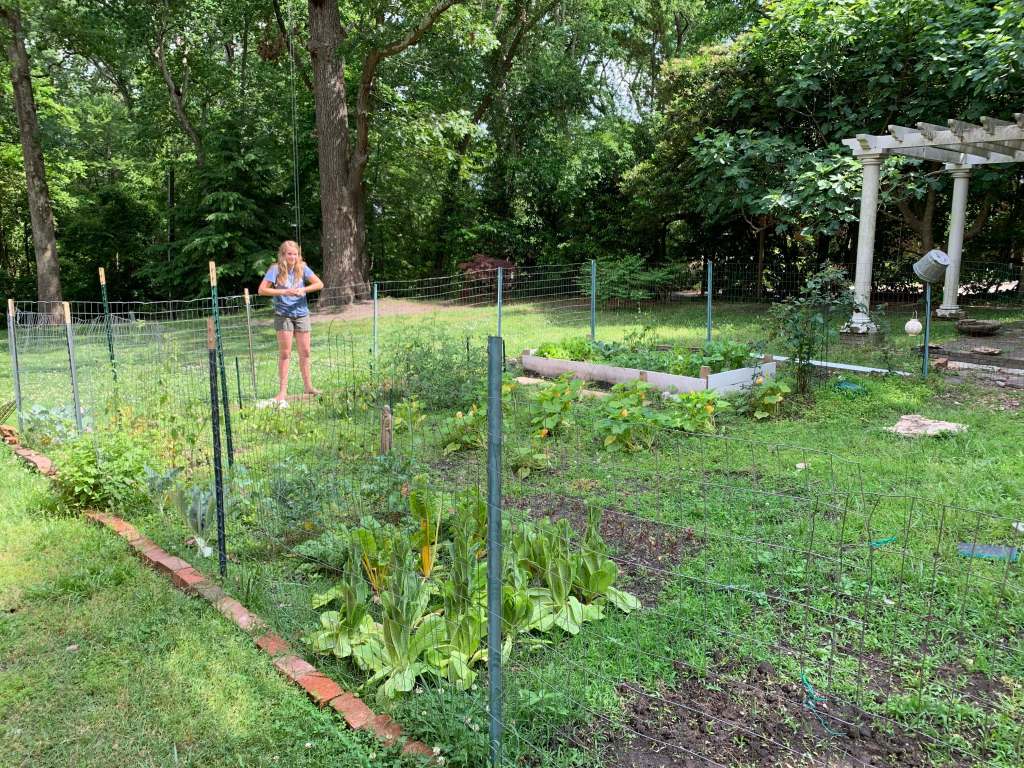
I’m proud of my young gardener and the firstfruits of her labors:

 I gotta have my orange juice.