Archive for the ‘Biblical Theology’ Category
Play acting
On the third day there was a wedding in Cana of Galilee, and the mother of Jesus was there. Now both Jesus and his disciples were invited to the wedding. And when they ran out of wine, the mother of Jesus said to him, “They have no wine.”
Jesus said to her, “Woman, what does your concern have to do with me? My hour has not yet come.”
His mother said to the servants, “Whatever he says to you, do.”
Now there were set there six waterpots of stone, according to the manner of purification of the Jews, containing twenty or thirty gallons apiece. Jesus said to them, “Fill the waterpots with water.” And they filled them up to the brim. And he said to them, “Draw out now, and take to the master of the feast.” And they took. When the master of the feast had tasted the water that was made wine, and did not know where it came from (but the servants who had drawn the water knew), the master of the feast called the bridegroom. And he said to him, “Every man at the beginning sets out the good wine, and when the [guests] have well drunk, then the inferior. You have kept the good wine until now!” This beginning of signs Jesus did in Cana of Galilee, and manifested his glory; and his disciples believed in him. (John 2)
One thing worth highlighting here is that the arrival of Jesus marks the arrival of good wine. If you are serving grape juice rather than wine in communion, then you are play acting that we are still living under the old covenants.
But a second thing worth noting is that it is purifying water that is turned into wine; the one necessarily gives way to the other. If you are baptizing your children, then well and good. But if you are not serving them the Lord’s supper, then you are play acting that we are still living under the old covenants.
Melchizedek
And he said to them, “How can they say that the Christ is the Son of David? Now David himself said in the Book of Psalms, ‘The Lord said to my Lord, “Sit at my right hand, till I make your enemies your footstool.” ’ Therefore David calls Him ‘Lord’; how is he then his son?” (Luke 20:41-44)
For this Melchizedek, king of Salem, priest of the Most High God, who met Abraham returning from the slaughter of the kings and blessed him, to whom also Abraham gave a tenth part of all, first being translated “king of righteousness,” and then also king of Salem, meaning “king of peace,” without father, without mother, without genealogy, having neither beginning of days nor end of life, but made like the Son of God, remains a priest continually.
Now consider how great this man was, to whom even the patriarch Abraham gave a tenth of the spoils. And indeed those who are of the sons of Levi, who receive the priesthood, have a commandment to receive tithes from the people according to the law, that is, from their brethren, though they have come from the loins of Abraham; but he whose genealogy is not derived from them received tithes from Abraham and blessed him who had the promises. Now beyond all contradiction the lesser is blessed by the better. Here mortal men receive tithes, but there he receives them, of whom it is witnessed that he lives. Even Levi, who receives tithes, paid tithes through Abraham, so to speak, for he was still in the loins of his father when Melchizedek met him. (Hebrews 7:1-10)
Fire
God inaugurates his covenant administrations with exceptional works of the Holy Spirit, normally accompanied by heavenly fire. Examples include:
- Genesis 3:24, the flaming sword of the cherubim
- Genesis 15:17, the smoking oven and burning torch that appear to Abram
- Exodus 3:2, God’s appearance to Moses in the burning bush
- Leviticus 9:24, fire from God lights Moses’ altar
- 2 Chronicles 7:1-3, fire from God lights Solomon’s altar
- 1 Kings 18:38, fire from God lights Elijah’s altar
- Zechariah 3:2, Joshua the high priest is described as a brand plucked from the fire by God
- Acts 2:3, fire appears on the church at Pentecost
Genesis 2 is an interesting case. God breathes into Adam the breath of life, commissions him, and fashions a bride for him. At this point Adam is called by a new name—ish, or man. It is commonly pointed out that this word is a likely pun for esh, or fire.
The pattern we see above validates this connection. God’s inaugurating his covenant with man as steward of creation is a life-giving work of the Holy Spirit, which involves heavenly fire that lights a new fire that man must preserve.
Silence the avenger
Twice in the last few months I have checked myself when quoting Psalm 8:
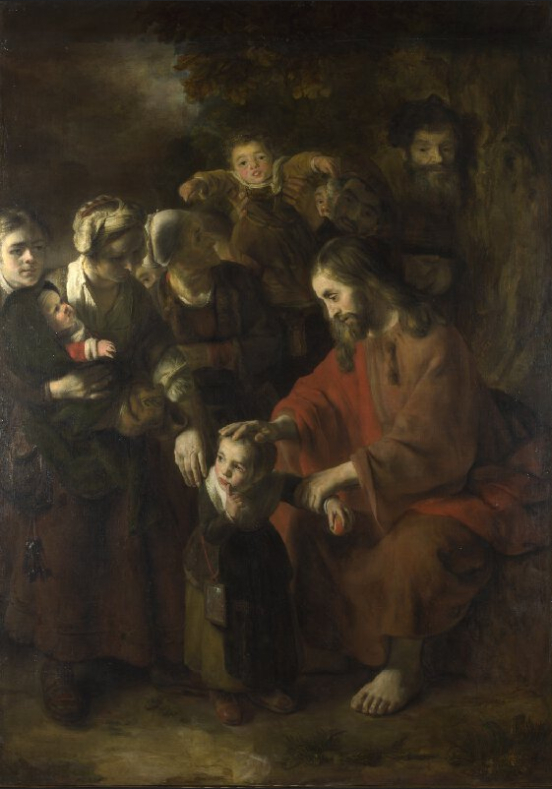
Out of the mouth of babes and nursing infants
You have ordained strength,
Because of your enemies,
That you may silence the enemy and the avenger.
The word “avenger” feels out of place. Why would it be necessary for infants to silence the kinsman redeemer-avenger? As it turns out, the word for avenger here is a more general term, possibly even conveying the idea of self-vengeance.
Jesus quotes Psalm 8 in Matthew 21:
But when the chief priests and scribes saw the wonderful things that he did, and the children crying out in the temple and saying, “Hosanna to the Son of David!” they were indignant and said to him, “Do you hear what these are saying?”
And Jesus said to them, “Yes. Have you never read, ‘Out of the mouth of babes and nursing infants you have perfected praise’? ”
Jesus leaves off the latter part of the verse, but we cannot avoid hearing its echo. Jesus is accusing the chief priests and scribes of having become God’s enemies, of seeking to avenge themselves against him and his people.
Likewise those who bar little ones from Jesus’s table. Many of them do so heedlessly rather than high-handedly. But there is still a rightful sting and shame they ought to feel as these little ones otherwise participate fully in Jesus’s worship.
Do not marvel
There was a man of the Pharisees named Nicodemus, a ruler of the Jews. This man came to Jesus by night and said to Him, “Rabbi, we know that you are a teacher come from God; for no one can do these signs that you do unless God is with him.”
Jesus answered and said to him, “Most assuredly, I say to you, unless one is born again, he cannot see the kingdom of God.”
Nicodemus said to Him, “How can a man be born when he is old? Can he enter a second time into his mother’s womb and be born?”
Jesus answered, “Most assuredly, I say to you, unless one is born of water and the Spirit, he cannot enter the kingdom of God. That which is born of the flesh is flesh, and that which is born of the Spirit is spirit. Do not marvel that I said to you, ‘You must be born again.’ The wind blows where it wishes, and you hear the sound of it, but cannot tell where it comes from and where it goes. So is everyone who is born of the Spirit.”
Nicodemus answered and said to Him, “How can these things be?”
Jesus answered and said to him, “Are you the teacher of Israel, and do not know these things?” (John 3)
Let’s see how Nicodemus ought to have derived this from Genesis. We know that God intended to give every gift to mankind, but he held one gift in temporary reserve until they matured:
And God said, “See, I have given you every herb that yields seed which is on the face of all the earth, and every tree whose fruit yields seed; to you it shall be for food. . . .”
And Yahweh God commanded the man, saying, “Of every tree of the garden you may freely eat; but of the tree of the knowledge of good and evil you shall not eat, for in the day that you eat of it you shall surely die.” (Genesis 1-2)
The serpent accused God of withholding a good gift, reserving it for himself:
Then the serpent said to the woman, “You will not surely die. For God knows that in the day you eat of it your eyes will be opened, and you will be like God, knowing good and evil.” (Genesis 3)
Let God be true but every man a liar. In order to receive God’s good gifts, there is now no other possible pathway except for mankind to pass through the the death that God prescribed.
One man passed through this death and was reborn from the grave: “even so must the Son of Man be lifted up.” (John 3) This is the birth that Jesus tells “you” (Nicodemus, singular) that “you” (mankind, plural) can now participate in by means of union with him. We are reborn by believing in him (John 3:16)—that is, by entrusting ourselves to him, allying ourselves to him.
Every nation
On the face of it, it is easy to recognize that the purpose of the gift of tongues was to bring God’s kingdom, in the words of Revelation, to every nation, tribe, tongue and people. You can see this in Acts 2 mentioning “every nation under heaven” and in the fact that Pentecost is a mirror image of Babel. Instead of reversing Babel, Jesus subverts it, or in the words of Michael Heiser, “infiltrates” it; without destroying nations as such, he orchestrates to bring every nation and language under his rule.
There are a few less obvious ways in which Scripture highlights this. Michael Heiser points out that God is not simply bringing the gospel into every language, but also transferring every nation from the elementary principles and powers back to Jesus. In doing so, Luke presents a litany of nations that mirrors the exhaustive list of seventy nations of Genesis 10. Of course, it is “every nation,” but it is also structured from east to west just as it is in Genesis 10. And while Heiser does not call attention to this, Luke’s list covers a total of seventeen nations and people groups. This is significant because seventeen (10+7) is often a Biblical analog for seventy (10*7). The number seventeen is significant in the structure of the Psalms, and is the backdrop for the 153 fish of John 21, since 153 is the triangle of 17. This is another way of indicating that the purpose of the gift of tongues was to thoroughly distribute the wonderful works of God to every human language and nation.
Heiser also suggests that the word for “divided” in verse 3 is a significant allusion to this fact, since it can also be taken to mean “distributed.” The gifts of the kingdom are distributed to every language.
Nazirite
There is a sense in which God’s covenant with David, and David’s kingship, are exemplary of the new covenant and of Jesus’s kingship in ways that exceed later covenants. Peter Leithart works to demonstrate some of the ways in which this is true in his outstanding book From Silence to Song.
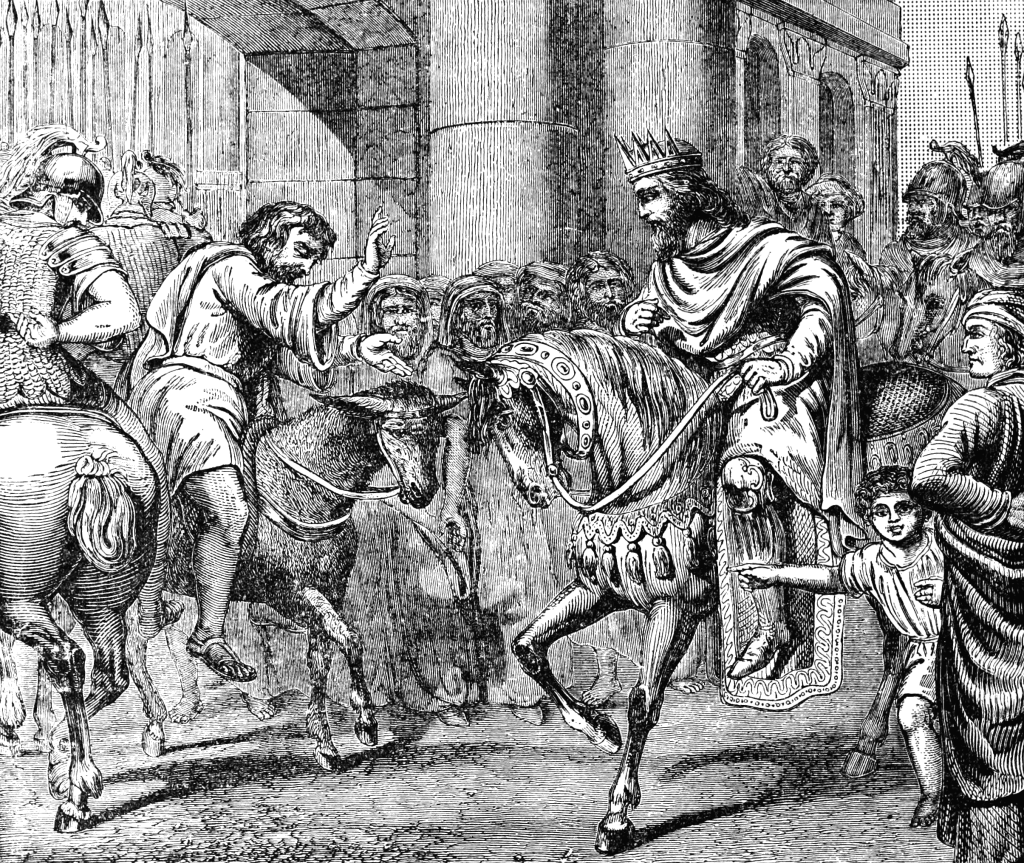
I especially like to highlight a few aspects of this. The so-called “Messianic Secret” is a fruitful parallel between the ministry of Jesus and the life of David. Related to this, the seven-year period in which Israel was gathered from Ish-bosheth to David is a significant parallel to the forty-year period in which old Israel was called to change her allegiance to Jesus. I especially like to reflect on the water crossings during the time Absalom drove David into the wilderness. Everyone who crossed the Kidron with David into the wilderness—including Ittai and his little ones (2 Sam. 15)—was baptized into David and enjoyed a union with David and all of the blessings of his kingship, victory, and vindication. In fact, on David’s return, it was necessary for the leaders to welcome David back by entering into his exile and crossing over the Jordan to bring him back (2 Sam. 19). These are clear analogs to our baptism into Jesus as well as our children’s baptism.
Mephibosheth was unable to join in this ministry to David. Instead, he allowed his hair to grow long (2 Sam. 19). Mephibosheth was thus to David what the Nazirite is to God. Earlier Nazirites had conducted a ministry of holy warfare; Mephibosheth’s ministry was instead a ministry of spiritual warfare, of prayer and fasting. This is instructive for Christians today. Today, all Christians are baptized; we are all priests (as well as being sons and prophets). There is therefore no more Nazirite, no need for a temporary priest or holy warrior. But the ministry of prayer—especially prayer in corporate worship—is how we fulfill the offices of priest and Nazirite today.
The fire that sat upon the heads of Christians in Acts 2 is equally instructive. This is not just the making of every Christian into a sacrifice and offering; it is also the making of every Christian’s head into a sacrifice and offering, just like the Nazritie. In terms of Pentecost, the work of speech, prayer, and worship is once again a significant characteristic of our service to God and his house.
Tongues redux
I heard it suggested that a straightforward way of reading “tongues of men and of angels” in 1 Cor 13 is referring to Greek and Hebrew. I’m not convinced that Hebrew is special in this way, but if so, this is consistent with my thesis that Paul is referring to Hebrew in the following chapter. It also implies the passing away of Hebrew as angels give way to men in the government of the church and the world. This coincides with the passing away of the language of the stars, as Gentile nations and rulers are called to recognize Jesus as well.
If you had to discern whether the New Testament commended ongoing prophecy only in the sense of foretelling, only in the sense of forthtelling, or both, on what basis could you do so? It does not seem to me that there is a distinguishing principle for this. Likewise for tongues, if you had to discern whether we should expect ongoing flames of fire, ongoing miraculous public speech in known languages, ongoing public speech in supposed unknown languages, ongoing private speech in supposed unknown languages, or some combination of these, on what basis could you do so? In particular: how could you possibly be content with one and not the others? Why would one be considered almost normative, and the others exceptional?
God appeared to Moses in a flame of fire from the midst of a bush which was not consumed (Exodus 3), and then later lit the fire on the altar himself (Leviticus 9). God thereby inaugurated his church with heavenly fire and expected the fire to be preserved by the faithful ordinary ministry of men (Leviticus 6); and it would have been disobedient and faithless for Moses to seek to re-create his earlier experience. “See, Lord, I let your fire run out. I buried your talent. Show us your power! Descend on us!” It is true that with successive covenant administrations, God re-established this fire, often after the sin of his church had extinguished it (2 Chronicles 7, 1 Kings 18, Acts 2); but each time he expected it to be preserved by the faithful ordinary worship of his ministers and people.
It shall never go out. (Leviticus 6)
Up to the throne
My friend James Lawrence pointed out that the date the movie 1917 takes place, April 6, is Good Friday of that year. This is also the date the US entered the war. This brings up some fascinating parallels to Holy Week, many of which seem to me to be clearly intentional.
General Erinmore underscores this parallel in a striking way with his quote from Kipling: “Down to Gehenna, or up to the Throne, He travels the fastest who travels alone.” Jesus’s own journey was one of a descent to the dead and an ascent to the Father’s throne. Tom Blake and Will Scofield’s journey is similar; Blake actually dies, and Scofield travels at night through the town of Ecoust with its burning church, even to the point of traveling underground. Both of these men’s movements are a kind of descent into hell, preceding Scofield’s ascension to the presence of Colonel Mackenzie and then his rest under the great tree.
At the opening of the movie, Blake and Scofield are chided and woken from sleep, much like the disciples at Gethsemane. Echoing Jesus’s cries at Gethsemane, Scofield later laments, “Why in God’s name did you have to choose me?”
Various times seem significant in the movie: the men are told to expect no resistance in daylight; the afternoon is “bloody quiet;” Scofield experiences a time of darkness as he passes out; and the denouement takes place at dawn. Some of the names are also significant. We see Blake and Scofield passing through Church Avenue, and they later make their way to Paradise Alley, where they meet Lieutenant Leslie, whose name means “holly garden.” Croisilles Wood recalls the cross. The men climb several hills.
There are significant mentions of food. Scofield shares a piece of bread with Blake. Later Scofield recalls trading a medal for a bottle of wine. Significantly, he drank this wine because “I was thirsty.” Later, Scofield shares his food with Lauri and the baby, a kind of midnight Passover meal.
There are telling injuries. Blake tells the story of a man named Wilco who loses his ear entirely, much like Malchus. You could also say that, in a manner of speaking, Wilco had been anointed with oil. Blake’s brother Joseph also has an ear injury, and the town of Ecoust is named for hearing. Scofield is wounded in his hand by a kind of a nail; Blake is pierced in his side. There are several other occasions where hearing and word are significant: the men have a direct order to convey; Scofield is exhorted to ensure there are witnesses. Blake is remembered by Scofield as always telling funny stories—parables.
Scofield experienced a kind of resurrection in the German bunker, where “they wanted to bury us.” He was temporarily blinded; recall that Jesus heals two blind men on his way to Jerusalem, one of which is healed by means of mud in his eyes. Blake urges Scofield to “wake up” and “stand up;” this calls to mind Ephesians 5:14, which has long been a part of the church’s Easter reading and song.
There are further deaths and resurrections. Scofield experiences a second resurrection after he is shot. He is tended-visited by a woman after this. In a manner of speaking, you could say that he gives this woman and the baby that she has found to one another, much like Jesus with Mary and John.
Most significantly, the two men together by their work save Joseph Blake and 1,600 men at sunrise. There is a more subtle resurrection in that we see chopped down cherry trees on Friday, but Scofield encounters cherry blossoms after his third death and resurrection in the river. Remember, too, that the earlier cherry trees were without fruit, just as the fig tree that Jesus encountered. Blake remarks that the trees will grow again when the stones rot; by comparison, Jesus, weeping over Jerusalem that is about to be cut down, proclaims that the stones will praise him if it will not.
In spite of these many resurrections, the significance of this day is hidden from most of the weary men who participate in it. Colonel Mackenzie had “hoped today might be a good day,” not realizing that this day not only secured the life of his men but also, from a great distance, the end of the war.
You could say that the two men do the work of their father; Erinmore is a fatherly figure, and Major Hepburn commends Scofield at the end with a “well done, lad.”
There are some less likely allusions as well, or ones that are more broadly Christian and not necessarily tied to Holy Week. For better or worse, the name of Jesus appears ten times in the movie. Blake and Scofield give water to their enemy. There is a “bowing chap;” Blake jokes that he considered entering the priesthood; nearly angelic helpers carry the body of Blake; and Lieutenant Leslie offers pardon for Blake and Scofield’s sins. As Blake and Scofield pass through the bunker, they are lights shining in darkness. In Croisilles Wood, a significant wind passes through the trees, and the men sing of their passage to heaven.
Some have suggested that the movie intends to mirror Dante’s Divine Comedy. In terms of the division of time, this does not at first glance seem very compelling, as Scofield’s beatific vision is very condensed. However, it is significant that the Divine Comedy itself mirrors Easter. And we also see at several points that Scofield is profoundly moved and motivated by his wife and daughters. So this motif also has some merit.
Christos anesti!
 I gotta have my orange juice.
Govern
with one comment
As a precondition to discipling the nations, the church will disciple the revolutionary spirit.
She will gain the means to do so by learning to govern her own revolutionary spirit.
Relevant to this:
Written by Scott Moonen
June 25, 2025 at 7:06 am
Posted in Biblical Theology, Christ is Lord, Commentary, History