Archive for the ‘Biblical Theology’ Category
Weekly communion
Following is a series of blog posts arguing for the practice of weekly communion in the church. Weekly communion is not something for which we have an explicit command in scripture, so at best it is possible to establish it as a “good and necessary consequence” of scriptural examples and commands. This makes it a question of fittingness, betterness, and wisdom rather than a matter of right and wrong that ought to bind everyone’s conscience equally. Still, we ought to pursue not only what is permissible but also what is best, and I hope that you will consider with me the merits and blessings of celebrating weekly communion in the church. What follows is a set of arguments primarily from biblical theology and biblical typology: what you might call a sort of typological logic. I hope you will find these arguments to be cumulatively persuasive.
- In everything, eucharist!
- Jesus knocks: will we open the door and have a meal with him?
- Worship is sacrificial, so as priests we too have a daily partaking of bread and wine
- Worship is a tryst, thus morsels and wine
- Worship is the gathering of the host, a dress review banquet
- Worship is spiritual warfare, and we must always find a table set in the presence of enemies
- Tithing is linked with bread and wine via Abraham and Melchizedek, and is to result in “food in my house”
- Worship is not only a tryst, but a jealousy inspection, a day of the Lord
- Bread is to be set out continually in God’s house
- There is nothing better than to eat, drink, and be joyful
- Joyful feasting is commanded on the day of the Lord
- Following Moses’s inspired application, Sabbath feasting is how we obey the fourth commandment
- The church’s week to week experience ought to be a taste of God’s blessing rather than his judgment and withdrawal
- Whether or not we eat communion, we are showing forth something about the kind of table Jesus sets for his people
- Worship is covenant renewal, and to renew covenant is to feast
- Worship is in fact the renewal of a marriage covenant, and is it even necessary to ask how often a husband and wife should get together?
- Now that we have a perpetual sacrifice and are made permanently holy, we are continually in a festal season
- Worship ought to be accessible to all, from the least to the greatest
- The worship service that the early church inherited from the apostles was a Eucharistic service
- To enter God’s gates with thanksgiving is to enter them with a thanksgiving feast
- Not to eat together with the church worldwide is to fail to walk in step with the truth of the gospel
- The memorials of the Sabbath and the Supper are linked
- We must not grow weary of the table of Yahweh
- God is the kind of father who, if his son asks for bread, gives him bread
While Jesus may graciously overlook the fact that much of his church today does not practice weekly communion, we still ought to consider whether it is better for us not to practice weekly communion, and for this I think we have hardly any excuse. God could have chosen the ongoing renewal of his covenant to take many forms, and he chose to cast it as a meal, a covenant meal, a family meal, for very good reasons. It is a widely acknowledged truism even among unbelievers that families ought to to eat together as much as possible.
I hope you will find that this has not only brought to mind the merits of weekly communion, but also other applications. There are many additional worthwhile directions we could take our investigation, and perhaps your mind is already reaching towards some of them. For example, we could ask whether it is better to use wine or grape juice in communion; whether it is better to use bread or crackers; what is the most fitting portion size for communion celebration; whether communion should tend to a penitential or a celebratory tone (Deut. 14:26, Neh. 8:9-12); just what kind of self-examination the apostle Paul means for us to make; whether little children ought to have a place at Jesus’s table (Ex. 10:9-11); where communion ought to fall in the order of worship and whether it ought to carry the burden of confession and absolution; the appropriateness or impropriety of individuals’ withdrawing from the table; and what sort of passages might be appropriate for use in communion exhortation beyond the tried and true words of institution. Perhaps we will consider some of these in the future if time permits.
Pastoral theology
We have considered several different models for worship, all of which capture different aspects of what it means for the church to meet with Jesus on the Lord’s day. As the chief shepherd-pastor, Jesus is concerned that all of his sheep would be fed and tended (John 21:15-19) as they meet with him.
Different parts of the Lord’s service have different degrees of accessibility to Jesus’s lambs. The sermon is perhaps the least accessible. Confession and singing and tribute-bringing are more accessible to all. But there is only one part of the Lord’s service that is accessible to all but the smallest infants, regardless of age (young or old) or mental capacity.
Thus, weekly communion: because Jesus wishes to feed all of his lambs as they come to worship him, so that all from the least to the greatest share in the experience of meeting with and receiving from him.
Continually
Paul writes to the Corinthians that:
. . . Christ, our Passover lamb, has been sacrificed. Let us therefore celebrate the festival . . . (1 Corinthians 5:7-8 ESV)
Calvin comments on this, writing that:
Paul, having it in view to exhort the Corinthians to holiness, shows that what was of old figuratively represented in the passover, ought to be at this day accomplished in us, and explains the correspondence which exists between the figure and the reality. In the first place, as the passover consisted of two part—a sacrifice and a sacred feast—he makes mention of both. For although some do not reckon the paschal lamb to have been a sacrifice, yet reason shows that it was properly a sacrifice, for in that rite the people were reconciled to God by the sprinkling of blood. Now there is no reconciliation without a sacrifice; and, besides, the Apostle now expressly confirms if, for he makes use of the word θύεσθαι, which is applicable to sacrifices, and in other respects, too, the context would not correspond. The lamb, then, was sacrificed yearly; then followed a feast, the celebration of which lasted for seven successive days. Christ, says Paul, is our Passover. He was sacrificed once, and on this condition, that the efficacy of that one oblation should be everlasting. What remains now is, that we eat, not once a year, but continually.
Thus, weekly communion: we, who have a perpetual sacrifice and are made permanently holy, are continually in a festal season.
One flesh
 We have called worship a kind of a tryst between Jesus and his bride, and have identified it as a covenant renewal, which is really a highfalutin way of saying the same thing. We as the church do not live in just any old covenant with Jesus, but a marriage covenant:
“Therefore a man shall leave his father and mother and hold fast to his wife, and the two shall become one flesh.” This mystery is profound, and I am saying that it refers to Christ and the church. (Eph. 5:31-32)
Luke Welch observes that human marriage-covenants have two primary covenantal motions in them: the wedding that establishes the marriage, and one-flesh sexual relations that “renew” it. He goes on to make the powerful point that in Jesus’s covenant with his bride, there are two analogous motions to our earthly marriages: Jesus’s death-resurrection-ascension that establishes the covenant (together with our baptism that brings us into it as individuals), and the continued communion that the church enjoys with Jesus at his table to renew this covenant. This communion is even a kind of one-flesh relationship, where the church-body consumes Jesus’s body (and is herself consumed by Jesus; Rev. 3:16).
Thus, weekly communion; because is it even necessary to ask how often a husband and wife should get together? Do not deprive one another (1 Cor. 7:5) or neglect to meet (Heb. 10:25).
Covenant renewal
While we have considered several models of Lord’s-day worship such as a tryst or the gathering of a military host, the primary model for corporate worship presented to us in scripture is that of covenant renewal. This is presented to us more by way of model and repetition than by way of explicit instruction, but it is one of those things that you begin to see everywhere once you realize it is there.
God’s people live and worship in covenant with him. Consistently, when God’s people assemble before him, there is a structure to that assembly that we call covenant renewal. This structure is repeated time and time again: in some of the great covenant renewals such as those of Deuteronomy and Ezra-Nehemiah, in the order of sacrifices prescribed for tabernacle and temple worship, and even in the heavenly pattern of worship laid out in Revelation. We see this in much of the language used to describe worship: worship is sacrificial (Rom. 12:1, Heb. 13:15), a drawing near to God (Heb. 4:16, 10:22), a visit to the new Jerusalem (Heb. 12:22), an eating at an altar-table (Mal. 1:7, Heb. 13:10), a going to Jesus (Heb. 13:13), an ascending to be with God (Ps. 24:3) that often symbolically takes place in an upper room (Acts 1:13, 20:8).
The consistent structure of covenant renewal is this:
- God calls his people into his presence
- God’s people respond by consecrating themselves: confessing sin
- God’s people ascend in song to meet with him, he speaks his word to them, and his people give tribute-gifts to him
- God fellowships and feasts with his people by serving them a covenant meal
- God commissions his people to go back into the world as his ambassadors and army
All of these elements are properly aspects of every covenant renewal, and the renewal is really incomplete if they are missing. For example, we ought to bring tithe-tribute to God every time we meet with him (Deut. 16:16). Likewise, to call worship a sacrifice is in fact to identify it essentially as a covenant meal: the one old-covenant offering that is called a sacrifice is the peace offering, which was the one offering that all worshippers were to eat with God in his presence. Similarly, Israel’s worship at Sinai was equated with a feast (Exodus 5:1,3; 10:7,9), and the worship-service of Revelation culminates in a feast (Rev. 19:9).
Thus, weekly communion; because we have weekly worship, and to worship is to renew covenant is to feast.
Bridegroom
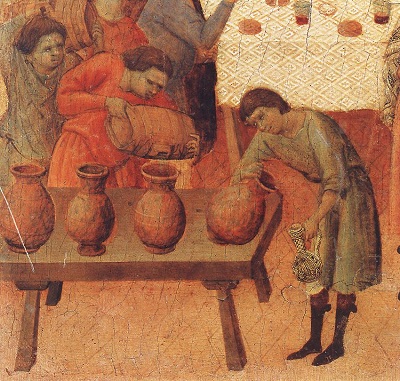 In John 2, Jesus attends a wedding at Cana, where he performs his first sign in John, the conversion of water into wine.
It is significant that John records this miracle occurred at a wedding, not merely a feast. John very skillfully writes this account in such a way as to equate Jesus with the bridegroom without, of course, suggesting that Jesus was actually the groom: Jesus provided the wine, and the master of the feast declares the bridegroom to have provided the wine.
This is the sign: Jesus is revealed as the provident Bridegroom, a theme which John takes up again in the following chapter, and which also underscores Jesus’s interactions with exemplary women throughout the book of John.
But the bride is missing from this account, and while many of John’s women are in need of a bridegroom, they only serve to typify the true bride. In a sense, the book of John serves as the revelation of the Bridegroom, and only in John’s book of Revelation do we finally see the Bride revealed.
Childermas
Today marks Childermas, the remembrance of Herod the Great’s massacre of the male babies of Bethlehem:
Then Herod, when he saw that he had been tricked by the wise men, became furious, and he sent and killed all the male children in Bethlehem and in all that region who were two years old or under, according to the time that he had ascertained from the wise men. (Matthew 2:16)
This was not the first massacre of Hebrew boys; Herod hearkens back to the Pharaoh of the Exodus:
Then the king of Egypt said to the Hebrew midwives, one of whom was named Shiphrah and the other Puah, “When you serve as midwife to the Hebrew women and see them on the birthstool, if it is a son, you shall kill him, but if it is a daughter, she shall live.” (Exodus 1:15-16)
And as we have previously considered, Matthew’s linking this to Hosea 11:1 is a subtle accusation that Herod has in fact become Pharaoh, and Israel has become Egypt.
Both Herod and Pharaoh were serpents trying to cut off the promised seed of Genesis 3:15. Blood shed unjustly calls for a blood avenger, and in each case God brought a redeemer (Moses, Jesus) through this shadow of death, and through that redeemer brought about the end of the tyrant who had sought a blood sacrifice for himself (through the ruin of Egypt, and the destruction of Jerusalem in AD 70). While Jesus himself is the sacrifice that gives us life, it is interesting to consider that there were babies who were a kind of sacrifice that gave Jesus life. It is reassuring that God is not blind to the wrath of tyrants. He hears spilled blood crying from the ground, and he hears the patient prayers of his church for deliverance from the tyrant, and he answers: Pharaoh and the Herods were brought low.
Herod and Pharaoh were right to fear the coming seed, who “visit[s] the iniquity of the fathers on the children, to the third and the fourth generation” (Numbers 14:18). Jesus truly reigns here and now, and not just over the time to come. It is deeply reassuring to know that no suffering, no cry for help, is unseen or unheard by him, nor does it go to waste. Rightly does the church proclaim to kings and rulers:
Now therefore, O kings, be wise;
be warned, O rulers of the earth.
Serve Yahweh with fear,
and rejoice with trembling.
Kiss the Son,
lest he be angry, and you perish in the way,
for his wrath is quickly kindled.
Blessed are all who take refuge in him. (Psalm 2:10-12)
This of course has application for the church today experiencing various kinds of tyranny and persecution around the world, a world that has murdered more than a billion babies over the past generation. In spite of all this, because of all this, Jesus is coming. Make ready by taking refuge in him.
Forsaken
The book of Job is, first and foremost, presenting Job as a type of Jesus the suffering servant. Job is the perfect, upright man (Job 1-2), the exemplary righteous man (Ezek. 14), who speaks what is right (Job 42) as he wrestles with God seeking a resurrection-vindication.
And at the ninth hour Jesus cried with a loud voice, “Eloi, Eloi, lema sabachthani?” which means, “My God, my God, why have you forsaken me?” (Mark 15:34)
Just as the Psalms are firstly the songs of Jesus, but become the songs of the church; Job also secondarily becomes a guide for the righteous to wrestle with God through our suffering and the suffering of our brothers. But unlike Job, our great accuser has now been cast out of heaven. More than that, while Job ascends into God’s presence only at the end of his story, we have access to God immediately and continually through Jesus in whom we have already ascended.
For we do not have a high priest who is unable to sympathize with our weaknesses, but one who in every respect has been tempted as we are, yet without sin. Let us then with confidence draw near to the throne of grace, that we may receive mercy and find grace to help in time of need. (Hebrews 4:15-16)
More than that, as the church we reign together with him.
[God] raised us up with him and seated us with him in the heavenly places in Christ Jesus. (Ephesians 2:6)
Finally, the book of Job serves as a caution to us, a reminder that God calls his own son, and all who follow him, to temporary sufferings and deprivations of the privileges of sonship so that through our suffering he can achieve an even more glorious outcome. Here and now the redeemed do not deserve these sufferings, but just like the sufferings of Jesus, we endure them as soldiers on a mission to bring about a far greater good.
Jesus said to him, “Then the sons are free. However, not to give offense to them, go to the sea and cast a hook and take the first fish that comes up, and when you open its mouth you will find a shekel. Take that and give it to them for me and for yourself.” (Matthew 17:26-27)
See also: Common disgrace, Prophet, Job.
Accuser
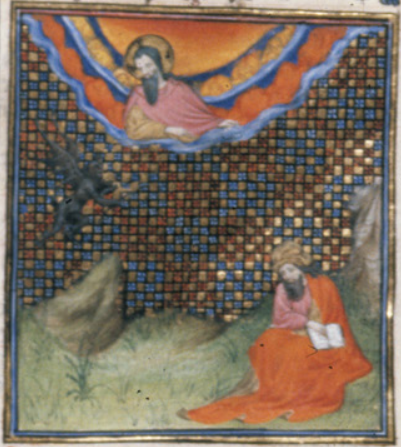 It is widely said that while it is fascinating to study Revelation, and frustrating that Christians disagree so widely over its interpretation, it is nonetheless ultimately encouraging that these differences of opinion matter little in how they impact day-to-day Christian living because we all agree that Jesus will win in the end. This is a nice sentiment, but I find it unconvincing because “the righteous shall live by faith” (Rom. 1:17), and it matters greatly to our faith what it is that Jesus has already accomplished for his people. For example, consider Revelation 12:10-12:
And I heard a loud voice in heaven, saying, “Now the salvation and the power and the kingdom of our God and the authority of his Christ have come, for the accuser of our brothers has been thrown down, who accuses them day and night before our God. And they have conquered him by the blood of the Lamb and by the word of their testimony, for they loved not their lives even unto death. Therefore, rejoice, O heavens and you who dwell in them! But woe to you, O earth and sea, for the devil has come down to you in great wrath, because he knows that his time is short!”
If this event has yet to happen, then Christians may fear the accusations of Satan day and night (consider Job) and must reassure themselves regularly that Jesus is our intercessor (Rom. 8:34). But if Jesus and the early martyrs have already cast Satan out of heaven and bound him (Rev. 20:2), then Christians today enjoy a kind of security and freedom in the presence of God that goes beyond having an advocate to stand with us. We do not even have an accuser. And it is my firm belief that this is the case.
Consider one piece of internal evidence. We are told later in Revelation that “blessed are the dead who die in the Lord from now on” (Rev. 14:13). Clearly this cannot be talking about those who die after the second coming of Jesus. This must be referring either to those who die after the resurrection and ascension of Jesus or, as I think most probable, those who die after the vindication of Jesus in the final destruction of the old-covenant creation in AD 70.
Consider also the fact that it is angels who are mediators of the judgments in Revelation. We are told in Hebrews 1-2 that it was the old covenants whose messages were mediated by angels, in contrast with the new covenant where Jesus is the mediator. We are told that the world of the new covenant is not subjected to angels but to Jesus (Heb. 2:5). Elsewhere Jesus gives the keys of the kingdom to the apostles and elders of the church (Matt. 16), and Paul teaches that the second coming is a time where we will judge angels, not where angels will judge man (1 Cor. 6:3). Taken together, the angelic actions in Revelation seem much more likely to describe the destruction of the old-covenant creation during the first century than the final judgment. Revelation depicts the changing of the guard, the retirement of angelic elders and their replacement with human elders.
Lastly, we can identify the Babylon of Revelation with the first-century city of Jerusalem. One way we can do so is because she is represented as a good church (Israel) finally gone completely bad. She is called a prostitute (Rev. 17), a source of blasphemy and abomination (Rev. 17), and a house of demons and everything unclean (Rev. 18). This is the culmination of all of the denouncements of the old-covenant prophets. Jesus is finally making good on his threats and vindicating his name. But more than that, Revelation itself identifies Babylon as the “great city” (Rev. 16-18), which it has previously named as Jerusalem: “the great city that symbolically is called Sodom and Egypt, where their Lord was crucified” (Rev. 11:8).
Hebrews reminds us that presently everything is in subjection to Jesus, even though we do not see this visibly in every way (Heb. 2:8-9). History now is an outworking of Jesus’s present enthronement and authority chiefly through the sacrificial ministry of the gospel, and will end not with king Jesus receiving a new kingdom, but with his giving a completed kingdom to the Father (1 Cor. 15). Christians can rest confidently in Jesus’s present rule, which among many other blessings means that our accuser has already been cast down and bound.
Tables
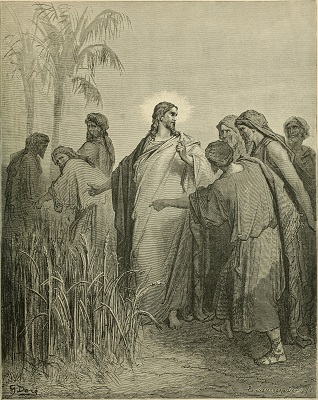 Jesus and the Pharisees argued over his disciples’ plucking of grain on the Sabbath (Matt. 12:1-8). Instead of minimizing the seriousness of what his disciples were doing, Jesus actually magnified it, comparing it to the example of David’s eating holy bread in 1 Samuel 21, but insisting that “something greater than the temple is here” (Matt. 12:6). Thus, weekly communion: to sit at a full table is to enjoy the blessings of the new covenant, but to sit at an empty table is to taste the relative impoverishment of the old covenant, and to side in a small way with the Pharisees, who wished to keep such blessings behind walls of partition.
Paul teaches us that Peter’s failure to eat together with Gentiles was “not in step with the truth of the gospel” (Gal. 2:14). Thus, weekly communion: if failing to eat together is such, failure to eat together at all is likewise a removal of our experience of the “one body” (1 Cor. 10-11) that is brought about by the gospel and is so inextricably connected to table fellowship.
It was to the Corinthians’ shame that their divisive practice of the Lord’s supper was so far removed from this truth of the one body brought about by the gospel that “when you come together, it is not [even] the Lord’s supper that you eat” (1 Cor. 11:20). Thus, weekly communion: if it is a shame to try to share the supper and fall short, it is equally a shame not even to try.
David sought out Jonathan’s crippled son Mephibosheth and honored him, so that Mephibosheth “ate always at the king’s table” (2 Sam. 9:13). Thus, weekly communion: if it is to David’s great credit and glory that Mephibosheth ate always at his table, it is to Jesus’s shame if we should eat only sometimes at his.
Whether we share communion or not on any given week, something is nonetheless being shown forth about the kind of table Jesus sets for his people, and the kind of welcome he gives to that table.
 I gotta have my orange juice.