[Girardian sacrifice:] it’s how civilization works. Now, if you’re not allowed to put the blame on somebody else, and you have to put the blame on yourself, then you have to kill yourself, right? That’s what we call mortification. Mortification is killing yourself. Instead of killing somebody else, putting all the blame on him and killing him, and instantly feeling good, you kind of have to wrestle day by day killing yourself: mortification of sin; dying to self.
That’s not something that happens all at once in a big crisis, and you just go out the other side and build your city. That’s something that’s hard to do, and it takes a long time to do; but gradually, the city is built. So, Christianity functions the same way, but because we have to kill ourselves and we have to have discipline in the church, it builds much more slowly. But it’s the same principle. Our city is built on the cornerstone of the death of Jesus Christ, just as the false cities of the world were built on human sacrifices.
Sometimes, quite literally: we read that Jericho was rebuilt by [Hiel of Bethel]. It says he laid the foundation with the death of his firstborn son. He killed his son, put him as a foundation stone; the city was built on him. That’s called a threshold sacrifice. And Cain’s [son’s] death is the foundation of Enoch. Remus’s death is the foundation of Rome. Remember, Romulus killed Remus and built Rome.
Jesus’ death is the foundation of the new Jerusalem.
But, see, we’re not allowed to get into this scapegoating thing. When there’s a crisis of culture, and there are distresses, and pressure is building up, we’re supposed to turn to the Psalms and interact with God. And we’re supposed to lay hold of the true Pentecost, which is the coming of the Holy Spirit. And we’re supposed to go back to the true old ways, which is the Bible and not some culture myth. That way we don’t get involved in fanaticism and crusades.
You know, it’s kind of interesting that people who are Christians find it much harder to get sucked up into movements than other people do. The more mature you are as a Christian, the more stable you are; the more you tend to be just a little bit nervous about big crusade-type things. You go to a Promise Keepers’ meeting, and there’s 10,000 charismatics there and 200 Calvinistic pastors. The charismatics all find it real easy to get into this. The Calvinists were saying, “well, I don’t know.” You know, they kind of get into it, and they’re kind of not sure. Some of the songs they feel like getting into, and some of them they don’t, right?
Because the more mature you are as a Christian, the more the gyroscope inside of you spins faster and faster, and you’re more stable. That’s the analogy I use. We all have gyroscopes inside ourselves, and the more mature we are, the faster the gyroscope spins, and the more stable you are; the less you are tossed about by every wind of doctrine, and the more difficult it is for you to get sucked up into mass movements. The more mortification you practice on the inside, the more you know of the Scripture: the more difficult it is for you to get sucked up into mass movements.
So at this point, we’re different. We don’t go out on a crusade and kill a bunch of people. We’re not supposed to. That’s not the way we relieve pressure on ourselves and on our society. But that’s the way they do, and that’s what’s happening here in Revelation chapter 13. The Jews experienced a big revival of what they think is their traditional religion, the oral law. That’s the problem. We had strayed from it. And a whole bunch of people who had become Christians undergo this experience. And what do we call those Christians who convert back to the oral law tradition? Judaizers. And Paul talks about them. He says, Demas is apostatized. There’s a big apostasy that happens that Paul talks about. It says it’s happening; it’s about to come: the big apostasy. A bunch of people who become Christians, and then all of a sudden they say, you know, “this was a mistake,” and they go back. They’re part of this revival, revival of false religion. And then there will be a persecution of those who don’t go along with it, which is the massacre of the two witnesses or the massacre of the 144,000. But then things don’t turn out the way they expect: because God acts.
One last point. . . . If the scapegoats in this activity turn out to be really innocent, sooner or later their killers feel guilt and become open to the message of the scapegoats. That’s why martyrdom leads to conversion. The Christians refuse to go along with what’s going on, so the Christians are massacred. But a lot of people begin to think, “maybe we shouldn’t have done this; these people were innocent.”
Remember what happens in Revelation chapter 11. Those who dwell on the land rejoice over the massacre of the believers, but: the people from the tribes and tongues and nations and peoples contemplate their dead bodies for three and a half days, don’t allow them to be buried. And then—we read that a lot of them are converted.
Rome had the same revival. When Nero burns Rome, the Romans had a big revival of the old ways, which of course were not old ways at all, but they became, “Rome, Rome is the answer. Rome this, Rome that.” And anybody who wouldn’t go along with it was put to death—which meant the Christians were. And Nero blamed the Christians for burning Rome; he started putting them to death. So, Christians are martyred. But what happens? Romans see Christians dying, they see that they’re innocent. They think about it, and then they’re converted. The blood of the martyrs becomes the seed of the church.
And that’s why, folks, historically it’s only through martyrdom that the church grows. It may be martyrdom in the big sense of being thrown to the lions, or it may be martyrdom in the sense that you practice self-mortification and killing yourself as you mortify sin. But it’s only as Christians mortify sin—and frequently it’s as Christians are actually put to death—that God brings pressure on the world and brings people to himself.
Well, I’m sorry, our time is way up. We’ll probably touch on this again next week, but then we have to move further into other aspects of what’s going on here. Take away from here: this is the way history moves—crisis, big Pentecost, mass movements, scapegoats. That’s what happens, and that’s what happened here.
Let’s pray. Father in heaven, we ask that you would spare us from going through this kind of thing in our day. We can see the pieces of the puzzle.
(James Jordan, Revelation in Detail # 77: A False Pentecost: Rev. 13:13)
I indeed baptize you with water unto repentance, but He who is coming after me is mightier than I, whose sandals I am not worthy to carry. He will baptize you with the Holy Spirit and fire. (Matthew 3:11 NKJV)
First of all, I am not a language scholar and I hesitate to make much of a preposition.
Second, John’s baptism is not the same thing as Trinitarian baptism, so we should hesitate to make straight-line applications from John to Jesus and his church. In a manner of speaking, John was bringing faithful covenant people back to life after their having come into contact with death. By contrast, Jesus by baptism brings people into his covenant for the first time, bringing them to life once and for all.
Nevertheless, the idea of a baptism being unto or toward repentance is significant. Rather than baptism being, as Robert Stein would have it, a mere synecdoche for a faith-repentance-baptism sequence, this shows that baptism is in fact a performance of repentance. Just as James teaches us that faith must be performed in order to be fully realized, so too repentance must be performed in order to be fully realized.
This by itself is not proof of paedobaptism, though it is highly consistent with paedobaptism and paedofaith. But it is proof against a facile credobaptism: if you require someone to repent before their baptism, you are in a sense requiring the impossible.
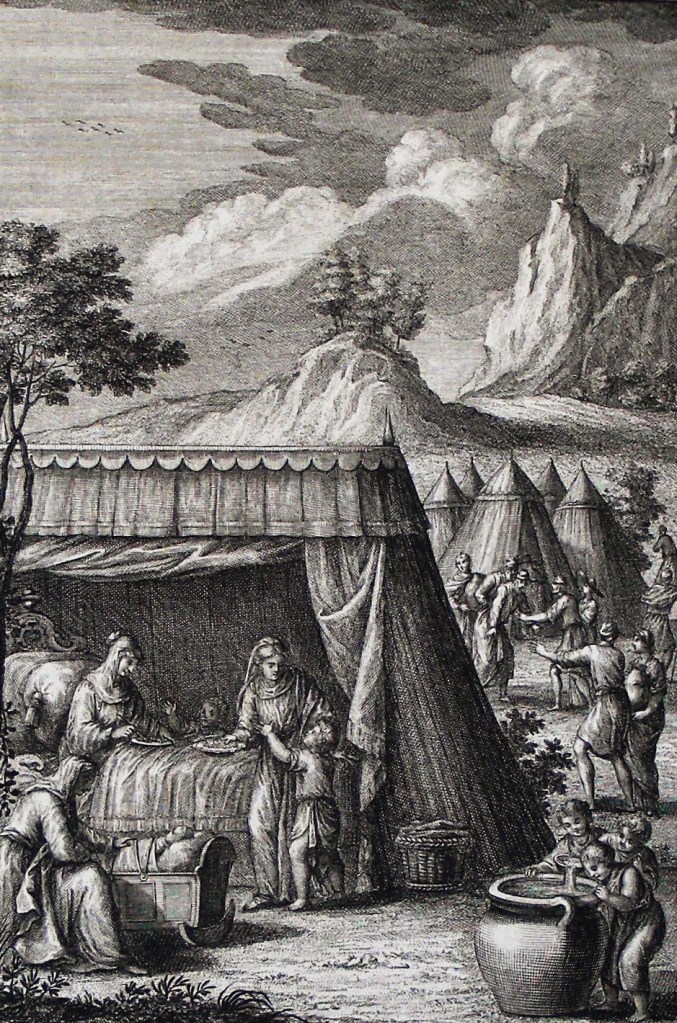
Leviticus 12 specifies the old covenants’ rules for purification after childbirth:
Then Yahweh spoke to Moses, saying, “Speak to the children of Israel, saying: ‘If a woman has conceived, and borne a male child, then she shall be unclean seven days; as in the days of her customary impurity she shall be unclean. And on the eighth day the flesh of his foreskin shall be circumcised. She shall then continue in the blood of her purification thirty-three days. She shall not touch any hallowed thing, nor come into the sanctuary until the days of her purification are fulfilled.
‘But if she bears a female child, then she shall be unclean two weeks, as in her customary impurity, and she shall continue in the blood of her purification sixty-six days.
‘When the days of her purification are fulfilled, whether for a son or a daughter, she shall bring to the priest a lamb of the first year as a burnt offering, and a young pigeon or a turtledove as a sin offering, to the door of the tabernacle of meeting. Then he shall offer it before Yahweh, and make atonement for her. And she shall be clean from the flow of her blood. This is the law for her who has borne a male or a female.
‘And if she is not able to bring a lamb, then she may bring two turtledoves or two young pigeons—one as a burnt offering and the other as a sin offering. So the priest shall make atonement for her, and she will be clean.’ ”
It’s widely recognized that circumcision is what serves to reduce the time of impurity for a son compared to a daughter; a son’s circumcision functions as a kind of partial sin-purification offering.
But it’s also interesting to note that these numbers (seven, thirty-three, fourteen, sixty-six) all appear in Genesis 46:
Now these were the names of the children of Israel, Jacob and his sons, who went to Egypt: Reuben was Jacob’s firstborn. The sons of Reuben were Hanoch, Pallu, Hezron, and Carmi. The sons of Simeon were Jemuel, Jamin, Ohad, Jachin, Zohar, and Shaul, the son of a Canaanite woman. The sons of Levi were Gershon, Kohath, and Merari. The sons of Judah were Er, Onan, Shelah, Perez, and Zerah (but Er and Onan died in the land of Canaan). The sons of Perez were Hezron and Hamul. The sons of Issachar were Tola, Puvah, Job, and Shimron. The sons of Zebulun were Sered, Elon, and Jahleel. These were the sons of Leah, whom she bore to Jacob in Padan Aram, with his daughter Dinah. All the persons, his sons and his daughters, werethirty-three.
The sons of Gad were Ziphion, Haggi, Shuni, Ezbon, Eri, Arodi, and Areli. The sons of Asher were Jimnah, Ishuah, Isui, Beriah, and Serah, their sister. And the sons of Beriah were Heber and Malchiel. These were the sons of Zilpah, whom Laban gave to Leah his daughter; and these she bore to Jacob: sixteen persons.
The sons of Rachel, Jacob’s wife, were Joseph and Benjamin. And to Joseph in the land of Egypt were born Manasseh and Ephraim, whom Asenath, the daughter of Poti-Pherah priest of On, bore to him. The sons of Benjamin were Belah, Becher, Ashbel, Gera, Naaman, Ehi, Rosh, Muppim, Huppim, and Ard. These were the sons of Rachel, who were born to Jacob: fourteen persons in all.
The son of Dan was Hushim. The sons of Naphtali were Jahzeel, Guni, Jezer, and Shillem. These were the sons of Bilhah, whom Laban gave to Rachel his daughter, and she bore these to Jacob: seven persons in all.
All the persons who went with Jacob to Egypt, who came from his body, besides Jacob’s sons’ wives, weresixty-six persons in all. And the sons of Joseph who were born to him in Egypt were two persons. All the persons of the house of Jacob who went to Egypt were seventy. (Genesis 46:8-27)
The numbers seven, thirty-three, fourteen, and sixty-six (together with the number sixteen) symbolically represent children who traveled to Egypt. There is a kind of forward progression to the numbers. The numbers of the children are incorporated into the number of the household, seventy. This number, seventy, is widely recognized to be symbolic of the nations, after the seventy nations listed in Genesis 10. In Egypt, Jacob through Joseph feeds those seventy nations in Genesis, but by the time of Exodus it becomes clear that Israel’s full mission to the seventy nations is just beginning (Exodus 15:27).
Glossing on this, it seems that in the ritual revolving around the birth of every single child, God wants his people to recognize a participation in and a responsibility for forward progression. The mother and child are ritually incorporated into a story (ranging from Genesis 10 and 46 to Exodus 15) with a history of God’s deliverance, an expectation of the future salvation of the nations, and accompanied with a responsibility of ministry to those nations.
It’s instructive to apply these numbers to David:
David was thirty years old when he began to reign, and he reigned forty years. In Hebron he reigned over Judah seven years and six months, and in Jerusalem he reigned thirty-three years over all Israel and Judah. (2 Samuel 5:4-5; see also 1 Kings 2:11; 1 Chronicles 3:4, 29:27)
In terms of Leviticus 12, David’s reign seems to function as a kind of 7-33 childbirth-purification cycle. Israel had, in a sense, for the first time given birth to a pre-eminent son. During this time God’s house was torn apart and she could not enter into worship as God intended. She had to undergo a time of purification before she could return to God’s house for worship. This, surely, is the deeper meaning behind God’s prohibition of David’s building his house. Interestingly, neither in Kings nor Chronicles is it recorded that God told Nathan that blood was the reason that David could not build the house. Rather, this is a conclusion that David received from God (though perhaps through Nathan):
And David said to Solomon: “My son, as for me, it was in my mind to build a house to the name of the Yahweh my God; but the word of the Yahweh came to me, saying, ‘You have shed much blood and have made great wars; you shall not build a house for My name, because you have shed much blood on the earth in My sight. Behold, a son shall be born to you, who shall be a man of rest; and I will give him rest from all his enemies all around. His name shall be Solomon, for I will give peace and quietness to Israel in his days. He shall build a house for My name, and he shall be My son, and I will be his Father; and I will establish the throne of his kingdom over Israel forever.’ (1 Chronicles 22:7-10)
We are to take from this a few applications.
First, the blood of war is analogous to the blood of childbirth. The establishment of a nation is analogous to the establishment of a family, house, household. In all cases, those who are bloodied must undergo a time of patience and purification before they can enjoy true rest.
Second, David is here highlighted as a kind of first, inaugural, or exemplary son. Although David’s reign is in this light presented as a time of waiting, God is doing a new thing with the house of David that he has not done before. I recommend Peter Leithart’s book, From Silence to Song, as a helpful reflection on some of the ways that David’s reign is an eruption into history of an extraordinary new covenant.
Third, this emphasizes that our hope for life and victory and rest is in the son of David.
Fourth, returning to Genesis 46, the ultimate purpose towards which David and his son’s rule are working is for the salvation of the nations; seven and thirty-three are moving towards seventy. “My house shall be called a house of prayer for all nations.” (Isaiah 56:7, Mark 11:17)
Finally, I want to return to the idea that the time after childbirth is a time of purification. Ultimately this implies that every Israelite child was baptized. This is because the mother’s “customary impurity” was a particularly virulent impurity:
If a woman has a discharge, and the discharge from her body is blood, she shall be set apart seven days; and whoever touches her shall be unclean until evening. (Leviticus 15:19)
The phrase “unclean until evening” is a synechdoche for washing in water; in other cases where people come into secondary contact with the woman, they must wash in water (vv. 21, 22, 23, 27). And although the Septuagint does not describe these washings as baptisms, Paul does (Hebrews 9:10). The childbirth-purification ritual that incorporates the woman and child into Israel’s history is thus a ritual that includes both baptism and sacrifice. It is therefore obviously the case that countless Hebrew newborns were baptized—likely each for several days in sequence.
And then, once David comes, it is necessary to become and remain incorporated into his history in order to be saved. In fact, in one prominent case this union-incorporation takes place by means of several baptisms; see Baptisms, Baptism exhortation.
Paul, in criticizing “various baptisms” in Hebrews 9, is not condemning baptism per se, but rather “various” baptisms, baptisms that are “only” baptisms. Paul still exults in one baptism (Ephesians 4:5), the one which unites us with Jesus (Romans 6, 1 Peter 3). We therefore baptize our babies, so that they may be incorporated into Jesus, Jesus’s history and future, and Jesus’s mission.
Jesus himself was therefore baptized as an infant, and this even before he was circumcised. Jesus’s own faithfulness and righteousness as an infant is precisely how we can have confidence that our own infants may be counted righteous by virtue of their incorporation into him. What was the point of Jesus’s coming as an infant if he did not intend to redeem infants and infancy itself? Augustine recognizes the force of this in a similar vein when arguing to those who have baptized their infants that it absolutely must be an effectual baptism rather than an empty one:
Those who say that infancy has nothing in it for Jesus to save, are denying that Christ is Jesus for all believing infants. Those, I repeat, who say that infancy has nothing in it for Jesus to save, are saying nothing else than that for believing infants, infants that is who have been baptized into Christ, Christ the Lord is not Jesus. After all, what is Jesus? Jesus means Savior. Jesus is the Savior. Those whom he doesn’t save, having nothing to save in them, well for them he isn’t Jesus. Well now, if you can tolerate the idea that Christ is not Jesus for some persons who have been baptized, then I’m not sure your faith can be recognized as according with the sound rule. Yes, they’re infants, but they are his members. They’re infants, but they receive his sacraments. They are infants, but they share in his table, in order to have life in themselves.
What are you telling me? That the child is perfectly all right, nothing wrong with it? Then why are you running with it to the doctor, if it’s perfectly all right? Aren’t you afraid he may say to you, “Take this child away, since you consider it to be perfectly all right; the Son of man only came to seek and save what had got lost; why bring the child to me, if it hadn’t got lost? (Augustine, Sermon 174, 7)
For it seemed good to the Holy Spirit, and to us, to lay upon you no greater burden than these necessary things: that you abstain from things offered to idols, from blood, from things strangled, and from sexual immorality. If you keep yourselves from these, you will do well.
Farewell. (Acts 15:28-29)
How then do we drink blood every week?
Then Jesus said to them, “Most assuredly, I say to you, unless you eat the flesh of the Son of Man and drink His blood, you have no life in you. Whoever eats My flesh and drinks My blood has eternal life, and I will raise him up at the last day. For My flesh is food indeed, and My blood is drink indeed. He who eats My flesh and drinks My blood abides in Me, and I in him. (John 6:53-56)
This is because Jesus’s blood does not leave his body. To drink Jesus’s blood is to participate in his body:
The cup of blessing which we bless, is it not the communion of the blood of Christ? The bread which we break, is it not the communion of the body of Christ? For we, though many, are one bread and one body; for we all partake of that one bread. (1 Corinthians 10:16-17)
A strong implication of this is that it is not licit to attempt to conduct the Lord’s supper in any context other than the gathered church. The Lord’s table is presented to the Lord’s church on the Lord’s day. If your gathering is not the church-body, then “it is not to eat the Lord’s supper” (1 Corinthians 11:20).
Samson is a type of Jesus. This is evident throughout his life: for example, his birth is announced to Samson’s mother by an angel.
I’m particularly interested in how Samson serves as a type of Jesus in his death:
Now the temple was full of men and women. All the lords of the Philistines were there—about three thousand men and women on the roof watching while Samson performed. Then Samson called to the Yahweh, saying, “O Lord Yahweh, remember me, I pray! Strengthen me, I pray, just this once, O God, that I may with one blow take vengeance on the Philistines for my two eyes!” And Samson took hold of the two middle pillars which supported the temple, and he braced himself against them, one on his right and the other on his left. Then Samson said, “Let me die with the Philistines!” And he pushed with all his might, and the temple fell on the lords and all the people who were in it. So the dead that he killed at his death were more than he had killed in his life. (Judges 16:27-30)
There are a few things we can take from this in application to Jesus’s death. First, Jesus’s death is the performance of a kind of vengeance against the old creation, against the sin that it produced, and against death itself.
Second, the fruit of Jesus’s death is equally the death of three thousand men and women. They were destroyed in the sense that they were brought into Jesus’s kingdom:
Then Peter said to them, “Repent, and let every one of you be baptized in the name of Jesus Christ for the remission of sins; and you shall receive the gift of the Holy Spirit. For the promise is to you and to your children, and to all who are afar off, as many as the Lord our God will call.”
And with many other words he testified and exhorted them, saying, “Be saved from this perverse generation.” Then those who gladly received his word were baptized; and that day about three thousand souls were added to them. (Acts 2:38-41)
The Levitical laws of uncleanness (Leviticus 16, etc.) generally have to do with the exposure of the “innermost man” to the outside world, especially in the context of participating in worship. The man who is walking in the flesh—the man who is lacking clean hands or a pure heart—is unwelcome in God’s house.
It is well known that the tabernacle-temple is a model of the human body. It is less well known that the high priest is a model of the tabernacle-temple, but Peter Leithart, James Jordan, and others observe this. The high priest’s garments are a sort of inside-out representation of the tabernacle-temple; starting with the ornate breastpiece, which appears to be a model of the ark. In fact, in 1 Sam 14:18, there is some uncertainty or equivocation between ephod and ark. Moreover, the ephod has two stones in it, just like the ark. As you move inward, the priest’s clothing can be said to correspond to the holy place and then to the courtyard.
What I find interesting here is the contrast between the inside-out of the high priest’s garments, and the inside-out of bodily discharges. You could say that the laws of purification are meant to teach what kind of inner life is forbidden to God’s people: a fleshly inner life. By the same token, the priest’s garments are meant to display what kind of inner life is prescribe for God’s people: an inner life of glory and beauty; an inner life that has a “heart of stone,” a heart that is tutored by God’s word and law. It is interesting, in this light, to consider that God wishes to replace our hearts of stone-law with hearts of flesh. God intends to transform our flesh to his purposes rather than to sinful purposes.
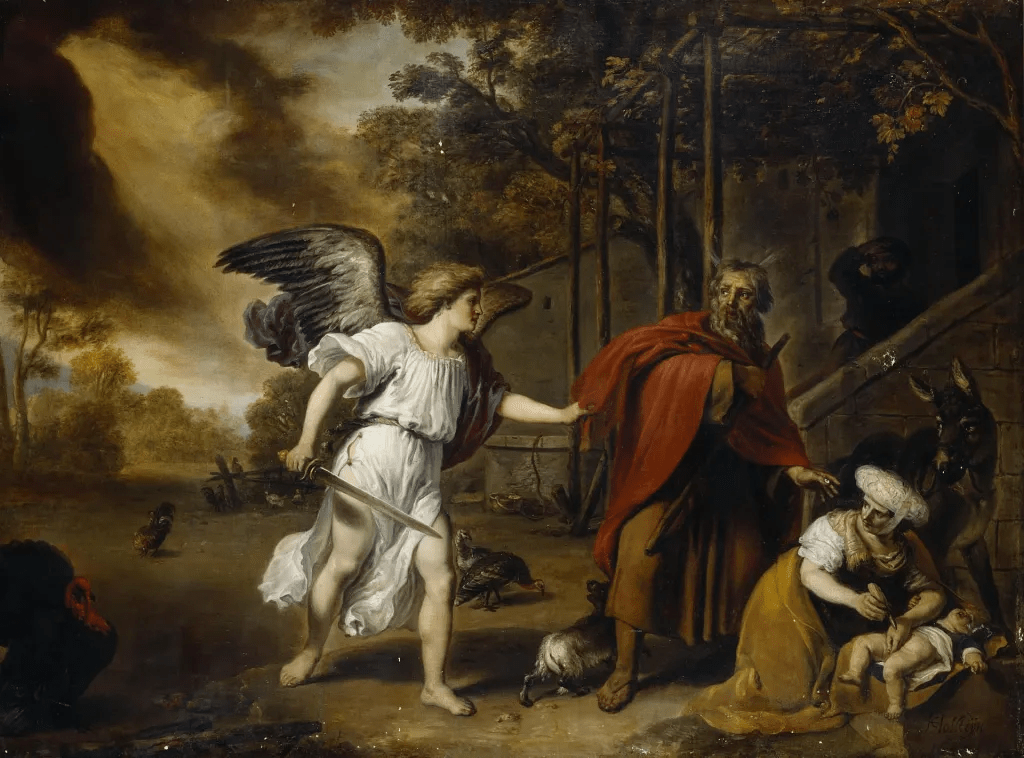
And Yahweh said to Moses, “When you go back to Egypt, see that you do all those wonders before Pharaoh which I have put in your hand. But I will harden his heart, so that he will not let the people go. Then you shall say to Pharaoh, ‘Thus says Yahweh: “Israel is my son, my firstborn. So I say to you, let my son go that he may serve me. But if you refuse to let him go, indeed I will kill your son, your firstborn.”’”
And it came to pass on the way, at the encampment, that Yahweh met him and sought to kill him. Then Zipporah took a sharp stone and cut off the foreskin of her son and cast it at Moses’ feet, and said, “Surely you are a husband of blood to me!” So he let him go. Then she said, “You are a husband of blood!”—because of the circumcision. (Exodus 4:21-26)
God requires the dedication of children to him. The children of the unrighteous are destroyed, while the children of the righteous are covenanted to him—on pain of death (in the case of Moses) or of excommunication:
And the uncircumcised male child, who is not circumcised in the flesh of his foreskin, that person shall be cut off from his people; he has broken My covenant. (Genesis 17:14)
This is why the Westminster Confession of Faith reminds us that “it [is] a great sin to contemn or neglect” baptism, including the baptism of our little ones. It is noteworthy that Moses faces this opposition from God on his way to be rejoined to God’s people; in fact, on his way to make preparations for a feast: it is especially important for our children to wear the sign of God’s covenant with them when they enter into his presence in worship.
Likewise, it is a great sin to contemn or neglect our little ones’ participation in the Lord’s Supper. I have written of how strongly this is implied by the New Testament food laws (do not destroy or stumble your brother; you will either be eating at God’s table or the table of demons; examine yourself; discern the body; wait for one another; walk straightforwardly about the truth of the gospel). But this requirement also goes back to the time that the church was given the name of Israel:
But the man who is clean and is not on a journey, and ceases to keep the Passover, that same person shall be cut off from among his people, because he did not bring the offering of Yahweh at its appointed time; that man shall bear his sin. (Numbers 9:13)
Are you clean (1 Corinthians 7:14)? You must be baptized and you must participate in the feast. In neglect of this command, the evangelical church has largely excommunicated her children. Until she repents of despising God’s children in this way, God will oppose her just as he opposed Moses.
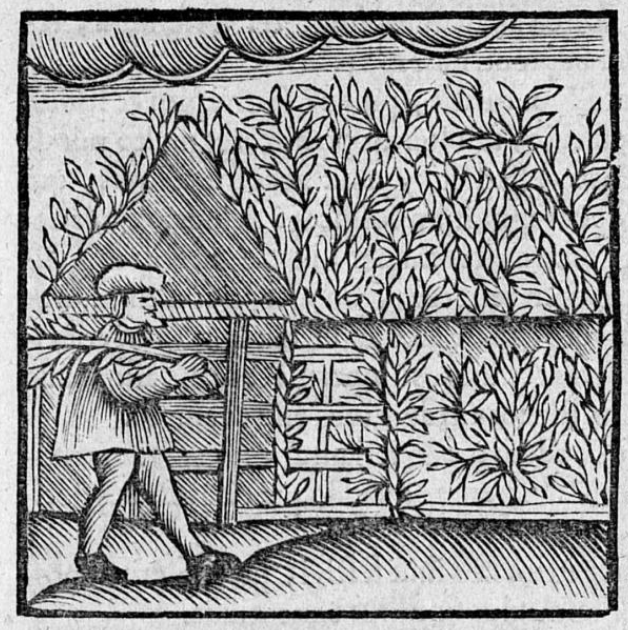
It is widely recognized that the Feast of Booths–Ingathering carries an eschatological symbolic weight. Unlike Passover, which was limited to circumcised Israelites, Booths is a feast in which the uncircumcised God-fearer was included (Deuteronomy 16:14). This anticipates the harvest of the nations into God’s house. The church’s celebration of the Lord’s Supper therefore stands in the line of Booths just as much as it stands in the line of Passover.
If you think of Booths as a type or prolepsis of the church age, it is quite interesting to observe that Booths also interrupts the weekly Sabbath calendar and temporarily introduces a new Sabbath calendar, obliquely tied to the festival time and not the old weekly cycle:
Then Yahweh spoke to Moses, saying, “Speak to the children of Israel, saying: ‘The fifteenth day of this seventh month shall be the Feast of Tabernacles for seven days to Yahweh. On the first day there shall be a holy convocation. You shall do no customary work on it.For seven days you shall offer an offering made by fire to the Yahweh. On the eighth day you shall have a holy convocation, and you shall offer an offering made by fire to the Yahweh. It is a sacred assembly, and you shall do no customary work on it. . . .
‘Also on the fifteenth day of the seventh month, when you have gathered in the fruit of the land, you shall keep the feast of the Yahweh for seven days; on the first day there shall be a sabbath, and on the eighth day a sabbath. (Leviticus 23:33-39)
In this new time, this church-time, the first and eighth days are the days of rest.
Now on the first day of the week, when the disciples came together to break bread . . . (Acts 20:7)
“Preterism” isn’t about an “end times position.” It is a matter of basic Biblical theology. It is about how and why Jesus could issue the Great Commission to people who were, at the time, what we now call “Judaizers” and read about in Galatians. It is about why the Bible would say that twelve people who didn’t believe Jesus would or should be crucified were authorized to preach “the Gospel of the Kingdom (Luke 9:6). It is about how Jesus could exhort people to “believe in the Gospel” (Mark 1:15) without teaching them anything about his necessary death and the resurrection that would follow (and knowing they would all react negatively to the idea just like Peter did later). Yet people were commended for believing that Gospel and condemned for refusing it.
Preterism is about growing up and not reading the Bible like a child. It is about maturing past the idiot notion that Jesus was a systematic theologian longing for the day when he could make us smart enough to articulate atonement theology, or justification by faith alone, or double predestination.
Preterism contradicts the error of a kind of soft dispensationalism that is rampant in Protestantism. While hard dispensationlism wrongly wants to make room for ongoing loyalty to Moses, the soft dispensationalism I have in mind wrongly wants to think that loyalty to Moses and loyalty to Jesus are different kinds of thing: that Jesus does not stand in thorough and proper continuity with Moses (contra Hebrews 3, etc.) as the one and only successor to Moses.
A good way to think about this is to realize that the gospels are recapitulating David’s time in the wilderness, and the rest of the New Testament is recapitulating the first few years of David’s reign. Believe it or not, people and their babies were truly saved before the coming of Jesus (e.g., Luke 1). During his time here, the anointed king Jesus secretly gathered people to himself much like David did. Just like David, Jesus endured suffering so that he and his people might be vindicated. Upon his resurrection and enthronement, a forty-year countdown started for all of his people to transfer their loyalty to him and to receive the blessings of his vindication. His people were already truly saved, but God presented a new loyalty test in order for them to continue in their salvation. It is now your loyalty to Jesus that saves you and gives you life.
Loyalty to Saul, though at one time a good thing, had an expiration date; after a certain point, your exclusive love for Saul or Ish-Bosheth would condemn you rather than save you, and even Saul’s own offspring had to find their salvation in David. Likewise, loyalty to Moses, though at one time a good thing, had an absolute expiration date (Romans 7, Hebrews 10); exclusive loyalty to Moses now in fact condemns you rather than saves you. But, equally, it is important to see that loyalty to Jesus is in complete continuity with the former loyalty to Moses. If your Moses is not in harmony with Jesus, then you have the wrong Moses (John 5)! This is one reason why we must baptize our babies, and why, with David (2 Samuel 12), we have full confidence that they belong to Jesus.
And he received the sign of circumcision, . . . that he might be the father of all those who believe, though they are uncircumcised, . . . and the father of circumcision to those . . . who also walk in the steps of the faith which our father Abraham had while still uncircumcised. For the promise that he would be the heir of the world was not to Abraham or to his seed through the law, but through the righteousness of faith. . . . Therefore it is of faith that it might be according to grace, so that the promise might be sure to all the seed, not only to those who are of the law, but also to those who are of the faith of Abraham, who is the father of us all. (Romans 4:11-16)
Therefore know that only those who are of faith are sons of Abraham. (Galatians 3:7)
What is promised to sons of Abraham?
And I will establish my covenant between me and you and your descendants after you in their generations, for an everlasting covenant, to be God to you and your descendants after you. Also I give to you and your descendants after you the land in which you are a stranger, all the land of Canaan, as an everlasting possession; and I will be their God. (Gen. 17:7-8)
Paul teaches us that, in Jesus, this promise is modulated from Canaan to the entire world. But it is clear that the promise still holds for sons of Abraham. If you are of faith, then you are a son of Abraham, and God has promised that he will be a God to your descendants.
 I gotta have my orange juice.