Archive for the ‘Biblical Theology’ Category
Foodless
Peter Leithart writes of weekly communion:
Foodless worship is unthinkable in the Bible and has been unthinkable through most of Christian history. . . .
The Church is not an “instrument” or “means” to achieve individual salvation. The Church is the present form of salvation in history.
De profundis
The book of Job is, in effect, an immense psalm. (René Girard, I See Satan Fall Like Lightning, 117)
Sola fide
The debate between credobaptists and paedobaptists is not so much a debate over what baptism is, as it is a debate over the nature of the church, the body, the covenant, the kingdom. Do the body and kingdom consist only of those who are beyond a certain point of intellectual development? In a sense, quite the opposite (Mark 10:15, Luke 18:17).
A key scripture for this debate is the prophet Jeremiah’s description of the new covenant in Jeremiah 31, and as quoted in Hebrews 8 and 10. This passage is often taken to imply that the new covenant is not just a new covenant but a new species of covenant: that its membership is fashioned spiritually, by faith; rather than naturally, by birth. This is a distinction that does not hold water, however: there are natural blessings in the new covenant; and salvation in the old covenants was by faith, grace, and through Jesus just as much as in the new. Moreover, as I have argued previously, Jeremiah 31 cannot be taken to mean that the new covenant excludes children; the opposite reading makes far better sense of the context and of related passages.
The church has almost universally confessed that her infant children go to be with Jesus if they die. Our infants are part of Jesus’s church-body-kingdom. Since they are to be seated at his heavenly table, it is right for us to seat them at his earthly table. Indeed, if they have a place at Jesus’s table, to refuse them access is to eat and drink judgment on ourselves (1 Cor 11:29) and to walk out of step with the truth of the gospel (Gal. 2:14). And of course, to say that our children are fit participants in the Lord’s supper is to sneak baptism in the back door, for baptism is the seal of entry into the body, and the supper the seal of continuation and renewal.
But even granting all this, credobaptists normally balk at the thought of baptizing infants because baptism is normally in scripture linked with faith. Thus, a young child who can express the basic confession of Romans 10:9 may be a fitting subject for baptism by virtue of his profession of faith, but not an infant: even if he is likely part of Jesus’s body, he must wait until his faith becomes evident.
To make our infants wait is to confess that they have no faith, or no faith that we can discern. But we speak otherwise when we say that Jesus receives them if they die, because we also confess that justification is by faith alone. If our infants are to stand justified before God—and we believe that they are—then it must be by faith.
More importantly, scripture teaches us that they do have faith; if we were to better moderate the evangelical diet of conversion songs with Psalm singing, this confession would resonate more strongly with us. Psalm 22:9 speaks first of David’s and Jesus’s infant faith, but also our own. Psalm 71:6 speaks of the same. (Here we see the very spiritual dimension of the old covenants.) Certainly David speaks of a child-like faith rather than an adult faith; there is much more of fiducia to it and much less of notitia and assensus. But it is faith none the less.
Thus, infant baptism: because justification is by faith alone.
Covenant
There’s a lot of material in the Bible on covenant, the vast majority of which focuses on God’s covenants with his people. But there are human relationships in the Bible also described as covenants, such as Abraham and Abimelech (Gen. 21:27, 32), and Jacob and Laban (Gen. 31:44). Importantly, marriages are named as covenants. God explicitly calls human marriage a covenant (Malachi 2:14). God also describes his own covenant with his people as a marriage (Ezek. 16), and this is surely one of the aspects of God’s marriage that is mirrored in our own (Eph. 5:32).
There are some dimensions of God’s covenant with his people that are not mirrored in all human marriages, except in rare cases such as Hosea. But there are still many insights into covenant from biblical theology that we can apply to our own marriage covenants. Here, in no particular order, are twelve reflections on marriage as a covenant:
Architecture. Covenants are relational-structural bonds. As a bond, a covenant establishes a sort of structure or architecture for the relationship. Like the architecture of a house, the covenant is not the purpose of marriage, but reflecting on the covenant can help us to understand the purpose and pattern of marriage. The covenant is sort of the hub or lattice on which all of the pieces of marriage can be arranged.
Complementarity. All covenants are asymmetric or complementary relationships in some way. Complementarity, the differing roles and responsibilities of husband and wife in the dance of marriage, is built into the fabric of covenant. For example, God calls the husband and wife together by the name of the husband (Gen. 5:2), and the first husband named the first wife. God, who establishes the marriage covenant (Matt. 19:6) has different exhortations and requirements for husbands and wives (Eph. 5:22, 25).
Particularity. Covenants are particular and exclusive: God is God and savior to these people; this man cleaves to this woman and no other.
Death. Covenants are not mere contracts that exchange goods and services for mutual benefit. Contracts have their place, but a covenant is a promise and a giving of oneself. Theologians speak of the “self-maledictory oath” in a covenant: covenant promises are a sort of “cross my heart and hope to die.”
Blessing and curse. There are always both blessings and curses attached to a covenant. God calls us to a standard of fidelity and sacrifice, but in this he equally intends to give us great gifts and happiness and joy. In fact, death and sacrifice are the very soil in which happiness and joy flourish.
Adoption. A good picture of a covenant is what happens in adoption: you leave an old world-situation-family and enter into a new one; you become responsible for and to one another. In fact, in marriage, husband and wife do adopt one another as brother and sister in a way (consider the sister-bride in the Song of Solomon).
New creation. Every covenant establishes a new creation, a new order of things. This involves a rejection and separation and death to what came before: what came before was good in its time, but it is no longer adequate for the current situation. Out of this death, every covenant brings a kind of new life or resurrection into a new world-creation.
Union. This new creation involves a new union: union with Jesus in one case, or union with one another in marriage. This is the husband and wife becoming one flesh, leaving and cleaving; it is an incorporation of the other into oneself. Sex is a part of this but it does not exhaust the meaning of it.
Signs. Covenants have covenant signs that mark their establishment and renewal. The old covenants were marked or renewed with rainbow, circumcision, offering, and sacrifice-feast. The new covenant is marked in baptism and renewed in the Lord’s Supper. Our marriage covenants are marked (often) by the exchange of rings, and renewed in sex.
Fellowship. These unions and covenant signs often include meals. The meals are an expression of fellowship, a high point of the entire covenant. Consider that God’s covenants are broken by false eating (Genesis 3, 1 Cor. 10) and in the end are summed up in a feast (Revelation 19). Even the most reluctant of covenants (Jacob and Laban) is an expression of equality through a meal (Gen. 31:54). Likewise there is an experience of equal footing and deep fellowship that we are to enjoy in our marriages.
Administration. Covenants make provision for their administration: they are not private agreements, but public ones. Our marriages are administered by God (Matt. 19:6, Mk. 10:9) through the help of his body that also serves as a witness.
Succession. All covenants make provision for their future and succession. God’s covenants include promises and instruction for future generations. God intends for our own marriage covenants normally to produce worshipers (Mal. 2). We also see that God intends to preserve Christian marriages (Mt. 19:6, Mk. 10:9), and this is not a mere platitude: he will give grace to us to accomplish this.
Begetting
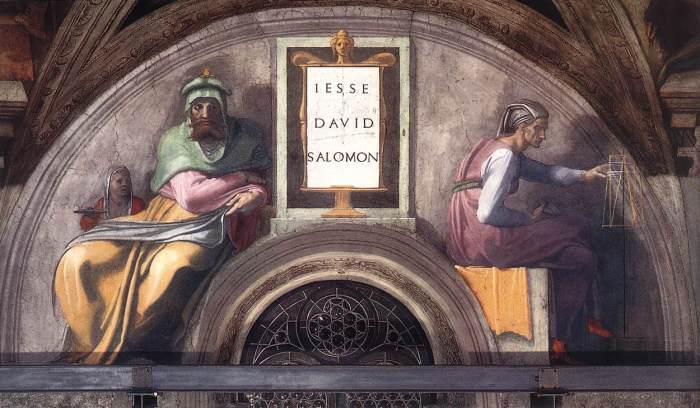
Peter Leithart makes the point that the genealogies of 1 Chronicles 1 shift from father-son language to the language of death with the introduction of kings. Building on this, we could say that:
- Priests beget sons and houses in a Fatherly fashion (1 Chronicles 6:3)
- Kings beget kings and kingdoms in a Son-like fashion, by dying (1 Chronicles 29:28 – 2 Chronicles 1:1)
- Prophets beget in a Spirit-like fashion, by speaking-breathing:
- New life into being by their prayer (1 Kings 17)
- A new covenant-creation-world into being by their authority (Zechariah)
- New prophets into being by their teaching (2 Kings 2:3)
All God’s people now are priests (1 Peter 2:5), kings (Ephesians 2:6), and prophets (Acts 2:17-18). Be fruitful, and multiply!
Sacrifice
James Jordan suggests a kind of monergistic understanding of sacrifice:
Sacrifice is something God does, not something we do. We commonly speak of “making a sacrifice” when we give something up for someone else. That “works-centered” notion of sacrifice does not do justice to the Biblical idea of sacrifice. The lamb led to the slaughter was not particularly thrilled at the idea, and neither was Jesus, who asked that if possible the cup might be taken from Him. When God comes to sacrifice us it is usually painful, and that is why singing the psalms is so important, because the psalms are full of pain.
We would like to think that when the pain comes, we will joyfully accept it. Sometimes that is what happens, but think about it: If you are able to keep a cool head during your suffering, then you are not experiencing the fullness of suffering. The most potent kind of suffering, and of sacrifice, comes when you experience a “dark night of the soul,” when it feels as if God has deserted you, when the inward agony does not let up day after day, when you are weak and not strong, when you join Job on the ash heap of ignorance concerning what God is doing to you. This kind of sacrificial experience means that the Great Physician is doing “depth surgery” on you, operating at levels you cannot understand. The psalms are full of this kind of experience, and it is this kind of experience that Lord’s Day worship is, in part, all about. (Theses on Worship, 86)
Good Samaritan
 James Jordan writes of a three-layered meaning of the parable of the Good Samaritan:
For 1900 years, pastors in every branch of the Church have interpreted the parable of the Good Samaritan as having a “first application” to our Lord Himself. Jesus is the Good Samaritan, who helped in the face of death when the Old Creation’s representatives (priest and Levite) were unable and unwilling to do so. The inn at which He left the man is the Church, the community of believers that has been given money and oil (the Spirit) to help converts. The broken man in the parable is the lawyer who asked Jesus, “Who is my neighbor?” Jesus answered, “I am your Neighbor, man. Don’t you see that you are near death? You have left the holy city Jerusalem and gone down to the accursed city of Jericho. You need a Neighbor, and I am He.” A secondary point of the parable of course, is to set an example for us, who are in Christ. (Theses on Worship, 56)
Luther states that “This Samaritan of course is our Lord Jesus Christ himself.” Calvin, on the other hand, notes in his commentary that he has “no liking” for this interpretation, suggesting that it “disguise[s] its natural meaning.” To be fair, Calvin here is not arguing against Luther directly, but rather against “advocates of free will” who apparently argue from the man’s injury rather than death that he was not beyond reach of saving himself. Perhaps Calvin would not after all disagree with Luther’s and Jordan’s more straightforward application.
I side with Luther and Jordan. With Frame (tri-perspectivalism) and Poythress (symphonic theology) I don’t think that we must choose a single natural meaning and application here to the exclusion of all others. For example, we follow the very same approach in the Psalms, where we acknowledge that Jesus is the first singer of the Psalms (consider Heb. 2:11-12), and yet both the church corporate (the body of Jesus) and the individual Christian (united with Jesus) are also proper singers of the Psalms.
Sovereignty and responsibility
Calvinism is often accused of a kind of fatalism or determinism that does violence to the will of the creature. But this is a caricature, at least of the best of Calvinism. For example, the Westminster Confession of Faith confesses that “God from all eternity, did, by the most wise and holy counsel of His own will, freely, and unchangeably ordain whatsoever comes to pass; yet . . . the liberty or contingency of second causes [is not] taken away, but rather established.” (WCF 3.1)
This was a position that ebbed and flowed in the church. Augustine defended the sovereignty of God against Pelagius, and the Protestant reformation once again recaptured it.
In his recent book, Delivered From the Elements of the World, Peter Leithart shows that a healthy Augustinian view still persisted in the early stages of medieval Scholasticism:
[H]igh Scholastics like Aquinas did not . . . think that human beings could in any way escape the oversight and providence of God. Human beings are ontologically incapable of being independent causes of anything. For Thomas at least, cooperation between God and humans is not competition, and causation is not a sum total of divine and human causation.
According to Fergus Kerr, this theme “takes us right to the heart of Thomas’s theology. He often quotes Isaiah 26:12: ‘Lord, thou has wrought all our works in us’—which he takes . . . precisely as excluding all competitiveness between divine and human agency.” Cooperation for Thomas does not picture “two rival agents on a level playing field,” but rather he “sees it as a mark of God’s freedom, and ours, that God ’causes’ everything in such a way that the creature ’causes’ it too.” . . . According to Kerr, Thomas consistently contests the notion that “if God produces the entire natural effect, surely nothing is left for the human agent to do,” emphasizing instead a doctrine of “double agency,” in which God and humans act to produce the same effect, though in different ways. Thomas rightly sees this as an implication of the doctrine of creation: “It is always by divine power that the human agent produces his or her own proper effect: that is the doctrine of creation. It is not superfluous, even if in principle God can by himself produce all natural effects, for them to be produced by us as causes. Nor is this a result of the inadequacy of divine power, as one might be tempted to think, thus giving way to the charms of process theology. On the contrary: it is a result of the immensity of God’s goodness (bonitas: “bounty”). It is another implication of the doctrine of creation that God wills to communicate his likeness to things not only so that they might simply exist but that they might cause other things. Indeed, this is how creatures generally attain the divine likeness—by causing.”
. . . On this early understanding [prior to 1250], . . . [d]ivine and human causation are never in competition; causation is not a “zero-sum game” in which creaturely causation can only be affirmed at the expense of divine causation. Every event in creation is wholly the product of God’s action, and yet at the same time it is totally caused by creatures. God causes by influencing from within the creation, not by exerting power externally from without. . . .
So long as divine and human causation were not seen to be competitive, and as long as a human action was not conceived of as the product of human causation added to divine causation, human contributions to salvation could not be conceived of as independent contributions. On this view, there might be a proper synergism: We work out our salvation not in addition to God working in us, but because God works in us. We work and love because his Spirit who is love is poured into us and his power works in us. As soon as the notion of causation assumes an area of pure nature in which human beings act and exist in semi-independence of God’s action, then synergism becomes a Pelagian nightmare. This is the kind of cooperation posited by late medieval theology, and the kind of cooperation the Reformers were correct utterly to reject. (Leithart, 320-324)
All this is simply to say that God is the author of his creation. We do not think to say that Sauron and Saruman are not deeply responsible and accountable for their actions just because Tolkien penned them. We do not think to say that Frodo and Sam made no great sacrifice or achieved no great thing because Tolkien had intended it all along. Nor do we think to charge Tolkien with a lack of affection for his creation, willfully subjecting so many to the destruction of Melkor, Smaug, Sauron, Saruman and others, merely to show off his ability to turn a beautiful story.
Nor should we think to charge God with this.
Yet, wonder of wonders, unlike any other author, God entered his own creation to make things more deeply right than any other story.
God so loved the world (John 3:16)
Outrushing the fall of man is the height of the fall of God. (Chesterton, Gloria in Profundis)
Deployed
If the Philistines have taken our cities and our churches, we can still be agents of Yahweh’s victory. If we end up in exile or worse, it is because Jesus is sending us into new territory. The ark wasn’t captured, and neither was Samson. They were deployed. When God is with us, we are never captives. We are always invaders. Wherever He sends us, He sends us with better news than Dagon’s, the good news of Dagon’s ultimate defeat.
Jonah
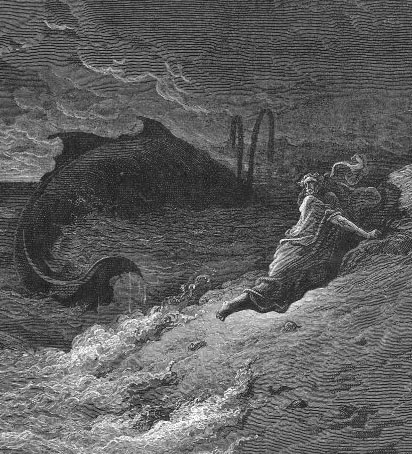 James Jordan offers a compelling psychologizing of Jonah, which he attributes to Scottish Presbyterian Patrick Fairbairn:
Jonah had been reluctant to preach to Nineveh, fearing that God would convert those people and thereby raise them up as a powerful nation. He knew that Israel deserved judgment, and that God had threatened to take the Gospel to another nation, thereby raising it up as a weapon to punish Israel (Deuteronomy 32:21). Sure enough, the people of Nineveh repented at the preaching of Jonah, and Jonah was horrified. In spite of her sins, Jonah loved wayward Israel and hated to see the Gospel taken from her to the Gentiles (compare Paul, Romans 9-11). (Jordan, Through New Eyes, 83)
This makes Jonah akin to the possibly despondent Elijah of 1 Kings 19. It also means that Jonah’s failure becomes a double failure. For one, even if this means that Jonah is not exhibiting garden variety nationalistic prejudice, clearly he is lacking in compassion for Assyria (witness God’s rebuke in Jonah 4:11). But in addition to that, he is misunderstanding God’s intentions towards Israel. Far from simply raising up Assyria as a scourge for Israel, God is actually using Jonah to prepare a place for Israel in exile. In fact, just as Moses spends forty years in the wilderness before leading Israel into the same experience, Jonah’s own experience is a foreshadowing of what God will bring the faithful remnant in Israel through. Just as Jonah is carried through the sea by a big fish before being spit upon dry land, Israel will be carried through the Gentile sea by Assyria before being brought back into their land. Just as Jonah is shaded from the heat of the sun by a plant, Israel will be shaded by Assyria for a time (God explicitly compares Assyria to the plant in Jonah 4:10-11).
The exile experience will be a judgment upon faithless Israel, but God will preserve a remnant through it, and will in fact use the residue of Ninevite believers converted by Jonah both to help soften the blow of exile and to help preserve his people. (You may wonder how it can be said that the ten lost northern tribes were preserved. The myth of the “ten lost tribes” is generally discredited. One quick illustration of this lies in the fact that Asher’s line remains alive in Luke 2:36.)
The Big Fish was Assyria. God was sending Jonah to convert Assyria to Him. Assyria would become a place of refuge and protection for Israel while they were in captivity. Eventually they would leave the land of Assyria (after Babylon and then Persia took it over) and return to their own land. (Similarly, in Jonah 4, converted Assyria would be a suddenly-arising gourd plant to shade captive Israel from the sun of God’s wrath.) Even though later on Assyria apostatized, as the book of Nahum records, still there would be a remnant there who would provide a pillow for Israel’s coming experience of captivity. (Jordan, Biblical Horizons issue 91, 1996)
Jordan observes that some of the imagery of Jonah also suggests that he is a new Noah creating out of Assyria an ark in which to preserve God’s people into the new post-exilic creation. Jonah’s name means dove, Jonah himself is carried safely through a storm on the seas, and the salvation brought by Jonah even includes the preservation of animals (Jonah 3:7-8, 4:11).
This understanding of what God is doing in Nineveh also serves to greater highlight his mercy. Not only is God showing mercy upon Jonah and upon the people and animals of Nineveh, but God is even as a result of this showing a double mercy upon Israel: first, to provoke them to a jealousy that will win them back to him (as in Romans 10); and second, to prepare not only a scourge but also a refuge for them. There is also possibly a “nearer” mercy that God is showing to Israel here. Jordan points out that there is the strange case of the savior for Israel mentioned in 2 Kings 13:5. Clearly this savior was not king Jehoahaz (2 Kings 13:7). It may be that God used Assyria as a more immediate shade to Israel as well.
Jesus later sleeps in a boat and calms a storm. Unlike Jonah, Jesus’s sleep is one of faith rather than unbelief. Jesus calms the storm and will later pass into the heart of the greater storm as a substitute, exactly like Jonah (Matthew 12, 16). Jesus does not simply use Jonah as a convenient analogy to express the time span of three days. In fact, “three days and three nights in the heart of the earth” is a strained analogy for the crucifixion. To make Jesus’s experience cover three days and three nights, we must extend it to his time on trial, so that the “heart of the earth” is Jerusalem and thus includes Jesus’s trial by Jew, Edomite, and Roman. (Calling Jerusalem the “heart of the earth” is not a novel reading; Ezekiel 38:12 refers to the “navel” of the land, and Ezekiel 5:5 describes Jerusalem as being in the “middle” of the nations.) So: Jesus passes into the storm of God’s wrath, at the hands of the Romans and Jews, to prepare a home for his people. We could speak of this home in both a not-yet and an already sense; Jesus prepares a place for us in the resurrection, but also a place for us now, in his church, which is a sort of ark and shade for God’s people in the present age.
So, then, the time Jesus spent in the tomb is parallel to the time Jonah spent in the Big Fish. Then Jesus is resurrected and goes forth to create a new Church (like Assyria) into which His old people can migrate for safety from the wrath to come upon Jerusalem. (Jordan, Biblical Horizons issue 91, 1996)
This ark-and-shade church was even founded by fishermen-apostles, and sailing tentmaker-apostles. There are a few more direct echoes of Jonah after the crucifixion. Peter struggles with God’s call to minister to Gentiles at the city of Joppa, but unlike Jonah at Joppa, Peter obeys God (Acts 10). Paul equally wrestles with the question of taking the gospel to the Gentiles in Romans 10-11, but expresses confidence that God will use it to bring about salvation. Paul thus does much sailing for the purpose of visiting Gentiles. Ultimately, Paul does not calm the storm like Jonah and Jesus, but leads people out of a sinking Roman ship in the midst of a storm (Acts 27). You could say that Rome served as a temporary protecting shade for the church during Jewish persecution, to allow the full number of Jews to pass into Jesus’s church. Then Rome’s protection is withdrawn, Jerusalem is destroyed, and the church stands alone as a possible protection from and even a table of bread in the storm.
In fact, you could even say that it is the church, through baptism, who turns the tables on the stormy nations and takes the waters of God to them; we are to “make disciples of all nations, baptizing them” (Matthew 28:19).
 I gotta have my orange juice.