Author Archive
Begetting

Peter Leithart makes the point that the genealogies of 1 Chronicles 1 shift from father-son language to the language of death with the introduction of kings. Building on this, we could say that:
- Priests beget sons and houses in a Fatherly fashion (1 Chronicles 6:3)
- Kings beget kings and kingdoms in a Son-like fashion, by dying (1 Chronicles 29:28 – 2 Chronicles 1:1)
- Prophets beget in a Spirit-like fashion, by speaking-breathing:
- New life into being by their prayer (1 Kings 17)
- A new covenant-creation-world into being by their authority (Zechariah)
- New prophets into being by their teaching (2 Kings 2:3)
All God’s people now are priests (1 Peter 2:5), kings (Ephesians 2:6), and prophets (Acts 2:17-18). Be fruitful, and multiply!
Sacrifice
James Jordan suggests a kind of monergistic understanding of sacrifice:
Sacrifice is something God does, not something we do. We commonly speak of “making a sacrifice” when we give something up for someone else. That “works-centered” notion of sacrifice does not do justice to the Biblical idea of sacrifice. The lamb led to the slaughter was not particularly thrilled at the idea, and neither was Jesus, who asked that if possible the cup might be taken from Him. When God comes to sacrifice us it is usually painful, and that is why singing the psalms is so important, because the psalms are full of pain.
We would like to think that when the pain comes, we will joyfully accept it. Sometimes that is what happens, but think about it: If you are able to keep a cool head during your suffering, then you are not experiencing the fullness of suffering. The most potent kind of suffering, and of sacrifice, comes when you experience a “dark night of the soul,” when it feels as if God has deserted you, when the inward agony does not let up day after day, when you are weak and not strong, when you join Job on the ash heap of ignorance concerning what God is doing to you. This kind of sacrificial experience means that the Great Physician is doing “depth surgery” on you, operating at levels you cannot understand. The psalms are full of this kind of experience, and it is this kind of experience that Lord’s Day worship is, in part, all about. (Theses on Worship, 86)
Good Samaritan
 James Jordan writes of a three-layered meaning of the parable of the Good Samaritan:
For 1900 years, pastors in every branch of the Church have interpreted the parable of the Good Samaritan as having a “first application” to our Lord Himself. Jesus is the Good Samaritan, who helped in the face of death when the Old Creation’s representatives (priest and Levite) were unable and unwilling to do so. The inn at which He left the man is the Church, the community of believers that has been given money and oil (the Spirit) to help converts. The broken man in the parable is the lawyer who asked Jesus, “Who is my neighbor?” Jesus answered, “I am your Neighbor, man. Don’t you see that you are near death? You have left the holy city Jerusalem and gone down to the accursed city of Jericho. You need a Neighbor, and I am He.” A secondary point of the parable of course, is to set an example for us, who are in Christ. (Theses on Worship, 56)
Luther states that “This Samaritan of course is our Lord Jesus Christ himself.” Calvin, on the other hand, notes in his commentary that he has “no liking” for this interpretation, suggesting that it “disguise[s] its natural meaning.” To be fair, Calvin here is not arguing against Luther directly, but rather against “advocates of free will” who apparently argue from the man’s injury rather than death that he was not beyond reach of saving himself. Perhaps Calvin would not after all disagree with Luther’s and Jordan’s more straightforward application.
I side with Luther and Jordan. With Frame (tri-perspectivalism) and Poythress (symphonic theology) I don’t think that we must choose a single natural meaning and application here to the exclusion of all others. For example, we follow the very same approach in the Psalms, where we acknowledge that Jesus is the first singer of the Psalms (consider Heb. 2:11-12), and yet both the church corporate (the body of Jesus) and the individual Christian (united with Jesus) are also proper singers of the Psalms.
Sovereignty and responsibility
Calvinism is often accused of a kind of fatalism or determinism that does violence to the will of the creature. But this is a caricature, at least of the best of Calvinism. For example, the Westminster Confession of Faith confesses that “God from all eternity, did, by the most wise and holy counsel of His own will, freely, and unchangeably ordain whatsoever comes to pass; yet . . . the liberty or contingency of second causes [is not] taken away, but rather established.” (WCF 3.1)
This was a position that ebbed and flowed in the church. Augustine defended the sovereignty of God against Pelagius, and the Protestant reformation once again recaptured it.
In his recent book, Delivered From the Elements of the World, Peter Leithart shows that a healthy Augustinian view still persisted in the early stages of medieval Scholasticism:
[H]igh Scholastics like Aquinas did not . . . think that human beings could in any way escape the oversight and providence of God. Human beings are ontologically incapable of being independent causes of anything. For Thomas at least, cooperation between God and humans is not competition, and causation is not a sum total of divine and human causation.
According to Fergus Kerr, this theme “takes us right to the heart of Thomas’s theology. He often quotes Isaiah 26:12: ‘Lord, thou has wrought all our works in us’—which he takes . . . precisely as excluding all competitiveness between divine and human agency.” Cooperation for Thomas does not picture “two rival agents on a level playing field,” but rather he “sees it as a mark of God’s freedom, and ours, that God ’causes’ everything in such a way that the creature ’causes’ it too.” . . . According to Kerr, Thomas consistently contests the notion that “if God produces the entire natural effect, surely nothing is left for the human agent to do,” emphasizing instead a doctrine of “double agency,” in which God and humans act to produce the same effect, though in different ways. Thomas rightly sees this as an implication of the doctrine of creation: “It is always by divine power that the human agent produces his or her own proper effect: that is the doctrine of creation. It is not superfluous, even if in principle God can by himself produce all natural effects, for them to be produced by us as causes. Nor is this a result of the inadequacy of divine power, as one might be tempted to think, thus giving way to the charms of process theology. On the contrary: it is a result of the immensity of God’s goodness (bonitas: “bounty”). It is another implication of the doctrine of creation that God wills to communicate his likeness to things not only so that they might simply exist but that they might cause other things. Indeed, this is how creatures generally attain the divine likeness—by causing.”
. . . On this early understanding [prior to 1250], . . . [d]ivine and human causation are never in competition; causation is not a “zero-sum game” in which creaturely causation can only be affirmed at the expense of divine causation. Every event in creation is wholly the product of God’s action, and yet at the same time it is totally caused by creatures. God causes by influencing from within the creation, not by exerting power externally from without. . . .
So long as divine and human causation were not seen to be competitive, and as long as a human action was not conceived of as the product of human causation added to divine causation, human contributions to salvation could not be conceived of as independent contributions. On this view, there might be a proper synergism: We work out our salvation not in addition to God working in us, but because God works in us. We work and love because his Spirit who is love is poured into us and his power works in us. As soon as the notion of causation assumes an area of pure nature in which human beings act and exist in semi-independence of God’s action, then synergism becomes a Pelagian nightmare. This is the kind of cooperation posited by late medieval theology, and the kind of cooperation the Reformers were correct utterly to reject. (Leithart, 320-324)
All this is simply to say that God is the author of his creation. We do not think to say that Sauron and Saruman are not deeply responsible and accountable for their actions just because Tolkien penned them. We do not think to say that Frodo and Sam made no great sacrifice or achieved no great thing because Tolkien had intended it all along. Nor do we think to charge Tolkien with a lack of affection for his creation, willfully subjecting so many to the destruction of Melkor, Smaug, Sauron, Saruman and others, merely to show off his ability to turn a beautiful story.
Nor should we think to charge God with this.
Yet, wonder of wonders, unlike any other author, God entered his own creation to make things more deeply right than any other story.
God so loved the world (John 3:16)
Outrushing the fall of man is the height of the fall of God. (Chesterton, Gloria in Profundis)
Religion and culture
Peter Leithart opens his recent book, Delivered From the Elements of the World, with the following observation:
No purely secular society exists or has ever existed. Define religion how you will: As a matter of ultimate concern, as belief in something transcendent, as the organizing master narrative for history and human lives, as a set of practices. However religion is defined, all institutions, structures and patterns of behavior have religious features. All cultures are infused with values and actions that have religious dimensions and overtones. Whether they name the name of a known God or not, societies and cultures are always patterned by some ultimate inspiration and aspiration.
By the same token, all religions have social aspects; they are all embedded in and rely on patterns of interaction among persons. Even the retreat of a solitary ascetic into the desert is a social act, since it is a retreat from social relation. And all religions deal with artifacts, symbols and rituals that might as well be called “cultural.”
Religion is not the “soul” of culture, nor culture the “body” of religion. Religions have bodies, and cultures have souls. It is rather the case that in dealing with any group of human beings, we are always dealing with socio-religious or religio-cultural entities. The common contemporary rhetoric of conflicts between religion and politics obscures the reality. Conflicts are never between politics and religion. Conflicts are always between rivals that are both religious and both political.
Islamic terrorists kill themselves and innocent bystanders for overtly religious reasons. In response, the United States sends troops to the Middle East to make the world safe from terrorism, but also to sacrifice themselves to preserve and advance America’s values, freedom and democracy. To say that the terrorist and the Marine are both motivated by religious values is not to make a moral equivalence. But we misread the times unless we recognize that the war on terror is a religious war on both sides.
We think ourselves all secular, all grown-up, but we have our taboos, our pollution avoidances, our instincts of recoil and disgust. Not so long ago, many found homosexual sodomy disgusting. In a matter of decades, the disgust has turned inside out, and now those who consider homosexual conduct sinful and unnatural are outcasts, treated with contempt. The freedom to engage in any form of consensual sex is now considered a right, and a sacred one, as inviolable as the sacred precincts of an ancient temple. (Delivered From the Elements of the World, 11-12)
Deployed
If the Philistines have taken our cities and our churches, we can still be agents of Yahweh’s victory. If we end up in exile or worse, it is because Jesus is sending us into new territory. The ark wasn’t captured, and neither was Samson. They were deployed. When God is with us, we are never captives. We are always invaders. Wherever He sends us, He sends us with better news than Dagon’s, the good news of Dagon’s ultimate defeat.
Jonah
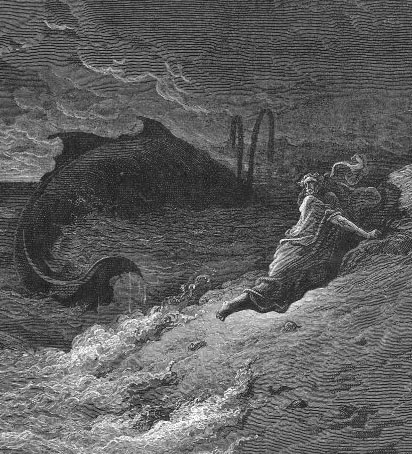 James Jordan offers a compelling psychologizing of Jonah, which he attributes to Scottish Presbyterian Patrick Fairbairn:
Jonah had been reluctant to preach to Nineveh, fearing that God would convert those people and thereby raise them up as a powerful nation. He knew that Israel deserved judgment, and that God had threatened to take the Gospel to another nation, thereby raising it up as a weapon to punish Israel (Deuteronomy 32:21). Sure enough, the people of Nineveh repented at the preaching of Jonah, and Jonah was horrified. In spite of her sins, Jonah loved wayward Israel and hated to see the Gospel taken from her to the Gentiles (compare Paul, Romans 9-11). (Jordan, Through New Eyes, 83)
This makes Jonah akin to the possibly despondent Elijah of 1 Kings 19. It also means that Jonah’s failure becomes a double failure. For one, even if this means that Jonah is not exhibiting garden variety nationalistic prejudice, clearly he is lacking in compassion for Assyria (witness God’s rebuke in Jonah 4:11). But in addition to that, he is misunderstanding God’s intentions towards Israel. Far from simply raising up Assyria as a scourge for Israel, God is actually using Jonah to prepare a place for Israel in exile. In fact, just as Moses spends forty years in the wilderness before leading Israel into the same experience, Jonah’s own experience is a foreshadowing of what God will bring the faithful remnant in Israel through. Just as Jonah is carried through the sea by a big fish before being spit upon dry land, Israel will be carried through the Gentile sea by Assyria before being brought back into their land. Just as Jonah is shaded from the heat of the sun by a plant, Israel will be shaded by Assyria for a time (God explicitly compares Assyria to the plant in Jonah 4:10-11).
The exile experience will be a judgment upon faithless Israel, but God will preserve a remnant through it, and will in fact use the residue of Ninevite believers converted by Jonah both to help soften the blow of exile and to help preserve his people. (You may wonder how it can be said that the ten lost northern tribes were preserved. The myth of the “ten lost tribes” is generally discredited. One quick illustration of this lies in the fact that Asher’s line remains alive in Luke 2:36.)
The Big Fish was Assyria. God was sending Jonah to convert Assyria to Him. Assyria would become a place of refuge and protection for Israel while they were in captivity. Eventually they would leave the land of Assyria (after Babylon and then Persia took it over) and return to their own land. (Similarly, in Jonah 4, converted Assyria would be a suddenly-arising gourd plant to shade captive Israel from the sun of God’s wrath.) Even though later on Assyria apostatized, as the book of Nahum records, still there would be a remnant there who would provide a pillow for Israel’s coming experience of captivity. (Jordan, Biblical Horizons issue 91, 1996)
Jordan observes that some of the imagery of Jonah also suggests that he is a new Noah creating out of Assyria an ark in which to preserve God’s people into the new post-exilic creation. Jonah’s name means dove, Jonah himself is carried safely through a storm on the seas, and the salvation brought by Jonah even includes the preservation of animals (Jonah 3:7-8, 4:11).
This understanding of what God is doing in Nineveh also serves to greater highlight his mercy. Not only is God showing mercy upon Jonah and upon the people and animals of Nineveh, but God is even as a result of this showing a double mercy upon Israel: first, to provoke them to a jealousy that will win them back to him (as in Romans 10); and second, to prepare not only a scourge but also a refuge for them. There is also possibly a “nearer” mercy that God is showing to Israel here. Jordan points out that there is the strange case of the savior for Israel mentioned in 2 Kings 13:5. Clearly this savior was not king Jehoahaz (2 Kings 13:7). It may be that God used Assyria as a more immediate shade to Israel as well.
Jesus later sleeps in a boat and calms a storm. Unlike Jonah, Jesus’s sleep is one of faith rather than unbelief. Jesus calms the storm and will later pass into the heart of the greater storm as a substitute, exactly like Jonah (Matthew 12, 16). Jesus does not simply use Jonah as a convenient analogy to express the time span of three days. In fact, “three days and three nights in the heart of the earth” is a strained analogy for the crucifixion. To make Jesus’s experience cover three days and three nights, we must extend it to his time on trial, so that the “heart of the earth” is Jerusalem and thus includes Jesus’s trial by Jew, Edomite, and Roman. (Calling Jerusalem the “heart of the earth” is not a novel reading; Ezekiel 38:12 refers to the “navel” of the land, and Ezekiel 5:5 describes Jerusalem as being in the “middle” of the nations.) So: Jesus passes into the storm of God’s wrath, at the hands of the Romans and Jews, to prepare a home for his people. We could speak of this home in both a not-yet and an already sense; Jesus prepares a place for us in the resurrection, but also a place for us now, in his church, which is a sort of ark and shade for God’s people in the present age.
So, then, the time Jesus spent in the tomb is parallel to the time Jonah spent in the Big Fish. Then Jesus is resurrected and goes forth to create a new Church (like Assyria) into which His old people can migrate for safety from the wrath to come upon Jerusalem. (Jordan, Biblical Horizons issue 91, 1996)
This ark-and-shade church was even founded by fishermen-apostles, and sailing tentmaker-apostles. There are a few more direct echoes of Jonah after the crucifixion. Peter struggles with God’s call to minister to Gentiles at the city of Joppa, but unlike Jonah at Joppa, Peter obeys God (Acts 10). Paul equally wrestles with the question of taking the gospel to the Gentiles in Romans 10-11, but expresses confidence that God will use it to bring about salvation. Paul thus does much sailing for the purpose of visiting Gentiles. Ultimately, Paul does not calm the storm like Jonah and Jesus, but leads people out of a sinking Roman ship in the midst of a storm (Acts 27). You could say that Rome served as a temporary protecting shade for the church during Jewish persecution, to allow the full number of Jews to pass into Jesus’s church. Then Rome’s protection is withdrawn, Jerusalem is destroyed, and the church stands alone as a possible protection from and even a table of bread in the storm.
In fact, you could even say that it is the church, through baptism, who turns the tables on the stormy nations and takes the waters of God to them; we are to “make disciples of all nations, baptizing them” (Matthew 28:19).
Courtroom
 It is common to think of the Christian’s future—either when we die or when we are resurrected—as commencing with a solemn and fearful judgment before God’s throne, a moment when we stand in the dock before God. For example, we may sing of Satan’s recurring accusation and God’s judgment, reminding ourselves that Jesus is “my only hope, my only plea.” It is commonly thought that we will have to verbalize this plea some future day when we stand before God’s throne as a sort of ticket to entry. This is not without good reason: confession and repentance and faith is indeed the attitude with which we as Christians, as so many Mephibosheths and Esthers, must approach God at all times. And it is not without scriptural justification: consider the great white throne judgment of Revelation 20, or Satan’s heavenly accusations of the righteous Job. We must give an account to God (Hebrews 4:13).
There is a kind of fear of God we are to have at all times (Deuteronomy 6:13, etc.), and there is a kind of judgment-evaluation that all men will experience (e.g., Psalm 96), and which will come as a surprise to some (Matthew 7:21-23). But it is worth considering God’s own situation and attitude as his people approach him, especially since Jesus has been raised for our justification and is now seated at the right hand of God the Father Almighty. This will help us to better understand the kind of fear we are to have and the kind of judgment we are to expect.
The first thing we must recognize is that the Western courtroom, where we stand in the dock and where there is judge and witness and accuser and advocate, does not fit the heavenly model. God is a judge, to be sure, but he is a judge by virtue of his being king. A kingly courtroom is a place not only for passing judgment, but also for receiving audience, receiving honor and tribute, hearing petition, giving instruction and reward and commission, and feasting. We see this confirmed in the arrangement of the tabernacle, the arrangement of the temple, the types of Christ such as David and Solomon and Ahasuerus, and in the churchly-heavenly models of approaching God (Hebrews, Revelation) that are given to us in the new creation. So the mental picture that we have of a contemporary Western courtroom does not adequately represent the setting and atmosphere that we will experience with God.
More importantly, as we approach God in his heavenly court, we must remember that the Christian has already been justified by faith in Jesus (Romans 3:28, Galatians 2:16, etc.). Not only that, but our justification-adoption has been publicly announced by God through his church by our baptism, which symbolically identifies us with Jesus (Romans 6, Colossians 2:12-13, Titus 3:4-7) so that we very clearly share in the Father’s baptismal declaration over him that he is “well pleased” with us (Matthew 3:17, Mark 1:11, Luke 3:22). There is no need for us to be re-justified before God in this sense.
We must also remember that the Christian’s accuser has already been cast down from the heavenly court (Revelation 12:10-12). There is quite simply no accusation lodged against us in the heavenly court, nor can there be for those who have been justified (Romans 8:31-39) and adopted as sons. Taken together, this completely changes the tone of our appearances before God. It is true that those who are only masquerading as sons will be readily discovered and dealt with in their meeting with God. False sons experience a judgment unto wrath. But it is not true that the Christian’s meeting with God begins with the tone of what is essentially yet another paternity test to verify we are still sons. We stand tall as true sons, returned from a mission, to be evaluated and then praised or even chided and disciplined, yet with the actual purpose not of being evaluated but of being received in fellowship. Even in discipline God is, in the best sense, for us and not against us. God is inseparably both judge and Father, but there is much more the Father than the judge as we enter the heavenly court. “There’s my son; isn’t he a fine son?” (Matthew 3:17, Job 1, etc.) Note well: we have this standing only in Jesus. But, praise God, we really and truly have it!
We see a clear picture of this in how the prodigal son returns to the prodigal father (Luke 15). The son does rightly to walk in humility, confessing and repenting. But how glorious the father’s response: both sonship and repentance play into the exuberant reception, but far more the sonship. Repentance is simply one of the things that sons do; you could say that it is in one sense a kind of test or proof of sonship, but it is not at all a kind of admission exam to the feasting table.
This is important for us to keep in mind not only as we look ahead to our death and resurrection, but also day in and day out. To petition God in prayer at any time is to come before his throne. We do this “in Jesus’s name,” and we may come bold and confident (Hebrews 4:16) to a Father who is eager to see us and to hear our requests. In an even more heightened sense, the Lord’s day corporate worship of the church is an audience with king Jesus, where we stand and sit before him at his throne and at his table. Here it is quite proper to begin with confession of our sin. And our confession and repentance must never become perfunctory. But neither must it be a terror, and we need not imagine it to be a terror to keep it from being perfunctory.
Our confession on entrance into Jesus’s presence follows his own invitation to assemble before him, and we may be confident from his invitation, disposition, and promises that he receives us in the spirit of a king holding feast far more than a king sitting in judgment over criminal cases. Our confession and repentance are a way of keeping a short account with our Father and King, a sort of washing our hands before we join him at the table. It is to his glory that we stand tall wearing his robes of righteousness rather than sackcloth and ashes as we gather around him (Matthew 22:11-13, Proverbs 14:28), and in fact we are commanded to stand before him with joyful hearts and faces rather than grieving over our sin (Nehemiah 8:9-12). The prodigal son changed clothes as he sat to feast with his father. And that feast is telling of the father’s heart; our weekly invitation from and feast with Jesus is another proof that he is already favorably disposed toward us.
We must also consider that our own role in God’s heavenly court is not to serve as the subject of the court’s deliberation, but to participate as junior judicial members of the court. We are seated with Jesus (Ephesians 2:6). We will participate in judging the world (1 Corinthians 6:2), and will even judge angels (1 Corinthians 6:3). The new creation brings about what we might call the prophethood of all believers (Acts 2:17), which places us in God’s heavenly council (Amos 3:7). Just as Abraham, Moses, Habakkuk, Amos, and other prophets pleaded with God in council to shape his plans, the church may now participate in God’s evaluations and judgments.
All this—our settled adoption and our participation in God’s judgments—means that, amazingly, we may freely call upon God to judge us: not on the basis of any kind of perfection or righteousness or deserving in ourselves, but because we have already been judged and found to be sons. The sons are free (Matthew 17:26), both in the heavenly court and in the world at large, except as God calls us to special missions of sacrifice and deprivation for the sake of our growth and for the sake of his kingdom.
Another way to put this is to say that the evaluations and judgments and justifications that we have yet to experience—each time we meet for worship or on the last day—have nothing to do with the kind of justification whereby we receive righteousness from Jesus and have perfect standing before God. That is finished, in the past, a permanent change of status. Instead, what we experience in part each week, and will one day experience in full, is a judgment, a declaration, even a species of justification, that publicly vindicates us rather than changing our status. We are not waiting to hear whether God will accept us; that is sure. We are waiting for all the world to see that we were right to trust in Jesus and his promises, that it was not, after all, a fool’s errand, but that through our patience and faith and suffering we have inherited the world.
It is true that some will be surprised at God’s evaluation on the last day (Matthew 7:21-23). But the Christian need not fear this, and must instead look forward to being publicly vindicated before the world for trusting in Jesus. The great white throne judgment is from one perspective a kind of judgment. But much more it is the cotillion ball at which the débutante church is set apart to be admired by all as she joins the society of the king and prince.
Christian, it is true that you need not fear God’s judgment because of your union with Jesus. But more than that, you do not even have in your future to stand in the dock in a kind of judicial courtroom, again because of Jesus. All such courtrooms exist only for those who reject the king, and the only courts you have to look forward to are audiences and meals with the king. Be sure that you continue to approach with humility and repentance, but be equally sure that you approach with faith and confidence in your rightful place at God’s table.
Irrevocable
Chesterton writes of Utopia, romance, and oaths:
I could never conceive or tolerate any Utopia which did not leave to me the liberty for which I chiefly care, the liberty to bind myself. Complete anarchy would not merely make it impossible to have any discipline or fidelity; it would also make it impossible to have any fun. To take an obvious instance, it would not be worth while to bet if a bet were not binding. The dissolution of all contracts would not only ruin morality but spoil sport. Now betting and such sports are only the stunted and twisted shapes of the original instinct of man for adventure and romance, of which much has been said in these pages. And the perils, rewards, punishments, and fulfilments of an adventure must be real, or the adventure is only a shifting and heartless nightmare. If I bet I must be made to pay, or there is no poetry in betting. If I challenge I must be made to fight, or there is no poetry in challenging. If I vow to be faithful I must be cursed when I am unfaithful, or there is no fun in vowing. You could not even make a fairy tale from the experiences of a man who, when he was swallowed by a whale, might find himself at the top of the Eiffel Tower, or when he was turned into a frog might begin to behave like a flamingo. For the purpose even of the wildest romance results must be real; results must be irrevocable. Christian marriage is the great example of a real and irrevocable result; and that is why it is the chief subject and centre of all our romantic writing. And this is my last instance of the things that I should ask, and ask imperatively, of any social paradise; I should ask to be kept to my bargain, to have my oaths and engagements taken seriously; I should ask Utopia to avenge my honour on myself.
All my modern Utopian friends look at each other rather doubtfully, for their ultimate hope is the dissolution of all special ties. But again I seem to hear, like a kind of echo, an answer from beyond the world. “You will have real obligations, and therefore real adventures when you get to my Utopia. But the hardest obligation and the steepest adventure is to get there.” (Orthodoxy, ch. 7)
Or screenwriters
Chesterton writes:
though St. John the Evangelist saw many strange monsters in his vision, he saw no creature so wild as one of his own commentators. (Orthodoxy, ch. 2)

