Author Archive
Judgment
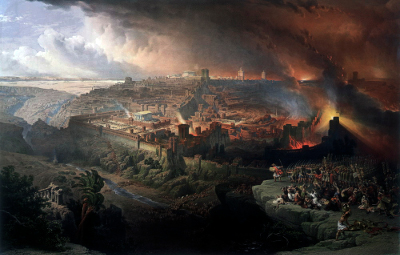 Preterism is interesting to me not only in how it makes sense of prophecy and history, but also in how it shapes our applying that prophecy to ourselves.
There is no question that there will be a future worldwide judgment (1 Corinthians 15). But a flat view of future worldwide judgment as the focus of prophecy (bypassing the extended comings of Jesus in the 1st century AD) leads us to a flattened application. It leads us to stress the world’s and even the Christian’s deserving of judgment (“none is righteous, no, not one;” “all our righteous deeds are like a polluted garment”), and stress the magnitude of God’s undeserved mercy to escape this judgment. This is a right and true perspective. But if we recognize that very much prophecy also focuses on the faithlessness and failure and judgment of Israel, then there are deeper qualities to this story that spring to life.
Preterism helps us to reckon with the fact that the Christian is truly righteous, that judgment for God’s people is only in the past. At the same time, it also helps us to reckon with the fact that the church will be judged more strictly and severely (1 Peter 4:17), not only at the end of time but also throughout history.
Neither David (Psalm 14:1-3) nor Paul (Romans 3:10-11) is making a universal statement about the absence of righteousness. David is speaking of the enemies of God’s people (the righteous actually show up immediately afterwards in Psalm 14:4ff!). Paul is speaking of God’s people rusted through: turned unrighteous with only a fake veneer of pretended righteousness, yet with a righteous remnant actually remaining in the newly established church. Isaiah (64:6) is speaking in a similar context; he does not assume the impossibility of righteousness, but rather recognizes that Israel’s former and now pretended righteousness really had become degenerate and polluted; they had presumed upon God’s grace and mercy.
So we see first of all that it is really possible to be righteous (Psalm 14:5), by the obedience of faith that brings justification. There is no future judgment for the Christian, only an evaluation as sons and daughters. Yet we also see that God holds his people to strict account; it is really possible to presume upon God’s mercy (Romans 2:4), and our justification requires our faith to be living and obedient (James 1-2). And this serves as a particular warning to the church to remain faithful, for while there is now a greater outpouring of the Spirit to ensure the life of the church (Jeremiah 31; Hebrews 8, 10; etc.), we have concrete historical reminders of the apostasy and presumption and judgment of God’s people throughout the Bible and culminating in AD 70. Churches and movements and denominations can fall even while Jesus strengthens and grows the greater church worldwide. Consider the greatness of the falls of the church in Rome in spite of Paul’s own personal warning to them:
But if some of the branches were broken off, and you, although a wild olive shoot, were grafted in among the others and now share in the nourishing root of the olive tree, do not be arrogant toward the branches. If you are, remember it is not you who support the root, but the root that supports you. Then you will say, “Branches were broken off so that I might be grafted in.” That is true. They were broken off because of their unbelief, but you stand fast through faith. So do not become proud, but fear. For if God did not spare the natural branches, neither will he spare you. Note then the kindness and the severity of God: severity toward those who have fallen, but God’s kindness to you, provided you continue in his kindness. Otherwise you too will be cut off. (Romans 11:17-22 ESV)
And recall that Babylon in Revelation is not a symbol of the world, but a symbol of Jerusalem’s good worship gone bad.
Preterism does not at all prevent us from applying prophecy and the reality of God’s judgment to the end of time and history. It simply helps us not to fast forward to that day without pausing to reflect on God’s judgments within time and history (especially the great twin reckonings of AD 30 and AD 70), and how God’s people experience these judgments. Jesus is both the one who truly and perfectly justifies (Romans 3:26), and also the one who walks among the lampstands (Revelation 1:13).
In the regeneration
We’ve considered how regeneration as it is used today is not the same sense in which the word is used in Scripture or even by the 16th century reformers. This has some interesting implications.
First, as we highlight the greater work of the Spirit in the new covenant (e.g., Jeremiah 31; Hebrews 8, 10), it is possible to overstate things. At times we come close to speaking as if the amazing regenerating work of the Spirit is new to the new covenant, but this cannot be the case, at least in the ordo salutis sense of regeneration. Anyone who was saved under the old covenants was saved in just the same way: through faith alone, by grace alone, by the work of Jesus alone, and only by the life–giving work of the Holy Spirit. However, if we consider that the regeneration, as Scripture uses the term, is not an internal reality so much as a status or stream into which we are placed, then there is a clear sense in which this is new to the new covenant. The king has finally now arrived with his kingdom and is seated on his throne; this life–giving stream finally now flows out of each of us to one another (John 7:38); so that you could even say the great change is that life is now contagious rather than death (Mark 5 versus Leviticus 15 and Numbers 19). We are no longer islands of life but currents of the life–giving stream itself; zephyrs of the great wind (John 3:8). And those who die now no longer wait under the altar (Rev. 6:9) but are blessed indeed (Rev. 14:13) with perfect rest. In this sense of the word, then, believers are now, for the first time in history, regenerated.
Second, this turns on its head the question of how much the new covenant moves from operating in corporate realities to individual realities. Individual realities are not lessened, of course; it is individuals who participate in this great salvation and this stream of regeneration. But the corporate–social realities are actually heightened in the new covenant. God’s people are transformed from the body of Moses (Jude 9) to the body of Christ. In this body there is a new kind of life-giving and cohesive power of the Holy Spirit that has never been seen before; so much so that this corporate body itself is a new creation and experiences rebirth (Ezekiel 37, John 3). To be saved is not merely to participate in a covenant and be joined to a body, but now to participate in the regeneration (Matt 19:28) that is and is to come.
The joy-filled life
I was delighted by C. R. Wiley’s thoughts on Tom Bombadil in these two blog posts: Bombadil at Home and The Bombadil Option.
I try to keep [Bombadil] in mind when the Gandalfs of the world try to send me gallivanting off on an adventure. I’m not immune, mind you. At times I feel the stirring, and sometimes I even ride off to try and save the day. But eventually I come home again. And after that?—wistfully stare out the window and long for significance?
Or should I gather water lilies for my Goldberry and enjoy her charms; eating the food she has prepared for me and sitting by the fire and laughing as I recall the queer antics of badgers? I think so—because that’s the world I’m made for, the world I go to save when the lust for derring-do sweeps me along. That’s the world I’ve been given to serve as master.
A god too great for the sky
This weekend our small group enjoyed our second annual caroling in downtown Fuquay.

Merry Christmas!
Bread of heaven

When the angels went away from them into heaven, the shepherds said to one another, “Let us go over to Bethlehem and see this thing that has happened, which the Lord has made known to us.” And they went with haste and found Mary and Joseph, and the baby lying in a manger. (Luke 2:15-16 ESV)
Bethlehem means house of bread. Into this house, in a feeding trough, is laid the bread of life. He is our bread for feeding upon, food from God to give us life.
I am the bread of life. . . . I am the living bread that came down from heaven. If anyone eats of this bread, he will live forever. And the bread that I will give for the life of the world is my flesh.” (John 6:48, 51 ESV)
He is also to be a tribute offering, bread that will be lifted up (John 8, 12). Like a tribute offering, he is presented with oil and frankincense in both his birth and death (Matthew 2:11, Mark 15:23, John 19:39).
When anyone brings a grain offering as an offering to the LORD, his offering shall be of fine flour. He shall pour oil on it and put frankincense on it and bring it to Aaron’s sons the priests. And he shall take from it a handful of the fine flour and oil, with all of its frankincense, and the priest shall burn this as its memorial portion on the altar, a food offering with a pleasing aroma to the LORD. (Leviticus 2:1-2 ESV)
His obedience—and in him, our obedience—are food for God.
For I desire steadfast love and not sacrifice, the knowledge of God rather than burnt offerings. (Hosea 6:6 ESV)
When he said above, “You have neither desired nor taken pleasure in sacrifices and offerings and burnt offerings and sin offerings” (these are offered according to the law), then he added, “Behold, I have come to do your will.” He does away with the first in order to establish the second. And by that will we have been sanctified through the offering of the body of Jesus Christ once for all. (Hebrews 10:8-10 ESV)
We, after all, are one loaf (1 Cor 10:17).
Because there is one bread, we who are many are one body, for we all partake of the one bread. (1 Corinthians 10:17 ESV)
Take, eat!
He will give to all the faithful
His own self for heavenly food.
Religion
Religion is the power to encounter the unique as unique; superstition is the weakness to make the unique into something already known. . . .
Religion is the power, gentlemen, to neglect space. Philosophy is the power to neglect time. (Eugen Rosenstock-Huessy, Comparative Religion, 1954)
Practical atheism
Ralph Allen Smith, commenting on Zephaniah 1 (emphasis added):
The people that are complacent are saying in their hearts, “The Lord will not do good, nor will he do ill. They are practical atheists, in a way. . . They don’t believe that God is going to bring covenantal blessing or covenantal judgment.“
Fruit
The works of a Christian man, who is justified and saved by his faith out of the pure and unsought mercy of God, ought to be regarded in the same light as would have been those of Adam and Eve in paradise if they had not sinned. Of them it is said, “The Lord God took the man and put him into the garden of Eden to dress it and to keep it” (Gen. 2:15). Now Adam had been created by God just and righteous, so that he could not have needed to be justified and made righteous by keeping the garden and working in it; but, that he might not be unemployed, God gave him the business of keeping and cultivating paradise. These would have indeed been works of perfect freedom, being done for no object but that of pleasing God, and not in order to obtain justification, which he already had to the full, and which would have been innate in us all.
So it is with the works of a believer. Being by his faith replaced afresh in paradise and created anew, he does not need works for his justification, but that he may not be idle, but may exercise his own body and preserve it. His works are to be done freely, with the sole object of pleasing God. Only we are not yet fully created anew in perfect faith and love; these require to be increased, not, however, through works, but through themselves. . . .
True, then, are these two sayings: “Good works do not make a good man, but a good man does good works”; “Bad works do not make a bad man, but a bad man does bad works.” Thus it is always necessary that the substance or person should be good before any good works can be done, and that good works should follow and proceed from a good person. . . .
As then trees must exist before their fruit, and as the fruit does not make the tree either good or bad, but on the contrary, a tree of either kind produces fruit of the same kind, so must first the person of the man be good or bad before he can do either a good or a bad work; and his works do not make him bad or good, but he himself makes his works either bad or good. (Martin Luther, Concerning Christian Liberty)
Veiled
You store up powers of discretion and of decision by reading poetry. Poetry has always to deal with your future. And I’m already able to know what I positively cannot know about myself, in this very strange garment woven as a dream about the future. If you wanted to know the same truth, which the poet offers you, in the form of an ethical code, in the form of a lecture on morality, without this poetic veil, you would become a solemn ass.
It is asinine to study a course of ethics in advance. No situation which you will have to meet will ever have anything to do with all the abstract notions, and sentences, and phrases, which you have picked up in the process of learning about yourself, directly. But it is very different when you have read Goethe’s Werther, or Moby–Dick or Pierre, and then become despondent. Your despondency will be illuminated. You can strengthen and fortify your heart in this simile. (Eugen Rosenstock–Huessy, Make Bold To Be Ashamed, 1953)
Love language
Adam McIntosh writes:
Self-sacrifice [is] the Bible’s love language (John 15:13).
 I gotta have my orange juice.