Solar time
God loves numbers and patterns. You are probably familiar with how the numbers 12 and 70 are significant in Scripture.
But God also delights in dissonance and lopsidedness. The numbers 12 and 70 are quite distant; their least common multiple is 420. A lunar month (29.5 days) does not evenly fit into a year (365 or 365.25 days). A week (7 days) does not evenly fit into either a lunar month or a lunar year. The earth is not perfectly round, nor are orbits perfectly circular.
There is a kind of beauty in this that we should not resist or despise. We are meant to be disciplined by both these patterns and dissonances. I commend to you Eugen Rosenstock-Huessy’s reflections on time and the conjunctions and successions of times. Of course, this quote barely scratches the surface of what Rosenstock-Huessy has to say about time.
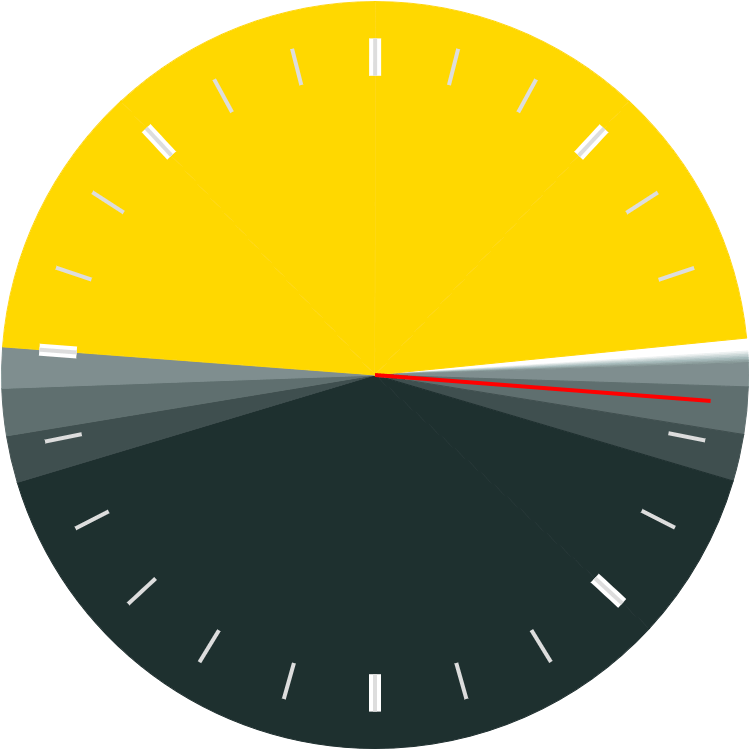
Inspired by Rosenstock-Huessy, I created a clock that reflects local and liturgical time. Here are some important points:
- Solar noon and midnight are pinned to the top and bottom of the clock.
- The face of the clock reflects a sweeping 24 hours. The white band indicates what you might call the “date line”—the divide between today and tomorrow. This divide trails the current time so that the clock primarily reflects a view of future hours.
- Daylight, nighttime, and the three twilights (civil, nautical, astronomical) are mapped on the clock.
- At extreme latitudes, day or night may not be present. The clock attempts to account for this but I have not fully tested it at every extreme. Please let me know if you run into problems.
- The major marks on the clock indicate a common understanding of the liturgical hours. The minor marks on the clock indicate a division of individual non-liturgical hours.
 I gotta have my orange juice.
[…] describe some of my motivation and some details on the clock’s behavior on my other […]
Solar time – full◦valence
March 1, 2026 at 7:27 am