Incorporation
Leviticus 12 specifies the old covenants’ rules for purification after childbirth:
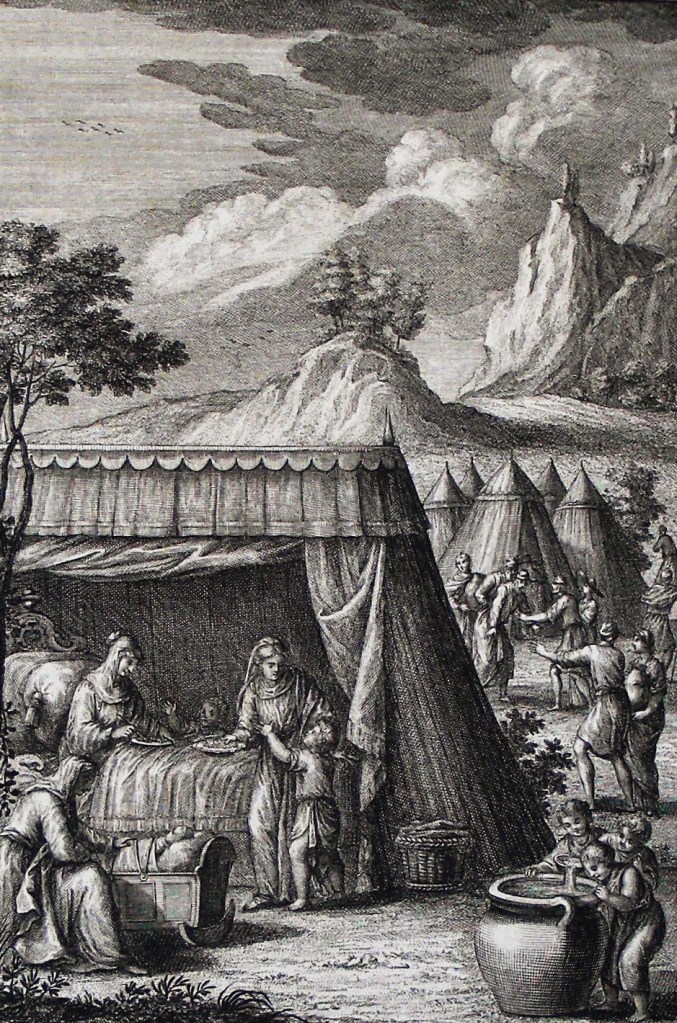
Then Yahweh spoke to Moses, saying, “Speak to the children of Israel, saying: ‘If a woman has conceived, and borne a male child, then she shall be unclean seven days; as in the days of her customary impurity she shall be unclean. And on the eighth day the flesh of his foreskin shall be circumcised. She shall then continue in the blood of her purification thirty-three days. She shall not touch any hallowed thing, nor come into the sanctuary until the days of her purification are fulfilled.
‘But if she bears a female child, then she shall be unclean two weeks, as in her customary impurity, and she shall continue in the blood of her purification sixty-six days.
‘When the days of her purification are fulfilled, whether for a son or a daughter, she shall bring to the priest a lamb of the first year as a burnt offering, and a young pigeon or a turtledove as a sin offering, to the door of the tabernacle of meeting. Then he shall offer it before Yahweh, and make atonement for her. And she shall be clean from the flow of her blood. This is the law for her who has borne a male or a female.
‘And if she is not able to bring a lamb, then she may bring two turtledoves or two young pigeons—one as a burnt offering and the other as a sin offering. So the priest shall make atonement for her, and she will be clean.’ ”
It’s widely recognized that circumcision is what serves to reduce the time of impurity for a son compared to a daughter; a son’s circumcision functions as a kind of partial sin-purification offering.
But it’s also interesting to note that these numbers (seven, thirty-three, fourteen, sixty-six) all appear in Genesis 46:
Now these were the names of the children of Israel, Jacob and his sons, who went to Egypt: Reuben was Jacob’s firstborn. The sons of Reuben were Hanoch, Pallu, Hezron, and Carmi. The sons of Simeon were Jemuel, Jamin, Ohad, Jachin, Zohar, and Shaul, the son of a Canaanite woman. The sons of Levi were Gershon, Kohath, and Merari. The sons of Judah were Er, Onan, Shelah, Perez, and Zerah (but Er and Onan died in the land of Canaan). The sons of Perez were Hezron and Hamul. The sons of Issachar were Tola, Puvah, Job, and Shimron. The sons of Zebulun were Sered, Elon, and Jahleel. These were the sons of Leah, whom she bore to Jacob in Padan Aram, with his daughter Dinah. All the persons, his sons and his daughters, were thirty-three.
The sons of Gad were Ziphion, Haggi, Shuni, Ezbon, Eri, Arodi, and Areli. The sons of Asher were Jimnah, Ishuah, Isui, Beriah, and Serah, their sister. And the sons of Beriah were Heber and Malchiel. These were the sons of Zilpah, whom Laban gave to Leah his daughter; and these she bore to Jacob: sixteen persons.
The sons of Rachel, Jacob’s wife, were Joseph and Benjamin. And to Joseph in the land of Egypt were born Manasseh and Ephraim, whom Asenath, the daughter of Poti-Pherah priest of On, bore to him. The sons of Benjamin were Belah, Becher, Ashbel, Gera, Naaman, Ehi, Rosh, Muppim, Huppim, and Ard. These were the sons of Rachel, who were born to Jacob: fourteen persons in all.
The son of Dan was Hushim. The sons of Naphtali were Jahzeel, Guni, Jezer, and Shillem. These were the sons of Bilhah, whom Laban gave to Rachel his daughter, and she bore these to Jacob: seven persons in all.
All the persons who went with Jacob to Egypt, who came from his body, besides Jacob’s sons’ wives, were sixty-six persons in all. And the sons of Joseph who were born to him in Egypt were two persons. All the persons of the house of Jacob who went to Egypt were seventy. (Genesis 46:8-27)
The numbers seven, thirty-three, fourteen, and sixty-six (together with the number sixteen) symbolically represent children who traveled to Egypt. There is a kind of forward progression to the numbers. The numbers of the children are incorporated into the number of the household, seventy. This number, seventy, is widely recognized to be symbolic of the nations, after the seventy nations listed in Genesis 10. In Egypt, Jacob through Joseph feeds those seventy nations in Genesis, but by the time of Exodus it becomes clear that Israel’s full mission to the seventy nations is just beginning (Exodus 15:27).
Glossing on this, it seems that in the ritual revolving around the birth of every single child, God wants his people to recognize a participation in and a responsibility for forward progression. The mother and child are ritually incorporated into a story (ranging from Genesis 10 and 46 to Exodus 15) with a history of God’s deliverance, an expectation of the future salvation of the nations, and accompanied with a responsibility of ministry to those nations.
It’s instructive to apply these numbers to David:
David was thirty years old when he began to reign, and he reigned forty years. In Hebron he reigned over Judah seven years and six months, and in Jerusalem he reigned thirty-three years over all Israel and Judah. (2 Samuel 5:4-5; see also 1 Kings 2:11; 1 Chronicles 3:4, 29:27)
In terms of Leviticus 12, David’s reign seems to function as a kind of 7-33 childbirth-purification cycle. Israel had, in a sense, for the first time given birth to a pre-eminent son. During this time God’s house was torn apart and she could not enter into worship as God intended. She had to undergo a time of purification before she could return to God’s house for worship. This, surely, is the deeper meaning behind God’s prohibition of David’s building his house. Interestingly, neither in Kings nor Chronicles is it recorded that God told Nathan that blood was the reason that David could not build the house. Rather, this is a conclusion that David received from God (though perhaps through Nathan):
And David said to Solomon: “My son, as for me, it was in my mind to build a house to the name of the Yahweh my God; but the word of the Yahweh came to me, saying, ‘You have shed much blood and have made great wars; you shall not build a house for My name, because you have shed much blood on the earth in My sight. Behold, a son shall be born to you, who shall be a man of rest; and I will give him rest from all his enemies all around. His name shall be Solomon, for I will give peace and quietness to Israel in his days. He shall build a house for My name, and he shall be My son, and I will be his Father; and I will establish the throne of his kingdom over Israel forever.’ (1 Chronicles 22:7-10)
We are to take from this a few applications.
First, the blood of war is analogous to the blood of childbirth. The establishment of a nation is analogous to the establishment of a family, house, household. In all cases, those who are bloodied must undergo a time of patience and purification before they can enjoy true rest.
Second, David is here highlighted as a kind of first, inaugural, or exemplary son. Although David’s reign is in this light presented as a time of waiting, God is doing a new thing with the house of David that he has not done before. I recommend Peter Leithart’s book, From Silence to Song, as a helpful reflection on some of the ways that David’s reign is an eruption into history of an extraordinary new covenant.
Third, this emphasizes that our hope for life and victory and rest is in the son of David.
Fourth, returning to Genesis 46, the ultimate purpose towards which David and his son’s rule are working is for the salvation of the nations; seven and thirty-three are moving towards seventy. “My house shall be called a house of prayer for all nations.” (Isaiah 56:7, Mark 11:17)
Finally, I want to return to the idea that the time after childbirth is a time of purification. Ultimately this implies that every Israelite child was baptized. This is because the mother’s “customary impurity” was a particularly virulent impurity:
If a woman has a discharge, and the discharge from her body is blood, she shall be set apart seven days; and whoever touches her shall be unclean until evening. (Leviticus 15:19)
The phrase “unclean until evening” is a synechdoche for washing in water; in other cases where people come into secondary contact with the woman, they must wash in water (vv. 21, 22, 23, 27). And although the Septuagint does not describe these washings as baptisms, Paul does (Hebrews 9:10). The childbirth-purification ritual that incorporates the woman and child into Israel’s history is thus a ritual that includes both baptism and sacrifice. It is therefore obviously the case that countless Hebrew newborns were baptized—likely each for several days in sequence.
And then, once David comes, it is necessary to become and remain incorporated into his history in order to be saved. In fact, in one prominent case this union-incorporation takes place by means of several baptisms; see Baptisms, Baptism exhortation.
Paul, in criticizing “various baptisms” in Hebrews 9, is not condemning baptism per se, but rather “various” baptisms, baptisms that are “only” baptisms. Paul still exults in one baptism (Ephesians 4:5), the one which unites us with Jesus (Romans 6, 1 Peter 3). We therefore baptize our babies, so that they may be incorporated into Jesus, Jesus’s history and future, and Jesus’s mission.
Jesus himself was therefore baptized as an infant, and this even before he was circumcised. Jesus’s own faithfulness and righteousness as an infant is precisely how we can have confidence that our own infants may be counted righteous by virtue of their incorporation into him. What was the point of Jesus’s coming as an infant if he did not intend to redeem infants and infancy itself? Augustine recognizes the force of this in a similar vein when arguing to those who have baptized their infants that it absolutely must be an effectual baptism rather than an empty one:
Those who say that infancy has nothing in it for Jesus to save, are denying that Christ is Jesus for all believing infants. Those, I repeat, who say that infancy has nothing in it for Jesus to save, are saying nothing else than that for believing infants, infants that is who have been baptized into Christ, Christ the Lord is not Jesus. After all, what is Jesus? Jesus means Savior. Jesus is the Savior. Those whom he doesn’t save, having nothing to save in them, well for them he isn’t Jesus. Well now, if you can tolerate the idea that Christ is not Jesus for some persons who have been baptized, then I’m not sure your faith can be recognized as according with the sound rule. Yes, they’re infants, but they are his members. They’re infants, but they receive his sacraments. They are infants, but they share in his table, in order to have life in themselves.
What are you telling me? That the child is perfectly all right, nothing wrong with it? Then why are you running with it to the doctor, if it’s perfectly all right? Aren’t you afraid he may say to you, “Take this child away, since you consider it to be perfectly all right; the Son of man only came to seek and save what had got lost; why bring the child to me, if it hadn’t got lost? (Augustine, Sermon 174, 7)
 I gotta have my orange juice.
Picture source: https://commons.wikimedia.org/wiki/File:The_Phillip_Medhurst_Picture_Torah_535._Purification_of_women._Leviticus_cap_12_vv_2-5._Harder.jpg
Scott Moonen
August 28, 2025 at 5:54 pm