Archive for March 2025
Mansfield Park
Some favorite quotes:
In everything but disposition they were admirably taught.
Lady Bertram . . . [was] one of those persons who think nothing can be dangerous or difficult or fatiguing to anybody but themselves.
Mrs Norris’s talking of it everywhere as a matter not to be talked of at present.
Of all transactions [marriage is] the one in which people expect most from others and are least honest themselves.
It will, I believe, be everywhere found, that as the clergy are, or are not what they ought to be, so are the rest of the nation.
It was a beautiful evening, mild and still, and the drive was as pleasant as the serenity of nature could make it; but when Mrs. Norris ceased speaking it was altogether a silent drive to those within. Their spirits were in general exhausted—and to determine whether the day had afforded most pleasure or pain, might occupy the meditations of almost all.
I speak what appears to me the general opinion; and where an opinion is general, it is usually correct.
Mrs. Norris . . . was now trying to be in a bustle without having any thing to bustle about, and laboring to be important where nothing was wanted but tranquility and silence.
There is nothing like employment, active indispensable employment, for relieving sorrow. Employment, even melancholy, may dispel melancholy.
My spirit prays
Jason Garwood recently proposed a reading of Paul’s head-covering passage that attempts to address apparent inconsistencies by using “quotation theory.” Quotation theory proposes that some of the text is not Paul’s writing, but his quotation of a previous letter from the Corinthians.
This made me wonder how we might apply quotation theory to 1 Corinthians 14. It seems to me that you could take the following statements to be quotations:
- “For he who speaks in a tongue does not speak to men but to God, for no one understands; however, in the spirit he speaks mysteries.” (v. 2)
- “He who speaks in a tongue edifies himself” (v. 3)
- “if I pray in a tongue, my spirit prays” (v. 14)
To me this is not really satisfying. It is interesting that it pushes against the idea of a private prayer language; but it requires Paul to be humoring the Corinthians more than pushing back against them, which doesn’t seem to strike the right balance. If what they are doing is allowable but immature, then I would expect more pushback: “though by this time you ought to be teachers.”
Quotation theory is quite a powerful scalpel; many folks want to use it to disregard the latter part of 1 Corinthians 14. It is an easy way to play the game of “has God indeed said.”
I’m still mulling over the interpretive key I suggested a year ago (see also this quote from James Rogers).
Elihu

I proposed that Elihu is one of Job’s adversaries and speculated why God does not rebuke him in Job 42:
Elihu is perhaps spared the worse condemnation because he is a young man imitating Job’s older counselors, who have a greater responsibility; or else because he repented while their hearts remained hardened.
Continuing to consider Job as a type of Jesus, I think we can more fully explain this difference if we see Elihu as one of Jesus’s disciples: fleeing, denying him, hiding in an upper room. Ironically, this makes Elihu the one who is vainly vaunting his righteousness.
If Job’s three friends are friends in the technical sense—his closest advisors, pillars of his kingdom—then Elihu is a lesser official. Like Jesus’s disciples, he is cowed by the example of the wicked stewards-usurpers, and betrays his king. By the time God is finished speaking, Elihu must have repented and restored his allegiance to Job.
Surrounded
The book of Job is, in effect, an immense psalm. (René Girard, I See Satan Fall Like Lightning, 117)
The interpretive key to the book of Job is that he is a type of Jesus.
Even among those who recognize this, Elihu is often seen as an enigma, partly because God does not call him out in Job 42. Obviously some of the things Elihu says are true—as with Job’s other accusers—but I think that that a close reading of how he applies these principles to Job makes it obvious that Elihu is among the bulls and dogs of Bashan that surround Job. Consider:
- Elihu’s burden is like wine ready to burst (32:19), and trips all over himself in his rush to judgment (“and Elihu answered [Elihu] and said . . .”), just as wine was thrust in Jesus’s face on the cross
- Elihu accuses Job of being unrighteous (32) or in relying excessively on his own righteousness (34, 35). Jesus on the cross was recognized as righteous (Luke 23), and in his high priestly prayer Jesus petitions his righteous father (John 17) for his well-deserved glorification—which is obviously a kind of vindication.
- Elihu observes that Job drinks scorn with water (34:7); Jesus is subject to all kinds of mocking on the cross
- Elihu accuses Job of going in the company of the workers of iniquity (34:8); Jesus is crucified with brigands
- Elihu accuses Job of complaining that righteousness is not profitable (34:9). Although this is not explicitly echoed on the cross beyond “why have you forsaken me,” such a complaint is within the scope of righteous speech. All we have to do is follow Girard’s pointing finger and examine Psalm 77.
- Elihu wishes for Job to be tried for rebellion (34:36-37). This is exactly what happened to Jesus.
Elihu is perhaps spared the worse condemnation because he is a young man imitating Job’s older counselors, who have a greater responsibility; or else because he repented while their hearts remained hardened.
Proper
From the vault of the evening sky, from the countryside beneath her gaze came the murmur of the mass intoned as she had heard it thousands of times before, in the voice of her father, who had explained the words to her when she was a child and stood at his knee: Then Sira Eirik sings the Præfatio when he turns toward the altar, and in Norwegian it means:
Truly it is right and just, proper and redemptive that we always and everywhere should thank Thee, Holy Lord, Almighty Father, eternal God. . . .
When she lifted her face from her hands, she saw Gaute coming up the hillside. Kristin sat quietly and waited until the boy stood before her; then she reached out to take his hand. There was grassy meadow all around and not a single place to hide anywhere near the rock where she sat.
“How have you carried out your father’s errand, my son?” she asked him softly. (Sigrid Undset, Kristin Lavransdatter, Kindle Edition, loc 11196)
Seven hundred years later my children hear this same declaration as they enter into worship:
Truly it is proper and right that we should at all times and in all places give thanks to You, O Lord, Holy Father, Almighty and Everlasting King, . . .
Edward
Sources:
- Waalwijk Wiki, Eduardus Constantinus Josephus Moonen, via the Internet Archive
- Waalwijk Wiki, Oorlogsmonument, via the Internet Archive
- Google Translate
Eduardus Constantinus Josephus Moonen
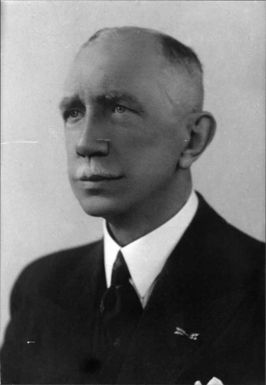
Eduardus Constantinus Josephus Moonen (Strijp, 24 June 1876 – Waalwijk, 6 September 1944) was married to Henriëtte Antonette Christine Sassen. He was mayor of Waalwijk from 1 March 1924 (Royal Decree 12 February 1924, no. 12) to 1 February 1944 and then acting mayor from 19 May 1944 to 6 September 1944. From 1924 to 1933 he was also deputy district judge.
Mayor
Moonen started his career in 1901 as a second lieutenant of the infantry and ended his military career as captain-adjutant in Breda. From this rank he was appointed mayor of Waalwijk quite unexpectedly. He was 48 years old at the time.
At the inauguration Moonen spoke the following words, in which he made his policy known: ‘It is entirely in line with my aim to be a good mayor for everyone, without exception for the entire population of Waalwijk’ and ‘from that source I will draw the strength to remain true to the motto that I want to make mine, even under difficult circumstances: everything for everyone.’
He became the binding force that tried to give shape to the trinity of the places that were merged in 1922. An expression of this was the way in which his twelve and a half years as mayor were celebrated. The entire population of Waalwijk, associations and institutions from Baardwijk, Waalwijk and Besoijen were present to honor their mayor.
Moonen’s term of office was characterised by more lows than highs. High unemployment, especially in the shoe and leather industry, caused the municipality concern. Support schemes were introduced. The shoe law brought some relief. The housing shortage increased and there were many slum dwellings. A development plan was drawn up for the area between Grotestraat and the railway line. The St. Crispijnstraat and surroundings were constructed, as well as the Besoijensche Steeg. The backlog of public facilities in Baardwijk was tackled. A public slaughterhouse was established. The harbor plans were continued and through Moonen’s persuasiveness the construction of the new town hall was assigned to Kropholler and carried out.
That he wanted to live up to his inauguration speech became apparent at the farewell of an alderman in 1926, when he pointed out the attitude that council members should have, namely to subordinate their own interests to the municipal interest. Genuine civic spirit, he stated, is the only basis on which an impartial treatment of public affairs can and may be based. Apparently other views existed during his term of office. For him, ‘omnibus idem’ (the same for everyone) applied.
As of 15 April 1924, Moonen was appointed deputy district judge. As a result of the abolition of the Waalwijk district court, he was honourably discharged from this office as of 1 January 1934.
He was faced with major decisions of conscience, he could no longer rely on the council, during the war years in the implementation of the measures imposed by the occupier. When Moonen retired in February 1944, he was called upon to take up the office again a few months later, as his deputies (the aldermen) were not available due to illness and busy work, and an NSB member apparently no longer wanted to come to the fore at that time.
On 6 September he died before the firing squad of Dutch SS members. His honorable discharge granted to him by the occupier in February 1944 was converted into an honorable discharge from K.B.
War victim
Mayor Moonen got up early on Wednesday, September 6, 1944. Like most people, he wondered where the liberators were; the reports about their advance were rather contradictory. He walked up and down in front of the town hall and accosted two resistance fighters who unfortunately knew just as little as he did. Around nine o’clock, Moonen entered the town hall, followed shortly afterwards by two women who wanted to talk to him. The tragedy had begun.
The previous day, a number of NSB members and Landwachters had been arrested. One woman was married, the other engaged to a Landwachter. They were naturally very worried about the two men. After all, they had also heard the stories about what would happen to the ‘traitors’ and they feared the worst. They turned to Mayor Moonen, but he could not help them any further (the two had been locked up in Sprang together with ten others). Disappointed, the women walked outside again. It was now half past nine.
Camouflaged vehicles drove into Waalwijk. It was the vanguard of the Landstorm Nederland. This battalion of Dutch SS men, the cadre of which was largely German, was on its way to the front near Antwerp. The SS men were in a grim mood. Furious about the flags they had seen on the way, they had shot at a crowd in Vlijmen and in doing so had killed three people, including a boy of barely seven.
In Waalwijk too, flags were hanging everywhere and the SS men stopped at the town hall to have them removed. That’s when the two women stepped outside. They accosted the first Dutch officer they saw and told their story. The SS man promised to help them. He stormed into the mayor’s office with his pistol drawn and demanded that the flags be taken inside and the two men returned to their wives. Moonen could do something about the first, but not about the second. The Dutch officer waited a while until most of the flags had been taken inside and then wanted to drive away again, because he also saw that the mayor had nothing to do with the kidnapping. At that moment his superior, Hauptsturmführer Maasz, arrived. The women also complained to him.
Maasz had a completely different character than his colleague. He was a typical arrogant Nazi for whom a human life was worth little. A few days earlier, he had had a soldier shot dead because he had stolen some petrol. He promised the women that he would wash the pig (i.e., do the job quickly). He approached Moonen, who had come outside and demanded the return of the land guards. He waved away protests: Moonen was mayor after all, he should know where the two were. He gave Moonen half an hour to find the men. The mayor went inside and called the leader of the Waalwijk OD for advice. But he did not know where the land guards were either.
Maasz’s patience was running out. He asked the women if they knew anything more about the kidnapping. ‘Yes,’ said one of them, ‘there was also a boy from Hoffmans there.’ The SS men then went to the house of the Hoffmans family, which had been pointed out by the women. There they dragged the 25-year-old Vincent and his 18-year-old brother Joop out of the house. Unfortunately, the women had been wrong. A cousin of the two brothers was involved in the kidnapping, but the brothers were completely innocent and did not know where the land guards were. Maasz did not care. He put the boys and the mayor under the lantern in the middle of the Raadhuisplein. It was now half past eleven. Maasz gave an ultimatum: he would wait until one o’clock, then the missing land guards had to be back. If not, the three would be shot dead.
Half an hour later, the SS men started to make preparations for the execution, presumably to scare the three men. Vincent now really got anxious and told the SS men that he had heard that the kidnapped men were somewhere in the municipality of Sprang-Capelle; he did not know where. Maasz sent a car, with Vincent as a guide, to Sprang. After half an hour, the car returned to Waalwijk empty-handed. Then a fourth person had to stand under the lantern, doctor Piet Lenglet. Lenglet had heard from an agent that the land guards might be released and he passed the message on to Maasz. When nothing happened, Maasz wanted to know from whom he had heard it. Lenglet did not want to betray his source and as punishment he was put with the others. It was about a quarter to one.
The clock ticked on relentlessly. The autumn sun beat down mercilessly on the heads of the four waiting men: doctor Lenglet, his face contorted with fear; Vincent Hoffmans, seemingly unmoved; his brother Joop with his hands hanging listlessly at his sides and mayor Moonen, the former officer, standing upright and with his head held high. The ultimatum had expired, but apparently Maasz was not happy either, because the time passed without anything happening. Mayor Moonen again pleaded for the three others. He pointed out that doctor Lenglet, as leader of a Red Cross team, was protected by international law. Maasz finally gave in and let Lenglet go. It was a quarter past one.
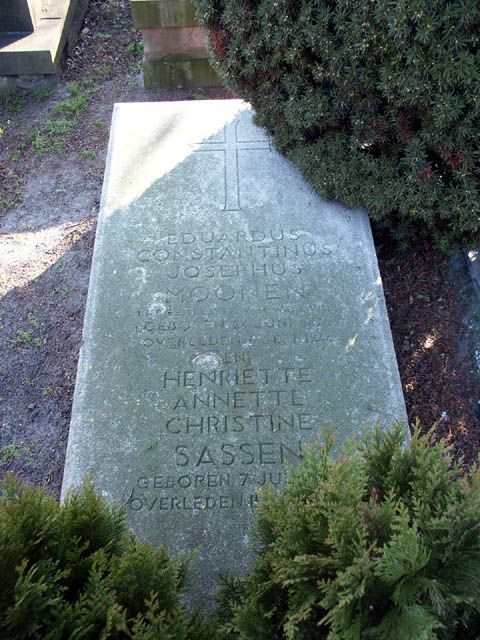
Maasz’s patience was now really at an end. Once again, after much insistence from Moonen, a priest was allowed to join them. Dean Heezemans tried to encourage the three condemned to death. Joop, the youngest, in particular, had a hard time. He tried to hold on to the priest. Then the dreaded order sounded: ‘Go ahead, it’s time.’
Because Mayor Moonen’s wife could follow everything from the window of the house on Raadhuisplein, Moonen asked as a last favor to have the execution take place behind the town hall. Maasz agreed. Together with two Dutch SS men, he accompanied the three men to the place of execution. The three Waalwijkers had to stand next to each other, facing the wall of the town hall. The two SS men picked up their weapons. Then Maasz shouted: ‘Feuer’ and the machine pistols crackled. It was exactly seven minutes past half past one.
The two non-commissioned officers turned out to be poor marksmen and only after a coup de grace were the mayor and Joop dead. Vincent miraculously survived the execution and the coup de grace. While dean Heezemans, who had seen that the coup de grace missed its target, distracted the SS men, he managed to scramble to his feet and run away. He was picked up and taken to ‘s-Hertogenbosch where an operation ultimately saved his life.
Oorlogsmonument (war monument)
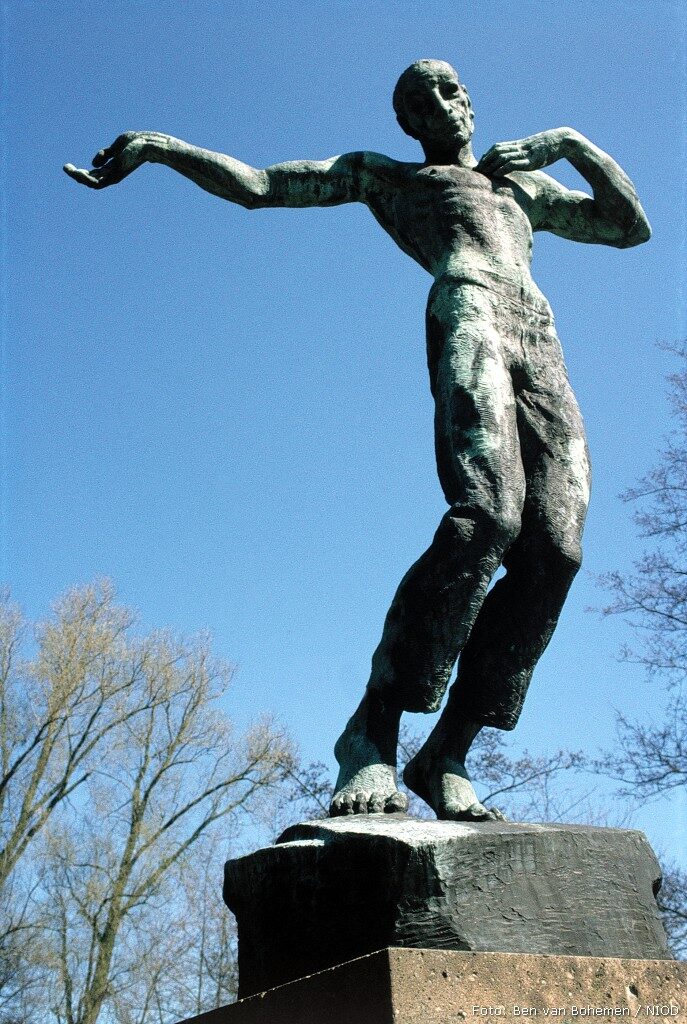
The War Memorial on Burg. Moonenlaan is a monument in memory of all Waalwijkers who died during the occupation and in particular of mayor Moonen, who was shot by the occupiers during the war. On October 30, 1949, the monument was unveiled by Mrs. H.A.C. Moonen-Sassen (1876-1957).
The commemoration takes place at the monument every year on 4 May.
Design
The monument, made by the Binder company from Haarlem, was designed by J.A. Raedecker. It is a statue of a male figure, collapsing after a firing squad. G.H. Holt designed the substructure and entourage.
Execution
The pedestal bears the dates ‘1940-1945’, the names of the Waalwijk war victims are engraved in the hard stone slabs that are placed around this pedestal, as well as a poem by Mrs. H. de Kat-van Zijl:
THEY FELL TO EARTH BEFORE THE GLOWING OF THE GOLDEN SUN,
FREEDOM DROVE AWAY THE LONG NIGHT OF WAR, FOR US, SPARED.
A MORE BEAUTIFUL MORNING SURROUNDED THEM, FALLEN TO HEAVENLY GARDEN,
WITH THE LIFE GIVEN TO THE BROTHERS, WOVEN FROM ETERNAL JOY.
The statue of cast bronze is 2.75 meters high. It stands on a 2-metre-high limestone column, which measures 1 x 1 meter at the top. The 4 x 4 meter pedestal is made of limestone with plates of bluestone. Bluestone boulders have been placed around the monument in a circle with a diameter of 16 m.
Special features
In 1965, art critic Pierre Janssen described the deeper meaning of this monument in the book ‘Two minutes is it quiet,’ referring to the gruesome and senseless execution by the Germans of mayor Moonen and Joop Hoffmans on 6 September 1944, with the following words:
Then they were captured and one day their lives suddenly ended. The man is just barely standing. But he will fall in a moment. Just look at his feet and his knees. Look, he is very lonely. He’s not angry. He does not resist anymore. He stretches out his arms and gives away his life. Just look at his face. It is a calm face. He sacrifices himself. This statue is there to help us remember that freedom is precious. A lot has been paid for it. Not with money, but with human lives.
Immediately after the liberation, De Echo van het Zuiden started collecting funds for the erection of a monument. Later, at the suggestion of the Waalwijks Belang association, it was decided that it should be a statue that would keep alive the memory of all Waalwijkers who died during the occupation.
The Waalwijk war monument was depicted on a postage stamp in 1965.
Raedecker is also the designer of the statues that are part of the National Monument on Dam Square in Amsterdam.
 I gotta have my orange juice.