Reprobate
Earlier, when Paul says that “none is righteous” (Rom. 3:10), he is obviously using it in a different sense. He is quoting Psalm 14, where David applies this statement to “the fool,” to “evildoers” and to the “children of man,” but takes comfort because “God is with the generation of the righteous” (i.e., the children of God). It is possible that Paul is applying Psalm 14 in a new direction, to all people everywhere. But there are better passages he could have used if he had wanted to make that point (e.g., Ps. 51:5). It seems more likely to me that he is saying something more subtle. Paul is not saying that no one anywhere is righteous; rather, he is making the provocative application of Psalm 14 to the Jews. They have ceased to be God’s righteous people and have become boastful evildoers, enemies of Jesus and his church.
Augustine agrees:
When, therefore, we look for the city of God in these seventy-two nations, we cannot affirm that while they had but one lip, that is, one language, the human race had departed from the worship of the true God, and that genuine godliness had survived only in those generations which descend from Shem through Arphaxad and reach to Abraham; but from the time when they proudly built a tower to heaven, a symbol of godless exaltation, the city or society of the wicked becomes apparent. Whether it was only disguised before, or non-existent; whether both cities remained after the flood, — the godly in the two sons of Noah who were blessed, and in their posterity, and the ungodly in the cursed son and his descendants, from whom sprang that mighty hunter against the Lord, — is not easily determined. For possibly — and certainly this is more credible — there were despisers of God among the descendants of the two sons, even before Babylon was founded; and worshippers of God among the descendants of Ham. Certainly neither race was ever obliterated from earth. For in both the Psalms in which it is said, They are all gone aside, they are altogether become filthy; there is none that does good, no, not one, we read further, Have all the workers of iniquity no knowledge? Who eat up my people as they eat bread, and call not upon the Lord. There was then a people of God even at that time. And therefore the words, There is none that does good, no, not one, were said of the sons of men, not of the sons of God. For it had been previously said, God looked down from heaven upon the sons of men, to see if any understood and sought after God; and then follow the words which demonstrate that all the sons of men, that is, all who belong to the city which lives according to man, not according to God, are reprobate.
—Augustine, City of God, Book XVI
Primeval Saints
Augustine the patriarch stan:
There [Abraham] called his wife his sister, and told no lie. For she was this also, because she was near of blood; just as Lot, on account of the same nearness, being his brother’s son, is called his brother. Now he did not deny that she was his wife, but held his peace about it, committing to God the defense of his wife’s chastity, and providing as a man against human wiles; because if he had not provided against the danger as much as he could, he would have been tempting God rather than trusting in Him. We have said enough about this matter against the calumnies of Faustus the Manichæan. At last what Abraham had expected the Lord to do took place. For Pharaoh, king of Egypt, who had taken her to him as his wife, restored her to her husband on being severely plagued. . . .
[Isaac] wished to bless the elder son, and instead of the elder, who was hairy, unwittingly blessed the younger, who put himself under his father’s hands, having covered himself with kid-skins, as if bearing the sins of others. Lest we should think this guile of Jacob’s was fraudulent guile, instead of seeking in it the mystery of a great thing, the Scripture has predicted in the words just before, Esau was a cunning hunter, a man of the field; and Jacob was a simple man, dwelling at home. Some of our writers have interpreted this, without guile. But whether the Greek ἄλαστος means without guile, or simple, or rather without reigning, in the receiving of that blessing what is the guile of the man without guile? What is the guile of the simple, what the fiction of the man who does not lie, but a profound mystery of the truth? But what is the blessing itself? See, he says, the smell of my son is as the smell of a full field which the Lord has blessed: therefore God give you of the dew of heaven, and of the fruitfulness of the earth, and plenty of grain and wine: let nations serve you, and princes adore you: and be lord of your brethren, and let your father’s sons adore you: cursed be he that curses you, and blessed be he that blesses you. The blessing of Jacob is therefore a proclamation of Christ to all nations. It is this which has come to pass, and is now being fulfilled. . . . So, when the elder son claims the promised blessing, Isaac is greatly afraid, and wonders when he knows that he has blessed one instead of the other, and demands who he is; yet he does not complain that he has been deceived, yea, when the great mystery is revealed to him, in his secret heart he at once eschews anger, and confirms the blessing. Who then, he says, has hunted me venison, and brought it me, and I have eaten of all before you came, and have blessed him, and he shall be blessed? Who would not rather have expected the curse of an angry man here, if these things had been done in an earthly manner, and not by inspiration from above?
—Augustine, City of God, Book XVI
Interpretive maximalism
I’m not surprised at Augustine’s inerrantism, but I am impressed and surprised at the great blend of caution and conviction in his interpretive maximalism:
But we have not now time to pursue this subject; and, indeed, we have already dwelt upon it in the work we wrote against Faustus the Manichean, who denies that there is anything prophesied of Christ in the Hebrew books. It may be that one man’s exposition excels another’s, and that ours is not the best; but all that is said must be referred to this city of God we speak of, which sojourns in this wicked world as in a deluge, at least if the expositor would not widely miss the meaning of the author. . . .
Now any one may object to this interpretation, and may give another which harmonizes with the rule of faith. . . Or any better interpretation may be given, so long as the reference to this city is maintained. And the same statement I would make of all the remaining particulars in this passage which require exposition, viz., that although different explanations are given, yet they must all agree with the one harmonious Catholic faith.
Yet no one ought to suppose either that these things were written for no purpose, or that we should study only the historical truth, apart from any allegorical meanings; or, on the contrary, that they are only allegories, and that there were no such facts at all, or that, whether it be so or no, there is here no prophecy of the church. For what right-minded man will contend that books so religiously preserved during thousands of years, and transmitted by so orderly a succession, were written without an object, or that only the bare historical facts are to be considered when we read them? . . .
[Here Augustine launches a lengthy and skillful attack on those “who contend that these things never happened, but are only figures setting forth other things.”]
. . . But none but a contentious man can suppose that there was no prefiguring of the church in so manifold and circumstantial a detail. For the nations have already so filled the church, and are comprehended in the framework of its unity, the clean and unclean together, until the appointed end, that this one very manifest fulfillment leaves no doubt how we should interpret even those others which are somewhat more obscure, and which cannot so readily be discerned. And since this is so, if not even the most audacious will presume to assert that these things were written without a purpose, or that though the events really happened they mean nothing, or that they did not really happen, but are only allegory, or that at all events they are far from having any figurative reference to the church; if it has been made out that, on the other hand, we must rather believe that there was a wise purpose in their being committed to memory and to writing, and that they did happen, and have a significance, and that this significance has a prophetic reference to the church, then this book, having served this purpose, may now be closed, that we may go on to trace in the history subsequent to the deluge the courses of the two cities — the earthly, that lives according to men, and the heavenly, that lives according to God.
—Augustine, City of God, Book XV
Hagar, part 6
I don’t hold to the idea of an enduring covenant of bondage or of Hagar: part 1, part 2, part 3, part 4, part 5.
But let’s imagine, for a moment, just for the sake of argument, that it does endure. What can we learn about it?
- You call it a different gospel, a perversion (Gal. 1)
- The teacher of it is twice accursed (Gal. 1)
- To keep it is to please men, not God (Gal. 1)
- To keep it is to be a false brother (Gal. 2)
- To keep it is to live in bondage (Gal. 2, 4, 5)
- To admire, imitate, or placate it is to be twice hypocritical, to be a sinner, a transgressor (Gal. 2)
- To practice it is to reject Jesus’ death and to be estranged from him (Gal. 2, 5)
- To keep it is to be bewitched, blinded, foolish, futile (Gal. 3)
- Those who keep it are not sons of Abraham, and are cursed and disinherited, confined under sin, untutored (Gal. 3)
- Those who keep it are not sons of God (Gal. 3, 4) but are slaves, and are to be cast out (Gal. 4) and cut off (Gal. 5)
Such a thing cannot have any enduring life in itself (see parts 1, 4). I am convinced that, if there is an appearance of something like this enduring, it is rather because the true religion spawns imitative false brothers in every generation (see part 5).
I think it is also fascinating that Paul’s treatment of the fruit of the flesh and the fruit of the Spirit immediately follows all of this. Union with Jesus and his Spirit go together; but so does rejection.
Sarcasm
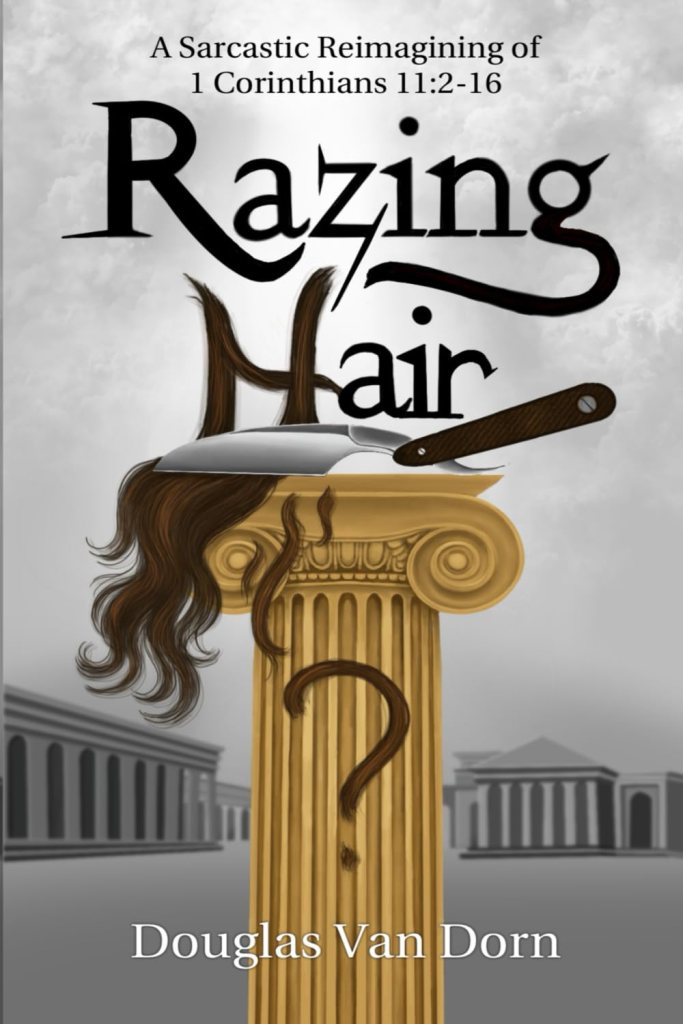
I recently read Douglas Van Dorn’s book, Razing Hair. I’m familiar with quotation theory as relates to 1 Corinthians, but the notion of Paul’s sarcasm provides interpretive ammunition that goes beyond mere quotation.
There are several strong arguments for Van Dorn’s hypothesis:
- Paul’s obvious use of sarcasm throughout his letters and in 1 Corinthians in particular
- Paul’s apparent use of sarcasm in 1 Cor 11:2
- Paul’s apparent neutralization of a “headship” rule in 1 Cor. 11:3
- Paul’s apparent neutralization of a “primacy” rule in 1 Cor. 11:12
- Paul’s apparent neutralization of the “nature” argument in 1 Cor. 11:14 by means of his Nazirite vow in Acts 18
In order to be truly compelling, I would expect this approach to be able to handle the apparent contradictions in 1 Corinthians 14 as well. Here is my attempt to parse these chapters in terms of Van Dorn’s approach. It seems to me that this might resolve the contradictions better than my earlier attempt. Consider the following (source: NKJV):
Chapter 11
Imitate me, just as I also imitate Christ. Now I praise you, brethren, that you remember me in all things and keep the traditions just as I delivered them to you.
LOL
But I want you to know that the head of every man is Christ, the head of woman is man, and the head of Christ is God.
Wait a minute: is this rule about headship, or not?
Every man praying or prophesying, having his head covered, dishonors his head. But every woman who prays or prophesies with her head uncovered dishonors her head, for that is one and the same as if her head were shaved. For if a woman is not covered, let her also be shorn. But if it is shameful for a woman to be shorn or shaved, let her be covered. For a man indeed ought not to cover his head, since he is the image and glory of God; but woman is the glory of man.
Do you realize how tortuous these rules are?
For man is not from woman, but woman from man. Nor was man created for the woman, but woman for the man. For this reason the woman ought to have a symbol of authority on her head, because of the angels. Nevertheless, neither is man independent of woman, nor woman independent of man, in the Lord. For as woman came from man, even so man also comes through woman; but all things are from God.
Really, who’s on first?
And who judges whom? (1 Cor. 6:3)
(NB this is strengthened if we remove the parenthetical “symbol”.)
Judge among yourselves. Is it proper for a woman to pray to God with her head uncovered? Does not even nature itself teach you that if a man has long hair, it is a dishonor to him?
Except for me, of course. (Acts 18)
But if a woman has long hair, it is a glory to her; for her hair is given to her for a covering.
Gotcha! There are layers upon layers to this.
But if anyone seems to be contentious, we have no such custom, nor do the churches of God.
You have a fine custom of contentiousness.
Now in giving these instructions I do not praise you, since you come together not for the better but for the worse. For first of all, when you come together as a church, I hear that there are divisions among you, and in part I believe it. For there must also be factions among you, that those who are approved may be recognized among you.
You have a fine custom of contentiousness and factiousness and vaunting.
Therefore when you come together in one place, it is not to eat the Lord’s Supper. For in eating, each one takes his own supper ahead of others; and one is hungry and another is drunk. What! Do you not have houses to eat and drink in? Or do you despise the church of God and shame those who have nothing? What shall I say to you? Shall I praise you in this? I do not praise you.
I’m wearing my sarcasm on my sleeve.
For I received from the Lord that which I also delivered to you: that the Lord Jesus on the same night in which He was betrayed took bread; and when He had given thanks, He broke it and said, “Take, eat; this is My body which is broken for you; do this in remembrance of Me.” In the same manner He also took the cup after supper, saying, “This cup is the new covenant in My blood. This do, as often as you drink it, in remembrance of Me.” For as often as you eat this bread and drink this cup, you proclaim the Lord’s death till He comes.
Behold a man who was not contentious or factious or vaunting.
Therefore whoever eats this bread or drinks this cup of the Lord in an unworthy manner will be guilty of the body and blood of the Lord. But let a man examine himself, and so let him eat of the bread and drink of the cup. For he who eats and drinks in an unworthy manner eats and drinks judgment to himself, not discerning the Lord’s body. For this reason many are weak and sick among you, and many sleep. For if we would judge ourselves, we would not be judged. But when we are judged, we are chastened by the Lord, that we may not be condemned with the world.
The choice is up to you: examine your contentious customs or be chastened.
Therefore, my brethren, when you come together to eat, wait for one another. But if anyone is hungry, let him eat at home, lest you come together for judgment. And the rest I will set in order when I come.
The rule is quite simple: don’t be contentious.
Chapter 12
This chapter is quite easy to fit into a sarcastic framework;
it continues the theme of sharply cutting down factiousness and vaunting.
Chapter 13
This chapter, too, is very easy to fit into a sarcastic framework:
don’t be proud; don’t be unprofitable; don’t be childish.
Chapter 14
Pursue love, and desire spiritual gifts, but especially that you may prophesy. For he who speaks in a tongue does not speak to men but to God, for no one understands him; however, in the spirit he speaks mysteries. But he who prophesies speaks edification and exhortation and comfort to men. He who speaks in a tongue edifies himself, but he who prophesies edifies the church. I wish you all spoke with tongues, but even more that you prophesied; for he who prophesies is greater than he who speaks with tongues, unless indeed he interprets, that the church may receive edification.
Speaking in gibberish is so considerate of others.
But now, brethren, if I come to you speaking with tongues, what shall I profit you unless I speak to you either by revelation, by knowledge, by prophesying, or by teaching? Even things without life, whether flute or harp, when they make a sound, unless they make a distinction in the sounds, how will it be known what is piped or played? For if the trumpet makes an uncertain sound, who will prepare for battle? So likewise you, unless you utter by the tongue words easy to understand, how will it be known what is spoken? For you will be speaking into the air. There are, it may be, so many kinds of languages in the world, and none of them is without significance. Therefore, if I do not know the meaning of the language, I shall be a foreigner to him who speaks, and he who speaks will be a foreigner to me. Even so you, since you are zealous for spiritual gifts, let it be for the edification of the church that you seek to excel.
All languages have significance—yeah, right.
You guys are just speaking indistinct gibberish.
Therefore let him who speaks in a tongue pray that he may interpret. For if I pray in a tongue, my spirit prays, but my understanding is unfruitful. What is the conclusion then? I will pray with the spirit, and I will also pray with the understanding. I will sing with the spirit, and I will also sing with the understanding. Otherwise, if you bless with the spirit, how will he who occupies the place of the uninformed say “Amen” at your giving of thanks, since he does not understand what you say? For you indeed give thanks well, but the other is not edified.
I am desperate for understanding.
You should really pray for some understanding, heh.
I thank my God I speak with tongues more than you all; yet in the church I would rather speak five words with my understanding, that I may teach others also, than ten thousand words in a tongue.
Or even a bajillion.
Brethren, do not be children in understanding; however, in malice be babes, but in understanding be mature.
Don’t speak like babies; be loyal like babies.
In the law it is written:
With men of other tongues and other lips
I will speak to this people;
And yet, for all that, they will not hear Me,
says the Lord.
You’re on a dangerous precipice there;
can’t you see this is a sign of judgment on you?
Therefore tongues are for a sign, not to those who believe but to unbelievers; but prophesying is not for unbelievers but for those who believe. Therefore if the whole church comes together in one place, and all speak with tongues, and there come in those who are uninformed or unbelievers, will they not say that you are out of your mind? But if all prophesy, and an unbeliever or an uninformed person comes in, he is convinced by all, he is convicted by all. And thus the secrets of his heart are revealed; and so, falling down on his face, he will worship God and report that God is truly among you.
Truly, you are out of your mind.
How is it then, brethren? Whenever you come together, each of you has a psalm, has a teaching, has a tongue, has a revelation, has an interpretation. Let all things be done for edification. If anyone speaks in a tongue, let there be two or at the most three, each in turn, and let one interpret. But if there is no interpreter, let him keep silent in church, and let him speak to himself and to God. Let two or three prophets speak, and let the others judge. But if anything is revealed to another who sits by, let the first keep silent. For you can all prophesy one by one, that all may learn and all may be encouraged. And the spirits of the prophets are subject to the prophets. For God is not the author of confusion but of peace, as in all the churches of the saints.
If you can’t say something nice, don’t say nothing at all.
Let your women keep silent in the churches, for they are not permitted to speak; but they are to be submissive, as the law also says. And if they want to learn something, let them ask their own husbands at home; for it is shameful for women to speak in church.
I know who visited the prophecy microphone last week.
“I sense that there is someone anxious and fearful and guilty here today . . .”
Or did the word of God come originally from you? Or was it you only that it reached? If anyone thinks himself to be a prophet or spiritual, let him acknowledge that the things which I write to you are the commandments of the Lord. But if anyone is ignorant, let him be ignorant.
You really think you know what you’re doing, huh?
Therefore, brethren, desire earnestly to prophesy, and do not forbid to speak with tongues. Let all things be done decently and in order.
This is not about gibberish; this is about something much bigger.
Hellmouth
Ecclesiocentrism is a decent label for my view of church and state. I want to see the development and growth of Christian nations and Christian families; this term helpfully highlights the fact that families and nations find their fulfillment not merely in their proper orientation to Jesus, but also in their proper orientation to his church.
Ecclesiocentrism also has something to say about the responsibilities and proper orientation of the church. If the sphere of the church is a kind of center-among-equals to the other spheres, then it must operate as a life-giving force. It must be a heavenmouth of life, authority, instruction, and example to the world.
But we know that the church can abandon her mission: she can commit adultery against her husband and become a hellmouth. This does not neutralize her centrality, but instead turns it into a corrupting and contagious kind of death, tyranny, instruction, and example.
James Jordan’s essays on dominion are a helpful introduction to this idea.
Considering the church as a hellmouth, Satanic and demonic activity were fairly rare in the old covenants. In contrast, Jesus encounters demons throughout Israel in his ministry. Jesus even encounters demons in synagogues (Mark 1, Luke 4). By itself this does not prove that the synagogues were the source of demonic activity, but it is interesting and suggestive. Revelation provides further evidence; there are such things as Satanic synagogues (chapter 2). And throughout Revelation there are bitter and bloody and Satanic waters issuing from various places, suggesting the idea that these are originating from false temple-churches and false teachers.
Of course, this polarity does not end in the first century. Rather, the polarity is heightened. The church that now crushes Satan under her feet (Romans 16), might also loose him. If it appears that Satan is deceiving the nations (Revelation 20), you should look first to the church to understand why.
Ecclesiocentrism does not say that political work is worthless. It is not worthless. But it does highlight that political work will not in the long run succeed or persist without also being paired with the reformation and maturation of the church. This is why I feel quite free to write about paedobaptism very pointedly from time to time, even though we have a lot of very important political fish to fry right now together with our baptistic brothers.
With this in mind, I thought it would be interesting to try to index faithful vs. unfaithful churches in the United States. This is impossible to do perfectly. My imperfect measure was to (1) look at Protestant denominations and their church attendance, and (2) index them on a spectrum of opposition to or affirmation of homosexuality. This is a very baldly obvious indicator of Satanic-demonic activity. One reason I excluded Catholicism is that it is difficult to identify its faithfulness at the level of a diocese or parish. I assumed instead that the Protestant balance was a good indicator of the Catholic tendency. I asked Claude Cowork to perform this analysis, so it is likely that there are a number of faults; but I think it is still interesting and useful as an approximate metric. Claude used a variety of data on denominational faithfulness (for example, PCA = faithful, PCUSA = unfaithful; of course this is a vast oversimplification) and church attendance. Claude also attempted to divide UMC based on whether churches had disafilliated. Interestingly, I had to instruct Claude to ignore Mormonism.
I give you the Hellmouth Index:

Fall
Pastor Peter Jones highlights that there are Edenic references in Numbers 13-14, including:
- Things evaluated as being good (13:19) and very good (14:7)
- The presence of a singular tree (13:20)
- A rich and fruitful land
- The taking of that fruit (13:20)
- Failure to trust in the goodness of God
- The repetition of land and ascend
With this framework, the entire sequence is a kind of new fall into sin, and in this light the attempted conquest at the end of Numbers 14 is especially an attempt to seize forbidden fruit out of its time. What is fascinating to me is that the time of forbiddenness is stacked on top of the time of permission. Surprisingly, this too is a repetition of Genesis, where God first declares that “every tree whose fruit yields seed; to you it shall be for food” (1:29) and only later excludes the tree of knowledge of good and evil (2:17). I agree with Jordan and others that God intended Adam and Eve eventually to mature (consider how the Bible identifies “knowledge of good and evil” with “wisdom”) to the point of eating from this tree. The parallel here in Numbers suggests to me that that permission might have been granted immediately if Adam and Eve had faced the serpent’s temptation faithfully.
The connection with bread is also interesting. Joshua declares that the Canaanites will be bread for Israel (14:9). Bread also appears in Genesis 3 as part of the curse; bread earned by sweat. The implication is that God is the provider of bread, but our obedience to him determines whether that bread will be earned with sweat.
You shall not defile
James Jordan offers an insight into Peter’s vision of the sheet. He does this at one point while reflecting on the sin of Jonah:
Peter says, I’ve never eaten anything defiled or unclean. And God says, “What God has cleansed, you shall not consider unclean.”
That’s not really what he says. He says, “What God has cleansed, you shall not defile.”
In other words, Peter, you’re like a corpse, and uncleanness spreads from you to these poor, innocent Gentiles. If you have this attitude, instead of spreading life and taking life and resurrection life where you go, you’re taking death and spreading death where you go. That’s what this actually says. He doesn’t say, don’t you regard him. He says, don’t you defile him. (Jonah, Part 2)
Jordan discusses this at greater length in his study on Acts:
“What God has cleansed, no longer consider unholy.” That’s what this says.
But that is not what the Greek says. It’s very clear in Greek, but it’s because it’s curious that it’s not translated literally, and we need to. “What God has cleansed, you shall not defile.”
Now, what that means is that Peter is the source of uncleanness and Peter is defiling Cornelius. Or he’s potentially doing so. You see? “What God has cleansed, you shall not defile.”
Now, of these animals that are in this net, in this sheet, we have clean ones and we have unclean ones. In Peter’s mind, the clean ones have been defiled. But in God’s mind, the clean ones are not defiled. So when it says what God has cleaned, which set of animals has God cleansed? Well, God has cleansed the unclean animals, you see, because the clean animals don’t need to be cleansed. Now, Peter might have thought they needed to be, but they didn’t, objectively speaking, need to be. So they’re not the ones God has cleansed. God has cleansed, symbolically speaking, the unclean animals: the lizards, the donkeys, the pigs, the roaches. They have become clean. So there is no longer any kind of barrier.
But now it says, “What God has cleansed, you shall not defile.” In other words, Peter, if your attitude toward these Gentiles continues to be one of hostility, you become the unclean one, and you will defile them. What is unclean about you will spread to them.
Now this is real strong, you see. It is about as strong a thing as God could say to a Jew. To say, you are going around saying that if we associate with these Gentiles, “Ooh, we’ve got to be careful because their uncleanness might spread to us and we’re so holy we have to preserve ourselves from these Gentiles and not associate with them.”
And God says just the opposite to Peter. He says that attitude makes you the father of uncleanness and you are the one who’s defiling them. You are causing trouble for them. And you’re the one that will have to be purged, Peter, if you have this attitude.
So, that is repeated three times for emphasis. . . . Now, when Peter figures it out, Peter doesn’t quite understand what’s going on until the men come from Cornelius, and then he understands. He’s got to go to this Gentile, baptize him, and bring him into the church. He must not go to him and treat him as if he was a second-class citizen, because if he does that, he’s defiling him. (Studies in Acts #4)
Peter later needed to be reminded by Paul that such behavior is a denial of the gospel (Galatians 2). Paul reminds us in Romans 14 that our eating can destroy one for whom Christ died.
This is a great danger for parents of little ones. If we deny them communion, then we are defiling and potentially destroying those whom God has not merely cleansed, but whom he calls holy (1 Corinthians 7).
Wisdom
James Jordan and his associates have developed a rich set of teaching around biblical themes related to wisdom. The following is an attempt to summarize key aspects of this teaching. To develop this, I leveraged Anthropic’s AI models to summarize a large set of lectures and publications from Jordan and others including Peter Leithart. I’ve done significant editing of my own on the result and I believe this reflects their teaching reasonably well.
For Jordan and his associates, wisdom is closely associated with the second of three stages that runs through creation, covenant history, biblical literature, and the Christian life:
We can begin with the phrase “prophet, priest, and king.” This is the order normally heard from preachers and theologians. But it is not really the Biblical order. The age of priests ran from Moses to Saul, the age of Kings from Saul to the end of the Kingdom, and the age of prophets from Elijah to Jesus. If we believe in any kind of development and maturation of the kingdom of God in history, we shall have to admit that king is more than priest, and prophet more than king. (James B. Jordan, Biblical Theology Basics, “Priest, King and Prophet,” 2002)
The offices are stages, not simultaneous roles:
We think of priests and kings and prophets as all existing at the same time. They’re all 30 years old, and the priest leads in worship, and the king runs the nation, and the prophet tells them what God wants them to hear. Now, there’s a certain amount of truth to that, but that is only secondary to the most important thing about prophet, priest, and king, which is that they exist in historical order.” (“One Life, Many Deaths,” Lecture 1: Bread & Wine)
Jordan observes that there is a progression of offices and ages: priest, king, and prophet. Priesthood is the age of childhood, law, and rote obedience in a small holy place.
A priest is by definition… the word kohen in Hebrew… means palace servant. A priest is a palace servant… And the priest has a very simple life. All a priest has to do is to keep the incense burning so that God’s house smells good, and to prepare the food for offering on the sacrifices. (James B. Jordan, “One Life, Many Deaths,” Lecture 1)
Kingship is the age of adulthood, wisdom, and discerning rule over a wider land.
To be a king is not just a matter of obeying and doing right and not doing wrong. The king has to rule by wisdom… [Solomon’s] wisdom involves some subtlety. And I’ll tell you the secret of wisdom and the secret of politics, which is something priests don’t have to worry about… The king has to choose between the lesser of two evils. (James B. Jordan, “One Life, Many Deaths,” Lecture 1)
Prophecy is the age of elderhood, vision, and world-shaping speech.
If we move from child to maturity, then with kings, from priest to king, with prophet we get to eldership… At the end of life, you don’t do things anymore. It’s speaking. The king acts, the elder speaks. (James B. Jordan, “One Life, Many Deaths,” Lecture 1)
No one becomes a king without first having been a priest, and no one passes from one stage to the next except through crisis, breaking, and a genuine kind of death.
From this movement from priest to king (from law to wisdom), Jordan develops a cluster of wisdom-related themes: maturation and glory-to-glory, crisis and death, the limping elder, long time sense, the wisdom canon, Solomon and Job and Jacob, the feast, the bride, and the prophetic overflow at the far end of the sequence. Wisdom is always coming out of a grave. It limps because it has been wounded; it waits because it has been taught by time; it eats wine where it once ate bread; and it knows itself to be a gift that only those who have consented to die can finally receive.
In our lives… God is in the process of making us into bread and then from time to time breaking us. And that process of breaking your life and the suffering that you go through gives you wisdom so that you become more like wine. (James B. Jordan, “One Life, Many Deaths,” Lecture 1)
Bread is for priests. Bread is simple… Wine is complicated; very easy to turn wine to vinegar if you’re not careful. It takes wisdom to put that stuff together and put it in a dark room and have it become Cabernet Sauvignon rather than vinegar. (James B. Jordan, “One Life, Many Deaths,” Lecture 1)
Priest, King, and Prophet
Jordan teaches that priest, king, and prophet are not three simultaneous offices sitting side by side (as reformed shorthand often has it) but often three successive stages of maturation. Each has a different relation to God’s word and world. The priest receives the word as written code and carries it out without improvisation: inspect the beast, read the rule in Leviticus, perform the rite.
The priest is a servant, specially a palace servant… The priest as such has very simple jobs: He inspects the animal brought for sacrifice; he helps the layman offer it; he inspects for leprosy… It is simple: You either obey or you don’t. (James B. Jordan, Biblical Theology Basics, “Priest, King and Prophet”)
The king receives the word as internalized principle and must apply it in situations the code never anticipated. He adjudicates between competing goods and chooses among lesser evils; he wields the sword; he does the work the law cannot accomplish.
A king has a different and far more mature task. When we get to the kingdom era, we get wisdom literature. Wisdom concerns not simple questions of right and wrong, but questions of what is wise and what is unwise in any given situation, new situations not specifically covered by the Law. More than this, the king must usually decide not between right and wrong, but between two evils… An example of such kingly wisdom is seen when Solomon must decide between the claims of the two harlots in 1 Kings 3. (James B. Jordan, Biblical Theology Basics, “Priest, King and Prophet”)
The prophet, finally, speaks a word that no longer describes or adjudicates but reframes; his sentence bends history.
A prophet is someone who by his words alone tears down an old world and creates a new one. His words cause people to think in a new way. He does not merely repeat what has been said before, or apply the old ways into new situations. He provides a new vision, a vision encompassing death and resurrection. Once a true prophet has spoken, no one can continue to think in the old comfortable way any longer. (James B. Jordan, Biblical Theology Basics, “Priest, King and Prophet”)
This pattern is exhibited in the Bible’s own literary structure. Torah is the priestly book; the histories and the wisdom literature are the kingly books; the prophets and Revelation are the prophetic books. The pattern is reflected in Israel’s political history: Moses and Aaron give way to Saul and David and Solomon, who give way in turn to Elijah and Jeremiah and Ezekiel.
In a larger way, the whole Adamic period is priestly, down to Noah. God gives the right to exercise capital punishment to mankind through Noah, and thus we enter a larger kingly period. With the age of the Patriarchs, we come to a larger prophetic period… With Moses, the new world arrives as a new creation, with Israel as a nation at its heart… [which] starts a new cycle within the nation of Israel: priestly (Sinaitic), kingly (Kingdom), prophetic (Remnant), and full prophetic (Restoration). (James B. Jordan, Biblical Theology Basics, “Covenant Phases in the Bible”)
The pattern is repeated in the locations of redemption: garden, then land, then world.
Adam was created to be a priest in the Garden. He was exiled into the Land… Cain went out and built a city, and thereby became the first king… Toward the end of this period, the prophet Enoch began to prophesy judgment in the larger World… Then after the death and resurrection of the world, Noah came as a prophet to set up the new world. (James B. Jordan, Biblical Theology Basics, “Covenant Phases in the Bible”)
The pattern repeats with food: bread, then wine, then fire.
You have bread in the morning when you wake up… wine is for relaxing when the work is finished. Another difference… is you don’t ordinarily give a lot of wine to your children… But right now, as little kids, you can have all the bread you want. And when you grow up and become an adult, you don’t eat bread anymore. You just drink wine. Or beer, which is liquid bread… See, this difference between beginning and end, between child and adult, corresponds to one of the most important differences between priests and king in the Bible. (James B. Jordan, “One Life, Many Deaths,” Lecture 1)
It repeats within each human life: a child who must obey rules, a young adult who must judge in complexity, an elder whose words are few but weighty. It is the pattern of Jesus’s own life, for he is the Greater Priest, the Greater King, and the Greater Prophet; he passes through each stage in his own career, climbing the cross as priest, ruling from the Father’s right hand as king, sending the Spirit as prophet.
We are placed in union with Jesus, and the deep pattern of His life is given to us. Ultimately, the pattern of Jesus’ life from childhood to full maturity, from priest to king to prophet, arises from the fact that as Son He is eternally immature, eternally adult, and eternally fully mature. By eating His body and drinking His blood, we are restored and renewed so that we can move properly through these three phases of life. (James B. Jordan, Biblical Theology Basics, “Priest, King and Prophet”)
From Law to Wisdom
Jordan is especially interested in the middle transition from priest to king, from law to wisdom. This is where much of Christian life happens, and it is the transition where much of the Christian church gets stuck. Law is given because children need rules; it provides the definite shape obedience must take before a person is mature enough to improvise. The Levitical code and the Ten Words train Israel in holiness. But the law was never meant to be the adult form of obedience. It is, as Paul indicates, a tutor or guardian: a role that expires at majority. When Israel grows up, the child’s catechism becomes the man’s internal bearing; what was once a wall around the heart becomes a spring within it.
In Proverbs chapter 8 and verse 15, wisdom says, “by me kings reign.” This is the important statement about wisdom. Wisdom is for kings. Wisdom is not for priests. Priests have law. Kings have wisdom. (James B. Jordan, 2005 BH Conference, “Wisdom and Rule I”)
Solid food is for the mature, who because of practice have their senses trained to discern good and evil. Ah, that takes us back to Genesis 2. Knowledge of good and evil. Mature people have knowledge of good and evil. Babies don’t have knowledge of good and evil… The first stage of the Word of God is law, rules for kids. The second stage of the Word of God is wisdom for those who have acquired knowledge of good and evil and are ready to move out of the kindergarten. (James B. Jordan, 2005 BH Conference, “Wisdom and Rule I”)
The king is not going to have such wisdom unless he learns the Law first. Wisdom builds on law, and king builds on priest. There must be a “priestly phase” of our lives, during which we learn wisdom through obedience and struggle, before we enter a “kingly phase” and have wisdom to give to others. (James B. Jordan, Biblical Theology Basics, “Priest, King and Prophet”)
Wisdom is the name of that mature bearing. It is law breathed in, experienced, turned over, tested against difficulty, and then applied by judgment. Jordan’s favorite illustration is Solomon and the two harlots. No rule in Leviticus tells the king how to decide who is the baby’s mother; he must read hearts. He must issue a command he does not mean literally (the sword-threat) as a way of exposing the true love that no written code could adjudicate.
What is the first big picture of wisdom that we have after Solomon asked for wisdom? What’s the next story we read? The story of the two harlots… Now, Solomon probably said, let me consult Deuteronomy and see what it says about how to deal with this. There wasn’t anything in there. It required wisdom to deal with that. It wasn’t written down. Now, you don’t get wisdom unless you live under law for a while and internalize the rules; then you grow up and you have your senses exercised to discern good and evil. (James B. Jordan, 2005 BH Conference, “Wisdom and Death I”)
The king is therefore more than a priest, not less. He has not escaped the law; he has metabolized it. And because he has, he is free to bend the letter in service of the spirit, knowing from within why the law said what it said in the first place.
The priest can choose between right and wrong, between obeying and disobeying, because his life is simple. The king has to choose between the lesser of two evils. And that is always true in politics… The best example in common life is a commander on the battlefield. If you are a private in the infantry, all you’ve got to do is obey… But if you are a king in the military, if you’re a commander, you have to pick some guys out for suicide missions… That’s not a right and wrong decision. That’s a lesser of two evils decision. (James B. Jordan, “One Life, Many Deaths,” Lecture 1)
This has a pastoral corollary. An officer of the church who has never lived the law cannot rule wisely, and an officer who has only ever lived the law, and has never passed beyond it into judgment, will rule rigidly and do harm. Wisdom requires both. The priest who has not yet become a king is a child; the king who has not first been a priest is a tyrant.
Because of sin, human beings apart from grace are bad priests, bad kings, and bad prophets. As bad priests, they are disobedient and rebellious… As bad priests, they are not willing to be learners for a time. They move right away into the trial-and-error phase that should come later, and often blab away their opinions to others, trying to be prophets to them when they have little useful to impart. As bad kings, they rule poorly. Because they refused to serve, they don’t know how to rule well… As bad prophets they give bad advice and set in motion evil trends that move history in the wrong direction. (James B. Jordan, Biblical Theology Basics, “Priest, King and Prophet”)
What one must become is a priest who has grown up, whose obedience is now a formed second nature rather than an external rule, and who can therefore be trusted with the sword, the cup, and the counsel.
Notice that you don’t cease to be a priest when you become a king. The rulebook is still there, and occasionally you have to go back and consult it. (James B. Jordan, Biblical Theology Basics, “Priest, King and Prophet”)
Crisis, Death, and the Limping Elder
No one moves from one stage to the next without a death, a death which should not be over spiritualized. The pattern is set in Genesis 2: Adam enters a tardema (a deep, death-like sleep) and his side is opened. When he wakes, he is not merely married; he is glorified, for the woman is his glory, and she could not come forth except through this cutting. Glorification, from the beginning, has the shape of a tomb with a garden on the far side.
Yahweh God caused a deep sleep to fall upon the man. And he slept. That is a special word… a totally different word in Hebrew. And he slept, and he took one of his ribs and closed up the flesh of that place. Now, you know, if you were sound asleep and somebody ripped a bone out of your side, I think you’d wake up. That didn’t happen because this was death sleep. . . . The Hebrew word is, the verb is radam, to fall into death’s sleep. Tardema is the noun. He was experiencing tardema, death’s sleep. . . . This place, this tardema place, is where visions take place. (James B. Jordan, 2016 BH Conference, “Good Death and Transfiguration”)
Very important for us to understand that God put Adam into a death situation and then resurrected and glorified him. How do we know that Adam was glorified?… Adam was not glorified. Then, after he woke up, he was glorified. Why? Because the woman is the [glory] of the man, according to Paul… So this is the first moment of glorification in history. (James B. Jordan, 2005 BH Conference, “Wisdom and Rule I”)
That’s what happens when you pass through really serious death sleep; you get ripped in half and you get put back together again as one flesh and you’re glorified. Doesn’t look so bad does it? That’s what death is. (James B. Jordan, 2016 BH Conference, “Good Death and Transfiguration”)
Every subsequent movement of covenant history repeats this pattern. The wilderness generation dies so the new generation can inherit. The priestly order under Eli collapses so the kingly order under David can rise. Solomon’s temple burns so the prophetic word can be heard without its shelter. And in Jesus the pattern is both fulfilled and universalized: his death is the door every Christian must walk through in order to enter an adult inheritance.
That crisis is seen in history when at the end of Israel’s priestly period in the days of Eli, God kills Eli’s two sons, Hophni and Phinehas, and he kills Eli because of their sins. And he tears the tabernacle in half… And he brings it back again with David and Solomon. And Solomon builds a temple and the priesthood is restored with the king. And at the end of that period… God kills the sons of King Zedekiah… And he starts again with Daniel and Ezekiel as very young men as prophets starting something new on the other side of that second death and judgment experience. (James B. Jordan, “One Life, Many Deaths,” Lecture 1)
In an individual human life, the death is often the mid-life crisis, the shattering of the plans and identities one had constructed in the priestly, rule-keeping years. Jordan is matter-of-fact about this. Wine cannot be made unless the grape is crushed, and it must ferment in the dark. The structures of a baked life are broken open so that the complex, time-requiring fermentation of wisdom can begin. His lecture series One Life, Many Deaths emphasizes this point: a single biography contains many little deaths, and each of them is a doorway to a larger measure of authority and glory for those who do not refuse them.
In most people’s lives, there is a crisis in the middle of their life, just as there is a great crisis in the middle of history when Jesus comes. He doesn’t come at the end of history or at the beginning. He comes in the middle of history. (James B. Jordan, “One Life, Many Deaths,” Lecture 2: Breaking the Bread)
You know, when men are young, they think they’re going to accomplish certain things. You get to be 40, 45, somewhere in there, and one day you look in the mirror and you realize you’re not going to accomplish all the things you thought you were going to accomplish… And something dies… And that becomes a great crisis in the lives of many men. (James B. Jordan, “One Life, Many Deaths,” Lecture 2)
At some point human beings begin to lose their strength; they begin to die in preparation for their final death and transformation into glory. Sometimes this death begins with some kind of mid-life crisis. With women it is associated with menopause. With men it is associated with the loss of power and the realization that they will not accomplish everything they had hoped to accomplish when they were young. This is when human beings start to become elders. Their kingly wisdom matures into prophecy, the ability to speak life-changing words. (James B. Jordan, Biblical Theology Basics, “Covenant Phases in the Bible”)
You’re going through a real hard time. And in the middle of that real hard time, it seems as if Jesus isn’t there either… This is what the Puritans call the desertion… It’s what the medievals call the dark night of the soul… That’s part of going through the cross. On the cross, Jesus didn’t have any sense that the Father and the Spirit were with him, did he? Real death is a sense of abandonment in the midst of suffering. (James B. Jordan, “One Life, Many Deaths,” Lecture 2)
The man who emerges on the far side of such a death has a limp. Jacob at Peniel is the paradigm: he wrestles all night, receives a new name, and emerges forever lame. The limp is not his punishment; it is his ordination.
A bruised thigh was Jacob’s reward, so that for the rest of his life he limped (Gen. 32:25–32). His limp was not a sign of his defeat, but of his victory… As Jacob crossed joyously over the river into the Promised Land, the sun rose behind him… Jacob could be assured of victory because of his limp. (James B. Jordan, Primeval Saints, 1988)
The message of Peniel is this: It was God who raised up Esau, Isaac, and Laban to wrestle with Jacob. All those years when Jacob wrestled with these three enemies, it was really God with whom he had to do. And why? Not to punish Jacob, but to train him, to make him strong. Just as a father gets down on the floor and wrestles with his children, so God had wrestled with Jacob. (James B. Jordan, Primeval Saints, 1988)
Every pastor, father, magistrate, and elder Jordan knows of has a similar wound somewhere in his story. The limp is the visible sign of earned authority: this person has been through something, has lost something, has failed at something, and has learned from it. The wound is what makes one’s counsel trustworthy. A wise man who is not limping somewhere is almost certainly not yet wise.
The Church always limps, because she always has the bruised heel. There are always embarrassments. There is always infighting. There are always inadequate responses. There are always problems… What looks like chaos to us, as the Church limps in circles, is from the perspective of eternity a beautiful dance, outwardly spiraling; a dance that will eventually draw all the universe into itself. (James B. Jordan, Primeval Saints, 1988)
Long Time Sense, Patience, and the Slow Ferment of Wisdom
Wisdom requires patience; it requires what Jordan calls a long time sense. It operates on large scales that modern people, and especially modern evangelicals, have difficulty grasping: generational, centennial, eschatological. The Garden itself was built on a postponement: Adam and Eve would eventually eat from the tree of the knowledge of good and evil, but they were to wait until God said so. They could not wait.
Right now, Adam can’t have the tree of the knowledge of good and evil. He’s not supposed to. But when God says it will be food for you, that means eventually he will eat of it. (James B. Jordan, 2005 BH Conference, “Wisdom and Rule I”)
The refusal of patience is the original folly, and every subsequent impatience recapitulates it. Israel demands a king before the time and receives Saul. A church demands revival and gets a technique. A father demands that his son be mature before he has finished being a child, and produces neither.
Solomon says, I’m too young… So give thy servant an understanding heart, a hearing heart, to judge thy people, to discern between good and evil… Now that’s the opposite of Adam’s attitude, you see. Adam’s attitude was, hey, I’ve been around for 14 hours already. I am ready to have knowledge of good and evil. Solomon says, I’m not old enough. He’s humble. (James B. Jordan, 2005 BH Conference, “Wisdom and Rule I”)
It took ninety-nine years for Abraham to mature to the point of being made a prophet, and it took ninety-seven years for Jacob to prevail with God. Yet, great as their privileges were, there was more to come. (James B. Jordan, Primeval Saints, 1988)
Abraham had matured through patient faith… Jacob had matured through wrestling faith to the point where he could wrestle with God and prevail. In both cases the development took a long time and involved patience and perseverance. And here again, the contrast is with Adam, Ham, Lot, and Esau, who were impatient, and who as a result never attained this high standing with God. (James B. Jordan, Primeval Saints, 1988)
Wisdom is intrinsically slow because it is intrinsically fermented. It is the product of a certain kind of weather acting over a certain amount of time on a life that has been broken open. This is why Ecclesiastes belongs to the wisdom canon as the necessary shadow of Proverbs: Proverbs assumes the sufficient time horizon in which obedience bears its characteristic fruit; Ecclesiastes reckons with the horizon of mortality, within which even wisdom cannot guarantee results. The mature man lives in both simultaneously, working as if both Proverbs and Ecclesiastes are true. Short-horizon piety gives up too quickly when Proverbs appears to fail. Pure Ecclesiastes resignation mistakes mystery for meaninglessness. The wise man can farm the earth patiently while acknowledging that his barns will one day belong to someone else.
At the center of this section is the statement, “all things are wearisome.” … If we look at things under the perspective of the judgment of God, then everything looks different… He still says, yeah, it’s vapor, but it’s not wearisome. God is going to bring an explanation to it all. God is going to bring it all under judgment. And so you can rejoice in all of it, even when things are not very pleasant. (James B. Jordan, 2005 BH Conference, “Survey of Ecclesiastes”)
Wisdom and Death: Why the Wise Man Must Die
Jordan teaches that wisdom is oriented toward and structured by death. This is the burden of his 2005 conference on Ecclesiastes and wisdom literature and the 2016 conference on death. The wise man is the one who has come to know his own mortality at close quarters, and wisdom’s depth is proportionate to that knowledge. A young man may be intelligent, gifted, even trained; but if he has not yet buried anyone, watched a work of his collapse, or confronted his own limits, his counsel will be fragile. Wisdom about death is not a morbid appendix to wisdom; it is the center.
Death was originally intended to be what Jesus goes through on the Sabbath day. And awakes to higher glory… But death is not a threat. Death is simply a promise… Then it’s because of sin that death becomes a problem for us. (James B. Jordan, 2016 BH Conference, “Good Death and Transfiguration”)
Truly, truly, I say to you, unless a grain of wheat fall into the earth and die, it remains by itself alone, but if it die, it bears much fruit… You plant one [seed] in the ground and you get one stalk… 800 corns on it. So one becomes 800… But it has to die… But now it’s coming to life again as something else. Just like a caterpillar. It spins itself a little tomb. And then it comes out as a butterfly. Glorified. (James B. Jordan, 2016 BH Conference, “Good Death and Transfiguration”)
This is why the king, who bears the sword, must have first stood inside the grave. The magistrate who would administer capital punishment lightly is disqualified. Kingship is serious because life and death are serious, and only those who have taken their own death seriously are fit to adjudicate the deaths of others. The priest never had to carry this weight; he slaughtered animals according to a code. The king slaughters according to judgment, and must be the kind of man whose judgment can be trusted. The way his judgment becomes trustworthy is by his own dying.
It is correct to say that part of the calling of the priest is to die for others, to be a sacrifice. Israel as a nation of priests was under the laws of uncleanness (symbolic death)… But it is also true that the king is called to die. Jesus died for us as priest and as king, so that we might become priests and kings… He dies as Melchizedekal priest-king, not as Aaronic priest only. (James B. Jordan, Biblical Theology Basics, “Priest, King and Prophet”)
The fact that the king is called upon to give up his glory and “die” for others is overlooked in this set of answers, because of the notion that sacrificial death is associated only with priesthood. This is a significant error, which we must see if we are to begin to understand the Biblical teachings regarding life and history. (James B. Jordan, Biblical Theology Basics, “Priest, King and Prophet”)
Job is a fitting example. His friends exhibit simplistic wisdom and it fails in their hands because the case exceeds their reach. Job learns, and the reader learns, that wisdom ends in faith, not in formula. The last move of the wise man, confronted with the whirlwind, is silence. And this, too, is a kind of death. It is the death of the claim to comprehend.
What are the four wisdom books? Proverbs. No, not Psalms. Ecclesiastes. Job and Song of Solomon. Those are the four books about how to be a king. Four king books. Job is the king of the land of Edom. (James B. Jordan, 2005 BH Conference, “Wisdom and Death I”)
While law and obedience are associated with the Sinaitic Era, wisdom and skill are associated with the Kingdom Era. The books of Law are given through Moses, while the books of wisdom are given through Solomon. It seems very likely, then, that Solomon was the author of Job… The book of Job, then, is not just about the sufferings of a righteous man… It is also about chaos in the body politic, and the position of the suffering king within that chaos. (James B. Jordan, Biblical Horizons, 1989–2007 archive)
Solomon, the Bride, and the Feast: Wisdom’s Consummation
Jordan and his associates also bring into their teaching the notions of feast and bride, thus making kingship and wisdom inherently nuptial. Jordan reads Proverbs 8 and Proverbs 31 together with the Song of Songs; Lady Wisdom is not a metaphorical accessory but the very personification of the mature kingly state. She is the one by whom kings reign. She is the competent woman of Proverbs 31; engaged in trade, in real estate, in manufacture, whose hands grip the spindle and whose lamp burns late. That is to say, she is the image of kingly dominion gathered into an adult life. The Song of Songs is the erotic consummation of this same complex: the king and his bride meet in a garden that has become a banqueting house, and their union is the proper end of the maturation sequence.
Peter Leithart writes:
It should be recalled, too, that the Proverbs are written by a King to a Prince… The dramatic premise of the book of Proverbs is this: A Prince must determine whether Lady Wisdom or Dame Folly will be his princess… The answer to our dramatic question is given in the final chapter of the book, the well-known Proverbs 31. It is no accident that the Proverbs ends with a celebration of the excellent wife. In the drama of Proverbs, the excellent wife is Lady Wisdom from the earlier chapters. (Peter J. Leithart, “The Dramatic Structure of Proverbs,” Biblical Horizons archive)
This structure and these characters are generally analogous to the major structures and characters of the Bible. The first prince, Adam, chose to follow the word of his adulterous wife (2 Cor 11:1–3), and ended up, as the Proverbs say, in Sheol. The Last Adam listened intently to the Word of His Father, and died to win a spotless Bride. Now He praises His bride in the gates; she is an excellent wife. (Peter J. Leithart, “The Dramatic Structure of Proverbs”)
From Jordan’s own treatment of Proverbs 8 wisdom:
Wisdom is not simply knowledge or even common sense. In the Biblical sense, wisdom has to do with making things and controlling things. Wisdom is practical. Thus, in Proverbs 8:30, wisdom is a “master workman.” Wisdom “knows how” as well as “knows what.” (James B. Jordan, Biblical Horizons archive)
The feast stands to the kingly stage as the sacrifice stands to the priestly. Where the priest ministers inside a tent, mediating between God and people through blood, the king throws a banquet in his hall, presiding over a joyful community of adults who eat meat and drink wine and sing. The Lord’s Supper combines both: Christ’s body is the priestly bread, his blood is the kingly wine; and thereby becomes the liturgical rehearsal of this entire sequence. Every Sunday, the church dies and rises, eats bread and drinks wine, is a priest on its knees and a king at table. The eschaton toward which the whole sequence bends is a wedding feast, because the mature church is a bride, and the mature Christ is a bridegroom who throws a banquet.
Look at the whole history of the Lord’s Supper. The cup was removed from the laity for centuries until the Hussites came along and demanded that they be given wine as well as bread, and the church excommunicated them all and they had to fight wars about it. (James B. Jordan, 2010 BH Conference, “Wine, Women, Song” Lecture 1)
This business of taking bread and breaking it, because what you eat tonight is broken bread, means that Jesus’ death has been given to you so that you can die. And what you drink tonight is poured out wine. It’s actually been taken out of a bottle and poured out into those things. And you drink it so that when you die and you pour out your life, it counts for something. (James B. Jordan, “One Life, Many Deaths,” Lecture 2)
Christian worship as it has developed, especially in the West, has the same shape:
1. Announcement of God — Call to Worship;
2. Transition from old to new — Confession and Absolution;
3. Laws — the Word;
4. Blessings and curses — the Lord’s Supper;
5. Arrangements for the future — Benediction and Dismissal
This shape arises from the heart of the covenant renewal itself.
(James B. Jordan, Biblical Theology Basics, “The Literary Shape of the Covenant”)
The Prophetic Overflow: Speech That Reshapes the World
At the far end of the sequence stands the prophet. If the king still acts in the world through sword and scepter, the prophet has passed beyond action into speech. At this final stage, the saint does very little, but what he says reorients the nations. The prophet is a dying king whose voice is outliving his power. Old age gathers its authority into the single instrument that is left—the word—and that word, if the prophet has kept faith, carries more weight than armies. Gray hair, as Proverbs says, is a crown.
At the end of life, you don’t do things anymore. It’s speaking. The king acts, the elder speaks. And what he says, if he has really learned wisdom… then he has the super wisdom to know exactly what things to say: to cause David to repent instantly; to know exactly what things to say to cause his grandchildren to look at the world in a new way and to start things a different way. (James B. Jordan, “One Life, Many Deaths,” Lecture 1)
In the Bible, a prophet is one of God’s chief counselors, whom God consults before He acts (Amos 3:7; 7:1–6; Genesis 20:7; 18:16–33). The prophet is the mature image of God, now woven into God’s fellowship as a junior partner in His Council. Becoming prophets is a third phase of our lives, our eldership, when we have not only acquired wisdom, but have tested our wisdom through years of being “kings” and now have acquired the ability to pass on both law and wisdom to others, those coming after us. (James B. Jordan, Biblical Theology Basics, “Priest, King and Prophet”)
The prophets Elijah and Elisha were human chariots of God (2 Ki. 2:12; 13:14). So was Ezekiel to be, and since now all of God’s people are prophets, so are we all to be. God is to ride enthroned on us, and we are to move at His direction. (James B. Jordan, Chariot of Fire, 1991)
In Jordan’s vision, the prophets from Elijah onward are preparing for the end of the old creation by speech. They do not build a new order themselves; they announce it and thereby call it forth. This is why the prophetic age is always apocalyptic; it culminates in fire. And this is why Pentecost, for Jordan, is the moment at which the Spirit of prophecy is universalized; every Christian in the new covenant is now a prophet, a king, and a priest, with the full maturation sequence miniaturized into each baptized life. The cosmic story has leapt into the individual biography, and what Israel traced over centuries, the Christian must trace over a lifetime.
On Pentecost, this Presence-fire was distributed as tongues to the Church, which carries its judgment and blessing to the four corners of the earth… The disciples were made chariots of fire in Acts 2 when tongues of fire came upon them, but when they united other people into their fellowship, they did so by sprinkling water on them (Acts 2:38). (James B. Jordan, Chariot of Fire, 1991)
We have moved from the priestly Old Creation to the kingly New Creation, but our kingship consists of words. It is a prophetic kind of kingship, and as history moves along the Church will become more and more mature as a prophetic host. Finally, after the day of judgment, the Church will be fully mature. (James B. Jordan, Biblical Theology Basics, “Covenant Phases in the Bible”)
The Cosmic-Historical Sweep: Childhood of the World to Maturity of the Church
Behind all of this is a story about the creation itself. God made the world immature, destined to mature. He made Adam a child-priest in a small garden sanctuary: not because a child-priest was the goal, but rather presenting the goal of maturity to him. Israel’s long tutelage under law was the childhood of the redeemed humanity. The Davidic-Solomonic monarchy was its adolescence. The prophets were its teachers at the threshold of adulthood. Christ’s death and resurrection are the moment at which the redeemed humanity comes of age; Pentecost is the moment at which the mature Spirit is poured out on all flesh, not only on a priestly caste. The New Covenant is therefore structurally adult, structurally prophetic; the church’s refusal to inhabit this maturity is a refusal of Pentecost itself.
Yet it is the destiny of this race of men to mature into a holy host… the fact that men are to mature from glory to glory (2 Corinthians 3:18), becoming ever more glorious in time, while the angels were created glorious at the outset, again indicates that the angelic host forms a picture of the goal of human maturation: from fetal “formlessness” to “angelic” glory. (James B. Jordan, Through New Eyes, 1988)
It was man’s task to build the world, carrying it from glory to glory, and making it a fit house for God. God dwells in heaven, but He wants also to dwell on earth, when man has made it ready for Him. (James B. Jordan, Through New Eyes, 1988)
Each epoch’s glory is real, and each subsequent epoch’s glory is greater. This is glory-to-glory (2 Corinthians 3): not a straight line of constant improvement, but an ascent by stages, each of which is a new plateau that required a death to reach. It is the same shape at every scale. It runs through cosmic history, through Israel’s biography, through Christ’s life, through the church’s history, through a single Christian’s years.
Western theology usually uses the word “glorification” to refer only to the final phase of human life, after the resurrection. The Bible, however, speaks of growing from glory to glory. Glorification is a work of the Spirit that begins in immaturity and ends in full maturity. We are fully glorified at the end, but we are in a process of glorification throughout our lives. The history of the covenants is a history of progressive glorification. (James B. Jordan, Biblical Theology Basics)
In each case there is a transition through death into resurrection, a passage from darkness to greater light, an evening before a new day. This is how God’s Spirit acted in Genesis 1, and it is the same way He acts in Bible history. (James B. Jordan, Biblical Theology Basics, “Covenant Phases in the Bible”)
From these two examples, which could be multiplied billions of times, we can see that the passage from priest to king to prophet is not something distinctively “religious,” but is in fact the essence of human life and growth. We are moving through these phases all the time, not only in small ways, but also in the larger course of our entire lifespan. (James B. Jordan, Biblical Theology Basics, “Priest, King and Prophet”)
The Critique of Modern Infantilism
Jordan’s pastoral critique follows directly from this. Much of modern evangelicalism and some of modern Reformed life is arrested at the priestly, childhood stage. Its concerns are the concerns of a well-trained child: personal conversion, rule-keeping, boundary-policing, the memorization of verses, the fear of the world, the anxious anticipation of the end. These are not wrong, any more than childhood is wrong. But they are not the goal. When a church refuses to grow into kingly wisdom—when it refuses to take up adult responsibility for art, politics, education, economics, the raising of its grandchildren—it leaves the kingly office vacant, and other powers move in. A church that will not be a king will be ruled by one. A church that will not exercise wisdom will be managed by cleverness.
We tend to miss [the holy war] because we’re so concerned about sin and redemption, but most of the Gospels are concerned with Jesus beating up demons… part of those controversies come from people who are only concerned about sin and salvation and evangelism, and they get very nervous if somebody starts talking about Christian government and applying the kingdom to all of life and those kinds of things. They don’t have that broader perspective. (James B. Jordan, 2005 BH Conference, “Wisdom and Death II”)
My topic this week is wine, women, and song, and also war… these are three things that are important, essential, new characteristics of the new covenant glory, which the church has done a bad job of affirming over the centuries… These are areas in which the church and Christendom have pretty regularly failed to be what God intends. And so there must be something important about these things, because somebody doesn’t want us to think about them. (James B. Jordan, 2010 BH Conference, “Wine, Women, Song” Lecture 1)
Today, let’s talk about wine for a few minutes… it’s part of childishness and other problems, but it’s also because somehow principalities and powers fear these things and they’re part of our warfare… Why was [the cup] rejected? Why is it a problem? (James B. Jordan, 2010 BH Conference, Lecture 12)
Jordan diagnoses the same condition more systematically two decades earlier:
In this essay, we have only skimmed the surface of the problems faced by the American Church in the area of music… [I have analyzed the problems in terms of] the economic poverty of the frontier era; the anti-intellectualism of the revivalistic heritage; the development of sentimentalism in the 19th century; the loss of the constraints of liturgy, or else the loss of the constraints of exclusive psalmody; the studied pursuit of infantilism in the 20th century. (James B. Jordan, Reconstruction of the Church, 1985)
The solution is not to skip priesthood and grasp directly at wisdom; that produces cleverness without righteousness, which is folly with a vocabulary. The solution is to live the priestly stage faithfully, accept the deaths that come at its end, and walk into the kingly stage with a limp. It is to sit long at the feet of the law, to eat bread in the garden, and then, when the breaking comes, to consent to the breaking and step into a larger room where wine is poured.
Now, you don’t acquire the ability to do that unless you spend a number of years being a priest and learning right and wrong. So you have to grow up as a child and be obedient and be spanked when you’re disobedient and learn right and wrong, and once you get that down inside yourself, then you can have these challenges where you’ve got much more difficult and complex decisions to make, and you kind of have to grope your way along. (James B. Jordan, “One Life, Many Deaths,” Lecture 1)
[We ask you to] make us more fully the kind of priestly bread that you want us to be, and give us the wisdom and the kingly wisdom that comes from the wine as well, and help us to live more faithfully as priests, and with greater insight and understanding as kings. (James B. Jordan, “One Life, Many Deaths,” Lecture 1, closing prayer)
Summary
In Jordan’s theology, wisdom is the name of the second stage of maturation through which God brings his covenant people and every individual Christian. It is what obedience becomes when it has been internalized, tested by time, broken open by suffering, and raised again on the far side of a death. It stands between the priestly age of law and childhood and the prophetic age of vision and elderhood, and it is entered only through crisis. Its paradigm figures (Solomon, Job, David, Jacob, Joseph) all limp in some fashion, because all of them have been wounded into kingship. Its literary canon (Proverbs, Job, Ecclesiastes, the Song of Songs) spans the range from the buoyant confidence of young obedience to the dark silence of the suffering saint to the consummating joy of the wedding feast. Its virtues are patience and long time sense; its instruments are the sword of judgment and the cup of wine; its telos is a bride, a banquet, and a world ruled in the Spirit. Jesus is the wisdom of God because he is the one who has walked the whole sequence: he became a child under the law, died the kingly death, rose into prophetic speech, and now gives his Spirit so that his people may, generation by generation, grow up into him. To seek wisdom in Jordan’s sense is therefore to consent to grow up: to accept that the life of faith will be marked by breakings, that its authority will come with a limp, that its fruits will ripen slowly, and that its final form will be a feast.
There is one covenant in three large phases. These phases of maturation in history reflect in time the eternal maturation of the Son by the work of the Spirit. These three phases can be characterized as:
1. Priestly, childhood;
2. Kingly, adulthood;
3a. Historical prophetic, eldership;
3b. Full prophetic, resurrection in glory.These 3–4 phases of the one covenant cover all of human history, and they also cover the full course of the normal human life… These 3–4 phases also cover smaller periods of history at various levels, as God’s Spirit causes humanity to mature through expanding cycles. (James B. Jordan, Biblical Theology Basics, “Covenant Phases in the Bible”)
The meaning of Jesus’ perfect human life is not only that He came to die for our sins, but also that He gives to us His perfect life. He gives it to us not so much as a model, for we do not in fact do the same things Jesus did, but as a type. A type is a deep-pattern impressed into us by the Holy Spirit. We are placed in union with Jesus, and the deep-pattern of His life is given to us… By eating His body and drinking His blood, we are restored and renewed so that we can move properly through these three phases of life. (James B. Jordan, Biblical Theology Basics, “Priest, King and Prophet”)
We can do so, confident that the limp of victory in Christ will mature into the dance of eternity. (James B. Jordan, Primeval Saints, 1988)
Bibliography
Quotations above are taken from James Jordan’s lectures and writings. Principal sources:
- Through New Eyes (1988)
- Primeval Saints (1988)
- Chariot of Fire (1991)
- The Sociology of the Church (1986)
- Christian Piety: Deformed and Reformed (1986)
- Reconstruction of the Church (1985)
- Biblical Horizons archive (1989-2007)
- Biblical Theology Basics essays (2002–2007)
- “One Life, Many Deaths” (three lectures)
- 2005 Biblical Horizons Conference on Ecclesiastes and Wisdom Literature
- 2010 Biblical Horizons Conference on Wine, Women, Song
- 2016 Biblical Horizons Conference on Death.
A few quotations are from Peter Leithart rather than James Jordan, and are noted as such.
Parable
A parable of catholicity
Grampa and gramma: You’re no grandson of ours unless you move back to our house!
Pawpaw and memaw: You’re no grandson of ours unless you move back to our house!
Applications
- This is absurd; we don’t have to choose between our grandparents. History is structured in such a way that the farther back we look, the more fathers we find, not the less.
- It is self-evident that honoring, appreciating, and living in fellowship with someone doesn’t require you to agree with them in every way or submit to all of their demands. Very likely love will sometimes require you to do the opposite.
- It appears comforting to have many things provided and taken care of for you (or so it may seem!). But if you gave in to their demands, you would be robbing yourself of opportunities that God is providing for you to grow by wrestling with complex and difficult things. You would be placing a limit on your maturity and faithfulness. In fact, we recognize that this is generally true of all paternalistic despotism, whether it exists in the family, the state, or the church: it is ultimately infantilizing; it devours life rather than giving and multiplying it.
Of course, my parable is too generous by far to Roman Catholicism and Eastern Orthodoxy. As things work out in reality, it is an organized gang of distant cousins insisting that you move in with them.

